Alvin SNAPER
Air Conditioner
Air Conditioner
Gallery of Clean Energy Inventions
Gary Vesperman
Compressed Air-Driven Air Conditioner/Heater
Alvin Snaper’s compressed air-driven air conditioner/heater
Alvin A. Snaper( Las Vegas, Nevada) relies on the principle of a vortex tube. Air whirled in a vortex tube separates with the cold air molecules collecting in one portion of the tube, and the warm air molecules collecting in another portion of the tube. The cold air is expelled from one end of the tube, and the warm air is expelled from the other end. It can be switched between providing 90% cold air and 10% warm air, or 10% cold air and 90% warm air.
The metal tube is about a foot long and a half-inch in diameter with a two-inch long compressed air intake tube perpendicularly attached about three inches from one end. The intake compressed air requirement specifications are 7 cubic feet per minute at a pressure of 40 pounds per square inch. The volume of air expelled is twice that of a refrigerant-type automobile air conditioner while requiring only one-fourth the horsepower. Also, no warm-up period is required as with conventional air conditioners or heaters. Its laboratory-certified efficiency is nearly 30%. The Author has seen during demonstrations conducted in inventor Snaper’s garage on a hot Las Vegas summer day temperature measurements of the air blowing out of the cold end at around 0 degrees Fahrenheit.
While the patent on the compressed air-driven air conditioner/heater has recently expired, it is still available for commercialization. Combined with an on-board battery charger, the advanced self-powered electric vehicle would be able to offer the exceptionally nice feature of continuous climate control, even while parked! Parked on a cold winter day, the interior of the vehicle would always be toasty warm. On a hot summer day, the parked vehicle’s interior would always be refreshingly cool.
US4407134 -- Air conditioning system
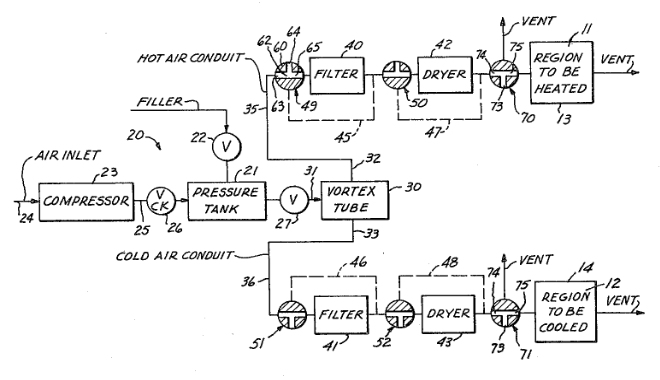
A conditioner system for air including a source of air under pressure, a vortex tube of the type which whirls air and in the process raises the temperatures of air in one region and cools it in another. The vortex tube has an inlet receiving air under pressure from the source, a hotter air outlet, and a colder air outlet. Conduit means conveys air from one of the outlets to a region to be treated by the air conveyed by the conduit means which may be hotter or colder air depending on the outlet selected.