Bo ZHAO, et al.
Thermal Diode
Thermal Diode
PHYSICAL REVIEW RESEARCH 7, 043150 (2025)
Perfect heat rectification and circulation with nonreciprocal radiative surfaces in the far field
Sina Jafari Ghalekohneh, Bo Zhao
[ PDF ]
Abstract -- Controlling photon-mediated energy flow is central to the future of communications, thermal management, and energy harvesting technologies. Recent breakthroughs have revealed that many-body systems violating Lorentz reciprocity can sustain persistent photon heat current at thermal equilibrium, hinting at a paradigm of heat flow akin to superconductivity. Yet, the behavior of such systems far from equilibrium remains largely unexplored. In this work, we uncover the rich physics of radiative heat transfer in nonequilibrium, far-field many-body systems composed of thermal emitters that break Lorentz reciprocity. We show that the total heat flow naturally decomposes into two distinct components: an equilibrium term, which generates a persistent circulating heat current within the system, and a nonequilibrium term, which governs energy exchange with the environment. Remarkably, while the internal persistent heat current is ever-present, the nonequilibrium contribution can be precisely engineered to achieve perfect heat rectification and circulation. Our results open a route toward designing thermal systems with unprecedented control — unlocking the potential for lossless heat circulation and one-way thermal devices. This fundamentally shifts the landscape for next-generation thermal logic, energy conversion,, and photonic heat engines.
Abstract -- A nonreciprocal Solar thermophotovoltaic (STPV) system includes an absorber configured to absorb broad-spectrum solar radiation and generate heat an intermediate emitter, and a single-junction photovoltaic cell configured to convert solar radiation to electrical energy. The intermediate emitter includes nonreciprocal radiative properties. The nonreciprocal radiative properties include absorbing light from the front side but only emitting light to the backside.
https://www.sciencedirect.com/science/article/abs/pii/S0735193322006108
Performance analysis of near-field tandem thermophotovoltaic systems based on radiative absorption distribution
Bowen Li, et al
Abstract -- Fluctuational electrodynamics and minority carrier diffusion equations are applied to evaluate the electric power output of a near-field tandem thermophotovoltaic (TPV) system with a bulk tungsten emitter (at 1500 K) and InGaSb/InAs tandem cells (at 300 K). We give evidence of the superiority of the tandem TPV system over the single-junction TPV system in the near-field regime because a tandem structure can harvest useful photons in a wider spectral range. It is also found that in comparison with the system with a bulk tungsten emitter, the practically achievable indium‑tin‑oxide (ITO) emitter and multilayer emitter could enhance the electricity output by a factor of 1.7 and 2.9 as a result of the supported surface plasmon resonances and hyperbolic modes, respectively. The conversion efficiency of the ITO emitter is 6% higher due to the suppression of the surface recombination loss, but the efficiency of the multilayer emitter is even 15% lower because of the heavy bulk recombination loss. These results highlight the possibilities to enhance the performance of the near-field tandem TPV systems via optimizing the radiative absorption distribution in the tandem cells, which is paramount important for the design and improvement of near-field tandem TPV systems.
https://pubs.acs.org/apchd5/article-abstract/5/7/2748/1265392/Thin-Film-Architectures-with-High-Spectral?redirectedFrom=fulltext
https://doi.org/10.1021/acsphotonics.8b00508
ACS Photonics (2018) 5 (7): 2748–2754.
Thin-Film Architectures with High Spectral Selectivity for Thermophotovoltaic Cells
Tobias Burge, et al.
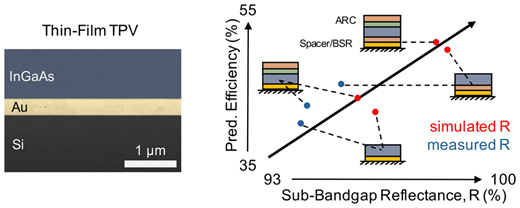
Abstract -- Thermophotovoltaic (TPV) systems are a promising technology for distributed conversion of high-temperature heat to electricity. To achieve high conversion efficiency, the transport of sub-bandgap radiation between the thermal emitter and PV cell should be suppressed. This can be achieved by recycling sub-bandgap radiation back to the emitter using a spectrally selective cell. However, conventional TPV cells exhibit limited sub-bandgap reflectance. Here we demonstrate thin-film In0.53Ga0.47As-based structures with high spectral selectivity, including record-high average sub-bandgap reflectance (96%). Selectivity is enabled by short optical paths through a high-quality material fabricated using epitaxial lift-off, high-reflectance back surfaces, and optimized interference. In addition, we use a parallel-plate TPV model to evaluate the impact of specific structural features on performance and to optimize the cell architecture. We show that a dielectric spacer between InGaAs and the Au back surface is an important feature that enables a predicted TPV efficiency above 50% (with a power output of 2.1 W/cm2), significantly higher than current TPV devices. This work provides guidelines for the design of high-efficiency, low-cost TPV generators.
https://www.nature.com/articles/s41467-020-16197-6
Integrated near-field thermo-photovoltaics for heat recycling
Gaurang R. Bhatt, Bo Zhao,
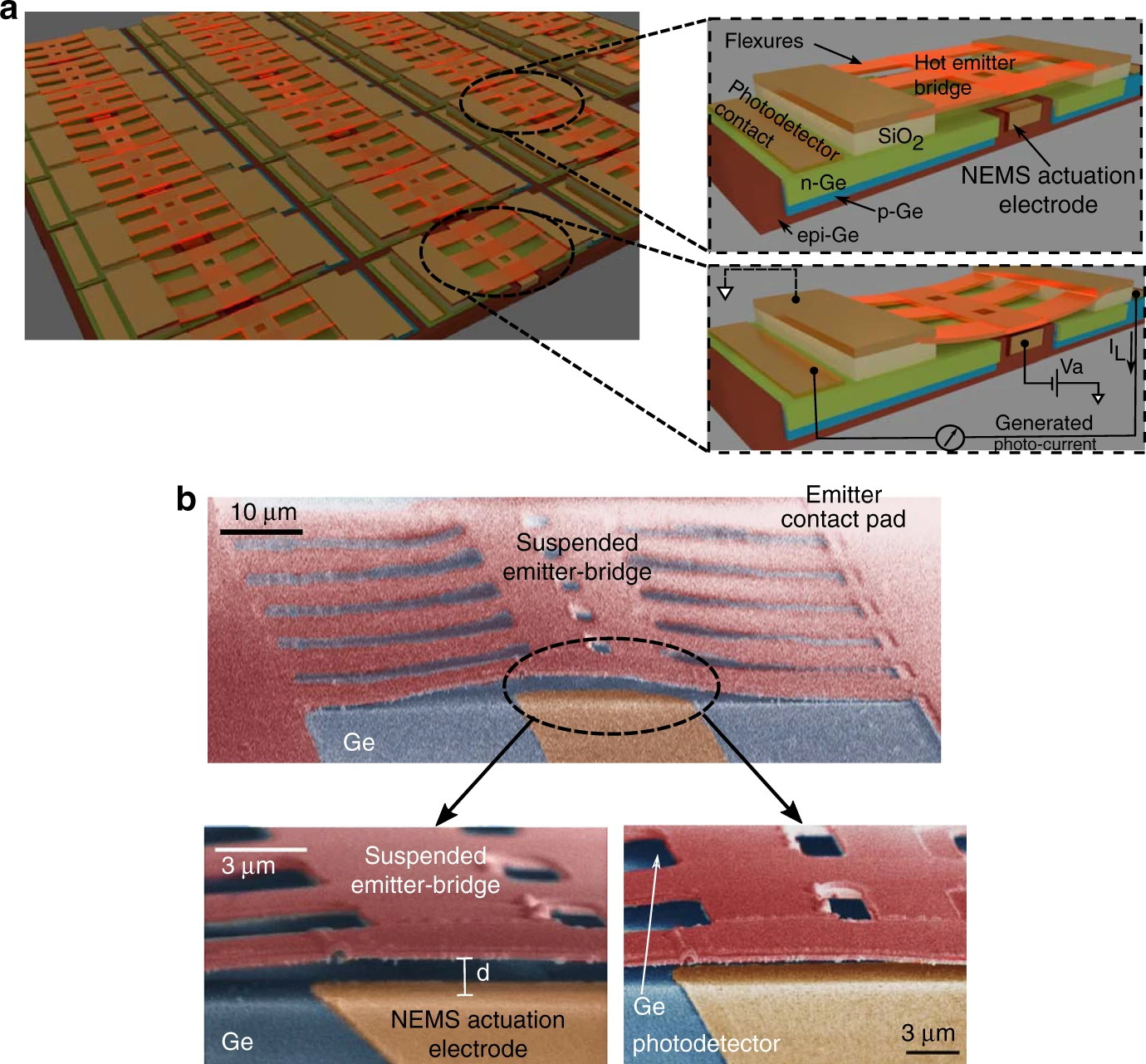
Abstract -- Energy transferred via thermal radiation between two surfaces separated by nanometer distances can be much larger than the blackbody limit. However, realizing a scalable platform that utilizes this near-field energy exchange mechanism to generate electricity remains a challenge. Here, we present a fully integrated, reconfigurable and scalable platform operating in the near-field regime that performs controlled heat extraction and energy recycling. Our platform relies on an integrated nano-electromechanical system that enables precise positioning of a thermal emitter within nanometer distances from a room-temperature germanium photodetector to form a thermo-photovoltaic cell. We demonstrate over an order of magnitude enhancement of power generation (Pgen ~ 1.25 μWcm−2) in our thermo-photovoltaic cell by actively tuning the gap between a hot-emitter (TE ~ 880 K) and the cold photodetector (TD ~ 300 K) from ~ 500 nm down to ~ 100 nm. Our nano-electromechanical system consumes negligible tuning power (Pgen/PNEMS ~ 104) and relies on scalable silicon-based process technologies.
https://web.ics.purdue.edu/~pbermel/pdf/Zhou16.pdf
Abstract -- Recently, there has been increasing interest in utilizing solar thermophotovoltaics (STPV) to convert sunlight into electricity, given their potential to exceed the Shockley–Queisser limit. Encouragingly, there have also been several recent demonstrations of improved system-level efficiency as high as 6.2%. In this work, we review prior work in the field, with particular emphasis on the role of several key principles in their experimental operation, performance, and reliability. In particular, for the problem of designing selective solar absorbers, we consider the trade-off between solar absorption and thermal losses, particularly radiative and convective mechanisms. For the selective thermal emitters, we consider the tradeoff between emission at critical wavelengths and parasitic losses. Then for the thermophotovoltaic (TPV) diodes, we consider the trade-off between increasing the potential short-circuit current, and maintaining a reasonable open-circuit voltage. This treatment parallels the historic development of the field, but also connects early insights with recent developments in adjacent fields. With these various components connecting in multiple ways, a system-level end-to-end modeling approach is necessary for a comprehensive understanding and appropriate improvement of STPV systems. This approach will ultimately allow researchers to design STPV systems capable of exceeding recently demonstrated efficiency values
https://energyzhao.github.io/pdf/Zhao%20et%20al.%202013%20IJHMT%202D%20TPV.pdf
Thermophotovoltaic emitters based on a two-dimensional grating/thin-film nanostructure
Bo Zhao, et al.
Abstract -- Thermophotovoltaic (TPV) devices can convert thermal radiation directly into electricity. To improve the efficiency of TPV systems, wavelength-selective emitters are designed to take thermal energy from various heat sources and then emit photons to the TPV cells. A two-dimensional grating/thin-film nano-structure is proposed as an efficient emitter, whose performance is enhanced by the excitations of both surface plasmon polaritons (SPPs) and magnetic polaritons (MPs). Rigorous coupled-wave analysis is used to predict the emittance as well as the electromagnetic field and current density distributions. The normal emittance of the proposed nanostructure is shown to be wavelength-selective and polariza-
tion-insensitive. The mechanisms of SPP and MP excitations in the nanostructure are elucidated for different polarizations. The current–density loop further confirms the existence of magnetic resonances. Furthermore, the effect of azimuthal and polar angles on the emittance spectra is also investigated, suggesting that the proposed structure has high emittance not only in the normal direction but also at large oblique angles
https://www.semanticscholar.org/paper/Thin-film-%E2%80%98Thermal-Well%E2%80%99-Emitters-and-Absorbers-for-Tong-Hsu/b0c505629f8858b077e495c61a721c246f85ccea
Scientific Reports 6 February 2015
Thin-film ‘Thermal Well’ Emitters and Absorbers for High-Efficiency Thermophotovoltaics
J. Tong, W. Hsu, Gang Chen
The proposed design approach does not require nanoscale patterning of the emitter and PV cell surfaces, but instead offers a simple low-cost solution to improve the performance of thermophotovoltaic systems.
Abstract -- A new approach is introduced to significantly improve the performance of thermophotovoltaic (TPV) systems using low-dimensional thermal emitters and photovoltaic (PV) cells. By reducing the thickness of both the emitter and the PV cell, strong spectral selectivity in thermal emission and absorption can be achieved by confining photons in trapped waveguide modes inside the thin-films that act as thermal analogs to quantum wells. Simultaneously, photo-excited carriers travel shorter distances across the thin-films reducing bulk recombination losses resulting in a lower saturation current in the PV cell. We predict a TPV efficiency enhancement with near-field coupling between the thermal emitter and the PV cell up to 38.7% using a thin-film germanium (Ge) emitter at 1000 K and an ultra-thin gallium antimonide (GaSb) cell supported by perfect back reflectors separated by 100 nm. Even in the far-field limit, the efficiency is predicted to reach 31.5%, which is over an order of magnitude higher than the Shockley Queisser limit of 1.6% for a bulk GaSb cell and a blackbody emitter at 1000 K. The proposed design approach does not require nanoscale patterning of the emitter and PV cell surfaces, but instead offers a simple low-cost solution to improve the performance of thermophotovoltaic systems.
https://www.pnas.org/doi/10.1073/pnas.1904938116
Self-sustaining thermophotonic circuits
Bo Zhao, et al
Significance
Photon-based systems that convert heat to electricity have been limited by low power density. Thermophotonic systems have the potential to significantly enhance the power density. This potential has not been realized in practice, due in part to the fundamental thermodynamic difficulty in designing a self-sustaining circuit that enables steady-state power generation. Current construction instead uses batteries which lower system efficiency and adds complexity. We overcome such difficulty by introducing an electronic circuit where multiple photons can be generated from a single electron. Our design enables a self-sustaining thermophotonic circuit that can achieve a steady-state power density exceeding traditional thermophotovoltaic systems by many orders of magnitude. This work highlights possibilities for constructing heat engines with light as the working medium.
Abstract -- Photons represent one of the most important heat carriers. The ability to convert photon heat flow to electricity is therefore of substantial importance for renewable energy applications. However, photon-based systems that convert heat to electricity, including thermophotovoltaic systems where photons are generated from passive thermal emitters, have long been limited by low power density. This limitation persists even with near-field enhancement techniques. Thermophotonic systems, which utilize active photon emitters such as light-emitting diodes, have the potential to significantly further enhance the power density. However, this potential has not been realized in practice, due in part to the fundamental difficulty in thermodynamics of designing a self-sustaining circuit that enables steady-state power generation. Here, we overcome such difficulty by introducing a configuration where the light-emitting diodes are connected in series, and thus multiple photons can be generated from a single injected electron. As a result we propose a self-sustaining thermophotonic circuit where the steady-state power density can exceed thermophotovoltaic systems by many orders of magnitude. This work points to possibilities for constructing heat engines with light as the working medium. The flexibility of controlling the relations between electron and photon flux, as we show in our design, may also be of general importance for optoelectronics-based energy technology.
https://1lib.sk/book/eLvADRjgOE/development-and-modelling-of-a-thermophotovoltaic-system.html
Development and Modelling of a Thermophotovoltaic System
Giovanni Mattarolo
https://1lib.sk/book/q8vErem0PB/thermophotovoltaics-basic-principles-and-critical-aspects-of-system-design.html
Thermophotovoltaics: Basic Principles and Critical Aspects of System Design
Thomas Bauer (auth.)
https://1lib.sk/book/zZNJ1xp3ZA/fundamentals-of-thermophotovoltaic-energy-conversion.html
Fundamentals of THERMOPHOTOVOLTAIC ENERGY CONVERSION
Donald L. Chubb