Description
TECHNICAL FIELD
[0002] These inventions relate to treated iron-based alloys, and more
particularly relate to processes and apparatuses for transforming
and/or shaping the same and the various materials resulting therefrom
obtained by treating low, medium, and high carbon steel and other
iron-based alloys to a complex steel microstructure which may include
portions of bainite, coalesced bainite, acicular ferrite, retained
austenite and/or martensite and combinations thereof by micro-treating
said iron based alloy.
BACKGROUND OF THE INVENTION
[0003] Traditionally, metallurgists have wanted to take low quality
metals, such as low carbon steel, and turn them into high quality
steels and more desirable products through inexpensive treatments,
including annealing, quenching, and tempering to name a few. Previous
attempts have met with limited success in that they did not always
produce a desirable product. Other attempts have failed on a large
scale due to high processing costs or the need to ultimately
incorporate expensive alloying.
[0004] Processing of high strength steel generally takes intense
capital equipment, high expenditures, expensive and dangerous heated
fluids, such as quenching oils and quenching salts, and
tempering/annealing processes which include the use of ovens, heated
equipment, and residual heat from pouring molten steel. These quenching
procedures are intended to raise the hardness of the steel to a
desirable value. Bainite and martensite can be made by these processes
and are very desirable materials for certain high strength applications
as they generally have Rockwell C hardness of from about 30 and up. The
increased hardness correlates to a comparable increase in tensile
strength.
[0005] Typical Advanced High Strength Steels have generally included
bainitic and/or martensitic phases. Bainite is generally acicular steel
structured of a combination of ferrite and carbide that exhibits
considerable toughness while combining high strength with high
ductility. Usually formed by austempering, bainite is a very desirable
product. One practical advantage of bainitic steels is that relatively
high strength levels can be obtained together with adequate ductility
without further heat treatment, after the bainite reaction has taken
place. Such steels, when made as a low carbon alloy, are readily
weldable, and bainite will form in the heat-affected zone adjacent to
the weld metal, thereby reducing the incidence of cracking.
Furthermore, these steels having a lower carbon content tend to improve
the weldability and reduce stresses arising from transformation. When
bainite is formed in medium and high carbon steels, weldability is
reduced due to the higher carbon content.
[0006] The other conventional high strength steel, martensite, is
another acicular steel made of a hard, supersaturated solid solution of
carbon in a body-centered tetragonal lattice of iron. It is generally a
metastable transitional structure formed during a phase transformation
called a martensitic transformation or shear transformation in which
larger workpieces of austenized steel may be quenched to a temperature
within the martensite transformation range and held at that temperature
to attain equalized temperature throughout before cooling to room
temperature. Martensite in thinner sections is often quenched in water.
Since chemical processes accelerate at higher temperatures, martensite
is easily destroyed by the application of heat. In some alloys, this
effect is reduced by adding elements such as tungsten that interfere
with cementite nucleation, but, more often than not, the phenomenon is
exploited instead. Since quenching can be difficult to control, most
steels are quenched to produce an overabundance of martensite, and then
tempered to gradually reduce its concentration until the right
structure for the intended application is achieved. Too much martensite
leaves steel brittle, whereas too little martensite leaves it soft.
SUMMARY OF THE INVENTION
[0007] In accordance with the present invention, low grade ferrous
alloys in strips, sheets, bars, plates, tubes, workpieces and the like
are converted into multi-phase high strength steels with a minimum of
cost, time and effort. Dual and multiple phase materials are achievable
by practicing the present invention.
[0008] There are provided methods and apparatuses for extremely rapid
micro-treating of low carbon iron-based alloys and articles made from
and containing those alloys. The iron-based, or ferrous,
alloys/articles start out having a first microstructure prior to the
micro-treating, and are converted into a second microstructure by rapid
heating and rapid cooling into high strength steels on at least a
portion of the alloy/article.
[0009] A method for rapidly micro-treating an iron-based alloy is
disclosed for forming at least one phase of a high strength alloy,
where the method comprises the steps of providing an iron-based alloy
having a first micro-structure with an austenite conversion
temperature. This first microstructure is capable of being transformed
to an iron-based alloy having a second micro-structure including the
above mentioned phases by rapidly heating at an extremely high rate,
such as 600[deg.] F./sec to 5000[deg.] F./sec. The traditional
austenitic conversion temperatures are elevated for given alloys due to
the short duration of the thermal cycle initiated by the rapid heating.
[0010] This heating step involves nearly immediate heating of the
iron-based alloy to a selected temperature above its austenite
conversion temperature. Then, the alloy is immediately quenched, also
at an extremely fast rate, i.e. 600[deg.] F./sec to 10,000[deg.] F./sec
on at least a portion of the iron-based alloy in a quenching unit
adjacent the heating unit. This procedure forms at least one phase of a
high strength alloy in a desired area, depending upon where the
treatment was performed. Extremely rapid quenching will form at least
one phase of a high strength alloy, as described more fully herein
below.
[0011] Quenching may be accomplished nearly instantaneously by various
methods and apparatuses, including water baths, water sprays, chilled
forming dies, air knives, open air convection, final operation chilled
progressive dies, final stage chilled line dies, chilled roll forming
dies, and quenching hydroforms among others.
[0012] Rapid quenching closely following rapid austenization has been
shown to develop a dual hardness microstructure as illustrated in the
attached drawings, herein incorporated by reference. Experimentation
has shown that flash processing of AISI 4130 yields multiple hardness
peaks of approximately 525 and 625 Vickers hardness. The combination of
hardnesses has been verified by single sensor differential thermal
analysis showing that two temperature ranges have transformation
occurring during the single quenching operation. In AISI 4130,
transformation occurs from 650C to 550C and again from 470C to 360C
during water cooling.
[0013] While the phenomena for this double cooling transformation is
not fully understood, multiple theories are present. The first is that
since the steel is rapidly heated and carbon leveling has not occurred
that carbon enriched areas transform to martensite while lesser carbon
areas transform to bainite.
[0014] Another possible theory is that the upper transformation
temperature occurs when austenite transforms to nano-scale platelets.
The second transformation occurrence during cooling is the coalescing
of the platelets into larger plates. This leads us to another
embodiment of this invention. Since a double transformation is
occurring, one could allow the first transformation to occur but halt
the second. For example, rapidly heat the iron based alloy, a few
seconds later, quench the iron alloy in a medium that is below the
first transformation finish temperature but above the second
transformation start temperature. The material would complete the first
transformation but never get to the second transformation.
[0015] This may cause for example, the first stage of Flash Bainite to
form, for example, just the nano coalesced bainite phase, but then
leave a significant amount of another phase, possibly retained
austenite, or some other austenite daughter product. The material could
then be brought down from the temperature between the first
transformation end temperature (i.e. 550C) and the second
transformation start temperature (470C).
BRIEF DESCRIPTION OF THE DRAWINGS
[0016] For a further understanding of the nature and advantages of the
expected scope and various embodiments of the present invention,
reference shall be made to the following detailed description, and when
taken in conjunction with the accompanying drawings, in which like
parts are given the same reference numerals, and wherein;
FIG. 1A is a FEGSEM micrograph
of bainite processed in accordance with the present invention;
FIG. 1B is a FEGSEM micrograph
of bainite processed in accordance with the present invention;
FIG. 2A is a graph of typical
temperature measurements at the inside wall of the processed tube;
FIG. 2B is a cooling cycle
time/temperature graph of the process in accordance with the present
invention;
FIG. 3 is a transform analysis
graph of temperature versus differential of temperature;
FIG. 4A is a mechanical
heterogeneity analysis of a raw material;
FIG. 4B is a similar analysis
of the flash processed material;
FIG. 5 is a graph of elongation
versus temperature; and
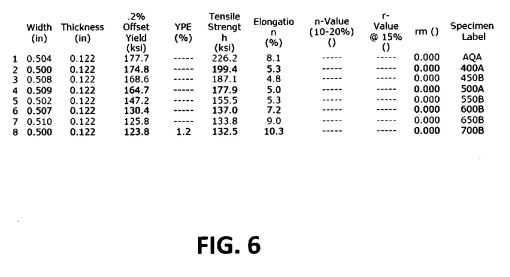
FIG. 6 is a stress versus
strain graph of various examples of material.
DETAILED DESCRIPTION OF THE DRAWINGS
[0026] It is a first aspect of the present invention to provide an
inexpensive, quick and easy way to produce a low, medium, or high
carbon iron-based alloy containing an appreciable percentage of
nano-sized platelet bainite while having some of the desirable
mechanical properties of nano-sized laths of martensite. While other
thermo-mechanical processing techniques require lengthy thermal
processing to obtain a complex bainitic-martensitic microstructure,
flash bainite processing does so with a single, rapid quenching
operation which takes less than 10 seconds from above the lower
austenitic temperature to below the lower martensitic temperature.
[0027] It is a second aspect of the present invention to provide a
method and apparatus for micro-treating low, medium, or high carbon
iron-based alloys to contain a desirable quantity of flash bainite
processed complex microstructural material with bainite and martensite
interspersed within the same prior austenitic grains. The micro-treated
low, medium, or high carbon iron-based alloy may have varying
thicknesses for different applications and may be readily weldable
while having high tensile strength, along with the ability to save
material and reduce weight. One aspect of the present invention for the
elevated interruption temperature is to use a quench medium at this
temperature that could be molten salts, among others. This aspect
causes the first iron based alloy transformation that is stopped by
molten salt. All other iron alloy transformations are intentionally
occurring in molten salt through either continuous cooling
transformation or time temperature transformation. From this temp,
550-470[deg.] C., the steel could be cooled in a manner in which the
remaining austenite is brought down to ambient temperature with either
no further transformation occurring or transformation to some other
desirable austenite daughter phases.
[0028] Another aspect of this invention has to do with the heating and
quenching apparatus. Other previously filed patent applications for
apparatus employ single or multiple heating and quenching heads to cool
the material. The present method employs a single heating unit to heat
multiple pieces of material. For example, a rectangular induction coil
could have material passing by it and heated both inside and outside of
the coil. If the coil were appropriately sized, a rectangular tube
could be heated inside the coil while other pieces, such as pieces of
bar stock could be heated on the outside of the coil simultaneously.
[0029] Another aspect of this invention has to do with heating
interrupted pieces of material. For example, a strip could have
multiple cutouts removed from its shape. These pieces could be
manufacture in the soft state and then Flash Bainite Processed in their
final hardness state. Sometimes, when such a strip is heated, the edges
near the cutouts will concentrate heat and melt the corners. The
present aspect of this invention will allow plugs of similar material
to be held in place of the interruptions to absorb the heat. This will
thus prevent the melted corners.
[0030] The concept of rapid heating, quenching, reheating, and
quenching was discussed in my previous patent applications filed on
Oct. 2, 2006, which is incorporated herein by reference, referring to
an iron based alloy component. The method could be applied as well to a
rolling strip of metal. A similar thermal technique known as quench and
partitioning has been used. Quench and partitioning technology
austenizes steel over many minutes, quenches to below the martensite
start temperature, either holds temp or reheats below martensitic start
temperature and then quenches to ambient. Another aspect of Quench and
partitioning technology austenizes steel over many minutes, quenches to
below the martensite start temperature, reheats above martensitic start
temperature and bainite finish temperature and then quenches to ambient
after a desired amount of transformation has occurred. The present
innovation is a new technique of Quench/Partition technology. As before
with an iron based alloy part, the heater will rapidly austenize the
steel strip, quench the material to enact a transformation, hold or
reheat with the second heater to a subaustenitic temperature to
stabilize or transform the existing microstructure, and then quench to
room temp with the second quench.
[0031] The resulting high strength steel may include at least one
portion of the resulting high strength material made of coalesced
bainite, bainite, martensite, ferrite, austenite, pearlite, and/or dual
or complex phase combinations thereof, depending on the placement of
the treatments described and claimed herein below.
[0032] Complex phase materials can be made, such as martensite and
bainite located next to ferrite. These highly desired complex phase
materials are achievable in the same workpiece by quenching only in
various patterns so that a pattern of high strength steel can be
manufactured in desired areas across the surface and/or cross section
of an article after it has been heated. By only quenching certain
areas, various material phases are possible in various locations where
desired.
[0033] Looking first with combined reference to FIGS. 1A and 1B, there
can be seen that the flash bainite includes a bi-modal distribution of
platelets or plates which exhibit highly desirable combinations of
strength, ductility and toughness. The flash processing of the present
invention creates almost distortion free flat sheets, bars, plates and
straight tubing. As can be seen in these figures, the microstructure
produces a fine grain structure within the bi-modal distribution of
microstructures which yields the surprising strength and ductility.
[0034] With reference to FIG. 2A, a graph is shown charting temperature
in degrees C. versus time in seconds to illustrate the cooling cycle as
processed at the inside wall of one of the test tubes. Typical
temperature measurements of this inside wall are showing that there is
a very low temperature-time history ratio. In this particular example,
utilizing AIS 414130 sheet metal tubing has a lower temperature to time
history ratio.
[0035] Looking now to FIG. 2B, there is shown a graph of temperature
versus time showing the flash processing temperature to time history
ratio in addition to the conventional continuous annealing temperature
to time history. Clearly, the temperature to time history ratio for the
continuous annealing is much greater than that ratio for the flash
processing.
[0036] FIG. 3 illustrates an analysis of temperature in degrees
centigrade versus the change in temperature also in degrees centigrade.
This analysis shows transformations at between 550 and 649 degrees C.
and 360 to 459 degrees C. This analysis suggests that we have two
different transformation conditions leading to very localized
microstructural heterogeneity, although experiencing homogeneity on a
macro scale.
[0037] Looking now to FIGS. 4A and 4B collectively, there can be seen
two mechanical heterogeneity analyses showing that there are two
distinct regions of microstructure between the raw material and the
flash processed material in accordance with the present invention.
These findings are consistent with the previous analyses showing two
separate transformations during the flash processing procedure. Both
FIG. A and FIG. B are graphs of normalized frequencies versus hardness,
which illustrates the distribution of hardness. FIG. 4A shows the base
metal hardness distribution as very slight, while the material that has
proceeded through flash processing illustrates both a high hardness
zone as well as a low hardness zone over a broader distribution of
hardness.
[0038] Looking now to FIG. 5, yet another aspect of the invention is
illustrated with fully strengthened with AISI 1010 material that has
been flash processed. This graph shows elongation versus peak flash
temperatures, to show that the highest flash temperature, 1180 degrees
C. having an elongation of 7.9%. At a peak flash temperature of 1010
degrees C., the elongation percentage is 5.6. Optimum elongation is
found at larger grain sizes. The chemistry of this material in percent
by weight is 0.10 C, 0.31 Mn, less than 0.01 Si, sulfur, phosphorus,
and 99.41 iron.
[0039] Last, we look at FIG. 6, which is a graph of tensile strength in
KSI versus tensile strain in percentage. With an example of AISI 1020
after heating to various temperatures in a range from 400 to 700
degrees C., 8 examples are shown with varying widths in inches. This
experiment shows that even after 300 seconds of tempering at 500
degrees C., flash processed AISI 1020 will retain 79% of its "as
quenched" tensile strength. Furthermore, the elongation does not drop
to + or -5% with less than 5 seconds of tempering.
[0040] In summary, numerous benefits have been described which result
from employing any or all of the concepts and the features of the
various specific embodiments of the present invention, or those that
are within the scope of the invention. The foregoing description of a
preferred embodiment of the invention has been presented for purposes
of illustration and description. It is not intended to be exhaustive or
to limit the invention to the precise form disclosed. Obvious
modifications or variations are possible in light of the above
teachings with regards to the specific embodiments. The embodiment was
chosen and described in order to best illustrate the principles of the
invention and its practical applications to thereby enable one of
ordinary skill in the art to best utilize the invention in various
embodiments and with various modifications as are suited to the
particular use contemplated. It is intended that the scope of the
invention be defined by the claims which are appended hereto.