Alexander Martin Lippisch (November 2, 1894 – February 11, 1976)
was a German pioneer of aerodynamics. He made important
contributions to the understanding of flying wings, delta wings
and the ground effect. His most famous design is the
Messerschmitt Me 163 rocket-powered interceptor.
Lippisch was born in Munich, Kingdom of Bavaria. He later
recalled that his interest in aviation stemmed from a
demonstration conducted by Orville Wright, over Tempelhof Field
in Berlin, in September 1909.[1] Nonetheless, he planned to
follow his father’s footsteps into art school. The outbreak of
World War I intervened. During his service with the German Army
from 1915–1918, Lippisch had the chance to fly as an aerial
photographer and mapper.
Following the war, Lippisch worked with the Zeppelin Company,
and it was at this time that he first became interested in
tail-less aircraft. In 1921 his first such design would reach
production in as the Lippisch-Espenlaub E-2 glider, built by
Gottlob Espenlaub. This was the beginning of a research
programme that would result in some fifty designs throughout the
1920s and 1930s. Lippisch’s growing reputation saw him appointed
the director of the Rhön-Rossitten Gesellschaft (RRG), a glider
research group.
Lippisch’s work led to a series of tail-less designs numbered
Storch I – Storch IX between 1927 and 1933 (these were not
related to the successful Fieseler Fi 156 Storch STOL aircraft
of WW2). These designs attracted little interest from the
government and private industry. Nonetheless, it was during this
time that Lippisch’s Ente (Duck) became the first aircraft to
fly under rocket power.
Experience with the Storch series led Lippisch to concentrate
increasingly on delta-winged designs. This interest resulted in
five aircraft, numbered Delta I – Delta V, which were built
between 1931 and 1939. In 1933, RGG had been reorganised into
the Deutsche Forschungsanstalt für Segelflug (DFS — "German
Institute for Sailplane Flight") and the Delta IV and Delta V
were designated as the DFS 39 and DFS 40 respectively.
In early 1939, the Reichsluftfahrtsministerium (RLM — “Reich
Aviation Ministry”) transferred Lippisch and his team to work at
the Messerschmitt factory, in order to design a high-speed
fighter aircraft around the rocket engines then under
development by Hellmuth Walter. The team quickly adapted their
most recent design, the DFS 194, to rocket power, the first
example successfully flying in early 1940. This was the direct
ancestor of what would become the Messerschmitt Me 163 "Komet".
Although technically novel, the Komet did not prove to be a
successful weapon, and friction between Lippisch and
Messerschmitt was frequent. In 1943, Lippisch transferred to
Vienna’s Luftfahrtforschungsanstalt Wien (LFW), to concentrate
on the problems of high-speed flight. That same year, he was
awarded a doctoral degree in engineering by the University of
Heidelberg.
Wind tunnel research in 1939 had suggested that the delta wing
was a good choice for supersonic flight, and Lippisch set to
work designing a supersonic, ramjet-powered fighter, the
Lippisch P.13a. wartime test footage By the time the war ended,
however, the project had only advanced as far as a development
glider, the DM-1.
Like many German scientists, Lippisch was taken to the United
States after the war under Operation Paperclip. Advances in jet
engine design were making Lippisch's ideas more practical, and
Convair became interested in a hybrid jet/rocket design which
they proposed as the F-92. [1] In order to gain experience with
the delta wing, they first built a jet powered test aircraft,
the 7003, which became the first powered delta-wing aircraft to
fly. Although the USAF lost interest in the F-92, the 7003 was
designated the XF-92A which gave Convair experience with the
delta-wing design. This led them to proposing it for most of
their projects through the 1950s and into the 1960s, including
the F-102 Delta Dagger, F-106 Delta Dart and B-58 Hustler.
From 1950–1964 Lippisch worked for the Collins Radio Company in
Cedar Rapids, Iowa, which had an aeronautical division. It was
during this time that his interest shifted toward ground effect
craft. The results were an unconventional VTOL aircraft (an
aerodyne) and an aerofoil boat. However, Lippisch contracted
cancer, and resigned from Collins.
When he recovered in 1966, he formed his own research company,
Lippisch Research Corporation, and attracted the interest of the
West German government. Prototypes for both the aerodyne and the
ground-effect craft were built, but no further development was
undertaken. The Kiekhaefer Mercury company was also interested
in his ground-effect craft and successfully tested one of his
designs as the Aeroskimmer, but also eventually lost interest.
Lippisch died in Cedar Rapids early in 1976.
Other Aircraft Designed by
Lippisch
Lippisch P.01-111, designed as a competitor to the Messerschmitt
Me-163 Komet.
Lippisch Li P.04-106, a tailless airplane designed as a
competitor to the Messerschmitt Me 329
Lippisch P.11, designed to compete with the Horten Ho-IX; the
latter went on to become the Horten (Gotha) Ho-(Go-)229.
Lippisch P.13a, a unique delta-winged, ramjet-powered
interceptor.
Lippisch P.13b, a unique airplane powered by a rotating
fuel-table of lignite, owing to the fuel shortages late in World
War 2 in Germany.
Lippisch P.15, a development of the Messerschmitt Me-163 Komet.
http://siris-archives.si.edu/ipac20/ipac.jsp?uri=full
Alexander Lippisch Photograph
Collection, [ca. 1920s-1950s]
Creator: Lippisch, Alexander, 1894-1976
Title: Alexander Lippisch Photograph
Collection, [ca. 1920s-1950s]
Phy. Description: 0.90 cubic feet (2 legal
document boxes)
Bio / His Notes:
Alexander Lippisch (1894-1976) began his career in Aeronautics
in February, 1918 when he joined the aircraft manufacturing
plant of Zeppelin-Dornier in Lindau, Germany as an
aerodynamicist. In 1921 Lippisch began his work on the
development of sailplanes and gliders. At the same time he
worked on the development of the tailless and the Delta-wing
aircraft. In 1939 Lippisch joined the Messerschmitt A.G.
Augsburg for the development of the ME 163 A and B. In 1943,
Lippisch took over the Aeronautical Research Institute (LFW)
were he developed the shape of the supersonic Delta wing. After
the war, he was in custody of the Air Technical Intelligence of
the U.S. Army. Lippisch was transferred to the United States
where he worked at Wright Field, for the Navy, and later with
Collins Radio Company. At Collins he developed a wing-less
aircraft, the Aerodyne. He also started the development of
another type of aircraft - the ram-wing or Aerofoil Boat.
Summary:
This collection contains photographs and drawings of the
tailless and all-wing aircraft with which Lippisch was involved.
Many of the photographs appear in Lippisch's book 'The Delta
Wing: A History and Development.'
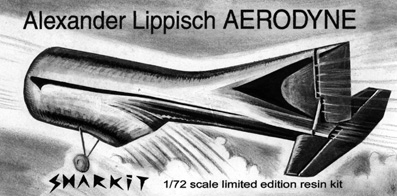
Alexander Lippisch was born in Munich, Germany in 1894.
Developing an affinity for delta-winged aircraft, he designed a
series of innoative gliders during the 1930s, his concepts
ultimately resulting in World War II's rocket-powered ME163
"Komet" interceptor. In 1950, Lippisch joined the American
Collins Radio Co. where he investigated the feasibility of
building a high-performance Vertical Take-Off and Landing (VTOL)
aircraft. The "Aerodyne" was the most interesting of his
concepts: Theoretically, it would be able to outpace most
conventional aircraft with the same weight/power ratio, it would
be able to achieve super-sonic speed, and it didn't have the
operational disadvantages of such "tail-sitters" as the Convair
XFY-1 "Pogo," Lockheed's XFV-1 "Salmon," or the Ryan X-13
"Vertijet."
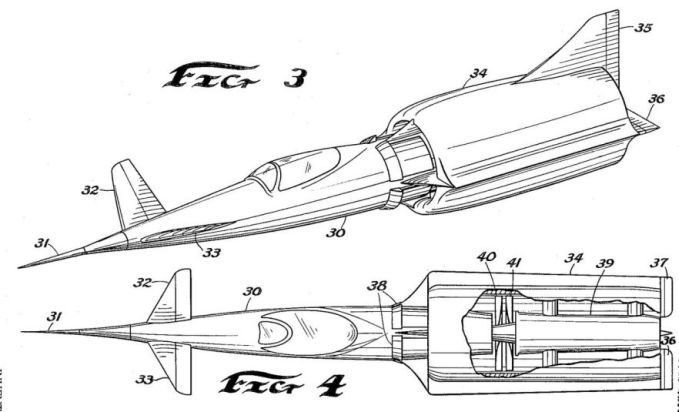
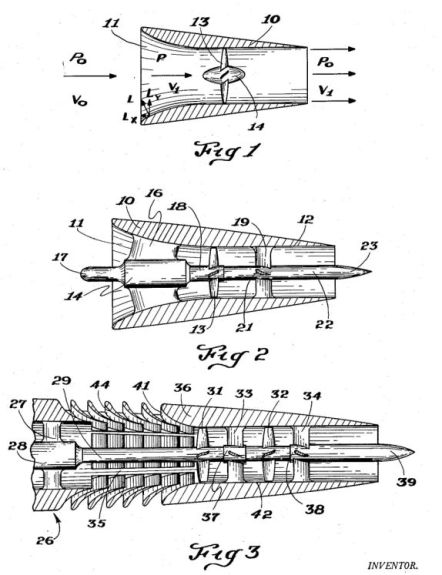
The Aerodyne's lift and propulsion were to be generated by two
co-axial shrouded propellers, the slipstream from which would be
deflected downward by "flaps" for vertical take-off and landing.
Control was to be achieved by deflecting part of the slipstream
emerging from the end of the tail boom, and by flaps in the
propeller slipstream.
Lippisch's fundamental equations survive on paper, and this
Sharkit represents one of the many models built for research
purposes. Despite the drawn cokpit, only unmanned craft were
built and tested.
The Aerodyne configuration was ultimately validated by the
Dornier aerodyne "E1," a high-speed VTOL drone developed between
1968 and 1971, and succesfully fight-tested in 1972. Hovering
flight tests showed extremely smoth attitude stabilization and
minimal ground-effects.
And, of course, the McDonnell-Douglas Harrier Jump Jet,
developed in the 1970s and still in operation today, employs
many of Lippisch's VTOL principles.
Alexander
Lippisch Digital Collection
Alexander Lippisch Papers (1897-1993, n.d.) located in Special
Collections, contains biographical material, correspondence,
scientific research, materials relating to patents,
publications, photographs, and films. In addition to a rich
array of material relating to Lippisch's work in aeronautical
engineering, the collection also includes biographical material
about Lippisch and publications and photographs related to
general aviation history.
Scientific files document Lippisch's work designing sailplanes
and gliders, delta winged aircraft, and aerodynes, as well as
research involving aerodynamics, smoke tunnels, and ground
effect. These files include materials such as calculations,
data, statistics and experimental test results, and technical
designs and conceptual drawings of aircraft designs. The
collection also includes copies of patent applications for
Lippisch's work as well as the work of other aeronautical
engineers.
Alexander Lippisch Digital Collection contains the technical
designs and conceptual drawings for Lippisch's aeronautical
designs including wingless aircraft, delta-wings, and aerodynes,
as well as numerous photographic images of delta wings.
l6 l7


YouTube - NASA Spiral Duct ESTOL Concept
Extremely Short Takeoff and Landing advanced vehicle concept
based upon the coupling of the Lippisch Aerodyne and Custer
Channel Wing. ...
Patents
GROUND EFFECT FLYING SURFACE
CA980387


AERO SKIMMER
CA987376
AEROFOILBOAT
US3661111
Ground effects utilizing and
transition aircraft
US3190582
Ducted aircraft with fore elevators
US2918229
Aerodyne with external flow
US2918233
Twin shroud aerodyne
US2918232
Fluid sustained and fluid propelled
aircraft
US2918231
Fluid sustained and
fluid propelled aircraft
US2918230
Fluid pump
US2905091
Axial blower with flow control
stator
US2810512
Fluid sustained and propelled
aircraft
US2752109
Fluid sustained aircraft
US2879957
Wingless aircraft
US2828929
Variable wing
US2743888
Fluid propelled airplane
US2696953
Aerodynamic stabilizing and
controlling means for delta wing aircraft
US2693325
Aircraft aerofoil
US1931928
WING ARRANGEMENT
US3627235
Aile d'avion utilisable en
particulier pour les avions sans queue, en forme de flèche
FR725009
WING ARRANGEMENT
CA905214
AEROFOILBOAT
CA903563
ROTOR AIRCRAFT
CA556254
AERODYNAMIC STABILIZER
CA515461
POWER PLANT
CA514116
AIRCRAFT AEROFOIL
CA340519
Tragfluegelausbildung fuer ein
Fahrzeug...
DE1234535
TRAGFLAECHENFAHRZEUG
DE2331429
Fluid reaction sustained and propelled aircraft
GB789775
VARIABLE WING
CA576217
FLUID PROPELLED AND SUSTAINED
AIRCRAFT
CA574955
AXIAL BLOWER WITH FLOW CONTROL
STATOR
CA570887