Arturo
VITTORI
WarkaWater Airwell
WarkaWater Airwell
http://www.wired.com/2014/03/warka-water-africa/
A
Giant Basket That Uses Condensation to Gather Drinking
Water
by Joseph Flaherty
by Joseph Flaherty
Around the world, 768 million people don’t have access to safe water, and every day 1,400 children under the age of five die from water-based diseases. Designer Arturo
Vittori believes the solution to this catastrophe lies not in high technology, but in sculptures that look like giant-sized objects from the pages of a Pier 1 catalog.
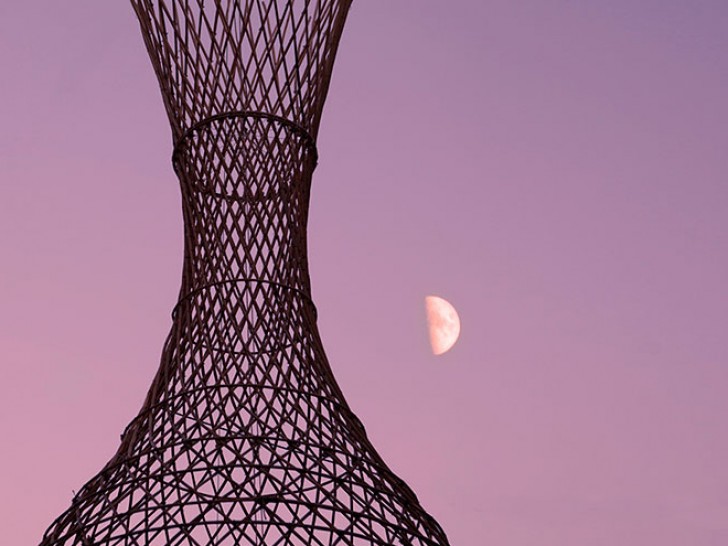
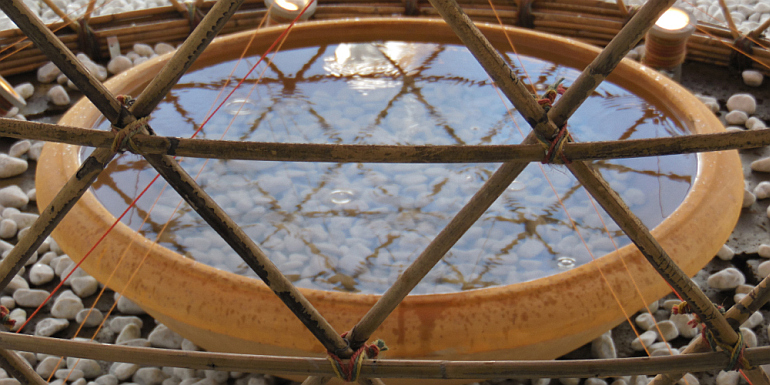
His stunning water towers stand nearly 30 feet tall and can collect over 25 gallons of potable water per day by harvesting atmospheric water vapor. Called WarkaWater towers, each pillar is comprised of two sections: a semi-rigid exoskeleton built by tying stalks of juncus or bamboo together and an internal plastic mesh, reminiscent of the bags oranges come in. The nylon and polypropylene fibers act as a scaffold for condensation, and as the droplets of dew form, they follow the mesh into a basin at the base of the structure.
“WarkaWater is designed to provide clean water as well as ensure long-term environmental, financial and social sustainability,” says designer Arturo Vittori.
Vittori decided to devote his attention to this problem after visiting northeastern Ethiopia and seeing the plight of remote villagers first hand. “There, people live in a beautiful natural environment but often without running water, electricity, a toilet or a shower,” he says. To survive, women and their children walk for miles to worm-filled ponds contaminated with human waste, collect water in trashed plastic containers or dried gourds, and carry the heavy containers on treacherous roads back to their homes. This process takes hours and endangers the children by exposing them to dangerous illnesses and taking them away from school, ensuring that a cycle of poverty repeats.
Exposure to this horrific scene motivated Vittori to take action. “WarkaWater is designed to provide clean water as well as ensure long-term environmental, financial and social sustainability,” he says. “Once locals have the necessary know how, they will be able to teach others villages and communities to build the WarkaWater towers.” Each tower costs approximately $550 and can be built in under a week with a four-person team and locally available materials.
A more obvious solution to a water shortage would be digging a well, but drilling 1,500 feet into Ethiopia’s rocky plateaus is expensive. Even when a well is dug, maintaining pumps and ensuring a reliable electrical connection makes the proposition unlikely.
Though the structure is made from organic material, Vittori designed it using traditional CAD tools.
Instead of looking to Western technology for a solution, Vittori was inspired by the Warka tree, a giant, gravity-defying domed tree native to Ethiopia that sprouts figs and is used as a community gathering space. “To make people independent, especially in such a rural context it’s synonymous of a sustainable project and guaranties the longevity,” says Vittori. “Using natural fibers helps the tower to be integrated with the landscape both visually with the natural context as well as with local traditional techniques.”
The design has been two years in the making and though the final product is handcrafted, Vittori has used the same parametric modeling skills honed working on aircraft interiors and solar powered cars to create a solution that is safe and stunning. The 88-pound sculpture is 26-feet wide at its broadest point but swoops dramatically to just a few feet across at its smallest point. Vittori and his team have tested the design in multiple locations and worked in improvements that increase the frame’s stability while simultaneously making it easy for villagers to clean the internal mesh.
Vittori hopes to have two WarkaTowers erected in Ethiopia by 2015 and is looking for financial rainmakers who’d like to seed these tree-inspired structures across the country.
http://inhabitat.com/nature-inspired-warkawater-towers-use-condensation-to-collect-drinking-water-in-ethiopia/
Brilliant
WarkaWater Towers Collect Drinking Water from Thin Air in
Ethiopia
by
Nicole Jewell
by
Nicole Jewell





http://www.vittori-lab.com/team/arturo-vittori
Arturo
Vittori

Italian architect and designer, is a founder of the research and design studio Architecture and Vision. After graduating from the Faculty of Architecture at the University of Florence, he gained experiences collaborating with architects such as Santiago Calatrava and Jean Nouvel. From 2002 to 2004 he was Manager of Cabin Design at Airbus,in Toulouse (France), taking part in the cabin design for the first A380 aircraft;from 2004 to 2006 he worked with Future Systems, collaborating with Anish Kapoor in the design of the Monte Sant’Angelo subway station in Naples, (Italy), while in 2006 he practiced yacht design at the London-based studio Francis Design. He has spoken at numerous international conferences on the topics of aerospace architecture, technology transfer and sustainability,and also taught and lead workshops on a variety of related themes.
Vittori has been teaching Industrial Design, at the First Faculty of Architecture “L. Quaroni,“University of Rome La Sapienza, and he teaches a graduate course in Product Design at the Faculty of Arts and Design at the University Iuav of Venice.
He is Research Professor at the IIT,Illinois Institute of Technology, of Chicago.He is a member of the Order of Architects of Viterbo Province, and the American Institute of Aeronautics and Astronautics (AIAA).
http://www.architectureandvision.com
WarkaWater
'WarkaWater' is a project conceived for the mountainous regions in Ethiopia, where women and children walk several hours to collect water. To ease this dramatic condition, the studio ‘Architecture and Vision’ is developing the project ‘WarkaWater’ which is harvesting potable water from the air and honors the disappearing Ethiopian warka trees. The 9 m tall bamboo framework has a special fabric hanging inside capable to collect potable water from the air by condensation. The lightweight structure is designed with parametric computing, but can be built with local skills and materials by the village inhabitants.
Background: Insufficient access to water for people in Ethiopia
Objectives: Harvest water out of fog in mountainous regions
Concept: Tower with net, also serve as social gathering point
Transport: 2 donkeys
Location: Ethiopia, Africa
Assembly: 3 days, 6 people
Structure: Modular lattice framework
Energy: Solar panel for night illumination
Materials: Bamboo or similar local material, rope, wire, PE-fabric
Dimensions: dia 8 m - 26 ft(with cables), h 9 m - 29 ft
Weight: 60 kg Project Number: 073
Project Name: WarkaWater
Typology: Structure for water collection
Year: 2012
Design Team: Architecture and Vision - Arturo Vittori & Andreas Vogler
Collaborators: Raffi Tchakerian (IUAV), Tadesse Girmay (EiABC), Massimiliano Caretti (CNR), Precious Desperts, Gianni Massironi, Gabriele Rigon
Concept: Architecture and Vision, Arturo Vittori & Andreas Vogler
Project Assistants: Raffi Tchakerian, Tadesse Girmay
Textile Design: Precious Desperts
Interaction Design: Massimiliano, Caretti, Giuseppe Gennaro
Communication: Gianni Massironi
Photos: Gabriele Rigon
http://www.architectureandvision.com/projects/chronological/84-projects/art/492-073-warkawater-2012?showall=&start=3
Video