Ronggui YANG et al
RadiCold
RadiCold
http://www.colorado.edu/today/2017/02/09/newly-engineered-material-can-cool-roofs-structures-zero-energy-consumption
A team of University of Colorado Boulder engineers has developed a scalable manufactured metamaterial — an engineered material with extraordinary properties not found in nature — to act as a kind of air conditioning system for structures. It has the ability to cool objects even under direct sunlight with zero energy and water consumption.
When applied to a surface, the metamaterial film cools the object underneath by efficiently reflecting incoming solar energy back into space while simultaneously allowing the surface to shed its own heat in the form of infrared thermal radiation.
The new material, which is described today in the journal Science, could provide an eco-friendly means of supplementary cooling for thermoelectric power plants, which currently require large amounts of water and electricity to maintain the operating temperatures of their machinery.
The researchers’ glass-polymer hybrid material measures just 50 micrometers thick — slightly thicker than the aluminum foil found in a kitchen — and can be manufactured economically on rolls, making it a potentially viable large-scale technology for both residential and commercial applications.
“We feel that this low-cost manufacturing process will be transformative for real-world applications of this radiative cooling technology,” said Xiaobo Yin, co-director of the research and an assistant professor who holds dual appointments in CU Boulder’s Department of Mechanical Engineering and the Materials Science and Engineering Program. Yin received DARPA’s Young Faculty Award in 2015.
The material takes advantage of passive radiative cooling, the process by which objects naturally shed heat in the form of infrared radiation, without consuming energy. Thermal radiation provides some natural nighttime cooling and is used for residential cooling in some areas, but daytime cooling has historically been more of a challenge. For a structure exposed to sunlight, even a small amount of directly-absorbed solar energy is enough to negate passive radiation.
The challenge for the CU Boulder researchers, then, was to create a material that could provide a one-two punch: reflect any incoming solar rays back into the atmosphere while still providing a means of escape for infrared radiation. To solve this, the researchers embedded visibly-scattering but infrared-radiant glass microspheres into a polymer film. They then added a thin silver coating underneath in order to achieve maximum spectral reflectance.
“Both the glass-polymer metamaterial formation and the silver coating are manufactured at scale on roll-to-roll processes,” added Ronggui Yang, also a professor of mechanical engineering and a Fellow of the American Society of Mechanical Engineers.
“Just 10 to 20 square meters of this material on the rooftop could nicely cool down a single-family house in summer,” said Gang Tan, an associate professor in the University of Wyoming’s Department of Civil and Architectural Engineering and a co-author of the paper.
In addition to being useful for cooling of buildings and power plants, the material could also help improve the efficiency and lifetime of solar panels. In direct sunlight, panels can overheat to temperatures that hamper their ability to convert solar rays into electricity.
“Just by applying this material to the surface of a solar panel, we can cool the panel and recover an additional one to two percent of solar efficiency,” said Yin. “That makes a big difference at scale.”
The engineers have applied for a patent for the technology and are working with CU Boulder’s Technology Transfer Office to explore potential commercial applications. They plan to create a 200-square-meter “cooling farm” prototype in Boulder in 2017.
The invention is the result of a $3 million grant awarded in 2015 to Yang, Yin and Tang by the Energy Department’s Advanced Research Projects Agency-Energy (ARPA-E).
“The key advantage of this technology is that it works 24/7 with no electricity or water usage,” said Yang “We’re excited about the opportunity to explore potential uses in the power industry, aerospace, agriculture and more.”
Co-authors of the new research include Yao Zhai, Yaoguang Ma and Dongliang Zhao of CU Boulder’s Department of Mechanical Engineering; Sabrina David of CU’s Materials Science and Engineering Program; and Runnan Lou of the Ann and H.J. Smead Department of Aerospace Engineering Sciences.
The research team, led by Principal Investigator Ronggui Yang (right) and Co-Principle Investigator Xiaobo Yin (left), will develop a system called RadiCold that if successful will enable efficient, low-cost cooling for thermoelectric power generation.

http://science.sciencemag.org/content/early/2017/02/08/science.aai7899
Science ( 09 Feb 2017 )
DOI: 10.1126/science.aai7899
Scalable-manufactured
randomized glass-polymer hybrid metamaterial for daytime
radiative cooling
Yao Zhai, Yaoguang Ma, Sabrina N. David, Dongliang Zhao, Runnan Lou, Gang Tan, Ronggui Yang, Xiaobo Yin
Yao Zhai, Yaoguang Ma, Sabrina N. David, Dongliang Zhao, Runnan Lou, Gang Tan, Ronggui Yang, Xiaobo Yin
Abstract
Passive radiative cooling draws heat from surfaces and radiates it into space as infrared radiation to which the atmosphere is transparent. However, the energy density mismatch between solar irradiance and the low infrared radiation flux from a near-ambient-temperature surface require materials that strongly emit thermal energy and barely absorb sunlight. We embedded resonant polar dielectric microspheres randomly in a polymeric matrix, resulting in a metamaterial that is fully transparent to the solar spectrum while having an infrared emissivity greater than 0.93 across the atmospheric window. When backed with silver coating, the metamaterial shows a noon-time radiative cooling power of 93 W/m2 under direct sunshine. More critically, we demonstrated high-throughput, economical roll-to-roll manufacturing of the metamaterial, vital for promoting radiative cooling as a viable energy technology.
http://www.colorado.edu/today/2015/08/25/cu-boulder-awarded-3-million-transformational-power-plant-cooling-technology
CU-Boulder
awarded $3 million for transformational power plant cooling
technology
The University of Colorado Boulder has received a $3 million federal grant to develop cooling technology that will enable efficient, low-cost supplementary cooling for thermoelectric power plants.
The grant spans three years and is from the U.S. Department of Energy’s Advanced Research Projects Agency-Energy (ARPA-E).
The CU-Boulder research team, led by Ronggui Yang, associate professor of mechanical engineering in the College of Engineering and Applied Science, will develop cold storage modules and a system called RadiCold that cools by infrared thermal emission to enable efficient, low-cost supplementary cooling for thermoelectric power generation.
If successful, CU-Boulder’s design could provide power plant operators a low-cost way to supplement cooling without using as much water as they do now.
“I am confident that we will be successful in developing this novel cooling technology that could be useful for both power plants and buildings,” said Yang.
In thermoelectric power generation, only 40 percent of the energy in the fuel is used for power generation. The remaining 60 percent becomes low-grade heat that needs to be carried away by cooling systems.
There are two types of cooling systems: wet and dry. Wet-cooling systems use water resources such as a river, lake or ocean and pass it directly over tubes containing condenser water, and then return it, warmer, to the original source. Dry-cooling systems use air to cool condenser water.
Most U.S. power plants use wet-cooling technologies because water can cool better than air, which allows power plants to operate more efficiently.
In fact, thermo-electric power plants are among the biggest consumers of fresh water in the world. Forty-one percent of total fresh water withdrawal - about 139 billion gallons per day - is used to cool condenser water. Three percent of the cooling water is evaporated and lost. This has an enormous environmental impact, especially in areas already suffering from fresh water shortages. These systems also release heat waste into the environment, which adversely affects wildlife, said Marta Zgagacz, of the University of Colorado’s Office of Technology Transfer and part of the team that will evaluate the commercialization potential of this innovative technology.
Researchers say dry cooling has the potential to significantly reduce water consumption, but the high cost and low efficiency of current technologies discourage their use.
Improved air-cooled heat exchangers can help overcome these challenges. Since air-cooled heat exchangers can only cool water temperatures as low as the surrounding temperature, supplemental cooling technologies - such as RadiCold - are needed to further decrease water temperatures in certain conditions.
Methods to cool a building roof by sending long-wavelength infrared light into the dark night sky have been known for a long time. However, cooling under direct sunshine, and more critically, manufacturing these cooling systems in a scalable and cost-effective way are areas ripe for research, said Co-Principle Investigator Xiaobo Yin, an assistant professor in both mechanical engineering and in the materials science and engineering program.
A RadiCold surface, which is a metal-coated micro-structured polymer, reflects sunlight and allows radiative cooling through infrared thermal emission for both day- and night-time power plant operation.
Using the new system, a passive zero-energy consumption thermal syphon will collect cold water in a local storage unit beneath the RadiCold surface while a low power consumption pipe network collects the cold water from local storage modules into a central storage system that can be used to cool power plant condensers. Roll-to-roll manufacturing technology will enable effective radiative cooling at a low cost.
“I am excited to work with my colleagues at CU-Boulder to transform innovative materials and component research into engineering systems,” said Gang Tan, assistant professor in the Department of Civil and Architectural Engineering at the University of Wyoming. “I also foresee great potential in building energy savings by developing cooling roof and ceiling systems using RadiCold surfaces.”
In addition to these senior researchers, the team will include three post-doctoral research associates, three doctoral students and a few undergraduate students. Two MBA students from the CU-Boulder Leeds School of Business will work closely with the team on technology to market analysis.
Associate Professor of Strategy and Entrepreneurship Tony Tong from the CU-Boulder Leeds School of Business is also part of the team that will evaluate the commercialization potential of this innovative technology.
ARPA-E is an agency within the U.S. Department of Energy that invests in disruptive ideas to create America’s future energy technologies. For more information on ARPA-E and its innovative project portfolio, please visit http://www.arpa-e.energy.gov/.
Contact:
Ronggui Yang, 303-735-1003
ronggui.yang@colorado.edu
Xiaobo Yin, 303-492-9689
xiaobo.yin@colorado.edu
Julie Poppen, CU-Boulder media relations, 303-492-4007
julie.poppen@colorado.edu
https://arpa-e.energy.gov/?q=slick-sheet-project/radiative-cooling-and-cold-storage
Radiative
Cooling and Cold Storage
Radiative Cooled-Cold Storage Modules and Systems (RadiCold)

Radiative Cooled-Cold Storage Modules and Systems (RadiCold)
Critical Need: In thermoelectric power generation, only about 40% of the energy in the fuel is converted into electricity. In other words, the power plant operates at about 40% efficiency. The remainder of the energy is converted to low-grade waste heat that must be removed to maintain the power plant's efficiency. Most power plants use water from nearby rivers, lakes, or the ocean for cooling. The water may pass directly over tubes containing the plant's heated condenser water, and then be returned, warmer, to the original source, or it may be evaporated to carry off the heat in water vapor. In areas with limited water or under drought conditions, dry-cooling systems use air to remove heat from the plant's condenser water. However, present dry-cooling technology reduces the power plant's efficiency and requires costly equipment. With water supplies becoming increasingly strained in many areas, economical dry-cooling approaches that do not reduce the efficiency of power plans are critically needed. Innovative methods to allow cooling below the daytime ambient air temperature and improve heat exchange between air and the plant's recirculating condenser water will provide the keys to ensuring the continued efficiency of power generation while decreasing the burden on water supplies.
Project Innovation + Advantages: Researchers from the University of Colorado at Boulder (CU-Boulder) will develop Radicold, a radiative cooling and cold water storage system to enable supplemental cooling for thermoelectric power plants. In the Radicold system, condenser water circulates through a series of pipes and passes under a number of cooling modules before it is sent to the central water storage unit. Each cooling module consists of a novel radiative-cooling surface integrated on top of a thermosiphon, thereby simultaneously cooling the water and eliminating the need for a pump to circulate it. The microstructured polymer film discharges heat from the water by radiating in the infrared through the Earth's atmosphere into the heat sink of cold, deep space. Below the film, a metal film reflects all incoming sunlight. This results in cooling with a heat flux of more than 100 W/m2 during both day and nighttime operation. CU-Boulder will use roll-to-roll manufacturing, a low-cost manufacturing technique that is capable of high-volume production, to fabricate the microstructured RadiCold film.
Potential Impact: If successful, CU-Boulder's design could provide power plant operators a low-cost way to supplement cooling without consuming additional water.
Security: Power plants can maintain energy efficiency by using the team's dry-cooling technology instead of water cooling when water use is restricted.
Environment: The team's system enables more efficient radiative cooling - eliminating the need for additional water or power inputs to cool power plant condenser water.
Economy: By applying low-cost manufacturing techniques, CU-Boulder estimates the structure will be an economical option for dry cooling.
Inventor(s): YANG RONGGUI, et al.
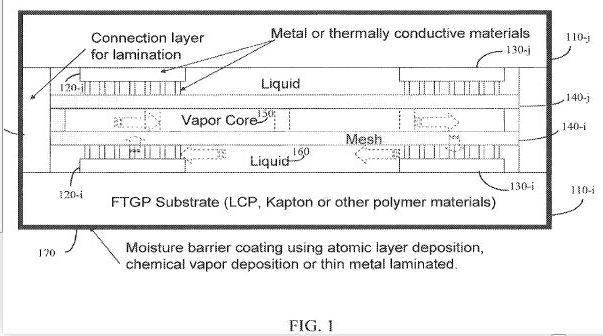
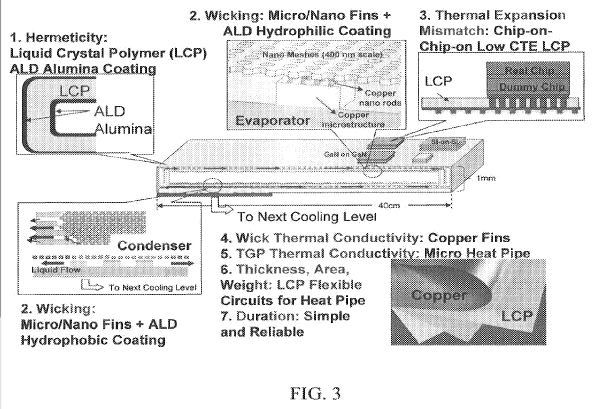
Methods, apparatuses, and systems are disclosed for flexible thermal ground planes. A flexible thermal ground plane may include a support member. The flexible thermal ground plane may include an evaporator region or multiple evaporator regions configured to couple with the support member. The flexible thermal ground plane may include a condenser region or multiple condenser regions configured to couple with the support member. The evaporator and condenser region may include a microwicking structure. The evaporator and condenser region may include a nanowicking structure coupled with the micro-wicking structure, where the nanowicking structure includes nanorods. The evaporator and condenser region may include a nanomesh coupled with the nanorods and/or the microwicking structure. Some embodiments may include a micromesh coupled with the nanorods and/or the microwicking structure..
BACKGROUND
This application relates generally to thermal ground planes. More specifically, this application relates to methods, apparatuses, and systems for flexible thermal ground planes.
The complexity and size of integrated circuits may been limited by the heat generated. Heat pipes have been used to transfer heat efficiently from one location to another. They have also been used to cool integrated circuits. The existing heat pipes for these purposes may consist of a rigid structure composed of copper, silicon, etc. Some modern electrical devices and systems demand a flexible circuit board along with a high capacity for heat dissipation.
There is thus a need for methods, systems, and devices that may also be flexible while transferring heat efficiently from one location to another or spread high flux heat from a small area to low heat flux over a larger area.
BRIEF SUMMARY
Certain embodiments thus provide methods, systems, and devices that may include a flexible thermal ground plane. Embodiments of flexible thermal ground planes may provide extremely high thermal performance with high evaporation/condensation heat transfer and effective liquid supply. Flexible configurations may be enabled by using polymer casing laminated and covered by moisture barrier coatings, enabled by atomic layer deposition, chemical vapor deposition, physical vapor deposition, or thin metal laminate, merely by way of example. Embodiments of flexible thermal ground planes may also involve low cost construction resulting from large size manufacturing, e.g. 3 ft wide and 1000 ft long, merely by way of example. For example, flexible thermal ground plane construction may take advantage of flexible circuit board manufacturing technology. Large size flexible thermal ground planes may thus be constructed for some embodiments, e.g. 20 cm by 40 cm by 1 mm, merely by way of example...