Se Hee
LEE , et al.
Kimchi vs Microplastics
Kimchi vs Microplastics
https://www.sciencedaily.com/releases/2026/05/260517211451.htm
This popular fermented food may help flush microplastics from the body
A kimchi-derived probiotic may help sweep dangerous nanoplastics out of the body before they accumulate in organs.
Scientists in South Korea have discovered that a probiotic bacterium found in kimchi may help the body flush out tiny plastic particles before they can build up in organs. In lab tests, the kimchi-derived microbe clung tightly to nanoplastics even under conditions designed to mimic the human intestine, where other bacteria quickly lost their grip.
The World Institute of Kimchi (President: Hae Choon Chang), a government-funded research institute under the Ministry of Science and ICT, announced the findings after studying a strain of lactic acid bacteria isolated from kimchi.
A research team led by Drs. Se Hee Lee and Tae Woong Whon at WiKim focused on a kimchi-derived bacterium called Leuconostoc mesenteroides CBA3656. The scientists tested how effectively the strain could attach to polystyrene nanoplastics (PS-NPs).
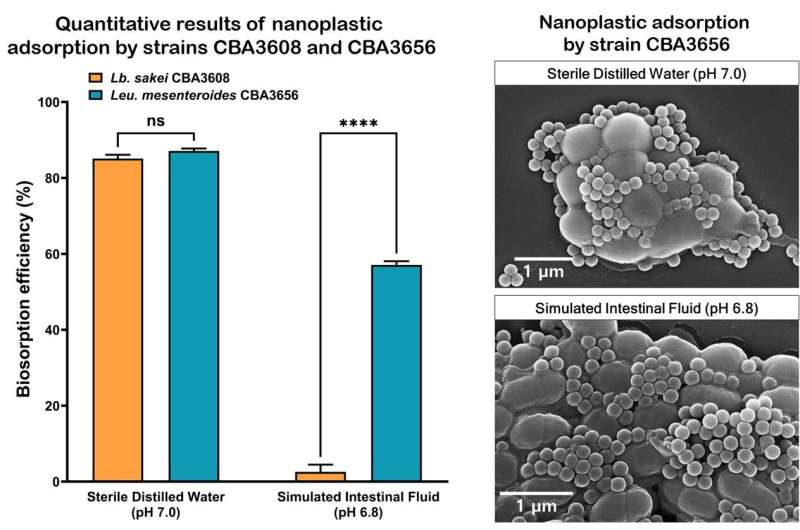
Under standard laboratory conditions, the kimchi strain achieved an adsorption efficiency of 87%, nearly matching a reference strain called Latilactobacillus sakei CBA3608, which recorded 85%.
The difference became much more noticeable under conditions designed to resemble the human intestine. The adsorption rate of the reference strain dropped sharply to just 3%, while strain CBA3656 maintained a far stronger binding level of 57%. According to the researchers, this suggests the kimchi-derived bacterium can continue attaching to nanoplastics even in environments similar to the human digestive tract...
https://www.sciencedirect.com/science/article/abs/pii/S0960852426003159?via%3Dihub
Bioresource Technology, 2026; 447: 134234
DOI: 10.1016/j.biortech.2026.134234
Efficient biosorption of nanoplastics by food-derived lactic acid bacterium.
Jisu Lee, et al.
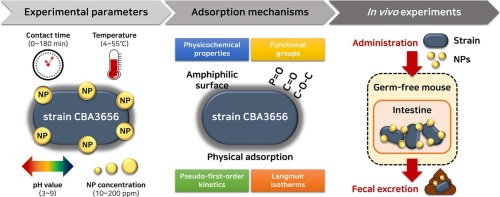
Abstract -- Nanoplastics (NPs) are increasingly prevalent in ecosystems and human food chains and pose potential health risks, necessitating effective removal strategies applicable to both environmental and intestinal conditions. However, bacteria capable of functioning in both contexts remain poorly explored. Here, the food-derived bacterium Leuconostoc mesenteroides CBA3656 exhibited high NP biosorption efficiency across a wide range of NP concentrations (10–200 ppm), pH values (3–9), and temperatures (4–55°C), along with rapid adsorption at short contact times. Biosorption behavior followed pseudo-first-order kinetics and the Langmuir isotherm model, indicating predominantly physical adsorption. Fourier-transform infrared spectroscopy revealed that functional groups such as Pdouble bondO, Cdouble bondO, and Csingle bondOsingle bondC in cell wall and membrane components contribute to NP interactions. Under simulated intestinal fluid, strain CBA3656 outperformed other Leuconostoc mesenteroides strains, and in vivo experiments demonstrated significantly enhanced fecal excretion of NPs. These results identify strain CBA3656 as a promising microbial biosorbent for NP mitigation.
https://phys.org/news/2026-03-kimchi-derived-probiotic-excretion-intestinal.html
Kimchi-derived probiotic found to promote binding and excretion of intestinal nanoplastics
by National Research Council of Science and Technology
A lactic acid bacterium isolated from kimchi may help promote the removal of nanoplastics from the body by binding to them in the intestine. Nanoplastics are ultrafine plastic particles measuring less than 1 micrometer that are generated during the degradation of larger plastic materials. These particles can enter the human body through food and drinking water. Due to their extremely small size, nanoplastics may cross the intestinal barrier and accumulate in organs such as the kidneys and brain. However, biological strategies to reduce nanoplastic accumulation in the gastrointestinal tract remain at an early stage of research.
A research team led by Drs. Se Hee Lee and Tae Woong Whon at The World Institute of Kimchi investigated the adsorption capacity of a kimchi-derived lactic acid bacterium, Leuconostoc mesenteroides CBA3656, against polystyrene nanoplastics (PS-NPs). The study was published in the journal Bioresource Technology.
Under standard laboratory conditions, strain CBA3656 showed a high adsorption efficiency of 87%, comparable to that of the reference strain Latilactobacillus sakei CBA3608 (85%). However, a notable difference was observed under simulated human intestinal conditions. While the adsorption rate of strain CBA3608 decreased sharply to 3%, strain CBA3656 maintained a substantially higher adsorption level of 57%. These results indicate that the kimchi-derived strain can stably bind nanoplastics even in environments resembling the human intestinal tract.
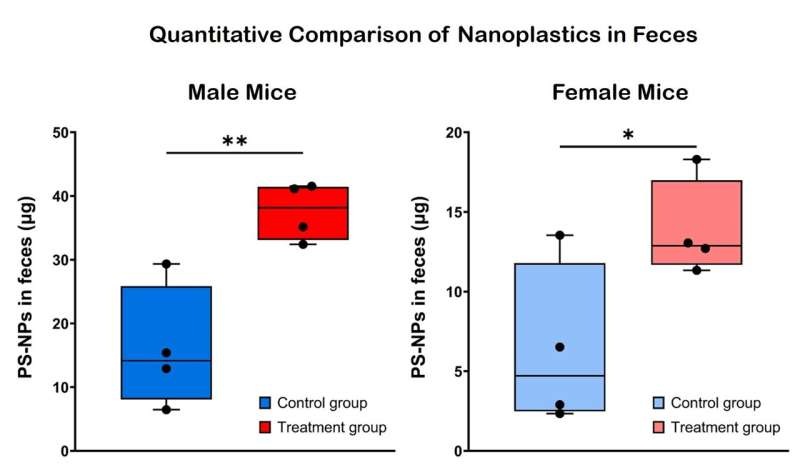
Significant findings were also observed in animal experiments using a germ-free mouse model. Compared with the control group that did not receive probiotics, both male and female mice administered strain CBA3656 showed more than a twofold increase in nanoplastics detected in feces. This result suggests that the probiotic may contribute to the excretion of nanoplastics by binding to them in the intestine.
This study provides scientific evidence that kimchi-derived lactic acid bacteria may interact with environmental micropollutants beyond their traditional role in fermentation. The findings provide new insight into potential biological mechanisms that may help reduce nanoplastic accumulation in the gastrointestinal tract.
"Plastic pollution is increasingly recognized not only as an environmental issue but also as a public health concern," said Dr. Sehee Lee, the lead researcher of the study. "Our findings suggest that microorganisms derived from traditional fermented foods could represent a new biological approach to address this emerging challenge. We will continue to expand the scientific value of kimchi microbial resources to contribute to public health and environmental solution.
https://worldwide.espacenet.com/advancedSearch?locale=en_EP
KR20260059693 -- Leuconostoc mesenteroides CBA3656 strain with microplastic biosorption capability and composition comprising the same
The present invention relates to a *Leuconostoc mesenteroides* CBA3656 strain capable of adsorbing microplastics, and to a composition comprising the same. Since the *Leuconostoc mesenteroides* CBA3656 strain of the present invention exhibits an excellent ability to adsorb microplastics that have entered the human body, it can be usefully employed as a biological agent to facilitate the easy and rapid removal of microplastics from the human body through excretion.
KR20250123718 -- NOVEL LEUCONOSTOC MESENTEROIDES AND FOOD USING THE SAME
The present invention relates to a novel Leuconostoc mesenteroides WiKim32 isolated from kimchi, to a kimchi seasoning containing the strain, and to a method for manufacturing kimchi using the same. The Leuconostoc mesenteroides WiKim32 according to the present invention as a probiotic, can be used for a variety of purposes such as relieving intestinal and stomach disorders of human or animals, enhancing immunity and the like, and can provide the kimchi seasoning, which is contained in the kimchi seasoning, as a mannitol-producing lactic acid bacterium, to exhibit the effects of harmful microorganisms reduction, quality uniformity, and the storage period extension. In addition, the Leuconostoc mesenteroides WiKim32 can be usefully used as a starter of fermented food.
KR10183636 -- WiKim32 Kimchi seasoning containing Leuconostoc mesenteroides WiKim32 and kimchi prepared by using the same
KR101799788 -- WiKim33 Primer set composition and kit for detecting strains of Leuconostoc mesenteroides WiKim33
KR101660847 -- LEUCONOSTOC MESENTEROIDES WIKIM33 STRAIN AND METHOD FOR PREPARING KIMCHI USING THE STRAIN