Drew LILLEY / Ravi PRASHER
Ionocaloric Cooling
https://newscenter.lbl.gov/2023/01/03/cool-new-method-of-refrigeration/
Berkeley Lab Scientists Develop a Cool New Method of Refrigeration
By Lauren Biron
January 3, 2023
Researchers hope that ionocaloric cooling could someday help replace refrigerants with high global warming potential and provide safe, efficient cooling and heating for homes
Adding salt to a road before a winter storm changes when ice will form. Researchers at the Department of Energy’s Lawrence Berkeley National Laboratory (Berkeley Lab) have applied this basic concept to develop a new method of heating and cooling. The technique, which they have named “ionocaloric cooling,” is described in a paper published Dec. 23 in the journal Science.
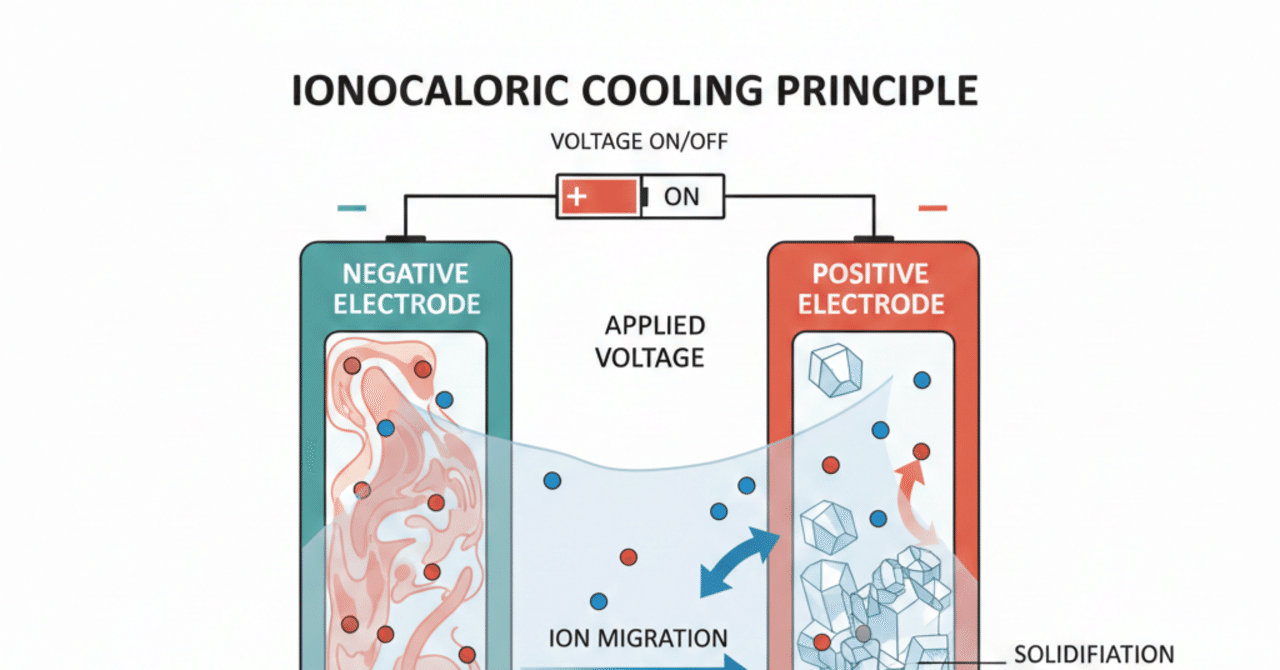
Ionocaloric cooling takes advantage of how energy, or heat, is stored or released when a material changes phase – such as changing from solid ice to liquid water. Melting a material absorbs heat from the surroundings, while solidifying it releases heat. The ionocaloric cycle causes this phase and temperature change through the flow of ions (electrically charged atoms or molecules) which come from a salt.
Researchers hope that the method could one day provide efficient heating and cooling, which accounts for more than half of the energy used in homes, and help phase out current “vapor compression” systems, which use gases with high global warming potential as refrigerants. Ionocaloric refrigeration would eliminate the risk of such gases escaping into the atmosphere by replacing them with solid and liquid components.
“The landscape of refrigerants is an unsolved problem: No one has successfully developed an alternative solution that makes stuff cold, works efficiently, is safe, and doesn’t hurt the environment,” said Drew Lilley, a graduate research assistant at Berkeley Lab and PhD candidate at UC Berkeley who led the study. “We think the ionocaloric cycle has the potential to meet all those goals if realized appropriately.”
Finding a solution that replaces current refrigerants is essential for countries to meet climate change goals, such as those in the Kigali Amendment (accepted by 145 parties, including the United States in October 2022). The agreement commits signatories to reduce production and consumption of hydrofluorocarbons (HFCs) by at least 80% over the next 25 years. HFCs are powerful greenhouse gases commonly found in refrigerators and air conditioning systems, and can trap heat thousands of times as effectively as carbon dioxide.
The new ionocaloric cycle joins several other kinds of “caloric” cooling in development. Those techniques use different methods – including magnetism, pressure, stretching, and electric fields – to manipulate solid materials so that they absorb or release heat. Ionocaloric cooling differs by using ions to drive solid-to-liquid phase changes. Using a liquid has the added benefit of making the material pumpable, making it easier to get heat in or out of the system – something solid-state cooling has struggled with.
Lilley and corresponding author Ravi Prasher, a research affiliate in Berkeley Lab’s Energy Technologies Area and adjunct professor in mechanical engineering at UC Berkeley, laid out the theory underlying the ionocaloric cycle. They calculated that it has the potential to compete with or even exceed the efficiency of gaseous refrigerants found in the majority of systems today.
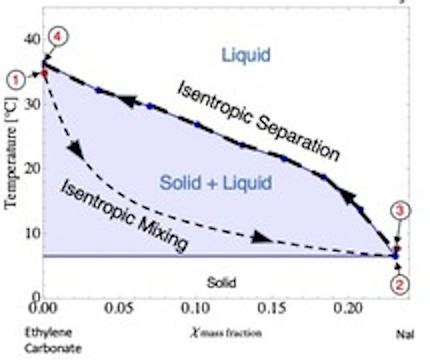
They also demonstrated the technique experimentally. Lilley used a salt made with iodine and sodium, alongside ethylene carbonate, a common organic solvent used in lithium-ion batteries.
“There’s potential to have refrigerants that are not just GWP [global warming potential]-zero, but GWP-negative,” Lilley said. “Using a material like ethylene carbonate could actually be carbon-negative, because you produce it by using carbon dioxide as an input. This could give us a place to use CO2 from carbon capture.”
Running current through the system moves the ions, changing the material’s melting point. When it melts, the material absorbs heat from the surroundings, and when the ions are removed and the material solidifies, it gives heat back. The first experiment showed a temperature change of 25 degrees Celsius using less than one volt, a greater temperature lift than demonstrated by other caloric technologies.
“There are three things we’re trying to balance: the GWP of the refrigerant, energy efficiency, and the cost of the equipment itself,” Prasher said. “From the first try, our data looks very promising on all three of these aspects.”
While caloric methods are often discussed in terms of their cooling power, the cycles can also be harnessed for applications such as water heating or industrial heating. The ionocaloric team is continuing work on prototypes to determine how the technique might scale to support large amounts of cooling, improve the amount of temperature change the system can support, and improve the efficiency.
“We have this brand-new thermodynamic cycle and framework that brings together elements from different fields, and we’ve shown that it can work,” Prasher said. “Now, it’s time for experimentation to test different combinations of materials and techniques to meet the engineering challenges.”
Lilley and Prasher have received a provisional patent for the ionocaloric refrigeration cycle, and the technology is now available for licensing by contacting ipo@lbl.gov.
Ionocaloric Cooling for Air Conditioning and Refrigeration 2022-072 – Intellectual Property Office
Ionocaloric Cooling for Air Conditioning and Refrigeration 2022-072
https://www.science.org/doi/10.1126/science.ade1696
Ionocaloric refrigeration cycle
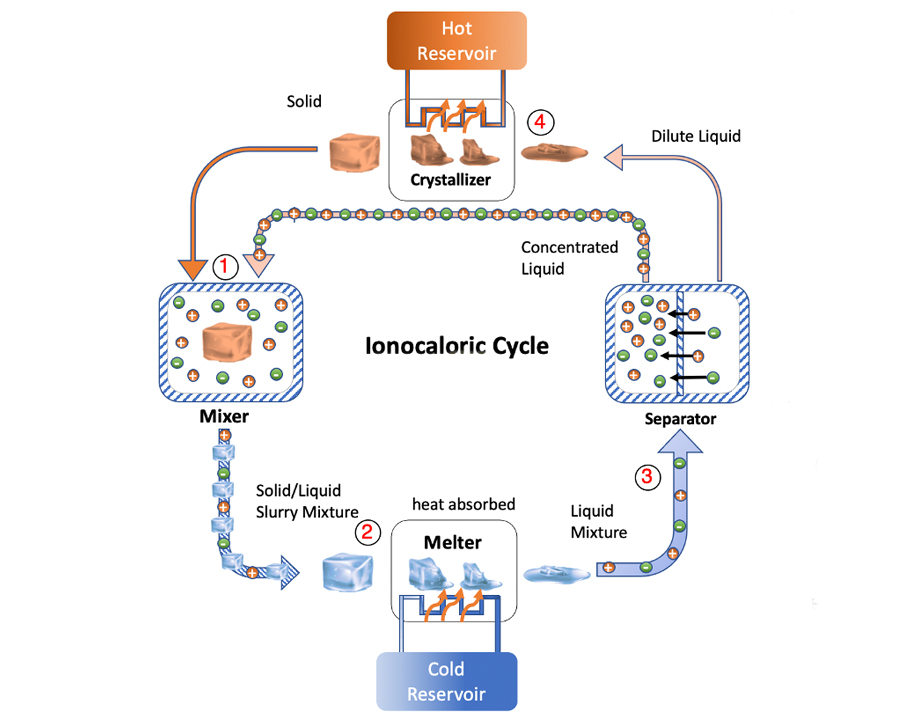
Ionocaloric cycle : When a current is added, ions flow and change the material from solid to liquid, causing the material absorb heat from the surroundings. When the process is reversed and ions are removed, the material crystalizes into a solid, releasing heat...
Lilley and corresponding author Ravi Prasher, a research affiliate in Berkeley Lab’s Energy Technologies Area and adjunct professor in mechanical engineering at UC Berkeley, laid out the theory underlying the ionocaloric cycle. They calculated that it has the potential to compete with or even exceed the efficiency of gaseous refrigerants found in the majority of systems today.
They also demonstrated the technique experimentally. Lilley used a salt made with iodine and sodium, alongside ethylene carbonate, a common organic solvent used in lithium-ion batteries.
“There’s potential to have refrigerants that are not just GWP [global warming potential]-zero, but GWP-negative,” Lilley said. “Using a material like ethylene carbonate could actually be carbon-negative, because you produce it by using carbon dioxide as an input. This could give us a place to use CO2 from carbon capture.”
Running current through the system moves the ions, changing the material’s melting point. When it melts, the material absorbs heat from the surroundings, and when the ions are removed and the material solidifies, it gives heat back. The first experiment showed a temperature change of 25 degrees Celsius using less than one volt, a greater temperature lift than demonstrated by other caloric technologies.
“There are three things we’re trying to balance: the GWP of the refrigerant, energy efficiency, and the cost of the equipment itself,” Prasher said. “From the first try, our data looks very promising on all three of these aspects.”...
https://pubmed.ncbi.nlm.nih.gov/36548416/
Science. 2022 Dec 23;378(6626):1344-1348.
doi: 10.1126/science.ade1696. Epub 2022 Dec 22.
Ionocaloric refrigeration cycle
Drew Lilley and Ravi Prasher
Abstract -- Developing high-efficiency cooling with safe, low–global warming potential refrigerants is a grand challenge for tackling climate change. Caloric effect–based cooling technologies, such as magneto- or electrocaloric refrigeration, are promising but often require large applied fields for a relatively low coefficient of performance and adiabatic temperature change. We propose using the ionocaloric effect and the accompanying thermodynamic cycle as a caloric-based, all–condensed-phase cooling technology. Theoretical and experimental results show higher adiabatic temperature change and entropy change per unit mass and volume compared with other caloric effects under low applied field strengths. We demonstrated the viability of a practical system using an ionocaloric Stirling refrigeration cycle. Our experimental results show a coefficient of performance of 30% relative to Carnot and a temperature lift as high as 25°C using a voltage strength of ~0.22 volts.
US20260029170 -- METHODS, SYSTEMS, AND DEVICES FOR IONOCALORIC HEATING AND COOLING
Inventor(s): PRASHER RAVI ; LILLEY DREW
Applicant(s): UNIV CALIFORNIA
Disclosed herein are methods, systems, and devices heating and cooling via an ionocaloric cycle. Methods include providing a first material in a solid state, combining the first material with a second material, wherein the second material provides an electrochemical field to the first material to reduce the melting point of the first material, and allowing the first material to melt, wherein the first material extracts heat from a cold reservoir upon melting. The method further includes separating the first material from the second material by a separation technique using a voltage applied to a combination of the first material and the second material and allowing the first material to precipitate, wherein the first material releases heat to a hot reservoir during precipitation.
https://www.ilkdresden.de/en/research/ionokalorische-kaelteerzeugung.html
Ionocaloric solid-liquid phase cooling process
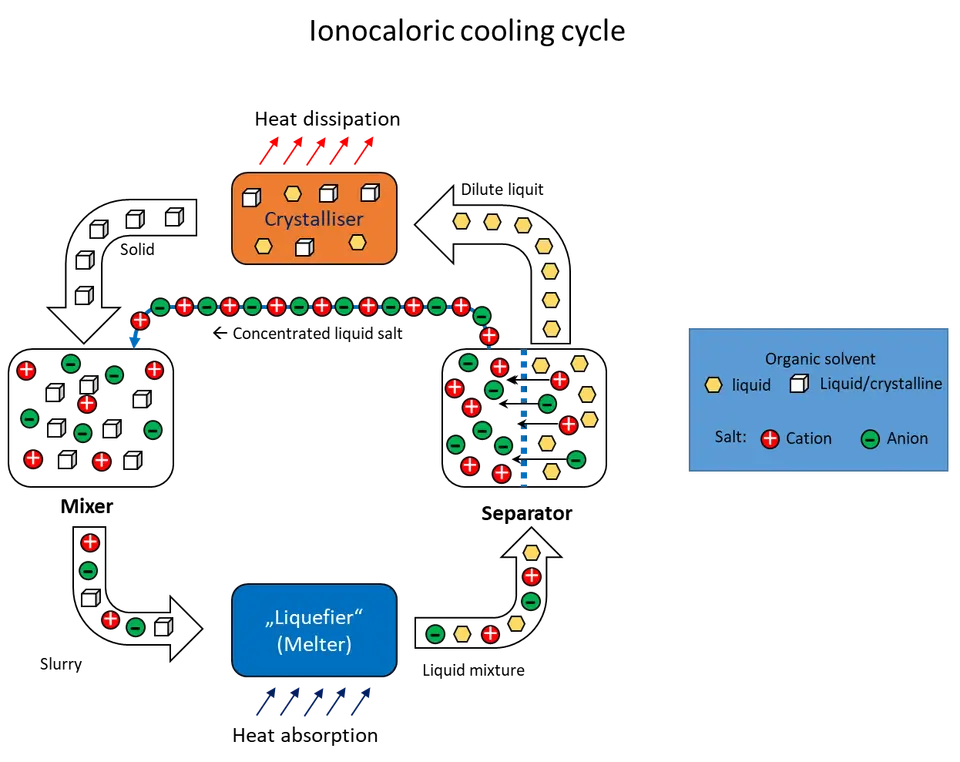
The utilisation of caloric effects for refrigeration purposes has been investigated and discussed for several years. Caloric effects in solids result from complex interactions between their atomic or molecular structures, which are influenced by mechanical pressure, magnetic fields or electric fields. The potential future utilisation of these caloric effects could drive the development of refrigeration systems that are characterised by higher energy efficiency and environmental friendliness than conventional cooling technologies. In 2022, Lilley and Prasher1 proposed a way of generating cold based on another calorific effect. What they called the "ionocaloric refrigeration cycle" (see figure) describes the cooling and heating of a mixture of substances by changing the ion concentration with an accompanying phase change. It could be used as a thermodynamic cycle, for example in refrigeration systems for moderate cooling. It is based on lowering the melting point of an organic substance by adding a salt. In a circular process, the two substances would first be mixed to absorb heat and then separated again into the individual compounds to release heat during phase transformation (recrystallisation). Compared to conventional cooling systems such as compression chillers, ionocaloric cooling has the potential to be more efficient and environmentally friendly. This is due to the fact that it does not use ozone-depleting or climate-damaging refrigerants and does not require mechanical components such as compressors.
The research project initiated at the ILK Dresden aims to identify and qualify material pairs according to refrigeration technology criteria that are suitable for the ionocaloric circulation process and could be used in existing and new cooling applications. As part of the laboratory tests, the mixing temperatures of potentially suitable material mixtures are measured and the eutectic compositions are determined using differential scanning calorimetry (DSC). Another focus is the separation of the molten material mixtures into their components. To this end, suitable separation processes are selected and tested for their efficiency. In the context of a possible technical use, it is necessary to examine the materials for their corrosive behaviour towards the selected substances. Ionocaloric cooling in the circulation process poses a particular challenge for technical operation, as an answer must be found to the question of how the substances can best be transported in the liquid and solid aggregate state and how they can be mixed and separated most efficiently..
Fig.: Ionocaloric refrigeration cycle based on Lilley und Prasher [1]
[1] Drew Lilley and Ravi Prasher: Supplementary Materials for Ionocaloric refrigeration cycle, Science 378, 1344 (2022)
https://www.youtube.com/watch?v=AXI2XpHS4tY
How Ionocaloric Cooling Works: The Future of Heat Pumps? // Zema Academy