Nima RAHBAR, et al.
Astrocrete
https://www.sciworthy.com/researchers-propose-making-concrete-with-human-bodily-fluids/
Researchers propose making concrete with human bodily fluids
It may seem weird and disgusting, but when you mix Martian surface dust with human serum albumin and urine, it makes a substance tougher than concrete that may be useful as a building material.
...What if we could make building materials by mixing biology with Martian chemistry? It might sound crazy, but scientists at the University of Manchester and the University of Oslo wanted to test whether different products of the human body, such as blood, could be mixed with Martian rock dust called regolith to make new materials.
Though this might sound like vampirism, humans have been using blood for thousands of years to make different binders and adhesives. Slaughterhouses in the 1900s collected animal blood to make a kind of glue used to hold together plywood and even bricks. Though sending cows to Mars would be too expensive, the crew on a mission to Mars can donate their own blood instead.
One major part of blood is blood plasma which is full of a sticky protein known as human serum albumin. The average healthy adult produces 12 to 25 grams of plasma a day and can donate their plasma as often as every few days, similar to donating blood. Because humans can donate a lot of plasma, the scientists in this study were curious if they could mix human serum albumin with the regolith on Mars to create concrete.
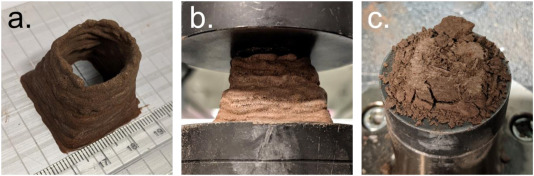
The team used a mixture of dust and rock similar to Mars’s regolith and put it into a plastic syringe. These syringes are cheap and light, making them good options for space missions. Using a second syringe, a mixture of human serum albumin and water was injected into the regolith and then heated up to 65oC to finish setting the blood concrete. Concrete samples were then loaded into a machine that squeezed them between two large disks. By measuring how much pressure was needed to crush a sample or cause it to crack, the researchers were able to identify the toughest concrete mixtures.
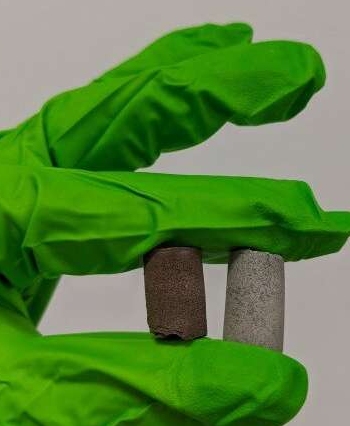
The researchers found that a mixture of regolith and 35% serum albumin produced blood concrete that was tougher than brick mortar from the hardware store. This material was used to create small, 3D-printed structures that could easily support the weight of a person on Mars. Surprisingly, the blood concrete was also a good adhesive for glass. When tested side-by-side with super glue, the blood concrete was harder to scrape off and bound the glass more tightly.
The key to the strength of the blood concrete was in the human serum albumin. When heated up, proteins go through a chemical change and change their structure. The new structure formed by human serum albumin was very sticky and bound tightly to the regolith, making the concrete extra strong.
Another way to change a protein’s structure is to treat it with different chemicals like urea. Urea is found in human urine and is very cheap and easy to produce thanks to the crew members. The research team collected urea from human urine and mixed this with human serum albumin and regolith to make an even stronger concrete. This material was more than twice as strong as brick mortar and was also denser. A denser material will act as a better shield against dangerous space radiation and therefore will make a better shelter.
Going to Mars will be incredibly difficult and costly. The authors propose that recycling human products into needed materials will cut costs and minimize waste on these missions. In the end, harvesting materials from Mars can be as tough as getting blood from a stone. Perhaps putting blood into stone will get us a few steps closer.
https://www.djc.com/special/concrete/10003364.htm
Brief history of concrete - DJC
They even unintentionally entrained the air in the mix by adding animal blood. That process created small air bubbles in concrete, making the mix more durable...
https://www.youtube.com/watch?v=ufxb3v3raus
The Secret Why the Romans Mixed Blood Into Their Concrete
NEXT NODE
https://www.manchester.ac.uk/about/news/affordable-housing-in-outer-space-scientists-develop-cosmic-concrete-from-space-dust-and-astronaut-blood/
Affordable housing in outer space: Scientists develop cosmic concrete from space dust and astronaut blood
...Scientists at The University of Manchester have now developed a way to potentially overcome this problem, by creating a concrete-like material made of extra-terrestrial dust along with the blood, sweat and tears of astronauts.
In their study, published in Materials Today Bio, a protein from human blood, combined with a compound from urine, sweat or tears, could glue together simulated moon or Mars soil to produce a material stronger than ordinary concrete, perfectly suited for construction work in extra-terrestrial environments...
SYSTEMS AND METHODS FOR CALCIUM SEQUESTRATION AND PRECIPITATION -- WO2026207299
This disclosure relates generally to methods and devices for capturing calcium. In particular, this disclosure provides a method comprising contacting at least one calcium-sequestering protein to a first solution for a first predetermined amount of time, thereby allowing the at least one calcium-sequestering protein to bind to calcium in the first solution; and contacting the at least one calcium-sequestering protein with a second solution for a second predetermined amount of time, the second predetermined amount of time being until a portion of the calcium is released from the at least one calcium-sequestering protein. This disclosure further provides a device comprising a sample interface configured to receive a sample comprising calcium; and a substrate embedded with a calcium-sequestering protein, thereby allowing the substrate to capture at least a portion of the calcium. The methods and devices herein allow for sequestering large quantities of calcium for downstream applications.
WATER TOLERANT ENZYMATIC STRUCTURAL MATERIAL -- US2024351954
A carbon-negative Engineering Structural Material (ESM) has a compressive strength approaching that of concrete and relies on a carbon-absorbing enzyme for crystalline formations formed cooperatively with a porous structure to achieve load-bearing properties. A tough scaffold forms through capillary suspension, a technique that utilizes capillary forces to concentrate particles in a liquid matrix. Carbonic anhydrase, a zinc-containing enzyme extracted from bovine erythrocytes, is harnessed to grow mineral materials, and the capillary suspension is used to create a construction material, including sand and a polymer. This combination enables the incorporation of precipitated calcium minerals into the structure, resulting in the development of water-resistant and load-bearing construction materials.
ENZYMATIC CONSTRUCTION MATERIAL FOR REPAIR AND CORROSION RESISTANCE AND DURABILITY -- US20230192548
Methods for repair of cracks and niches in concrete using carbonic anhydrase embedded in a gelatin, hydrogel, or other aqueous matrix are provided. A durable corrosion resistant concrete mix containing carbonic anhydrase is provided, as are methods of making and using the durable corrosion resistant concrete. Corrosion resistance and durability derive from decreased porosity compared to concrete without the enzyme, conferring decreased access of deleterious materials such as chloride ions to interior portions of the concrete.
ENZYMATIC CONSTRUCTION MATERIAL -- US2023117517
Materials and methods for a rapid and effective way to create a carbon negative self-healing construction material are described. The construction material uses sand aggregates, a trace amount of catalyst, a small dosage of scaffolding material with a crosslinking agent, and a calcium source. The curing is performed at a high temperature for a short period or at room temperature for a long period. The catalyst-driven method to bridge the sand particles results in a dense, stiff, strong, and tough structural material, which upon exposure to calcium source and CO2 heals itself repeatably.
Method for enzymatic repair of cementitious surfaces -- US10647617
An aqueous solution of carbonic anhydrase and calcium chloride is contacted with a cementitious surface defining at least one opening or fissure in the presence of ambient carbon dioxide to thereby cause the calcium chloride and carbon dioxide to react, whereby calcium carbonate precipitate from the solution and seals the opening or fissure.
https://journal.ijprse.com/index.php/ijprse/article/view/1196
Investigating the Effect of Incorporating Animal Blood into Concrete
Licel Jade C. Maraña, et al.
[ PDF ]
Abstract -- Concrete has been a fundamental material in construction because of its durability and strength. Despite this, traditional beliefs and practices continue to shape construction practices, such as the idea that the incorporation of animal blood may increase the strength of concrete.
This study aimed to investigate the influence of adding animal blood, specifically pig blood, into the concrete mixture, with emphasis on its compressive strength. The samples were divided into 3 groups: the Control group, which has 0% pig’s blood, Sample 1 with 5% of pig’s blood, and Sample 3 with 10 % of pig’s blood, based on the amount of water in the mixture.
The workability of all sample batches was measured by a slump test before casting of concrete mixture into the cylindrical mold. The test specimens were cured for 7, 14 and 28 days. The compressive strength test was performed according to ASTM standard to determine the performance of the modified concrete.
The results indicated that the incorporation of animal blood, specifically pig’s blood, negatively affected the compressive strength for all curing periods, with increasing reductions as the percentage of pig’s blood was increased. While the modified concrete mixtures developed strength with time, they always underperformed compared to the control group. This suggests the pig’ blood can negatively affect the hydration process and cement bonding properties. These results contradict the traditional belief that animal blood strengthens the concrete
https://www.globalconstructionreview.com/blood-concrete-found-self-heal-cracks/
Blood in concrete found to self-heal cracks
American researchers have found a way to use an enzyme extracted from blood cells to make a self-healing concrete that is four times more durable than traditional formulae.
A team at the Worcester Polytechnic Institute in Massachusetts say the carbonic anhydrase enzyme reacts with atmospheric carbon dioxide to create calcium carbonate crystals that automatically fill cracks before they cause structural problems.
The work, published in the journal Applied Materials Today, details three concrete mixes. One will autonomously mend small cracks, a second can induce self-healing in larger cracks, and a third can be used to mend cracks that have already formed in traditional concrete.
Nima Rahbar, an associate professor of civil and environmental engineering at the institute, was the lead author of the paper. He commented: “If tiny cracks could automatically be repaired when they first start, they won’t turn into bigger problems that need repair or replacement. It sounds sci-fi, but it’s a real solution to a significant problem in the construction industry.”
He added: “We looked to nature to find what triggers the fastest CO2 transfer, and that’s the CA enzyme. Since enzymes in our bodies react amazingly quickly, they can be used as an efficient mechanism to repair and strengthen concrete structures.”
The process, which Rahbar has patented after five years of research, can heal millimetre-scale cracks within 24 hours.
To mend a bigger crack or hole, Rahbar said, calcium and CO2 can be applied to spur autonomous healing. The same mixture can be used, but with a different application process, to initiate healing in already-set traditional concrete.
https://www.worldanvil.com/w/the-engineering-corps/a/blood-concrete-material
...Other important additives are blood and animal fat. These additions have two effects. First, the blood and fat react with the rest of the mixture to both accelerate the formation of crystals and create air bubbles that allow the concrete to expand and contract with changes in temperature, thus making it more resistant.
Second, the use of sacrificial blood from either willing or unwilling donors allows for magic to be infused in the concrete so as to give him specific properties. Those properties mostly consist of different types of wards and resistance magic. The owner of the architecture in which the concrete is used can also add their own blood to the mix during a specific ritual so as to gain control of the building afterwards...
https://www.popsci.com/science/mars-blood-concrete/
Researchers propose building homes on Mars with human blood
AstroCrete uses a protein found in plasma as a binder. No, really.
...Ancient Roman concrete is known for its excellent resiliency, strength, and even self-healing properties. But masons often used other key ingredients in the brickmaking: blood and urine. Knowing this, a research team from Iran’s Kharazmi University recently mixed and tested multiple potential building materials using various combinations of sediment found on Mars, as well as other easily obtainable components.
“Ancient Romans utilized organic additives, including animal blood, primarily to improve the durability and workability of their mortar,” they wrote in a subsequent study published in the journal, Acta Astronautica. “Although it is a bit strange, blood can be utilized to create strong concrete or bricks for onsite construction on Mars.”
Depending on the region of the planet, Martian soil contains the right chemical composition for multiple types of concrete. After compiling geological data collected by past Mars landers and orbiters, the team identified 11 potential concrete options for future astronauts. These included geopolymer and magnesium silica mixtures. They then created simulated building material samples using a 3D printer, stress tested them, and recorded the results.
According to the team, a sulfur-based concrete will likely be the most reliable initial material for buildings on Mars. But researchers also suggest that another, more outlandish contender could be AstroCrete, a modern form of Roman concrete that contains additional, human-sourced ingredients.
“The production process is simple. Aggregates (Martian regolith) bind together through contact with human serum albumin (HAS), a protein found in blood plasma,” they write.
The team theorizes that a single astronaut could produce enough HAS to make the amount of AstroCrete necessary to construct a single-occupancy dwelling in about 72 weeks. To increase the AstroCrete’s compressive strength and plasticity while also lowering its brittleness, the study authors offer another possible additive—urea extracted from sweat, tears, and urine. An additional major benefit of AstroCrete is that it requires no water to mix, which is especially useful given the planet’s almost entirely arid conditions.
https://www.techbriefs.com/component/content/article/40189-concrete-like-material-from-space-dust-and-astronaut-blood
Concrete-Like Material from Space Dust and Astronaut Blood
...The scientists demonstrated that a common protein from blood plasma — human serum albumin — could act as a binder for simulated Moon or Mars dust to produce a concrete-like material. The resulting material, called AstroCrete, had compressive strengths as high as 25 MPa (megapascals) — about the same as the 20 - 32 MPa seen in ordinary concrete.
The scientists found that incorporating urea — a biological waste product that the body produces and excretes through urine, sweat, and tears — could further increase the compressive strength by over 300%, with the best performing material having a compressive strength of almost 40 MPa, which is substantially stronger than ordinary concrete.
The scientists calculate that over 500 kg of high-strength AstroCrete could be produced over the course of a two-year mission on the surface of Mars by a crew of six astronauts. If used as a mortar for sandbags or heat-fused regolith bricks, each crewmember could produce enough AstroCrete to expand the habitat to support an additional crewmember, doubling the housing available with each successive mission.
The scientists investigated the underlying bonding mechanism and found that the blood proteins denature, or “curdle,” to form an extended structure with interactions known as “beta sheets” that tightly hold the material together.
https://www.sciencedirect.com/science/article/pii/S2590006421000442
Materials Today Bio
Blood, sweat, and tears: extraterrestrial regolith biocomposites with in vivo binders
A.D. Roberts, et al.
[ PDF ]
https://en.wikipedia.org/wiki/Lunarcrete
AstroCrete
AstroCrete is a concrete-like material proposed to be used on Moon or Mars made from regolith and human serum albumin (HSA), a protein from human blood. Scientists demonstrated that such material had compressive strengths as high as 25 MPa, while ordinary concrete had 20–32 MPa. By adding urea (byproduct in urine, sweat, and tears), the resultant material became substantially stronger than ordinary concrete, with 40 MPa of compressive strength.
As noted by the authors: " In essence, human serum albumin produced by astronauts in vivo could be extracted on a semi-continuous basis and combined with lunar or Martian regolith to 'get stone from blood', to rephrase the proverb. We believe that human serum albumin extraterrestrial regolith biocomposites could potentially have a significant role in a nascent Martian colony.
Researchers also experimented with synthetic spider silk and bovine serum albumin as regolith binders, noting that these materials could also be produced on Mars after advancements in biomanufacturing technology.
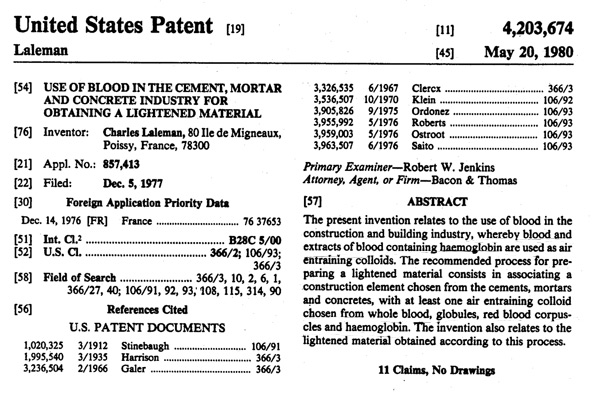
US4203674 -- Use of blood in the cement, mortar and concrete industry for obtaining a lightened material
The present invention relates to the use of blood in the construction and building industry, whereby blood and extracts of blood containing haemoglobin are used as air entraining colloids. The recommended process for preparing a lightened material consists in associating a construction element chosen from the cements, mortars and concretes, with at least one air entraining colloid chosen from whole blood, globules, red blood corpuscles and haemoglobin. The invention also relates to the lightened material obtained according to this process.
GB522172 -- Improvements in or relating to plastic self-hardening compositions
The setting of cement-rubber compositions of the kind described in Specification 369,561 is delayed by grinding the cement, prior to its admixture with rubber dispersion, with a colloidal organic substance such as casein, glue, haemoglobin, or blood albumen which surrounds the cement particles with a slowly moisture-absorbent layer. The setting of the composition may be further delayed by addition of water.
FR376406 -- Ciment perfectionné
US1020325 -- COMPOSITION OF MATTER
US3536507A -- Hydraulic cementitious mixtures
The properties, such as strength, of hydraulic cementitious mixtures are improved by including therein a small amount of an admixture which is derived from the fermentation liquor resulting from the aerobic fermentation of liquid carbohydrates, e.g., molasses from beet or cane sugar, corn, wheat or wood pulp, in the presence of an assimilable nitrogen compound such as ammonia with a microorganism or extract therefrom that produces glutamic acid or its precursors; a derivative may be the whole fermentation liquor or the end liquor which remains after the separation of glutamic acid from the fermentation liquor, as by acidification.