Eddie SINES
Direct Energy Conversion
Direct Energy Conversion
102 Practical Energy Innovations
Gary Vesperman
Source : Infinite Energy Magazine (2014)
Photons to Electrons
...Using Type II YBCO superconducting materials, the plan is to configure this material in such a way as to allow photons, not electrons, to cause a moving ‘avalanche effect’ in the superconducting material – knocking it out of the super-conducting state.
As photons are injected into the surface of the thin films of YBCO, static flux quanta emanating off the pole of a permanent magnet is channeled through two different magnetic paths. See Figure 1 for a simplified overview of the device.
Figure 1
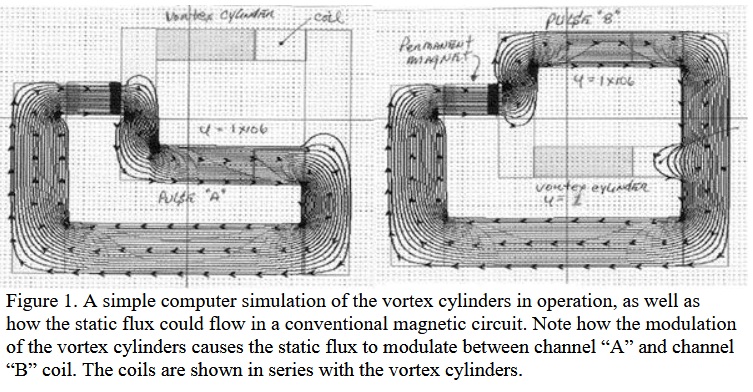
Note that in a normal magnetic circuit, electrons were used to produce magnetic fields. In this case a strong permanent magnet is used to produce an equivalent field. This new design is a more energy efficient method. To control the static flux and modulate it from one coil to the other, a new device utilizing ‘vortex cylinders’ is proposed. These man-made vortex cylinders are comprised of hundreds of small quartz tubes. Each of these tubes is designed to channel static flux through a magnetic circuit. In effect, each vortex cylinder is a ‘solid-state air gap’ with an inductance that can be varied by introducing coherent photons of a given wavelength and energy level.
The vortex cylinder would exhibit an extremely high permeability on the order of 106 H/m.
The high-energy 930-nm photons interact at the atomic level where the electrons formed Cooper pairs. The high-energy photons are used to drive the superconductor material in and out of the superconductive state. When the Type II YBCO is in the normal state it has no magnetic properties, and the materials are similar to glass or a ceramic, which is known to have no effect on magnetic flux.
One of the most exciting parts of this new concept is that when the vortex cylinder is not exposed to the coherent photon source it will drop back into the superconducting state as long as the vortex cylinder is held at or below its Tc.
What is significant in this application is the DEC will be able to produce a difference in the static flux density in two different coils over time and in effect produce a counter EMF or electricity without any moving parts. This design could replace the moving armature as well as the high-speed steam turbine of the coal fired boiler plant and all the associated support equipment – reducing the footprint of the generating plant considerably, as well as cost. The device can be cycled in a manner similar to a conventional switch mode power supply using a standard half bridge driver. The flux is flowing through one side of the magnetic circuit while the other side has a very low or zero flux density. The photon source is then turned off, and the other side of the vortex cylinder circuit is turned on, completing one full switching cycle. The technical process is known as ‘photon Cooper pair breaking’. Since the YBCO vortex cylinder remains at a relatively constant temperature, only a small amount of LN2 is used during the ‘latent heat of vaporization’.
The waste heat from generating electricity is expected to be a small fraction of the overall energy produced, with an estimated efficiency of 99.5%. This process can be repeated billions of times with no loss in electrical performance.
The device requires LN2 as a cryogenic ‘fuel’. This cost is small compared to the present day cost of mining hydrocarbons, like coal, or extracting crude oil. Since the DEC does not use combustion to convert potential energy into kinetic energy, the only byproduct is a small amount of waste heat and nitrogen gas which is released back into the atmosphere where it originated, closing the loop without the production of CO2 or other harmful emissions.
The Future of DEC – This paper was intended to provide a simple overview of a complex concept, one that has a rich foundation in conventional physics, magnetism, optics, quantum mechanics, superconductivity, and many other technical areas. Should the DEC become a reality, the reduction in CO2 emissions would greatly improve the environment. Given the volumes of technical papers available worldwide and new superconducting materials, mankind is better positioned to realize new breakthroughs in DEC technology. We have the technology, the materials and the knowledge to succeed where past efforts have failed. This vision can help save the planet from pollution, global warming, skyrocketing energy costs, and the security risk of sourcing our energy from countries that sponsor terrorism.
Conclusion – Humanity and the planet are at a crossroad in history and time. The Earth’s atmosphere, land masses and oceans are under attack from every direction. Humanity is depleting resources that can never be replaced. Humanity needs to focus on reviewing the planet’s ecosystem more than ever before. It is with great hope that the scientific community will realize the potential in the DEC concept and support the development of
such a clean energy system.
Acknowledgments – The author would like to express his deep appreciation to his wife, Debbie, for her support and encouragement in this clean energy adventure. In addition, I would also like to offer my sincere thanks to all of the people who have supported my R&D efforts over the past three years, allowing me to follow my dream of clean energy.
About the Author – The author worked at the Naval Research Laboratory as an Electronic Engineering Technician for 26 years before retiring to work full time on various R&D projects under the banner of a new start up company called Potomac Energy Projects, LLC. The author holds a number of active patents in the area of passive coil winding cooling methods related to power transformers, motors and generators. Potomac Energy Projects LLC is working on a number of patent pending applications related to clean energy technology that do not use the combustion process to produce electricity.
Additional Information About the DEC Concept – Infinite Energy editors asked some additional questions of inventor Eddie Sines about his “Direct Energy Conversion” concept:
Q: How much energy is required to liquefy nitrogen gas into a liquid which is used to maintain the cryogenic temperature on the device so it can maintain a superconductor environment?
A: Potomac Energy Project’s goal is to show the concept can make electricity without any moving parts using coherent photons from a solid-state laser used to stimulate a magnetic circuit designed around a Type II superconductor. PEP plans to demo a small working device that will use a small amount of liquid nitrogen ~1 liter Dewar to prove the concept is real. One liter of liquid nitrogen (LN2) cost ~$0.06/liter at an energy cost of
~1 kilowatt-hour. (Ref: Http://hypertextbook.com/facts/2007/KarenFan.shtml)
Q: How much photon energy is needed to modulate static flux?
A: In the case study, PEP will use a 3-watt solid-state laser operating at 33% efficiency that delivers ~1 watt of laser photon energy that will be directed into the superconductor structure causing a modulation of the vortex cylinders at a given frequency. Two different magnetic paths will modulate the static flux emanating off the pole of a permanent magnet. The flow of static flux is controlled by photon modulation so electricity can be generated, i.e. coils must see a difference in flux density in order to produce electricity. The conversion efficiency or process is ~99.6%. The high efficiency is based on the photon computed temperature and the boiling point of liquid nitrogen. Only a small amount of photon energy is needed to modulate the superconductor thin films, because of the limited number of atoms involved and by taking advantage of avalanche principles.
Only 0.4% of the conversion energy is loss in heat, unlike a coal fired power plant and nuclear power plant which is ~67%. While liquid nitrogen is present the small device PEP is working on could produce as much as ~10 kilowatts of electricity and be of a size not much larger than a standard soda can.
The process is efficient because of the crystal lattice structure found inside of the superconductor thin films material and the way electrons interact with the photons. With the introduction of the 930 photons, this energy packet is ideal for electrons in a low-energy orbit to be absorbed and causes them to jump to the next higher quantum orbit whereby they break the superconductor state. This process is known as an avalanche. One photon injected into the superconductor starts this process which is similar to a runaway nuclear reaction, only without nuclear byproducts.
The most exciting part is, when the laser photon source is turned off, the superconductor material rejects the absorbed photon energy as long as there is LN2 available and then returns to its original low energy quantum orbit which is a superconductor state. The process is supported as long as the cryogenic temperature is low enough to support the superconductor state.
Q: Is the input energy coming from the photon source or the nitrogen?
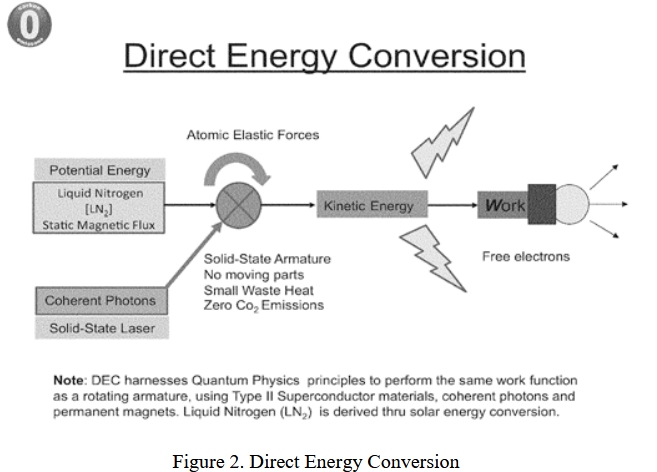
A: Figure 2 below provides an overview of how the DEC process works. The energy used to effect flux modulation is derived from the photon; this energy only starts the avalanche process. Liquid nitrogen supplies a cryogenic cold potential energy and heat generated during the process of producing electricity boils off the LN2. The static magnetic flux source is supplied by a permanent magnet known to be a potential energy source. The permanent magnet is also responsible for the production of the vortices in the superconductor’s cylinders. Superconductor vortices convert the potential energy of the permanent magnet into kinetic energy without any additional input energy. The potential energy of the permanent magnet is converted into kinetic energy when vortices form. By controlling which vortex cylinder is working one can control the path of the static flux and the flux coupled to coils in the magnetic circuit. Note here that only one magnetic path is in the superconducting state at any one time. The DEC concept converts known potential energy into electricity at super high efficiencies without waste products.
Figure 2. Direct Energy Conversion
Inventor: Eddie A. Sines
METHOD AND APPARATUS FOR DIRECT ENERGY CONVERSION
US9080557
A method and apparatus for direct energy conversion that combines the properties of Type II superconductor thin films, including the Meissner effect to create vortices to control and modulate static flux coupled in a magnetic circuit, where the laws of induction are used to produce an electrical signal without the use of moving armatures. The dynamics of magnetic flux modulation results from suppression of superconductivity and the Meissner effect by external photon irradiation. The apparatus employs a vortex channel based on the Meissner Effect, a laser, a permanent magnet, fiber optics for carrying the laser beam to the vortex channel, and a transformer composed of two separate windings. The transformer windings are arranged in a circuit having a first path through the permanent magnet and a first coil of the transformer windings; and a second path through the permanent magnet, the vortex channel, and the second coil of the transfer windings.
METHOD AND APPARATUS FOR DIRECT ENERGY CONVERSION
US8736085
A method and apparatus for direct energy conversion employs modulated sta tic magnetic flux emanating from the pole of a permanent magnet. Photon Coop er pair breaking is used to force a quantum state in Type II superconductor thin films by modulating a vortex channel made up of a bundle of vortex tube s isolated from each other for channeling static magnetic flux. Flux quanta are pinned inside the vortex channel by the magnetic interaction of the Meis sner effect, atomic elastic forces, and an effect of electrons moving on the surfaces of the vortex tubes, and a massive shift in the permeability at th e front of vortex channel. Static flux conducted through the vortex channel while in a superconducting state is modulated by forcing a quantum state of the Cooper pairs to toggle the vortex channel in and out of a superconductin g state, which modifies its permeability up to 1 x 10⁶ .mu..