
rexresearch.com
Construction details
See also : Air Wells, Dew Ponds and Fog Fences: Methods to Condense Atmospheric Humidity...
http://www.rexresearch.com/airwells/airwells.htm
http://www.rexresearch.com/airwells/klaphake,htm
http://www.rexresearch.com/airwell3/airwell3.htm
http://www.rexresearch.com/ellsworth/ellsworth.htm
&c...

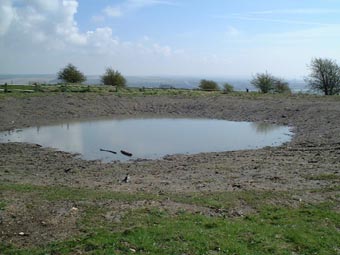


The water collectors known as "dew ponds" were invented in prehistoric times, but the technology is nearly forgotten today. A few functional dew ponds can still be found on the highest ridges of England's bleak Sussex Downs and on the Marlborough and Wiltshire Hills, and connected to castle walls. They always contain some water that apparently condenses from the air during the night. Gilbert White described a dew pond at Selbourne (south of London), only 3 feet deep and 30 feet in diameter, that contained some 15,000 gallons of water which supplied 300 sheep and cattle every day without fail.
Investigations by UNEP (1982) and by Pacey and Cullis (1986) determined that the ponds do not catch significant amounts of dew, but actually were filled mainly by rainfall. Pacey and Cullis may, however, have confused dew precipitation with rainfall --- two different processes. The ponds may also collect fog. (Ref 18)
Edward A. Martin proved that dew ponds are not filled by precipitated dew because the water usually is warmer than the air, so no dew could be deposited. He concluded that mist condenses on the water already in the pond, or else the grass collects dew which gravitates to the bottom and forms a pond. Both mechanisms probably are active.
The ancient question, "Does dew rises from the soil by evaporation or precipitates by condensation from the air?" first was posed by Aristotle. John Aitken proved in 1885 that dew rises or falls as conditions allow. He also determined the favorable conditions for the formation of dew: (1) a radiating surface, (2) still air, and (3) moist, warm earth. The ability of materials to capture dew depends on their specific heats. The best material is swan's down, followed by flax or cotton, silk, paper, straw, wool, earth, charcoal, silica sand, and powdered chalk.
Arthur J. Hubbard described a dew pond in his book Neolithic Dew-Ponds and Cattleways (1907):
"There is [in England] at least one wandering gang of men... who will construct for the modern farmer a pond which, in any suitable situation in a sufficiently dry soil, will always contains water. The water is not derived from springs or rainfall, and is speedily lost if even the smallest rivulet is allowed to flow into the pond.
"The gang of dew-pond makers commence operations by hollowing out the earth for a space far in excess of the apparent requirements of the proposed pond. They then thickly cover the whole of the hollow with a coating of dry straw. The straw in turn is covered by a layer of well-chosen, finely puddled clay, and the upper surface of the clay is then closely strewn with stones. Care has to be taken that the margin of the straw is effectively protected by clay. The pond will eventually become filled with water, the more rapidly the larger it is, even though no rain may fall. If such a structure is situated on the summit of a down, during the warmth of a summer day the earth will have stored a considerable amount of heat, while the pond, protected from this heat by the non-conductivity of the straw, is at the same time chilled by the process of evaporation from the puddled clay. The consequence is that during the night the warm air is condensed on the surface of the cold clay. As the condensation during the night is in excess of the evaporation during the day, the pond becomes, night by night, gradually filled. Theoretically, we may observe that during the day, the air being comparatively charged with moisture, evaporation is necessarily less than the precipitation during the night. In practice it is found that the pond will constantly yield a supply of the purest water.
"The dew pond will cease to attract the dew if the layer of straw should get wet, as it then becomes of the same temperature as the surrounding earth, and ceases to be a non-conductor of heat. This practically always occurs if a spring is allowed to flow into the pond, or if the layer of clay (technically called the 'crust') is pierced."
Additional construction details were explained in Scientific American (May 1934):
"An essential feature of the dew-pond is its impervious bottom, enabling it to retain all the water it gathers, except what is lost by evaporation, drunk by cattle, or withdrawn by man. The mode of construction varies in some details. The bottom commonly consists of a layer of puddled chalk or clay, over which is strewn a layer of rubble to prevent perforation by the hoofs of animals. A layer of straw is often added, above or below the chalk or clay. The ponds may measure from 30 to 70 feet across, and the depth does not exceed three or four feet.” (Figures 39 & 40)(Ref. 19)
Figure 39 ~ Dew Pond:

Edward A. Martin also described their construction in his book Dew Ponds (London, 1917). In particular, he notes that in order to ram the clay and puddle the surface, horses are driven round and through the pond for several hours. The base of the pond is planted with grass; without grass, the pond dries up. Trees and brush are planted around the pond to provide shade.Dew Pond (Oxteddle Bottom, Sussex):
( Photo: Chris Drury )

The simplest form of dew pond is used in Cornwall, where areas of about 40 square feet are prepared on mountain slopes by coating the ground with clay and surrounding it with a small wall. The clay is covered with a thick layer of straw that collects dew during the night. Straw is said to be more effective than grass for the purpose. Since the straw is moist both day and night, it rots quickly and must be replaced frequently.(Ref. 20)
In his book, The Naturalist on the Thames, published circa 1900, C. J. Cornish gave a description of British dew ponds, excerpted here:
“The dew ponds, so called because they are believed to be fed by dew and vapours, and not by rain, have kept their water, while the deeper ponds in the valleys have often failed. The shepherds on the downs are careful observers of these ponds, because if they run dry they have to take their sheep to a distance or draw water for them from very deep wells. They maintain that there are on the downs some dew ponds which have never been known to run dry. Others which do run dry do so because the bottom is injured by driving sheep into them and so perforating the bed when the water is shallow, and not from the failure of the invisible means of supply. There seem to be two sources whence these ponds draw water, the dew and the fogs...
“The fogs will draw up the hollows towards the ponds, and hang densely round them. Fog and dew may or may not come together; but generally there is a heavy dew deposit on the grass when a fog lies on the hills. After such fogs, though rain may not have fallen for a month, and there is no water channel or spring near the dew pond, the water in it rises prodigiously...
“The shepherds say that it is always well to have one or two trees hanging over the pond, for that these distil the water from the fog. This is certainly the case. The drops may be heard raining on to the surface in heavy mists.”
Cornish quoted Gilbert White’s Journal of May, 1775:“’[I]t appears that the small and even the considerable ponds in the vales are now dried up, but the small ponds on the very tops of the hills are but little affected’. Can this difference be accounted for by evaporation alone, which is certainly more prevalent in the bottoms? Or, rather, have not these elevated pools some unnoticed recruits, which in the night time counterbalance the waste of the day? " These unnoticed recruits, though it is now certain that they come in the form of those swimming vapours from which little moisture seems to fall, are enlisted by means still not certainly known. The common explanation was that the cool surface of the water condensed the dew, just as the surface of a glass of iced water condenses moisture. The ponds are always made artificially in the first instance, and puddled with clay and chalk.
“Mr. Clement Reid… notes his own experiences of the best sites for dew ponds. They should, he thinks, be sheltered on the south-west by an overhanging tree. In those he is acquainted with the tree is often only a stunted, ivy-covered thorn or oak, or a bush of holly, or else the southern bank is high enough to give shadow. ‘When one of these ponds is examined in the middle of a hot summer's day’, he adds, ‘it would appear that the few inches of water in it could only last a week. But in early morning, or towards evening, or whenever a sea-mist drifts in, there is a continuous drip from the smooth leaves of the overhanging tree. There appears also to be a considerable amount of condensation on the surface of the water itself, though the roads may be quite dry and dusty. In fact, whenever there is dew on the grass the pond is receiving moisture’.
“Though this is evidently the case, no one has explained how it comes about that the pond surface receives so very much more moisture than the grass. The heaviest dew or fog would not deposit an inch, or even two inches, of water over an area of grass equal to that of the pond. None of the current theories of dew deposits quite explain this very interesting question. Two lines of inquiry seem to be suggested, which might be pursued side by side. These are the quantities distilled or condensed on the ponds, and the means by which it is done; and secondly, the kind of tree which, in Gilbert White's phrase, forms the best "alembic" for distilling water from fog at all times of the year. It seems certain that the tree is an important piece of machinery in aid of such ponds, though many remain well supplied without one.”
An improved form of traditional dew pond was invneteded by A.J. Hubbard, et al., and granted British Patent # 13,039 (1 March 1905), "Improvements in Reservoirs for Collecting Dew". The complete specification is as follows:
"For the purpose of securing water supply in the absence of rainfall, springs, or streams, reservoirs adapted to collect dew have been constructed by excavating the ground over an area and to a depth sufficient to form a basin of adequate capacity and providing the same with a compound lining comprising a bed of straw as a non-conductor and a superimposed water-tight layer of clay.
"The action of such a reservoir depends on the fact that the non-conducting layer of straw prevents the tendency to the equalization of temperature of the clay layer and water to that of the earth. The water, cooled by radiation, consequently retains the coldness so caused, and the temperature of the air in contact with it is reduced below the dew point. Consequently the water vapour in the air condenses and collects in the reservoir. Such reservoirs as heretofore constructed, however, have been comparatively inefficient, and, unless on chalk, liable to destruction by moisture, worms, or other causes, disadvantages which it is an object of this invention to obviate, for which purpose, according thereto the basin is provided with a lining possessing both impermeable and non-conducting properties. In practice this can be advantageously effected by the use of a compound lining comprising two layers of impermeable material with interposed material that is non-conducting or is a bad conductor of heat. In order that the non-conducting property of the lining be not impaired it is necessary that the lining should be so formed that the non-conducting material cannot become wet. For this reason when absorbent non-conducting material is interposed between two layers of impermeable material, the two layers of impermeable material are continuously joined a the edges in a watertight manner. For the purpose of increasing the evaporation and consequently reducing the temperature of the surface upon which the water vapour is to be condensed, a water-retaining cover is preferably superimposed upon the upper layer of impermeable material. Where necessary owing to the character of the soil, a solid foundation is formed in the basin upon which the lower layer of impermeable material is laid.
"The drawing shows, diagrammatically, in vertical section, by way of example, a reservoir for dew according to this invention, in which a is a concrete foundation, b a layer of asphalt, c a layer of asbestos, d a second layer of asphalt having its edge joined to that of the lower layer b as at e so as to completely enclose the asbestos c, and thus prevent it becoming wet and its non-conducting property becoming impaired; f is a layer of bricks of a porous nature which are rapidly cooled to a low temperature owing to the evaporation of the water absorbed by them; g is a stone curb which serves to prevent the edges of the lining being damaged.
"In some cases the concrete foundation a may be dispensed with, as also the porous bricks f."

Another form of dew pond was invented by S.B. Russell in the 1920s. According to the description in Popular Science (September 1922), "A dew reservoir 30 feet square will collect 24,000 gallons of water in a year, or an average of 120 gallons daily during the hot summer months and 50 gallons daily for the remainder of the year...
"The Russell reservoir consists of a concrete cistern about 5 feet deep, with sloping concrete roof, above which is a protective fence of corrugated iron which aids in collecting and condensing vapor on the roof and prevents evaporation by the wind. The floor of the cistern is flush with the ground, while sloping banks of earth around the sides lead up to the roof.
"Moisture draining into the reservoir from the low side of the roof maintains the roof at a lower temperature than the atmosphere, thus assuring continuous condensation.
"At one side of the reservoir is a concrete basin set in the ground. By means of a ball valve, this basin is automatically kept full of water drawn from the reservoir." (Figure 41)(Ref 21)
Russell's Dew Pond:


http://www.countrylife.co.uk
02 June 2006
by
Sandy Mitchell
Already, the search for remedies to what it is feared will be the direst water shortages in southern England since the summer of 1976 (despite May being unusually wet) has led to discussion in the House of Commons of scenarios that sound like science fiction, including icebergs towed from the Arctic Ocean, and a giant desalination plant on the Essex coast.
Yet nothing could be simpler than a dew pond.
These small ponds can be found scattered across the downs, wherever sheep and cattle traditionally went for summer grazing, in Hampshire, Sussex, the Peak District and Yorkshire. Surviving ponds probably number at least 500 across the country, although they are often overgrown nowadays, their banks badly trampled by livestock, serving as little more than picturesque havens for butterflies or a romantic spot for picnicking ramblers.
But they still have a magical and highly significant property." People have noticed that they rarely run dry, even in the hottest summer, and it is apparent that, during the night, they receive a supply of water sufficient to counter-balance the great drags that are made upon them by cattle and evaporation," notes Edward Martin, in a research paper entitled Dew Ponds: History, Observation and Experiment.
The great mystery is where the water that fills them up at night can come from. These ponds -- also known as "mist ponds" or "fog ponds" lie on the downs far above the level at which streams begin to form, nor does any piped-water supply reach them. The name "dew pond" is the clue.
According to folklore, it is the overnight dew itself, falling on the round-backed downs and on the ponds themselves, that keeps them full, whatever the weather.
If that really is the case, then surely water companies and the government should be thinking not only of mega-projects such as a national water grid to bring down water from Scotland, but also of encouraging farmers in suitable areas to harvest the dew with new ponds.
Dew ponds could even be something that a house owner, with a big enough garden and on high enough land, might see as a fashionable eco-friendly accessory to match his heat-exchanging borehole or roof-top windmill. Far better, after all, than relying on standpipes.
To create a dew pond is relatively simple. According to Jackson House, a Somerset-based pond builder with 50 years' experience in the business, "the secret of making one is to insulate it so that the water remains colder than the earth beneath. That means that when the dew is falling, it hits the cold surface of the pond and drops its own moisture. In the old days, people used to put down layers of straw and layers of clay in the bottom, which worked the same as a thermos flask". He estimates the cost of digging a typical 10yd by 10yd dew pond, and of lining it with a tough waterproof layer laid over an insulating geo-textile blanket, would work out at no more than £12,000.
Of course, it was a more romantic and much tougher task back at the turn of the century when the last specialist gangs were creating them by hand in the age-old way, as this description in the Wiltshire Gazette of December 29, 1922, goes to show: "Up to ten years ago, the dew pond makers started upon their work in September, and they toured the country for a period of six or seven months, making in sequence from six to fifteen ponds in a season of winter and spring.
"The laying of the floor is then proceeded with from the centre, called the crown, four or five yards in circumference, and to this each day a width of about two yards is added.
"Only so much work is undertaken in one day as can be finished at night, and this must be covered over with straw. No layering may be done in frosty or inclement weather. And this is the method of construction: 70 cart loads of clay are scattered over the area. The clay is thoroughly puddled, trodden and beaten in flat with beaters, a coat of lime is spread, slaked, and rightly beaten until the surface is as smooth as a table, and it shines like glass."
Descriptions follow of yet more stages of laborious hammering of the ground, and wetting it, then coating it with further layers of lime, straw and earth. The cost of this Herculean labour was a meagre £40, the wages of three men included. There are ponds in good condition now which were made 36 years ago, and which have never been known to fail to yield an adequate supply of water even in this year of drought, concluded the Gazette's correspondent.
One man who is currently on a quest to resolve the abiding mystery of dew ponds is Martin Snow, an IT consultant based in Worthing. In his spare time, he marches around the hills from East Sussex to Beachy Head as part of a university study, and the very first task he set himself was to locate remaining dew ponds.
'It is becoming like a treasure hunt,' says an eager Mr Snow. 'Occasionally you get a hint of a pond, then go back to the maps, and find, on different editions, that they appear or disappear.' By his calculation, there are as many as 100 to 200 in West Sussex alone, some of which may have begun as watering holes dug by Neolithic man for his livestock.
He goes on to point out that dew ponds were strategically positioned to make the most of mist and of rainclouds billowing up from the nearby coast to the chilly heights of the downs, where any water that collects is less likely to evaporate. "Effectively you are often in the cloud up here, and, if it is chilled enough, it will condense. Some people say an overhanging tree will help a pond a lot and I can believe that because, if you go out walking when the mist on the downs is extremely thick, you will find trees dripping with moisture.";
So it seems that dew ponds are indeed fed by dew and are truly droughtproof. 'It seems magical, but when you start looking at the numbers, it starts to make sense. Dew ponds work,' he concludes.
Who can build me a dew pond?
House Bros & Bailey: Hillside Mill, Yeovil, Somerset (01935 433358; <a href="http://www.lakesandgolfcourses.com" target="_blank")
Land & Water: Albury, Surrey (01483 202733
www.land-water.co.uk
White Horse Contractors: Abingdon, Oxfordshire
(01865 736272
www.whitehorsecontractors.co.uk
Miles: Bury St Edmunds, Suffolk ( 01359 242 356 )
www.miles-water.com
BTCV Handbooks Online
handbooks.btcv.org.uk
Chapter 387
A look at ponds and waterways

New ponds
... that a thick layer of damp straw spread over the puddled clay would prevent its drying and cracking before the pond filled. It might also act as binding. The straw would rot eventually, but once the pond filled this would not matter. Some ponds have a bottom layer of chalk or lime, about 50mm (2") thick, which may serve to keep earth-worms from penetratinDesign</h3> Dew ponds occur mainly on porous soils where the rainfall is about 1m (40") per year, and the annual evaporation from a body of open water is in the range of 450mm (18"). The traditional dew pond design ensures an adequate water supply from rainwater alone, by maximising the pond's catchment area in relation to its evaporation area. The average dew pond is about 18m (20 yards) across its water surface with a further collection margin of at least 3.6m (4 yards).
A typical dew pond contains over 273,000 litres (60,000 gallons) of water, and even under conditions of drought, should last three months before going dry. However, if stock are watered at the pond, the rate of water loss will greatly increase. The dew pond has a built up rim, which acts as a water catchment area. The cross section shows how the evaporation area shrinks as the water level drops. The vertical scale is exaggerated in the diagram. The maximum depth can vary from 1.2-2.4m (4-8').
The various layers indicated are those of the 'average' dew pond, although Pugsley (1939), found that there were many variations. Straw is sometimes claimed to be a 'non-conducting' material critical to the pond's performance, but there is no consistency in its use and many successful ponds have no straw. It is likely, howeveg the puddled clay. Some have a thick top layer of rubble, broken chalk or stone which helps protect the impervious layer from animals' hooves. Some ponds are made of concrete, and one has a layer of gas tar, showing the influence of more modern technology on an ancient craft.

Siting
In times past, the siting as well as construction of dew ponds was something of a mystery, a closely kept secret among professional pond-makers, who combined water-dousing with pond-making. However, most so-called dew ponds are in fact aided by surface drainage, and locating the pond in a shallow depression will increase the catchment. Too much runoff is not desirable, as the pond will rapidly silt up. Ponds receiving runoff from cultivated land will silt up much more quickly than ponds in permanent pasture.
It may be possible to take advantage of runoff from minor roads and tracks, although this may also cause silting as well as problems from pollutants such as oil residues. Site dew ponds well away from trees, as their roots may damage the pond lining.
Wiltshire Council
http://www.wiltshire.gov.uk
Question Date :3rd January 2003
Question:
Are the dew ponds on the Wiltshire downs fed by dew and how old are they?
Answer:
Dew ponds are actually fed by rainwater and they are normally situated in a slight depression so that there is a reasonable sized catchment area for rain. The amount of dew falling in a year is around half an inch whereas the rainfall will be between 30 and 40 inches a year. The water retention properties of the dew ponds lay in their making and the appreciation of the margins of the pond as a catchment area. The bottom layer of the pond was puddled chalk or clay, which was normally covered by straw, laid as it would have been on a thatched roof. This was then covered by a mixture of loose materials such as chalk rubble, sand, flints or gravel.
Most existing dew ponds date from the 19th or early 20th centuries, although a few may be 18th century. The only apparent ancient one is Oxenmere on Milk Hill on the downs to the north of the Vale of Pewsey. A Saxon charter of 825 refers to this pond as marking the boundary of Alton Priors, which it still does. It is possible that a pond has been here since that date but only if it has been cleaned out and its lining renewed every 100 to 200 years for Ralph Whitlock estimated that the life of a dew pond is 100 to 150 years.
The ponds were about eight feet deep and would often be fenced, with a small gap that nothing bigger than a sheep could get through. This saved the bottom of the pond being damaged by cattle. Dew pond makers tended to tour the country between September and April making up to 15 ponds, depending on their size. It would take four men about four weeks to construct a fair sized pond. Well known dew pond makers at the end of the 19th century were Charles White, Joel Cruse, Jabez Earley and Daniel Pearce of Imber. The decline of sheep on Salisbury Plain and the downs lessened the need for these ponds and it is believed that the last one in Wiltshire was made by the Smith family of West Lavington in 1938.
http://www.jstor.org/stable/1777822
By
Edward A. Martin, F.G.S
Author of "Dew Ponds: History, Observation, and Experiment."
What is a Dew Pond ?
The subject of the dew pond is one of perennial interest, and questions as to how it works and where it is to be found, and what is its secret, are frequently asked.
The ponds to which the name has been applied are found as a rule on high chalk country, and hence they have been closely connected with the chalk downs which extend from Beachy Head to the west of Sussex.
People have noticed that they rarely run dry, even in the hottest summer, and it is apparent that they receive during the night a supply of water sufficient to counter-balance the great draughts that are made upon them by cattle and evaporation during the day.
It has been assumed, therefore, that the dew which falls so heavily on the grass of the downs during the hot summers and autumns also falls into the ponds, and thus makes up for any loss during the' day-time, whether by cattle or by evaporation.
That this is pure assumption has, I think, been satisfactorily shown, but the idea is a fascinating one, and the mysterious filling of the dew pond will no doubt for a long time still exercise the minds of the curious.
Owing to the bringing of water by pipes and bore-holes to many lonely downland farms, it is sad to notice that many of the ponds have been allowed for want of a little attention to leak their contents away.
When once they are made they require so little attention, and they seem to be so perennial, that successive farmers neglect them. The growth of water-weeds and rushes is rapid, and unless these are cleared away from time to time the ponds are bound to leak.
The roots of such vegetation find their way through the foundations and provide many channels for the water to pass through. They may, too, be repaired carelessly. One fine pond on the Sussex Downs that I knew was not only cleared of its weed, but all the valuable chalky puddle, which formed its waterproof bed, was cleared away also. The result has been that it will no longer hold water. Neglect and carelessness has been the ruin of most of the Sussex dew ponds, and really fine ones are now few and far between.
I have used and still use the term " dew pond " for these upland ponds, but it may be startling to some to be told that there is no such thing as a dew pond. You may ask a farmer where he gets his water from, and he will answer you from the dew. If you ask him what becomes of the rain, or the mists that roll over the downs, he will say, well, that is just the same as dew ; everything that comes out of the air is the same as dew. As a matter of fact, the name " dew pond " was not known much more than a century ago. They were known as " mist ponds." This name has been met with in Surrey, Kent, and Wiltshire, and at Worms Heath, and the name of "fog pond" or "cloud pond" was at one time well known at Hampstead.
Gilbert White noticed the phenomenon of high-lying ponds and wrote about them in 1776.
Miall wrote, " It is plain that the water in such ponds is not drawn from springs, nor from surface drainage, nor wholly from rain.
Being a native of the south-down country I have always been interested in these ponds, although for some years my interest did not extend beyond the newts and the pond-snails that they contained. But some time ago I was awarded a grant by the Royal Society to make actual observation and experiments into the working of dew ponds. I occupied a disused windmill on Clayton Down, so as to be on the spot day and night, and so catch the dew in the act, so to speak, if perchance it had anything to do with the filling of ponds. My experiments extended over a period of three years, during which I observed the habits of a good many ponds in the central area of the South Downs between the coast and the Weald.
Dew in the strict meaning of the word can never feed a pond. It is formed from the moisture in the air being in contact with the cooled earth when this has radiated its heat after nightfall. Formation of dew on grass is, of course, a very common phenomenon. But in three months' observations on a pond there were but five occasions when the water was found to be below dew-point. Four of these were between 7 a.m. and 8 a.m., and the rising heat of the sun would have soon done away with this state of affairs. But even where most likely to be formed, it has been estimated that the annual dew-fall does not exceed 1.5 inches.
Night after night I have watched for the semblance of dew being formed on the banks of a pond, but without success. The grass on the down may be wringing wet with dew, but it was impossible for this to trickle down into the pond. A few grasses with shallow roots growing in a pond might cause the formation of some dew, but in the best -kept dew ponds the grasses are not allowed to grow. Only on one occasion out of many hundreds of observations did there appear in one pond to be a slight increase of water during a clear night when no rain fell. I was forced to conclude that the name "dew pond" was a misnomer, and nothing has appeared since the period of my observations to shake the stability of my conclusions.
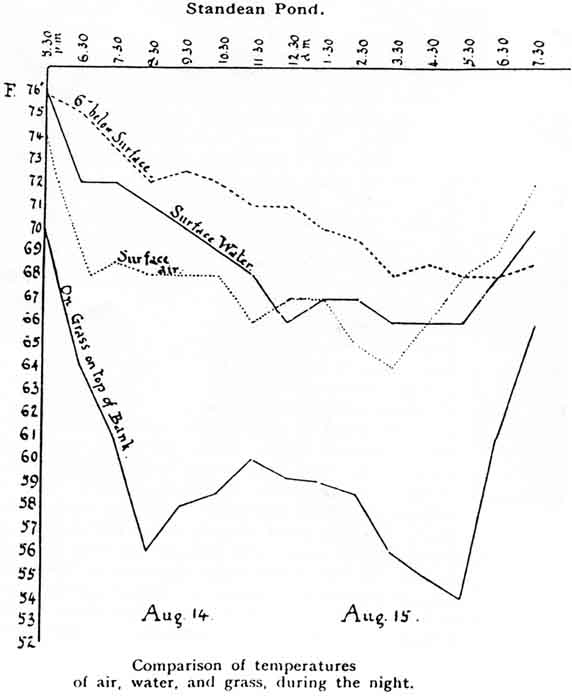
All my observations, went to show, as was to be expected, that the temperature of water of a pond rarely went down below dew-point during the night. In hot summer weather, when with the accumulation of heat the temperature of the water gradually rose in the day-time, there was insufficient time during the short summer nights for radiation to proceed to such a degree that its temperature went down below dew-point. The specific heat of water is, of course, very great, and its changes of temperature are very gradual, whereas changes on the grass, on the dry bank of a pond, and in the atmosphere, are more rapid.
These changes are shown in the diagram, from which it will be seen that in a short summer night the temperature on the grass went down to 54° F., whilst that of the water, although sympathetically following the former, went down only to 66° F. If dew can ever be deposited on the water a much longer period of radiation is necessary than can as a rule be found in a summer night. Of course the water appears to be cool to the hand, but that is only because the hand is of a much greater temperature.
The construction of the bottom of a pond must be such as to ensure that it be watertight. In Sussex, finely-powdered chalk is almost invariably used, and this is worked into a puddle, giving a whitey colour to the water when disturbed by cattle. Clay is used in some parts, and this is of course more easily worked into a puddled condition. In western Sussex clay is found here and there in pockets on the Downs, and where this is the case it is brought into requisition. But if it has to be brought up from the gault clay below the hills, the cost of making a pond is considerably augmented, and chalk puddle is used. In the remaking of the Chanctonbury ponds a few years ago sufficient clay was found near at hand for the purpose. The whole secret of getting the bottom to be waterproof lies in the finely-divided condition to which the chalk or clay is reduced. This is frequently done by driving a team of horses and a broad-wheeled cart round and round the pond for an hour or more each day, so as to reduce to powder any lumps that remain. An old labourer told me that when he was a boy he was employed for this purpose. After the broad-wheeled cart had done its work, the puddle was flattened out with a spade, until it was quite smooth. The margin as treated in the same way, and thus nearly all the rain that fell ran down into the pond. When the bottom is made of clay it is the practice to mix the puddle with a certain amount of lime, and this prevents the working of worms. These creatures can be very destructive to the waterproof bottom of a pond.
Although straw is never used, so far as could be ascertained, in making ponds in Sussex, it is used considerably in Wiltshire and Yorkshire. But there is a considerable division of opinion as to why it is used. One on Thorpe Downs, near Lough-borough, was stated by Mr. Slade to be laid down as follows: First, about 12 inches of clay, mixed with some lime, then a layer of straw, to prevent the sun cracking the clay, and then a layer of loose rubble.
During 400 years it only leaked in one year, and this was caused by the roots of rushes which penetrated the clay. In Yorkshire, Mr. Mortimer said that there were very many ponds in the Midwolds. In constructing them, straw is placed on the impervious bed of beaten clay, to prevent the broken chalk, which is strewed on the clay, from being trodden into the clay. On the Wiltshire Downs, straw is cut into short lengths and mixed with the clay to prevent it cracking and letting the water through. But some of the ponds there are of more complicated construction, consisting of three layers of clay alternating with three layers of straw. The straw would prevent a good deal of slipping and cracking of the clay, but it would, of course, be thoroughly compressed by the weight of the clay, and would also be in so thoroughly a water-logged condition that it would be useless as an encouragement to precipitation, and its non-conducting power would be lost.
Diagrammatically, the basis of some of the ponds that have come under notice are shown here, and it will be seen that there is considerable variety in
construction.
Gilbert White noticed the contrast between those ponds which were situated at an elevation above the surrounding country and those which were situated at the lower levels. Many of the latter are, of course, fed by brooks, and when these dry up in the course of a hot summer the ponds also suffer. No one questions the source of their water. It is quite apparent. But it only occurs to an observant mind to ask the question why water is still found in the higher ponds when the lower ones are dried up. If the rainfall were spread equally over all months of the year then ponds would never run dry. But it is not so, and those months which are most liable to drought are just those months when the higher ponds furnish a supply of water in spite of the drought below. Further, there is evaporation from the surface of a pond to consider. This is very considerable, and it is, of course, only the difference between the two that will be of service in feeding a pond. During four years (1909 to 1912 inclusive) I found the average rainfall to be 43-61 inches on Clayton Down, considerably more than had been anticipated. The most reliable experiments of evaporation that I have been able to find, extending over thirty years, gave, at Croydon, an average of 18-14 inches. The difference between the two, namely, 25-47 inches, would be the amount of rain that would go to feed the pond, supposing that the surface-area of the pond was the only collecting ground. But the area of the banks around the pond form a collecting area at least as much again as the pond-surface, and sometimes twice or more than that area, so that the total of rain feeding the pond must be multiplied accordingly. But it must also be remembered that a good deal of rain falling on the bank percolates into the soil. Some banks are of loose material and others are found to have been rammed hard. With the best of ponds perhaps not ,more than a half of the rainfall flows down into the pond.
Thus we have a total as follows, when the banks are twice the area of the pond.
On the pond surface 25-47 inches, on the banks half of twice 43-61 inches, or a total of 69-08 inches. A wide bank twice the area of the pond is quite a common occurrence. Unfortunately there is least rainfall in the months when there is the greatest evaporation. Nine-tenths of the total evaporation occurs in the six summer months, and only about a third of the rainfall, so that in order to account for the filling of the ponds we must look to some other recruit. This is to be found in mists and fogs.
No one can be on the watch on the Downs for many weeks together without being struck by the frequency and density of the mists. Rolling up from the coast they fill up all hollows, before apparently jumping off at the escarpment facing the Weald. Sometimes when they disappear masses are still seen filling up the hollows of the ponds. During my experiments I distinctly found occasions when there was a slight rise in the surface of a pond, when rain was but a slight factor. These were always cloudy or foggy nights or days, or so windy that the deposition of dew was out of the question. One has but to walk on the downs in a thick mist to experience the quantity of water that they give out. Not only is the grass wetter than even after the heaviest dew, but one's clothing becomes reeking with moisture. Bushes can be heard dripping their loads on to the grass or fallen leaves beneath. If such bushes are' on the edge of a pond their moisture will in part trickle down into it. It has, therefore, been advocated that if possible trees or bushes should be planted at the edge of, or overhanging, the pond. Such would undoubtedly add to the water in it, but this would not be dew. And the difficulty would remain of getting trees or bushes to grow in such exposed positions. But it must be confessed that all the best ponds have no trees or bushes on or near them. By a gradual process of elimination I was forced to the conclusion that there was no source of moisture but mist or low clouds to account for the fact that well-made ponds do not dry up in the summer.
Real dew, that is, dew formed out of the low-lying layer resting immediately upon the soil, is almost pure water. It occurred to me to ascertain how the water from ponds compared with pure water. To do so I obtained specimens of water from eighteen ponds, and these were analysed. The quantity of chlorine found in them was noticeable, and this was probably brought in by winds from the sea, or by mists blown in from the same source. One specimen was obtained soon after a pond had dried up, -but had been partly filled again by rain. It contained the lowest proportion of chlorine of the whole series. But the mists that blew in from the sea were probably condensed around finely-divided salt nuclei, and when these fell into pond-areas they would gradually increase the salinity of the water, owing to the process of evaporation which is always going on. Thus those ponds that had been in existence for the longest time would have the most chlorine, and this was fully borne out by the analyses of three pond-waters which have never been known to fail. As a contrast, the water of a pond was analysed into which there fell a good deal of animal pollution. It was a clay-puddled pond. The amount of chlorine therein found was com-parable to that contained in sewage, and this was but to be expected. The total hardness of all chalk -puddled ponds was naturally great. When soils from the Downs have been analysed these have always been found to contain chloride of sodium, and this is gradually washed downwards into the sub-soil. But in carefully-prepared ponds this remains, and accumulates, and hence their increasing salinity as time goes on. As the salt-laden mists roll up from the sea their particles are, as I hold, deposited by gravity wherever arrested by a depression. As the clouds which give rise to rain are formed in the same manner, these must contain a good deal of salt also, and when it rains this will also fall. But in the summer months it is the deficiency of rain that has given rise to the phenomena ofdew-ponds ; hence I think we must look entirely to mists for the explanation of a constant supply of water when there is a deficiency of rain. Most authorities have observed that when a pond is first dug out it is advisable to give it some artificial assistance, and this is done by pouring water over the puddle or by heaping snow around it when that is possible. A water surface thus appears to favour the further deposition of water out of the mists. My own observations did not go to show that after misty nights there occurred any of those great rises in the surfaces of ponds which have been from time to time recorded, and I am of opinion that these increases have been exaggerated, but herein lies ground for further experimental work.
Details of experiments which I carried out on the South Downs, together with thermometric tables of many observations which I made, will be found in "The Geographical journal," for August, 1909, and October, 1910, and can there be referred to, if desired.
As regards the age of the ponds. As the earliest men in our country probably dwelt on the Downs they must have in some way provided themselves with a water supply. They must have made ponds for this purpose, having noticed that when chalk had been well-trampled out by cattle it became watertight. Such ponds may thus have been made by Early Man, but it requires a keen imagination to say that the existing ponds date from the time of neolithic man. As man took to the lower lying country he probably neglected his upland ponds. Many new ones may have been brought into use when the downs once more came to be used as sheep-walks, during the wool-growing times of the mediaeval sheep-masters, and it is possible that some of the present-day ponds date from the times of the immigrant Fleming. This, however, is purely conjectural.
Originally published as No 64 in the School Nature Study Union series. Copyright © 2002
<martin(at)dewponds.info>Martin Snow and contributors as noted. All rights reserved.
http://www.wiltshire.gov.uk/community/getprinted.php?id=156
Wiltshire Community History
Title :
Author :
WAM Vol. 42, pages 73-5
Full Text : A valuable article by the Rev. Edgar Glanfield, Vicar of Imber, appeared in the Wiltshire Gazette, Dec. 29th, 1922, in which he sets down information as to the method of making these ponds, gained directly from living parishioners of Imber, who in past years carried on a regular and hereditary business of dew pond making -Charles Wise, aged 81, Joel Cruse, aged 79, both master dew pond makers, and Jabez Earley and Daniel Pearce, both nearly 80 years old, their assistants. A great deal has been written on the subject of the way in which dew ponds gain their water supply, but it is generally believed now that they are chiefly dependent on rain. Mr Glanfield however, is concerned only with their formation.
“Up to ten years ago the dew pond makers started upon their work about the 12th of September, and they toured the country for a period of six or seven months, making in sequence from six to fifteen ponds, according to size and conveniences, in a season of winter and spring..... They travelled throughout Wiltshire and Hampshire, and occasionally into Somersetshire arid Berkshire, and even into Kent.” The dew pond maker with three assistants at 18s. a week, would require about four weeks to make a pond 22 yards, or one chain, square. Providing all his own tools and appliances he would charge about £40 for the work. “ The work commenced by the removal of the soil to the depth of eight feet. The laying of the floor is then proceeded with from the centre, called the crown, four or five yards in circumference, and to this each day a width of about two yards is added, and continued, course by course until the sides of the basin attain to the normal level of the site. Only so much work with the layers of materials set in order, is undertaken in one day as can be finished at night, and this must be covered over with straw and steined. No layering may be done in frosty or inclement weather. And this is the method of construction:- seventy cart loads of clay are scattered over the area, suggested above. The clay is thoroughly puddled, trodden and beaten in flat with beaters, a coat of lime is spread, slaked, and rightly beaten until the surface is as smooth as a table, and it shines like glass. After it has been hammered in twice, a second coat of lime is applied, to the thickness of half-an-inch, which is wetted and faced to save the under face. A waggon load of straw is arranged and the final surface is covered with rough earth to the thickness of nine inches. The pond when finished affords a depth of water of seven feet." It is then fenced round to keep off cattle and horses, whose hoofs, would break through the bed, and admit sheep only, for whose use the ponds are made. The durability of the dew pond is put at “perhaps 20 years, though “there are ponds in good condition now which were made 36 years ago, and which have never been known to fail to yield an adequate supply of water even in this year of drought (1921). The decay of the industry is attributed partly to the greatly increased cost of the making of the ponds, and partly to the fact that they have been superseded by the windmill pumping water from wells.
Mr. Edward Coward, of Devizes, had an excellent letter in the Spectator, January 14th, 1922, p. 47, on the method of making Dew Ponds in Wiltshire. He says “the site is first excavated, and the soil taken out thrown up as a bank so as to lengthen the shore of the pond. A start is made from the centre. A layer of clay about three inches thick when loose, is strenuously and methodically rammed. Then lime is spread, and it is rammed again. Two more layers of clay and lime are treated in the same way. The work is built up from the centre, not sectionally up the sides. Each day's work is carefully covered with straw; this, for the moment, is to prevent the puddle from drying and cracking. When the whole area is treated it is covered with a layer of straw more than a foot thick. This in turn is covered with nine inches of chalk rubble. The object of the straw is to protect the puddle from indentations which might be made by the rubble until it is properly set. A pond made in this way, thirty feet square at the edge of the puddle area, took seventy small cartloads of clay and about twelve tons of lime. I have heard, of course, of the straw being put under the clay, and am aware of the insulating theory involved. I cannot conceive, however, how a puddle could be made good on the top of a springy substance like straw. Firm ground to ram upon is the very essence of this method of construction.” He regards rain as the most important factor in the filling of the ponds. “In my opinion the whole surface of the hollow in a pond which is used daily by sheep becomes puddled by the action of their hoofs, and with the exception of the first rainfall after a drought, practically the whole of the rain which falls finds its way to the water.
Abbreviations used: WAM Wiltshire Archaeological & Natural History Magazine
http://www.buildagardenpond.com/build/gardenponddesigns.html
Clay puddling, I am glad to report, is an art in pond construction that went out with handlebar mustaches and high-wheeled bicycles. It never was much of an art, in my opinion, but I don't think any discussion of pond building would be complete without some mention of it, for it was one of the pioneer techniques of water gardening.
Puddling with Clay
The builder of a clay-puddled pond first made a concave excavation, sloping the sides carefully at an angle of not more than 40 to 45 degrees. He then lined the concavity with a 6- to 8-inch layer of the coarsest straw he could find. On top of the straw he put a 6-inch layer of clay, which he moistened and tamped down into the straw as tightly as possible.
All the clay-puddled ponds I have seen required a constant trickle of water into them to make up for that lost by seepage. Spring or stream water, always 15 to 20 degrees colder than still water warmed by the sun, maintained a pond temperature too cold for good (frequently too cold for any) water-lily growth. A trickle piped into the pond from a household water system would be even colder, and expensive to boot.
The clay linings of these ponds attracted crawfish as spilled molasses attracts flies. After a couple of them had burrowed through the pond's lining, many a pond enthusiast in the old days discovered that overnight his beautiful water garden had become just a mud hole, so to remain until he patched the holes and refilled the pond.
Clay-puddled ponds are now blessedly of the past, and good riddance. Any structure that will enable a couple of crawfish to ruin a man's whole summer just isn't practical enough to bother building.
DEW PONDS
Natural dew ponds, also known as cloud ponds and mist ponds, are near-miraculous works of nature. They just happen, sometimes, in shady places that remain constantly damp, even in hot, dry weather. The mystery of them is their principal fascination. They have no apparent source of water, and yet they thrive, their cold, clear waters never seeming to diminish.
A few English water gardeners with plenty of time and even more patience have been able to construct them and make them work. An artificial dew pond is built, much as a puddled-clay pond, although on a much smaller scale. The layer of straw that goes into the excavation is much thicker, perhaps a foot or more of it. The clay lining is tamped in upon the straw in the conventional way.
Nature does the rest, sometimes with a little help in the beginning. In time, the pond fills with rain water. The nest of straw serves as insulation, so that the clay shell and the water in it remain somewhat cooler at all times than the surrounding air. Dew condenses nightly on the cool clay banks, runs down into the little pond, and replaces moisture lost by seepage and evaporation.
An amateur should not attempt to build a dew pond, because few of them work out. As only the very hardiest of aquatic growths can be coaxed to live in one, even if it does turn out satisfactorily, the water gardener receives little reward for his labors.
Dewponds - Gazetteer - Brighton Area
Brighton and Hove City Council own most if not all the farmland withinand adjacent to their borders.
Much is on lease to tenant farmers, who have to pay a rent to the finance department, it might be thought that this arrangement could be at variance to any desire for conservation that the ratepayers may have.
All the council owned farmland is administered by the Estates Section of the Performance and Resources Department of the City Council. I was pleased to note that there is a Countryside Service, which has been involved in a number of restorations of Dewponds, which lie on land owned by the city, though not necessarily within it's administrative borders. They are also responsible, among other duties, for the ongoing management of the ponds for wildlife and amenity.
I am pleased to feature this contribution from one of their rangers :-
From David Larkin (Countryside Ranger)
Having worked on the restoration of several dew ponds for Brighton & Hove Council.
The modern method is:
Re-profile the site (silt builds up in the centre more than the edges) Remove large flints (to prevent liner being damaged )
Spread Teram over the area ( a tough protective "cloth")
Spread liner, we were using butyl but are now using heavy gauge, virtually tear proof 0.5mm PVC (which can be welded into 20x40m strips in the factory) as it is a lot cheaper
Spread another layer of Terram
Spread a layer of clay about 1ft thick
A liner is necessary in most ponds now as we no longer have the patter of sheep's feet to re-puddle the clay as the pond refills over the winter.
Straw was used to protect the liner and should not rot too quickly in anaerobic conditions but Terram is stronger and should not rot at all. The clay can be quite a problem, quarry bottoms are cheapest, but the wrong sort of clay slumps and exposes the liner.
Unfortunately this method is not very successful where there are cows present as they puncture the liner.
I have seen an example of a stone pitched pond in the Chilterns (I think) but would be interested in any ideas on how to construct a cow proof dew pond.
Excavation
Prior to restoration I have had some trial excavations done, there was no evidence of any clay in the pond Bevendean. I assume this was puddled chalk of which there are references in the literature (the base for new coast road at Black Rock was created by spraying and rolling the chalk).
The pond on Hollingbury Hill shown on the 1970 map was originally built of local clay, then concreted over, before being backfilled with the remains of an adjacent barn to make a green for the golf course in the 1930's. This subsequently went out of use and the whole area was densely scrubbed over prior to restoration.
Hopefully the drawings from this excavation will get published eventually.
Puddling
I seem to recall Oxen were used for puddling, pulling a wide wheeled cart full of stones around, this would have been during relatively dry weather, possibly laying a layer, wetting it, puddling it, then laying another layer, etc, I think this is how the chalk ponds were done. Quite different from having them in the pond all year.
I remember reading of experiments with mica at the turn of the century into the heat effects around dew ponds, I think they were inconclusive as vandals ended the experiment prematurely,
From memory Brighton Council/Brighton & Hove Council have restored the following dew ponds
Ditchling Beacon (following clearance of munitions by army)
Lotts Pond, Stanmer Woods (concrete, 1980's MSC team)
Housdean Farm
Bevendean Down
Varncoombe Hill, Waterhall Farm
Sweet Hill, Waterhall Farm
Piddingworth, Stanmer Park
Rock Pond, Standean Farm
Tanners Pond, Standean Farm
Falmer Hill, Falmer Court Farm (Removal of silt)
and created dew ponds at Waterhall East Brighton Golf Course
http://www.jstor.org/stable/659048
PDF, 7 MB
