Gustave Le Bon
The Evolution of Matter
Translated by F. Legge
The Walter Scott
Publishing Co., Ltd. (London)
Ch.
Scribner’s Sons (New York)
1909
Contents
Book
I
The New Ideas On Matter
Chapter I ~The Theory of Intra-Atomic Energy and the Passing-Away of Matter
(1) The New Ideas on the Dissociation of Matter --- Matter not indestructible --- Radioactivity universal property of matter --- Intra-atomic energy --- General Propositions ~ (2) Matter and Force --- Matter as a variety of energy --- All phenomena transformation of equilibrium --- Energy consequence of condensation of nebula ~ (3) Consequences of the vanishing of matter --- Nothing created, everything perishes --- Destruction of matter very slow --- Indestructibility of mass must go --- Possibly conservation of energy also --- Atoms planetary systems.
Chapter II ~ History of the Discovery of the Dissociation of Matter, and of Intra-Atomic Energy
Author’s discovery of Black Light --- Of radioactivity of all bodies --- M. Becquerel on the reflection, etc., of uranium rays --- Acceptance of the author’s theory by M.de Heen --- Unpopularity at outset --- Testimony of M. Dastre --- Of M. Poincare --- Of English writers --- M. de Heen’s comparison of the discovery of Black Light with that of x-rays --- M. Bohn’s appreciation.
Book
II
Intra-Atomic Energy And The Forces Derived
Therefrom
Chapter I ~ Intra-Atomic Energy: Its Magnitude
(1) The existence of intra-atomic energy --- Emission of particles with enormous speed by matter when dissociating --- Energy developed equal to that of 1,340,000 barrels of gunpowder --- This energy within not without the atom --- Its origin ~ (2) Estimate of quantity of energy in matter --- That contained in the smallest coin sufficient to send train more than four times around the Earth --- Other measurements by Rutherford, Abraham, and Thomson ~ (3) Forms of energy condensed in matter --- Kinetic energy in pinhead = 208,873,000,000 kilogram-meters ~ (4) Utilization of intra-atomic energy --- Useless at present because dissociation of matter cannot be hastened --- This difficulty overcome, power will be free to all.
Chapter II ~ Transformation of Matter Into Energy
Old idea that matter had nothing in common with energy --- Difficulty of upsetting this notion --- Lord Kelvin’s first view --- New ideas only make their way gradually --- Influence of prestige on scientific belief.
Chapter III ~ Forces Derived From Intra-Atomic Energy --- Molecular Forces, Electricity, Solar Heat, Etc.
(1) Origin of Molecular Forces --- Cohesion, chemical affinity, etc., only explicable as intra-atomic energy ~ (2) Origin of Electricity --- Constantly increasing importance of electricity --- Electricity form of infra-atomic energy set free by dissociation of matter ~ (3) Origin of Solar Heat --- Stars not necessarily cooling --- Heat lost by radiation may be compensated for by energy liberated in dissociation
Chapter IV ~ Objections To The Doctrine Of Intra-Atomic Energy
M. Poincare’s M. Painleve’s, and M. Naquet’s objection that no endothermic combination stable --- Answer: matter not stable since easily dissociated --- M. Gauthier’s confirmation of this --- M. Despaux’s objection: quantity of matter and energy in the world invariable --- Answer: facts about radium disprove this --- M. Duclaud and M. Laisant’s criticisms --- Prof. Re’s, Somerhausen’s, and Pio’s opinions --- Consequences of sudden dissociation of gram of radium --- Ann. Scientifique’s and M. Sagaret’s remarks.
Book
III
The World Of The Imponderable
Chapter I ~ Classic Separation Between Ponderable and Imponderable --- Is There An Intermediate World?
Lavoisier’s Definitions and Berthelot’s Approval --- Larmor’s reconciliation of ether and nature --- Particles emitted during dissociation of matter the link with ether.
Chapter II ~ Immaterial Basis of Universe: The Ether
Importance of Ether in Physics --- Difficulty of defining its properties --- Not a gas --- Other opinions --- Imponderable but condensable --- Larmor’s opinion that material molecule only ether.
Chapter III ~ Different Equilibria In The Ether
All ethereal equilibria very unstable --- Vortex ring theory --- Explains gravitation --- M. Gautier’s opinions on this --- M. Benard’s experiments --- Matter a particular state of ethereal equilibrium.
Book
IV
The Dematerialization of Matter
Chapter I ~ Interpretation of Dissociation Experiments
(1) The First Interpretations --- Crookes’ ultra-gaseous state --- Kinetic theory of gases described --- Cathode rays really identical with particles of dissociating matter ~ (2) Interpretations now current --- Discovery of x and uranium rays make old explanations untenable --- Ionization merely dissociation --- Contrasts between ordinary and ionic electricity --- Dissociation products identical for all substances.
Chapter II ~ Products of Dematerialization of Matter
(1) Classification of Above Products --- Classification necessary --- Can be divided into 6 classes ~ (2) Characteristics of Dissociation Elements: viz., emanation, positive and negative ions, electrons, cathode rays, and x-rays
Chapter III ~ Dematerialization of Specially Radioactive Substances
(1) Products of dematerialization of such substances ~ (2) Alpha rays or positive ions ~ (3) Beta rays or negative electrons ~ (4) gamma or x-rays ~ (5) Semi-material Emanations of Radioactive Substances ~ (6) Induced radioactivity. All these stages in return of matter towards ether.
Chapter IV ~ Dematerialization of Ordinary Bodies
(1) Causes of dematerialization – How dissociation proved ~ (2) Dissociation by light ~ (3) By Chemical reactions ~ (4) By electric action ~ (5) By combustion ~ (6) By heat ~ (7) Spontaneous dissociation ~ (8) Part played by dissociation in natural phenomena.
Chapter V ~ Artificial Equilibria Of Elements Produced By Dissociation
Possibility of photographing momentary equilibria --- Attractions and repulsions of dissociated particles --- Globular electricity --- The ionic fluid and its geometrical forms
Chapter VI ~ How Matter Can Dissociate
(1) Causes of modification of molecular and atomic structures --- Equilibria disturbed by slight but appropriate action – Acoustic analogy ~ (2) Mechanism of dissociation ~ (3) Causes of dissociation of very radioactive substances ~ (4) Does radium exist?
Book
V
The Intermediate World Between Matter And
Ether
Chapter I ~ Properties Of Substances Intermediate Between Matter And Ether
Only irreducible characteristic of matter mass --- Variation of mass in case of electric fluid --- Kaufmann and Abraham’s researched on this --- Particles real link between ponderable and imponderable.
Chapter II ~ Electricity A Semi-Material Substance
(1) Radioactive and Electrical Phenomena ~ (2) Elements emitted by Electric machine compared with emission of radioactive bodies --- Aggregates identical with alpha, beta, gamma rays --- Aggregates also give ultraviolet light --- Experiments with Dr Oudin.
Chapter III ~ Properties of Electric and Material Fluids Compared
Superior mobility of electric fluid --- Cornu’s analogies --- Neutral; electric fluid not observable --- Susceptibility to gravitation real distinction.
Chapter IV ~ Movements of Electric Particles
Example of electrified sphere at rest: no magnetic force --- In motion, magnetic force appears --- Acceleration of motion produces vibrations of ether ---Rowland’s and Zeeman’s experiments --- Electronic theory
Book
VI
The World of Ponderability: Birth, Evolution,
and End of Matter
Chapter I ~ Constitution of Matter and Forces Which Maintain Material Edifices
(1) Former ideas on structure of atoms ~ (2) Current ideas on constitution of matter ~ (3) Magnitude of elements of matter ~ (4) Forces which maintain molecular structures ~ (5) Attractions, repulsions and equilibria of isolated molecules – Osmotic phenomena and Leduc’s experiments.
Chapter II ~ Variations of Material Equilibria With Change of Environment
(1) Mobility and sensibility of matter ~ (2) Variation of equilibria with change of medium --- Matter in incessant motion.
Chapter III ~ Various Aspects of matter
(1) Gaseous, liquid and solid states ~ (2) Crystalline state of matter and life of crystals --- Von Schron’s experiments --- Double generation of crystals.
Chapter IV ~ Unity of Composition of Simple Bodies
(1) Are all simple bodies formed from one element? ~ (2) Are simple bodies of unvarying fixity? --- Berthelot’s experiments --- Chemical species variable
Chapter V ~ Variability of Chemical Species
(1) Variability of simple bodies --- Author’s experiments on variation of elements by actions by presence --- Transmutation of elements ~ (2) Variability of compounds --- Action of caffeine and theobromine combined --- Modification of atomic equilibria possible.
Chapter VI ~ Chemical Equilibria of Material Substances
(1) Chemical equilibria of minerals ~ (2) Of organic substances --- Living being an aggregate of cells
Chapter VII ~ Intra-Atomic Chemistry and the Unknown Equilibria of Matter
(1) Intra-atomic chemistry ~ (2) Colloid metals ~ (3) Diastases, enzymes, toxins, and action by presence --- Catalyst liberators of energy ~ (4) Oscillating chemical equilibria.
Chapter VIII ~ Birth, Evolution and End of Matter
(1) Genesis and evolution of atoms --- Nebulae and the spectroscope --- Atom follows law of birth, growth, and death ~ (2) End of matter --- Electricity one its last stages, ethereal vibrations last of all ~ (3) Conclusions, recapitulation, and functions of hypothesis.
Second
Part
Experimental Researches
Preliminary Notes
Chapter I ~ General Methods of Verifying
Dissociation
Chapter II ~ Methods of Verifying
Dissociation by Light
Chapter III ~ Dissociation by Various
Parts of Spectrum
Chapter IV ~ Possibility of Rendering
Ordinary Matter Radioactive
Chapter V ~ Negative Leak Caused by Light
Chapter VI ~ Dissociation by Combustion
Chapter
VII ~ Dissociation by Chemical Reactions
Chapter
VIII ~ Dissociation of Very Radioactive Bodies [ Missing
Pages 381 +>]
Chapter
IX ~ Ionization of Gases
Chapter X
~ Emanation of All Substances
Chapter
XI ~ Absence of Radioactivity in Finely-Divided Bodies
Chapter
XII ~ Variability of Chemical Species
Chapter
XIII ~ Passage Through Matter of Dissociated Particles
Chapter
XIV ~ Historical Documents
Papers by the Author Published in the Revue
Scientifique
Index of
Authors [Not included here]
Index of
Subjects [Not included here]
List of
Illustrations [Not included here]
Translator’s Preface
[Not included here]
This work is devoted to the study of the Evolution of Matter --- that is to say, of the fundamental components of things, of the substratum of the worlds and of the beings which exist on their surface.
It represents the synthesis of the experimental researches which I have during the last 8 years published in numerous memoirs. In their result they have shown the insufficiency of certain fundamental scientific principles on which rests the edifice of our physical and chemical knowledge.
According to a doctrine which seemed settled forever, and the building up of which has required a century of persistent labor, while all things in the universe are condemned to perish, two elements alone, Matter and Force, escape this fatal flaw. They undergo transformations without ceasing, but remain indestructible and consequently immortal.
The facts brought to light by my researches, as well as by those to which they have led, show that, contrary to this belief, matter is not eternal, and can vanish without return. They likewise prove that the atom is the reservoir of a force hitherto unrecognized, although it exceeds by its immensity those forces with which we are acquainted, and that it may perhaps be the origin of most others, notably of electricity and solar heat. Lastly, they reveal that, between the world of the ponderable and that of the imponderable, till now considered widely separate, there exists an intermediate world.
For several years I was alone in upholding these ideas. Finally, however, their validity has been admitted, after numbers of physicists have determined in various ways the facts I have pointed out, principally those which demonstrate the universality of the dissociation of matter. It was above all the discovery of radium, long after my first researches, that fixed attention on these questions.
Let not the reader be alarmed at the boldness of some of the views which will be set forth herein. They are throughout supported by experimental facts. It is with these for guides that I have endeavored to penetrate unknown regions, where I had to find my way in thick darkness. This darkness does not clear away in a day, and for that reason he who tries to mark out a new road at the cost of strenuous efforts is rarely called to look at the horizon to which it may lead.
It is not without prolonged labor and heavy expense that the facts detailed in this volume have been established (1). If I have not yet obtained the suffrages of all the learned, and if I have incensed many among them by pointing out the fragility of dogmas which once possessed the authority of revealed truths, at least I have met with some valiant champions amongst eminent physicists, and my researches have been the cause of many others. One can hardly expect more, especially when attacking principles some of which were considered unshakeable. The great Lamarck uttered no ephemeral truth when he said, “Whatever the difficulties in discovering new truths, there are still greater ones in getting them recognized”.
[(1) To make this book easier to read, the experiments in detail have been brought together at the end of the volume, to which they form a second part. All the plates illustrating the experiments have been drawn or photographed by my devoted assistant, M. F. Michaux. I here express my thanks to him for his daily assistance at my laboratory during the many years over which my researched have extended. I also owe hearty thanks to my friend E. Senechal, and the eminent Prof. Dwelshauvers-Dery, Corresponding Member of the Institute, who have kindly revised the proofs of this volume.]
3I should be armed with but scanty philosophy if I remained surprised at the attacks of several physicists, or at the exasperation of a certain number of worthy people, and especially at the silence of the greater number of the scholars who have utilized by experiments.
Gods and dogmas do not perish in a day. To try to prove that the atoms of all bodies, which were deemed eternal, are not so, gave a shock to all received opinions. To endeavor to show that matter, hitherto considered inert, is the reservoir of a colossal energy, was bound to shock more ideas still. Demonstrations of this kind touching the very roots of our knowledge, and shaking scientific edifices centuries old, are generally received in anger or in silence till the day when, having been made over again in detail by the numerous seekers whose attention has been aroused, they become so widespread and commonplace that it is almost impossible to point out their first discoverer.
It matters little, in reality, that he who has sown should not reap. It is enough that the harvest grows. Of all occupations which may take up the too brief hours of life, none perhaps is so worthy as the search for unknown truths, the opening out of new paths in that immense unknown which surrounds us.
The New Ideas On Matter
Chapter I
The Theory of Intra-Atomic Energy and of the Passing Away of Matter
1. The New Ideas on the Dissociation of Matter ~
The dogma of the indestructibility of matter is one of the very few which modern has received from ancient science without alteration. From the great Roman poet, Lucretius, who made it the fundamental element of his philosophical system, down to the immortal Lavoisier, who established it on bases considered eternal, this sacred dogma was never touched, and no one ever sought to question it.
We shall see in the present work how it has been attacked. Its fall was prepared by a series of earlier discoveries apparently unconnected with it: cathode rays, x-rays, emissions from radioactive bodies, etc., all have furnished the weapons destined to shake it. It received a still graver blow as soon as I had proved that phenomena at first considered peculiar to certain exceptional substances, such as uranium, were to be observed in all the substances in nature.
Facts proving that matter is capable of a dissociation fitted to lead it into forms in which it loses all its material qualities are now very numerous. Among the most important I must note the emission by all bodies of particles endowed with immense speed, capable of making the air a conductor of electricity, of passing through obstacles, and of being thrown out of their course by a magnetic field. None of the forces at present known being bale to produce such effects, particularly the emission of particles with a speed almost equaling that of light, it was evident that we here found ourselves in presence of absolutely unknown facts. Several theories were put forth in explanation of them. One only --- that of the dissociation of atoms, which I advanced at the commencement of these researches --- has resisted all criticism, and on this account is now almost universally adopted.
It is several years now since I proved by experiment for the first time that the phenomena observed in substances termed radioactive --- such as uranium, the only substance of that kind then known --- could be observed in all substances in Nature, and could only be explained by the dissociation of their atoms.
The aptitude of matter to disaggregate by emitting effluves of particles analogous to those of the cathode rays, having a speed of the same order as light, and capable of passing through material substances, is universal. The action of light on any substance, alighted lamp, chemical reactions of very different kings, an electric discharge, etc., cause these effluves to appear. Substances termed radioactive, such as uranium or radium, simply present in a high degree a phenomenon which all matter possesses to some extent.
When I formulated for the first time this generalization, though it was supported by very precise experiments, it attracted hardly any attention. In the whole world one physicists, the learned Prof. de Heen, alone grasped its import and adopted it after having verified its perfect correctness. But the experiments being too convincing to permit of a long challenge, the doctrine of the universal dissociation of matter has at last triumphed. The atmosphere is now cleared, and few physicists deny that this dissociation of matter --- this radioactivity as it is now called --- is a universal phenomenon as widely spread throughout the universe as heat or light. Radioactivity is now discovered in nearly everything, and in a recent paper Prof. J.J. Thomson has demonstrated its existence in most substances --- water, sand, clay, brick, etc.
What becomes of matter when it dissociates? Can it be supposed that when atoms disaggregate they only divide into smaller parts, and thus form a simple dust of atoms? We shall see that nothing of the sort takes place, and that matter which dissociates dematerializes itself by passing through successive phases which gradually deprive it of its material qualities until it finally returns to the imponderable ether whence it seems to have issued.
The fact once recognized that atoms can dissociate, the question arose as to whence they obtained the immense quantity of energy necessary to launch into space particles with a speed of the same order as light.
The explanation in reality was simple enough, since it is enough to verify, as I have endeavored to show, that, far from being an inert thing only capable of giving up the energy artificially supplied to it, matter is an enormous reservoir of energy --- intra-atomic energy.
But such a doctrine assailed too many fundamental scientific principles established for centuries to be at once admitted, and before accepting it various hypotheses were successively proposed. Accustomed to regard the rigid principles established for centuries to be at once admitted, and before accepting it various hypotheses were successively proposed. Accustomed to regard the first principles of thermodynamics as absolute truths, and persuaded that an isolated material system could possess no other energy than that supplied from without, the majority of physicists long persisted, and some still persist, in seeking outside it the sources of the energy manifested during the dissociation of matter. Naturally, they failed to discover it, since it is within, and not without, matter itself.
The reality of this new form of energy, of this intra-atomic energy of which I have unceasingly asserted the existence from the commencement of my researches, is in no way based on theory, but on experimental facts. Though hitherto unknown, it is the most powerful of known forces, and probably, in my opinion, the origin of most others. Its existence, so much contested at first, is more and more generally accepted at the present time.
From the experimental researches which I have detailed in various memoirs and which will be summarized in this work, the following propositions are drawn:
(1) Matter, hitherto deemed indestructible, vanishes slowly by the continuous dissociation of its component atoms.
(2) The products of the dematerialization of matter constitute substances placed by their properties between ponderable bodies and the imponderable ether --- that is to say, between two worlds hitherto considered as widely separate.
(3) Matter, formerly regarded as inert and only able to give back the energy originally supplied t it, is, on the other hand, a colossal reservoir of energy --- intra-atomic energy --- which it can expend without borrowing anything from without.
(4) It is from this intra-atomic energy manifested during the dissociation of matter that most of the forces in the universe are derived, and notably electricity and solar heat.
(5) Force and matter are two different forms of one and the same thing. Matter represents a stable form of intra-atomic energy; heat, light, electricity, etc., represent instable forms of it.
(6) By the dissociation of atoms --- that is to say, by the dematerialization of matter, the stable forms of energy termed matter is simply changed into those unstable forms known by the names of electricity, light, heat, etc.
(7) The law of evolution applicable to living beings is also applicable to simple bodies; chemical species are no more invariable than are living species.
For the examination of these several propositions a large part of this work will be reserved. Let us in this chapter take them as proved and seek at once the changes they bring about in our general conception of the mechanism of the universe. The reader will thus appreciate the interest presented by the problems to which this volume is devoted.
2. Matter and Force ~
The problem of the nature of matter and of force is one of those which have most exercised the sagacity of scholars and philosophers. Its complete solution has always escaped us because it really implies the knowledge, still inaccessible, of the First Cause of things. The researches I shall set forth cannot therefore allow is to completely solve this great question. They lead, however, to a conception of matter and energy far different from that in vogue at the present day.
When we study the structure of the atom, we shall arrive at the conclusion that it is an immense reservoir of energy solely constituted b y a system of imponderable elements maintained in equilibrium by the rotations, attractions and repulsions of its component parts. From this equilibrium results the material properties of bodies such as weight, form, and apparent permanence. Mater also represents movement, but the movements of its component elements are confined within a very restricted space.
This conception leads us to view matter as a variety of energy. To the known forms of energy --- heat, light, etc. --- there must be added another --- matter, or intra-atomic energy. It is characterized by its colossal greatness and its considerable accumulation within very feeble volume.
It follows from the preceding statements that by the dissociation of atoms, one is simply giving to the variety of energy called matter a different form --- such as, for example, electricity or light.
We will endeavor to give an account of the forms under which intra-atomic energy may be condensed within the atom, but the existence of the fact itself has a far greater importance than the theories it gives rise to. Without pretending to give the definition so vainly sought for if energy, we will content ourselves with stating that all phenomenality is nothing but a transformation of equilibrium. When the transformations of equilibrium are rapid, we call them electricity, heat, light, etc.; when the changes are slower, we give them the name of matter. To go beyond this we must wander into the region of hypothesis and admit, as do several physicists, that the elements of which the aggregate is represented by forces in equilibrium, are constituted by vortices formed in the midst of ether. These vortices possess an individuality, formerly supposed to be eternal, but which we know now to be but ephemeral. The individuality disappears, and the vortex dissolves in the ether as soon as the forces which maintain its existence cease to act.
The equilibria of these elements of which the aggregate constitutes an atom, may be compared to those which keep the planets in their orbits. So soon as they are disturbed, considerable energies manifest themselves, as they would were the earth or any other planet stayed in this course.
Such disturbances in planetary systems may be realized, either without apparent reason, as in very radioactive bodies when, for divers reasons, they have reached a certain degree of instability, or artificially, as in ordinary bodies when brought under the influence of various excitants --- heat, light, etc. These excitants act in such cases like the spark on a mass of powder --- that is to say, by freeing quantities of energy greatly in excess of the very slight cause which has determined their liberation. And as the energy condensed in the atom is immense in quantity, it results from this that to an extremely slight loss in matter there corresponds the creation of an enormous quantity of energy.
From this standpoint we may say of the various forms of energy resulting from the dissociation of material elements, such as heat, electricity, light, etc., that they represent the last stages of matter before its disappearance into the ether.
If, extending these ideas, we wish to apply them to the differences presented by the various simple bodies studied in chemistry, we should say that one simple body only differs from another by containing more or less intra-atomic energy. If we could deprive any element of a sufficient quantity of the energy it contains, we should succeed in completely transforming it.
As to the necessarily hypothetical origin of the energies condensed within the atom, we will seek for it in a phenomenon analogous to that invoked by astronomers to explain the formation of the sun, and of the energies it stores up. To their minds this formation is the necessary consequence of the condensation of the primitive nebula. If this theory be valid for the solar system, an analogous explanation is equally so for the atom.
The conceptions thus shortly summed up in no way seek to deny the existence of matter, as metaphysics has sometimes attempted to do. They simply clear away the classical duality of matter and energy. These are two identical things under two different aspects. There is no separation between matter and energy, since matter is simply a stable form of energy and nothing else.
It would, no doubt, be possible for a higher intelligence to conceive energy without substance, for there is nothing to prove that it necessarily requires a support, but such a conception cannot be attained by us. We can only understand things by fitting them into the common frame of our thoughts. The essence of energy being unknown, we are compelled to materialize it in order to enable us to reason thereon. We thus arrive --- but only for the purpose of demonstration --- at the following definitions: --- Ether and matter represent entities of the same order. The various forms of energy (electricity, heat, light, matter, etc.) are its manifestations. They only differ in the nature and the stability of the equilibria formed in the bosom of the ether. It is by those manifestations that the universe is known to us.
More than one physicist, the illustrious Faraday especially, has endeavored to clear away the duality existing between matter and energy. Some philosophers formerly made the same attempt, by pointing out that matter was only brought home to us by the intermediary of forces acting on our senses. But all arguments of this order were considered, and rightly, as having a purely metaphysical bearing. It was objected to them that it had never been possible to transform matter into energy, and that this latter was necessary to animate the former. Scientific principles, considered assured, taught that Nature was a kind of inert reservoir incapable of possessing any energy save that previously transmitted to it. It could no more create it than a reservoir can create the liquid it holds. Everything seemed then to point out that Nature and Energy were irreducible things, as independent of one another as weight is of color. It was therefore not without reason that they were taken as belonging to two very different worlds.
There was, no doubt, some temerity in taking up anew a question seemingly abandoned forever. I have only done so because my discovery of the universal dissociation of matter taught me that the atoms of all substances can disappear without return by being transformed into energy. The transformation of matter into energy being thus demonstrated, it follows that the ancient duality of Force and Matter must disappear.
3. Consequences of this Principle of the Vanishing of Matter ~
The facts summed up in the preceding pages show that matter is not equal, that it constitutes an enormous reservoir of forces, and that it disappears by transforming itself into other forms of energy before returning to what it is, nothingness.
It can therefore be said that if matter cannot be created, at least can it be destroyed without return. For the classical adage, "Nothing is created, nothing is lost" (attributed to Lavoisier) must be substituted the following: --- Nothing is created, but everything is lost. The elements of a substance which is burned or sought to be annihilated by any other means are transformed, but they are not lost, for the balance affords proof that their weight has not varied. The elements of atoms which are dissociated, on the contrary, are irrevocably destroyed. They lose every quality of matter, including the most fundamental of them all --- weight. The balance no longer detects them. Nothing can recall them to the state of matter. They have vanished in the immensity of the ether which fills space, and they no longer form part of our universe.
The theoretical importance of these principles is considerable. At the same time when the ideas I am upholding were not yet defensible, several scholars took pains to point out how far the time-honored doctrines of the everlasting nature of matte constituted a necessary foundation for science. Thus, for instance, Herbert Spencer in one of the chapters of First Principles, headed "Indestructibility of Matter", which he makes one of the pillars of his system, declares that, "Could it be shown, or could it with reason be supposed, that Matter, either in its aggregates or in its units, ever becomes non-existent, it would be needful either to ascertain under what conditions it becomes non-existent, or else to confess that true Science and Philosophy are impossible". This assertion certainly seems too far-reaching. Philosophy has never found any difficulty in adapting itself to new scientific discoveries. It follows, but does not precede them.
It is not only philosophers who declare the impossibility of assailing the dogma of the indestructibility of matter. But a few years ago the learned chemist Naquet, then Professor at the Faculte de Medicine of Paris, wrote, "We have never seen the ponderable return to the imponderable. In fact, the whole science of chemistry is based on the law that such a change does not occur, for if it did so, goodbye to the equations of chemistry!".
Evidently, if the transformation of the ponderable into the imponderable were rapid, not only must we give up the equations of chemistry, but also those of mechanics. However, from the practical point of view, none of these equations are yet in danger, for the destruction of matter takes place so slowly that it is not perceptible with the means of observation formerly employed. Losses in weight under the hundredth part of a milligram being imperceptible by the balance, chemists need not take them into account. The practical interest of the doctrine of the vanishing of matter, by reason of its transformation into energy, will only appear when means are found of accomplishing with ease the rapid dissociation of substances. When that occurs, an almost unlimited source of energy will be at man’s disposal gratis, and the face of the world will be changed. But we have not yet reached this point.
At the present time, all these questions have only a purely scientific interest, and are for the time as much lacking practical application as was electricity in the time of Volta. But this scientific interest is considerable, for these new notions prove that the only elements to which science has conceded duration and fixity are, in reality, neither fixed nor durable.
Everybody knows that it is easy to deprive matter of all its attributes, save one. Solidity, shape, color and chemical properties easily disappear. The very hardest body can be transformed into an invisible vapor. But, in spite of every one of these changes, the mass of the body as measured by its weight remains invariable, and always reappears. This invariability constituted the one fixed point in the mobile ocean of phenomena. It enabled the chemist, as well as the physicist, to follow matter through its perpetual transformations, and this is why they considered it as something mobile but eternal.
It is to this fundamental property of the invariability of mass that we had always to comeback. Philosophers and scholars long ago gave up seeking an exact definition of matter. The invariability of the mass of a given quantity of substance --- that is to say, its coefficient of inertia measured by its weight, remained the sole irreducible characteristic of matter. Outside this essential notion, all we could say of matter was that it constituted the mysterious and ever-changing element whereof the worlds and the beings who inhabit them were formed.
The permanence and, therefore, the indestructibility of mass, which one recognizes throughout the changes in matter, being the only characteristic by which this great unknown conception can be grasped, its importance necessarily became preponderant. On it the edifices of chemistry and mechanics have been laboriously built up.
To this primary notion, however, it became necessary to add a second. As matter seemed incapable by itself of quitting the state of repose, recourse was had to various causes, of unknown nature, designated by the term forces, to animate it. Physics counted several which it formerly clearly distinguished from each other, but the advance in science finally welded them into one great entity, Energy, to which the privilege of immortality was likewise conceded.
And it is thus that, on the ruins of former doctrines and after a century of persistent efforts, there sprang up two sovereign powers which seemed eternal --- matter as the fundamental woof of things, and energy to animate it. With the equations connecting them, modern science thought it could explain all phenomena. In its learned formulas all the secrets of the universe were enclosed. The divinities of old time were replaced by ingenious systems of differential equations.
These fundamental dogmas, the bases of modern science, the researches detailed in this work tend to destroy. If the principle of the conservation of energy --- which, by-the-by, is simply a bold generalization of experiments made in very simple cases --- likewise succumbs to the blows which are already attacking it, the conclusion must be arrived at that nothing in the world is eternal. The great divinities of science would also be condemned to submit to that invariable cycle which rules all things --- birth, growth, decline, and death.
But if the present researches shake the very foundations of our knowledge, and in consequence our entire conception of the universe, they are far from revealing to us the secrets of the universe. They show us that the physical world, which appeared to us something very simple, governed by a small number of elementary laws, is, on the contrary, terribly complex. Notwithstanding their infinite smallness, the atoms of all substances --- those, for example, of the paper on which these lines are written --- now appear as true planetary systems, guided in their headlong speed by formidable forces of the laws of which we are totally ignorant.
The new routes which recent researches open out to the investigations of inquirers are yet hardly traced. It is already much to know that they exist, and that science has before it a marvelous world to explore.
History of the Discovery of the Dissociation of Matter and of Intra-Atomic Energy
What brought into prominence the facts and principles summarized in the preceding chapter which will be unfolded in this work? This I will now proceed to show. The genesis of a discovery is rarely spontaneous. It only appears so because the difficulties and the hesitations which most often surround its inception are generally unnoticed.
The public troubles itself very little with the way in which inventions are made, but psychologists will certainly be interested by certain sides of the following account. In fact, they will find therein valuable documents on the birth of beliefs, on the part played, even in laboratories, by suggestions and illusions, and finally on the preponderant influence of prestige considered as a principal element of demonstration.
My researches preceded, in their beginning, all those carried out on the same lines. It was, in fact, in 1896 that I caused to be published in the Comptes Rendu de l’Academie des Science, solely for the purpose of establishing priority, a short notice summing up the researches I had been making for two years, whence it resulted that light falling on bodies produced radiations capable of passing through material substances. Unable to identify these radiations with anything known, I pointed out in the same note that they must probably constitute some unknown force --- an assertion to which I have often returned. To give it a name I called this radiation black light.
At the commencement of my experiments I perforce confused dissimilar things which I had to separate one after the other. In the action of light falling on the surface of a body there can be observed, in fact, two very distinct orders of phenomena:
(1) Radiations of the same family as the cathode rays. They are incapable of refraction or of polarization, and have no kinship with light. These are the radiations which to so-called radioactive substances, such as uranium, constantly emit abundantly and ordinary substances freely.
(2) Infrared radiations of great wavelength which, contrary to all that has hitherto been taught, pass through black paper, ebonite, wood, stone, and, in fact, most non-conducting substances. They are naturally capable of refraction and polarization.
It was not very easy to dissociate these various elements at a time when no one supposed that a large number of bodies, considered absolutely opaque, were, on the contrary, very transparent to the invisible infrared light, and when the announcement of the experiment of photographing a house in two minutes and in the dark-room through an opaque body would have been deemed absurd.
Without losing sight of the study of metallic radiations, I gave up some time to the examination of the properties of the infrared (1). This examination led me to the discovery of invisible luminescence, a phenomenon which had never been suspected, and enabled me to photograph objects kept in darkness for 18 months after they had seen the light.
[(1) In order not to confuse things which differ, I have reserved the term Black Light for these radiations. They will be examined in another volume devoted to the study of energy. Their properties differ considerably from those of ordinary light, not only by their invisibility, an unimportant characteristic due solely to the structure of the eye, but by absolutely special properties --- that, for instance, of passing through a great number of opaque bodies and of acting in an exactly contrary direction to other radiations of the spectrum.]
These researched terminated, I was able to proceed with the study of metallic radiations.
It was at the commencement of the year 1897 that I announced in a note published in the Comptes Rendu A. S., that all bodies struck by light emitted radiation capable of tendering air a conductor of electricity (2)
[(2) This property is still the most fundamental characteristic of radioactive bodies. It was by working from this only that radium and polonium were isolated.]
A few weeks later in C.R.A.S., I also gave details of quantitative experiments serving to confirm the above, and I pointed out the analogy of the radiations emitted by all bodies under the action of light with the radiations of the cathode ray family, an analogy which no one till then had suspected.
It was at the same period that M. Becquerel published his first researches. Taking up the forgotten experiments of Niepce de Saint-Victor, and employing, like him, salts of uranium, he showed, as the latter had already done, that these salts emitted in darkness radiations able to act on photographic plates. Carrying this experiment further than his predecessor, he established the fact that the emission seemed to persist indefinitely.
Of what did these radiations consist? Still under the influence of the ideas of N. de St.-Victor, Becquerel thought at first that it was a question of what Niepce termed “stored-up light” --- that is to say, a kind of invisible phosphorescence, and to prove it, he started experiments described at length in the C.R.A.S., which induced him to think that the radiations emitted by uranium were refracted, reflected, and polarized.
This point was fundamental. If the emissions of uranium could be refracted and polarized, it was evidently a question of radiations identical with light and simply forming a kind of invisible phosphorescence. If this refraction and polarization had no existence, it was a question of something totally different and quite unknown.
Not being able to fit in M. Becquerel’s experiments with my own, I repeated them with different apparatus, and arrived at the conclusion that the radiations of uranium were not in any way polarized. It then followed that we had before us not any form of light, but an absolutely new thing, constituting, as I had asserted at the beginning of my researches, a new force: “The properties of uranium were therefore only a particular case of a very general law”. It is with this last conclusion that I terminated one of my notes in the Comptes Rendu of 1897.
For nearly three years I was absolutely alone in maintaining that the radiations of uranium could not be polarized. It was only after the experiments of the Canadian physicist, Rutherford, that M.Becquerel finally recognized that he had been mistaken.

It will be considered, I think, very curious and one of the most instructive chapters in the history of science that for three years not one single physicist was to be met with in the whole world who thought of repeating --- though they were extraordinarily simple --- the experiments of M. Becquerel on the refraction, reflection, and polarization of the uranium rays. On the contrary, the most eminent published ingenious theories to explain this very refraction, reflection, and polarization.
It was a new version of the story of the child with the golden tooth on which the scholars of the day wrote important treatises, till one day it occurred to a skeptic to go see if the said child was really born with a golden tooth. It will be difficult, after such an example, to deny that, in scientific matters, prestige forms the essential element in conviction. We must therefore not scoff too much at those in the Middle Ages who knew no other sources of demonstration than the statements of Aristotle.
Leaving to its fate the doctrine which for several years I alone upheld, I continued my researches, enlarged the circle of my investigation, and showed that similar radiations arise, not only under the action of light, but also under very varying influences, chemical reaction especially. It became therefore more and more evident that the radiations of uranium were only, as I said from the very first, a particular case of a very general law.
This general law, which I have not ceased to study, is as follows: --- Under divers influences, light, chemical action, electric action, and often even, spontaneously, the atoms of simple bodies, as well as those of compound bodies, dissociate and emit effluves of the same family as the cathode rays.
This generalization is at the present day almost universally admitted, but the preceding statement shows that it needed some courage to formulate it for the first time, Who could have supposed any relationship between the radiations of uranium and any effluves whatever, cathodic or otherwise, since nearly all physicists then admitted, on M. Becquerel’s authority, the polarization and the refraction of these rays?
When the question as to polarization was definitely settled, it took but little time to establish the correctness of the facts stated by me. But it was only after the German physicists Giesel, Meyer, and Schweidler discovered in 1899 that the emissions of radioactive bodies were, like the cathode rays, capable of deviation by a magnet, that the idea of a probable analogy between these phenomena began to spread. Several physicists then took up this study, the importance of which has increased day by day. New facts arose on all sides, and the discovery of radium by Curie gave a great impetus to these researches.
M. de Heen, Prof. of Physics at the University of Liege, and Director of the celebrated Institute of Physics in that town, was the first to accept in its entirety the generalization I had endeavored to establish. Having taken up and developed my experiments, he declared in one of is papers that in point of importance they were on a par with the discovery of x-rays. They were the origin of numerous researches on his part, which led to remarkable results. The movement once started, it had to be followed up. On all sides radioactivity was sought for, and it was discovered everywhere. The spontaneous emission is often very weak, but becomes considerable in substances placed under the influence of various excitants --- light, heat, etc. All physicists are now agree in classing in the same family the cathode rays and the emissions from uranium, radium, and bodies dissociated by light, heat, and the like.
If, notwithstanding my assertions and my experiments, these analogies were not at once adopted, it is because the generalization of phenomena is at times much more difficult to discover than the facts from which this generalization flows. It is, however, from these generalizations that scientific progress is derived. "Every great advance in the sciences", said the philosopher Jevons, "consists of a vast generalization revealing deep and subtle analogies".
The generality of the phenomenon of the dissociation of matter would have been noticed much sooner if a number of known facts had been closely examined, but this was not done. These facts, besides, were spread over very different chapters of physics. For example, the loss of electricity occasioned by ultraviolet light had long been known, but one little thought of connecting the fact with the cathode rays. More than 50 years ago N. de St.-Victor saw that, in the dark, salts of uranium caused photographic impression for several months; but as this phenomenon did not seem connected with any known fact, it was put on one side. For a hundred years the gases of flame had been observed to discharge electrified bodies without anyone attempting to examine the cause of this phenomenon. The loss of electric charges through the influence of light had been pointed out several years before, but it was regarded as a fact peculiar to a few metals, without any suspicion of how general and important it was.
All these phenomena and many others, such as electricity and solar heat, are very dissimilar in appearance, but are the consequence of the same fact --- namely, the dissociation of matter. The common link which connects them appeared clearly directly we established that the dissociation of matter and the forms of electricity which result from it are to be ranked among the most widely spread natural phenomena.
The establishment of the fact of the dissociation of matter has allowed us to penetrate into an unknown world ruled by new forces, where matter, losing its properties as matter, becomes imponderable in the balance of the chemists, passes without difficulty through obstacles, and possesses a whole series of unforeseen properties.
I have had the satisfaction of seeing, while still alive, the recognition of the facts on which I based the theories which follow. For a long time I had given up all such hope, and more than once had thought of abandoning my researched. They had, in fact, been rather badly received in France. Several of the notes sent by me to the Academy of Sciences provoked absolute storms. The majority of the members of the Section of Physics energetically protested, and the scientific press joined in the chorus. We are so hierarchized, so hypnotized and tamed by our official teaching, that the expression of independent ideas seems intolerable. Today, when my ideas have slowly filtered into the minds of physicists, it would be ungracious to complain of their criticisms or the silence of most of them towards me. Sufficient for me is it that they have been able to avail themselves of my researches. The book of nature is a romance of such passionate interest that the pleasure of spelling out a few pages repays one for the trouble this short decipherment often demands. I should certainly not have devoted over 8 years to these very costly experiments had I not at once grasped their immense philosophical interest and the profound perturbation they would finally cause to the fundamental theories of science.
With the discovery of the universal dissociation of matter is linked that of intra-atomic energy, by which I have succeed in explaining the radioactive phenomena. The second was the consequence of the first-named discovery.
The discovery of intra-atomic energy cannot, however, be quite assimilated to that of the universality of the dissociation of matter. This universal dissociation is a fact, the existence of intra-atomic energy is only an interpretation. This interpretation, besides. Was necessary, for, after having tried several hypotheses to explain the radioactive phenomena, nearly all physicists have finally fallen in with the explanation I proposed when I announced that science was face to face with a new force hitherto entirely unknown.
It may interest the reader to know how the researches which have thus been briefly recorded were received in various countries.
It was especially abroad that they created a deep impression. In France, they met with a hostility which was not, however, unanimous, as will be seen by M. Dastre, Prof. at the Sorbonne and a member of the Institute:
"In the course of 5 years a fairly long journey has been covered on the road towards the generalization of the fact of radioactivity. Starting with the idea of a property specific to uranium, we have reached the supposition of a well-nigh universal natural phenomenon.
"It is right to recall that this result was predicted with prophetic perspicacity by Gustave Le Bon. From the outset this scholar endeavored to show that the action of light, certain chemical reactions, and lastly the action of electricity, call forth the manifestation of this particular mode of energy. Far from being rare, the production of these rays is unceasing. Not a sunbeam falls on a metallic surface, not an electric spark flashes, not a discharge takes place, not a single body becomes incandescent, without the appearance of a pure or transformed cathode ray. To Gustave LeBon must be ascribed the merit of having perceived from the first the great generality of this phenomenon. Even though he has used the erroneous term of Black Light, he has nonetheless grasped the universality and the principal features of this product. He has above all set the phenomenon in its proper place by transferring it from the closet of the physicist into the grand laboratory of nature". (Revue des Deux Mondes, 1901)
In one of the annual reviews on physical studies which he publishes annually, Prof. Lucien Poincare has very clearly summarized my researched in the following lines:
"M. Gustave Le Bon, to whom we owe numerous publications relating to the phenomena of the emission by matter of various radiations, and who was certainly one of the first to think that radioactivity is a general phenomenon of nature, supposes that under very different influences, light, chemical action, electrical action, and often even spontaneously, the atoms of simple bodies dissociate and emit effluves of the same family as cathode and x-rays; but all these manifestations would be particular aspects of an entirely new form of energy, quite distinct from electrical energy, and as widely spread throughout nature as heat. M. de Heen adopts similar ideas" (Rev. Generale des Sciences, January 1903).
I have only one fragment of a phrase to correct in the above lines. The eminent scholar says that I was "one of the first" to show that radioactivity is a universal phenomenon. This should read "the first". It suffices to turn to the texts and to their dates of publication to be convinced of this fact. My first memoir on the radioactivity of all bodies under the action of light appeared in the Revue Scientifique of May 1897.
It is natural enough that one should not be a prophet in one’s own country. It is sufficient to be a little of one elsewhere. The importance of the results brought to light by my researches was very quickly understood abroad. Out of the different studies they called forth, I shall confine myself to reproducing a few fragments.
The first is a portion of the preamble to four articles devoted to my experiments in the English Mechanic, January-April 1903): ---
"During six years Gustave Le Bon has continued his researches on certain reactions which he at fist termed Black Light. He scandalized orthodox physicists by his audacious assertion that there existed something else which had been quite unknown. However, his experiments decided other searchers to verify his assertions, and many unforeseen facts were discovered; Rutherford in America, Nedon in France, de Heen in Belgium, Lenard in Austria, Elseter and Geitel in Switzerland have successfully followed in the lines of Gustave Le Bon. Summing up today the experiments made by him for the last six years, Gustave Le Bon shows that he has discovered a new force in nature which manifests herself in all bodies. His experiments cast a vivid light on such mysterious subjects as the x-rays, radioactivity, electrical dispersion, the action of ultraviolet light, etc., Classical books are silent on all these subjects, and the most eminent electricians know not how to explain these phenomena".
The second of the articles to which I have above alluded is one in The Academy (Dec. 6, 1902, under this heading: "New Form of Energy":
"Hardly anything is more marked than the way in which the ideas of men of science with regard to force and matter have completely changed during the last 10 years" The atomic theory that every scrap of matter could be divided in the last resort into atoms ach in itself indivisible and combining among themselves only in fixed proportions, was then a law of scientific faith, and led to pronouncements like those of a late President of the Chemical Society, who informed his hearers in his annual allocution that the age of discovery in chemistry was closed, and that henceforth we had better devote ourselves to a thorough classification of chemical phenomena. But this prediction was no sooner uttered than it was falsified. There came before us Mr. (not then Sir William) Crookes’ discovery oF what he called ‘radiant matter’ --- then Roentgen’s ray ---… until now M. Gustave LeBon… assured us that these new ideas are not several things but one thing, and that they all of them point to a form of matter spread throughout the world indeed, but so inconceivably minute that it becomes not matter but force... The consequences of the final acceptance of [M. Le Bon’s] theory are fairly enormous... As for chemistry, the whole fabric will be demolished at a blow; and we shall have a tabula rasa on which we may write an entirely new system wherein matter will pass through matter, and ‘elements’ will be shown to be only differing forms of the same substance. But even this will be nothing compared with the results which will follow the bridging of the space between the material and the immaterial which M. Le Bon anticipates as the result of his discoveries, and which Sir William Crookes seems to have foreshadowed in his address to the Royal Society upon its late reception of the Prince of Wales".
I will add to these quotations a passage from the divers articles which M. de Heen, Prof. of Physics at the University of Liege, ha kindly devoted to my researches: ---
"The resounding effect produced in the world by the discovery of the x-rays is well known, a discovery which was immediately followed by one more modest in appearance, but perhaps more important in reality ---, viz., that of Black Light, as the result of the researched of Gustave LeBon. This last scholar proved that bodies struck by light, especially metals, acquire the faculty of producing rays analogous to the x-rays, and discovered that this was not simply an exceptional phenomenon, but, on the contrary, one of an order of phenomena as common throughout nature as caloric, electricity, and luminous manifestations, a thesis which I also have constantly upheld from that time".
But all this is already ancient history. The anger which my first researches provoked in France has vanished. The staffs of the laboratories formerly so hostile have welcomed with sympathetic curiosity the first editions of this work. The proof of this I have found in several articles, and especially in the review by one of the most distinguished young scholars of the Sorbonne, of which I give a few extracts: ---
"It will be Dr Le Bon’s title to fame that he was the first to attack the dogma of the indestructibility of matter, and that he has destroyed it within the space of a few years. In 1986 he published a short note which will mark one of the most important dates in the history of science, for it has been the starting point of the discovery of the dissociation of matter... To the already known forms of energy, heat, light, etc., another must be added, namely matter or intra-atomic energy. The reality of this new form of energy, which Dr LeBon has made known to us, rests in no way upon theory, but is deduced from experimental fact. Although unknown till now, it is the most mighty of known forces, and may even be the origin of most of the others... The beginning of Dr Le Bon’s work produces in the reader a deep impression; one feels in it the breath of a thought of genius... Dr LeBon has been compared to Darwin. If one were bound to make a comparison, I would rather compare him to Lamarck. Lamarck was the first to have a clear idea of the evolution of living beings. Dr Le Bon was the first to recognize the possibility of the evolution of matter, and the generality of the radioactivity by which its disappearance is manifested" (Georges Bohn, Revue des Idees, 15 January 1906).
The reader will, I hope, excuse this short pleading. The repeated forgetfulness of certain physicists has compelled me to utter it. The new phenomena I have discovered have cost me too much labor, too much money, and too much annoyance for me not to try to keep a firm hold on a prize obtained with so much difficulty.
Intra-Atomic Energy And The Forces Derived Therefrom
Chapter I
Intra-Atomic Energy --- Its Magnitude
(1) The Existence of Intra-Atomic Energy
I have given the name of Intra-atomic Energy to the new force, differing entirely from those hitherto observed, which is produced by the dissociation of matter --- that is to say, by the whole series of radioactive phenomena. From the chronological point of view, I ought evidently to commence by describing this dissociation; but as intra-atomic energy governs all the phenomena examined in this work, it seems to me preferable to begin by its study.
I shall therefore suppose an acquaintance with the facts concerning the dissociation of matter which I shall set forth later, and shall confine myself at present to recalling one of the most fundamental of these facts --- the emission into space, from bodies undergoing dissociation, of immaterial particles animated by a speed capable of equaling and even of eften exceeding a third of the speed of light. That speed is immensely superior to any we can produce by the aid of the known forces at our disposal. This is a point which must be steadily kept in mind from the first. A few figures will suffice to make this difference evident.
A very simple calculation shows, in fact, that to give a small bullet the speed of dissociation would require a firearm capable of containing 1,340,000 barrels of gunpowder. As soon as the immense speed of the particles emitted was measured by the very simple methods I describe elsewhere, it became evident that an enormous amount of energy is liberated during the dissociation of atoms. Physicists then sought in vain and many are still seeking the external source of this energy. It was understood, in fact, to be a fundamental principle that matter is inert and can only give back, in some form or other, the energy which has first been supplied to it. The source of the energy manifested could therefore only be external.
When I proved that radioactivity is a universal phenomena and not peculiar to a small number of exceptional bodies, the question became still more puzzling. But, as this radioactivity is above all manifested under the influence of external agents --- light, heat, chemical forces, etc. --- it is comprehensible that we should seek for the origin of this proved energy among these external causes, though there is no comparison between the magnitude of the effects produced and their supposed causes. As to spontaneously radioactive bodies, no explanation of the same order was possible, and this is why the question set forth above remained unanswered and seemed to constitute an inexplicable mystery. Yet, in reality, the solution to the problem is very simple. In order to discover the origin of the forces which produce the phenomena of radioactivity, one has only to lay aside certain classical dogmas. Let us first of all remark that it is proved by experiments that the particles emitted during dissociation possess identical characteristics, whatever the substance in question and the means used to dissociate it. Whether we take the spontaneous emission from radium or from a metal under the action of light, or again from a Crookes’ tube, the particles emitted are similar. The origin of the energy which produces the observed effects seems therefore to be always the same. Not being external to matter, it can only exist within this last.
It is this energy which I have designated by the term intra-atomic energy. What are its fundamental characteristics? It differs from all forces known to us by its very great concentration, by its prodigious power, and by the stability of the equilibria it can form. We shall see that, if instead of succeeding in dissociating thousandths of a milligram of matter, as at present, we could dissociate a few kilograms, we should possess a source of energy compared with which the whole provision of coal contained in our mines would represent an insignificant total. It is by reason of the magnitude of intra-atomic energy tht radioactive phenomena manifest themselves with the intensity we observe. This is it which produces the emission of particles having an immense speed, the penetration of material bodies, the apparition of x-rays, etc., phenomena which we will examine in detail in other chapters. Let us confine ourselves, for the moment, to remarking that effects such as these can be caused by none of the forces previously known. The universality in nature of intra-atomic energy is one of the characteristics most easy to define. We can recognize its existence everywhere, since we now discover radioactivity everywhere. The equilibria it forms are very stable, since matter dissociates so feebly that for a long time one could believe it to be indestructible. It is, besides, the effect produced on our senses by these equilibria that we call matter. Other forms of energy --- light, electricity, etc., are characterized by very unstable equilibria.
The origin of intra-atomic energy is not difficult to elucidate, if one supposes, as do the astronomers, that the condensation of our nebula suffices by itself to explain the constitution of our solar system. It is conceivable that an analogous condensation of the ether may have begotten the energies contained in the atom. The latter may be roughly compared to a sphere in which a non-liquifiable gas was compressed to the degree of thousands of atmospheres at the beginning of the world.
If this new force --- the most widespread and the mightiest of all those of nature --- has remained entirely unknown till now, it is because, in the first place, we lacked the reagents necessary for the proof of its existence, and then, because the atomic edifice erected at the beginning of the ages is so stable, so solidly united, that its dissociation --- at all events by our present means --- remains extremely slight. Were it otherwise the world would have vanished long ago.
But how is it that a demonstration so simple as that of the existence of intra-atomic energy has not been made since the discovery of radioactivity, and especially since I have demonstrated the generality of this phenomenon? This can only be explained by bearing in mind that it was contrary to all known principles to recognize that matter could by itself produce energy. Now, scientific dogmas inspire the same superstitious fear as did the gods of old, though they have at times all their liability to be broken.
(2) Estimate of the Quantity of Intra-Atomic Energy Contained in Matter ~
I have said a few words as to the magnitude of intra-atomic energy. Let us now try to measure it.
[Page 40 missing]
... millions of kilograms, figures which correspond to about 6,800,000,000 horsepower if this gram of matter were stopped in a second. This amount of energy, suitably disposed, would be sufficient to work a goods train on a horizontal line equal in length to a little over four times and a quarter the circumference of the earth. To send this same train over this distance by means of coal would take 2,830,000 kilograms.
What determines the greatness of the above figures and makes them at first sight improbable is the enormous speed of the masses in play, a speed which we cannot approach by any known mechanical means. In the factor mv2, the mass of one gram is certainly very small, but the speed being immense the effects produced become equally immense. A rifle-ball falling on the skin from the height of a few centimeters produces no appreciable effect in consequence of its slight speed. As soon as this speed is increased, the effects become more and more deadly, and with the speed of 1000 meters/second given by the powder now employed, the bullet will pass through very resistant obstacles. To reduce the mass of a projectile matters nothing if one arrives at a sufficient increase in speed. This is exactly the tendency of modern musketry, which constantly reduces the caliber of the bullet but endeavors to increase its speed.
Now the speed which we can produce are absolutely nothing compared with those of the particles of dissociated matter. We can barely exceed a kilometer per second by the means at our disposal, while the speed of radioactive particles is 100,000 times greater. Thence the magnitude of the effects produced. These differences become plain when one knows that a body having a velocity of 100,000 kilometers/second would go from the earth to the moon in less than four seconds, while a cannon ball would take about 5 days.
Taking into account a part only of the energy liberated in radioactivity, and by a different method, figures inferior to those given above, but still colossal, have been arrived at. The measurements of Curie prove that one gram of radium emits 100 calorie-grams/hour, which would give 876,000 calories/year. If the life of a gram of radium is 1000 years, as is supposed, by transforming these calories into kilogram-meters at the rate of 1125 kilogram-meters per great calorie, the immensity of the figures obtained will readily appear. Necessarily, these calories, high as is their number, only represent an insignificant part of the intra-atomic energy, since the latter is expended in various radiations.
The fact of the existence of a considerable condensation of energy within the atoms only seems to jar on us because it is outside the range of things formerly taught us by experience; it should, however, be remarked that, even leaving on one side the facts revealed by radioactivity, analogous concentrations are daily observable. Is it not strikingly evident, in fact, that electricity must exist at an enormous degree of accumulation in chemical compounds, since it is found by the electrolysis of water that one gram of hydrogen possesses an electric charge of 96,000 coulombs? One gets an idea of the degree of condensation at which the electricity existed before its liberation, from the fact that the quantity above mentioned is immensely superior to what we are able to maintain on the largest surfaces at our disposal. Elementary treatises have long since pointed out that barely a 20th part of the above quantity would suffice to charge a globe the size of the earth to a potential of 6000 volts. The best static machines in our laboratories hardly give forth 1/10,000 of a coulomb per second. They would have to work unceasingly for a little over 30 years to give the quantity of electricity contained within the atoms of one gram of hydrogen.
As electricity exists in a state of considerable concentration in chemical compounds, it is evident that the atom might have been regarded long since as a veritable condenser of energy. To grasp thereafter the notion that the quantity of this energy. To grasp thereafter the notion that the quantity of this energy must be enormous, it was only necessary to appreciate the magnitude of the attractions and repulsions which are produced by the electric charges before us. It is curious to note that several physicists have touched the fringe of this question without perceiving its consequences. For example, Cornu pointed out that if it were possible to concentrate a charge of one coulomb on a very small sphere,, and to bring it within one centimeter of another sphere likewise having a charge of one coulomb, the force created by this repulsion would equal 918 dynes, or about 9 billion kilograms.
Now, we have seen above that by the dissociation of water we can obtain from one gram of hydrogen an electric charge of 96,000 coulombs. It would be enough --- and this is exactly the hypothesis lately enunciated by J.J. Thomson --- to dispose the electric particles at suitable distances within the atom, to obtain, through their attractions, repulsions, and rotations, extremely powerful energies in an extremely small space. The difficulty was not, therefore, in conceiving that a great deal of energy could remain within an atom. It is even surprising that a notion so evident was not formulated long since.
Our calculation of radioactive energy has been made within those limits of speed at which experiments show that the inertia of these particles does not sensibly vary, but it is possible that one cannot assimilate their inertia --- though this is generally done --- to that of material particles, and then the figures might be different. But they would nonetheless be extremely high. Whatever the methods adopted and the elements of calculation employed --- velocity of the particles, calories emitted, electric attractions, etc. --- one arrives at figures differing from each other indeed, but all extraordinarily high. Thus, for example, Rutherford fixes the energy of the alpha particles of thorium at 600,000,000 times that of a rifle-ball. Other physicists who, since the publication of one of my papers have gone into the subject, have reached figures sometimes very much higher. Assimilating the mass of electrons to that of the material particles, Max Abraham arrives at this conclusion: "That the number of electrons sufficient to weigh one gram carry with them an energy of 6 x 10 13 joules". Reducing this figure to our ordinary unit, it will be seen to represent about 80 million horsepower per second, about 12 times greater than the figures I found for the energy emitted by one gram of particles with a speed of 100,000 kilometers per second.
J.J. Thomson also has gone into estimates of the magnitude of the energy contained in the atom, starting with the hypothesis that the material atom is solely composed of electric particles. His figures, though also very high, are lower than those just given. He finds that the energy accumulated in one gram of matter represents 1.02 x 10¹⁹ ergs, which would be about 100 billion kilogram-meters. These figures only represent, according to him, "an exceedingly small fraction" of that possessed by the atoms at the beginning and gradually lost by radiation.
(3) Forms Under Which Energy Can Be Condensed In Matter ~
Under what forms can intra-atomic energy exist. And how can such colossal forces have been concentrated in very small particles? The idea of such a concentration seems at first sight inexplicable, because our ordinary experience tells us that the extent of mechanical power is always associated with the dimensions of the apparatus concerned in its production. A 1000 hp engine is of considerable volume. By association of ideas we are therefore led to believe that the extent of mechanical energy implies the extent of the apparatus which produces it. But this is a pure illusion consequent on the weakness of our mechanical systems, and easy to dispel by very simple calculations. One of the most elementary formulas of dynamics teaches us that the energy of a body of constant size can be increased at will simply by increasing its speed. It is therefore possible to imagine a theoretical machine composed of the head of a pin turning round in the bezel of a ring, which, notwithstanding its smallness, should possess, thanks to its rotative force, a mechanical power equal to that of several thousand locomotives.
To fix our ideas, let us suppose a small bronze sphere (density 8.842) with a radius of 3 millimeters and consequently of one gram in weight. Let us suppose that it rotates in space round one of its diameters with an equatorial speed equal to that of the particles of dissociated matter (100,000 kilograms/second), and that, by some process or other, the rigidity of the metal has been made sufficient to resist this rotation. Calculating the vis viva [kinetic energy] of this sphere it will be seen to corresponding to 203,873,000,000 kilogram-=meters. This is nearly the work that 1510 locomotives averaging 500 hp each would supply in an hour. Such is the amount of energy that could be contained in a v ery small sphere animated by a rotary movement of which the speed should be equal to that of the particles of dissociated matter. If the same little ball turned on its own center with the velocity of light (300,00 kilograms/second) which represents about the speed of the beta particles of radium, its kinetic energy would be 9 times greater. It would exceed 1.8 billion kilogram-meters and represent the work of one hour by 13,590 locomotives.
It is precisely these excessively rapid movements of rotation on their axis and round a center that the elements which constitute the atoms seem to possess, and it is their speed which is the origin of the energy they contain. We have been led to suppose the existence of these movements of rotation by various mechanical considerations much anterior to the discoveries of the present day. These last have simply confirmed former ideas and have retransferred to the elements of the atom the motion which was attributed to the atom itself at a time when it was considered indivisible. It is only, no doubt, because they possess such velocities of rotation that the elements which constitute the atoms can, when leaving their orbits under the influence of various causes, be launched at a tangent through space with the velocities observed in the emissions of particles of matter in the course of dissociation.
The rotation of the elements of the atom is moreover the very condition of their stability, as it is for a top or a gyroscope. When under the influence of any cause the speed of rotation falls below a certain critical point, the equilibrium of the particles becomes unstable, their kinetic energy increases and they may be expelled from the system, a phenomenon which is the commencement of the dissociation of the atom.
(4) The Utilization of Intra-Atomic Energy ~
The last objections of the doctrine of intra-atomic energy are daily disappearing, and it is now hardly contested that matter is a prodigious reservoir of energy; while the search for the means of easily liberating this energy will surely be one of the most important problems of the future. It is important to notice that, although the numbers above arrived at in various ways point out the existence in matter of immense forces --- so unforeseen hitherto --- they by no means imply that these forces already are at our disposal. In fact the substances which dissociate quickest, like radium, only disengage very minute quantities of energy. All those millions of kilogram-meters which a simple gram of matter contains amount in reality to very little if, to obtain them, we have to wait millions of years. Suppose a strong box containing several thousand millions of gold dust to be closed by a mechanism which only permits the daily extraction of a milligram of the precious metal. The owner of that strong box, notwithstanding his great wealth, would be in reality very poor, and would remain so, so long as his efforts to discover the secret of the mechanism by which he could open it were unsuccessful.
This is our position as regards the forces enclosed in matter. But, to succeed in capturing them, it was first necessary to be acquainted with their existence, and of this one had not the least idea a few years ago. It was even though very certain that they did not exist. But shall we succeed in easily liberating the colossal power which the atoms conceal in their bosom? No one can foresee this. No more could one say in the days of Galvani that the electrical energy which enabled him to move with difficulty the legs of frogs and to attract small scraps of paper would one day set in motion enormous railway trains. It will perhaps always be beyond our power to totally dissociate the atom, because the difficulties must increase as dissociation advances, but it would suffice if we could succeed in easily dissociating a small part of it. Whether the gram of dissociated matter that we have supposed to be taken from a ton of matter or even more, matters nothing. The result would always be the same from the point of view of the energy produced. The researches which I have essayed on these lines, and which will be set forth here, show that it is possible to largely hasten the dissociation of various substances.
The methods of dissociation are, as we shall see, numerous. The most simple is the action of light. It has further the advantage of costing nothing. In so fresh a field, with a new world opening out before us, none of our old theories should stop those who seek. "The secret of all who make discoveries", says Liebig, "is that they look upon nothing as impossible". The results that could be obtained in this order of researches are truly immense. The power to dissociate matter freely would place at our disposal an infinite source of energy, and would render unnecessary the extraction of that coal. The scholar who discovers the way to liberate economically the forces which matter contains will almost instantaneously change the face of the world. If an unlimited supply of energy were gratuitously placed at the disposal of man he would no longer have to procure it at the cost of arduous labor. The poor would then be on a level with the rich, and there would be an end to all social questions.
Transformation Of Matter Into Energy
Modern science formerly established a complete separation between matter and energy. The classic ideas on this scission will be found very plainly stated in the following passage of a recent work by Prof. Janet: ---
"The work we live in is, in reality, a double work; or rather, it is composed of two distinct worlds: one the world of matter, the other the world of energy. Copper, iron, and coal are forms of matter, mechanical labor and heat are forms of energy. These two worlds are each ruled by one and the same law. Matter and energy can assume various forms without matter ever transforming itself into energy or energy into matter... We can no more conceive energy without matte than we can conceive matter without energy" (Janet, Lecons d’Electricite).
Never, n fact, as says M. Janet, has it been possible till now to transform matter into energy; or, to be more precise, matter has never appeared to manifest any energy save that which had first been supplied to it. Incapable of creating energy, it could only giv e it back. The fundamental principles of thermodynamics taught that a material system isolated from all external action cannot spontaneously generate energy.
All previous scientific observations seemed to confirm this notion that no substance is able to produce energy without having first obtained it from outside. Matter may serve as a support to electricity, as in the case of a condenser; it may radiate heat as in the case of a mass of metal previously heated; it may manifest forces produced by simple changes of equilibrium as in the case of chemical transformation; but in all these circumstances the energy disengaged is but the restitution in quantity exactly equal to that first communicated to the portion of matter or employed in producing the combination. In all the cases just mentioned, as in all others of the same order, matter does no more than give back the energy which had first been given to it in some shape or other. It has created nothing, nothing has gone forth from itself.
The impossibility of transforming matter into energy seemed therefore evident, and it was rightly invoked in the works which have become classic to establish a sharp separation between the world of matter and the world of energy. For this separation to disappear, it was necessary to succeed in transforming matter into energy without external addition. Now, it is exactly this spontaneous transformation of matter into energy which is the result of all the experiments on the dissociation of matter set forth in this work. We shall see from them that matter can vanish without return, leaving behind it only the energy produced by its dissociation. The spontaneous production so contrary to the scientific ideas of the present time, appeared at first entirely inexplicable to physicists busied in seeking outside matter and failing to find it, the origin of energy manifested. We have shown that the explanation becomes very simple so soon as one consents to recognize that matter contains a reservoir of energy which it can lose in part, either spontaneously or by the effect of slight influences.
These slight influences act somewhat like a spark on a quantity of gunpowder --- that is to say, by liberating energies far beyond those of the spark. Strictly speaking it might be urged, doubtless, that in that case it is not matter which transforms itself into energy, but simply an intra-atomic energy which is expended; but as this matter cannot be generated without matte vanishing without return, we have a right to say that things happen exactly as if matter were transformed into energy.
Such a transformation becomes, moreover, very comprehensible so soon as one is thoroughly penetrated with the idea that matter is simply that form of energy endowed with stability which we have called intra-atomic energy. It results from this that when we say that matter is transformed into energy, it simply signifies that intra-atomic energy has changed its aspect to assume those divers forms to which we give the names of light, electricity, etc. And if, as we have shown above, a very small quantity of matter can produce, in the course of dissociation, a large amount of energy, it is because one of the most characteristic properties of the intra-atomic forces is their condensation, in immense quantities, within an extremely circumscribed space. For an analogous reason a gas compressed to a very high degree in a very small reservoir can give a considerable volume of gas when the tap is opened which before prevented its escape.
The preceding notions were quite new when I formulated them for the first time. Several physicists are now arriving at them by different ways, but they do not reach them without serious difficulties, because some of these new notions are extremely hard to reconcile with certain classic principles. Many scholars have as much trouble in admitting them as they experienced 50 years ago in acknowledging as exact the principle of the conservation of energy. Nothing is more difficult than to rid oneself of the inherited ideas which unconsciously direct our thoughts.
These difficulties may be appreciated by reading a recent communication from one of the most eminent of living physicists, Lord Kelvin, at a meeting of the British Association, regarding the heat spontaneously given out by radium during its dissociation. Yet this emission is no more surprising than the continuous emission of particles having a speed of the same order as that of light, which can be obtained not only from radium, but from any substance whatever.
"It is utterly impossible", writes Lord Kelvin, "that the heat produced can proceed from the stored energy of radium. It therefore seems to me absolutely certain that if the emission of heat continues at the same rate, this heat must be supplied from outside" (Philosophical Magazine, February 1904).
And Lord Kelvin falls back upon the commonplace hypothesis formed at the outset on the origin of the energy of radioactive bodies, which were attributable, as it was thought, to certain mysterious forces from the ambient medium. This supposition had no experimental support. It was simply the theoretical consequence of the idea that matter, being entirely unable to create energy, could only give back what had been supplied to it. The fundamental principles of thermodynamics which Lord Kelvin has helped so much to found, tell, in fact, that a material system isolated from all external action cannot spontaneously generate energy. But experiment has ever been superior to principles, and when once it has spoken, those scientific laws which appeared to be the most stable are condemned to rejoin in oblivion, the used-up, outworn dogmas and doctrines past service.
Other and bolder physicists, like Rutherford, after having admitted the principles of intra-atomic energy, remain in doubt. This is what the latter writes in a paper later than his book on radioactivity: ---
"It would be desirable to see appear some kind of chemical theory to explain the facts, and to enable us to knows whether the energy is borrowed from the atom itself or from external sources" (Archives des Sciences Physiques a Genieve, 1905,p. 53).
Many physicists, like Lord Kelvin, still keep to the old principles: that is why the phenomena of radioactivity, especially the spontaneous emission of particles animated with great speed and the rise in temperature during radioactivity, seem to the utterly inexplicable, and constitute a scientific enigma, as M. Ascart has recently said. The enigma, however, is very simple with the explanation I have given.
One could not hope, moreover, that ideas so opposed to classic dogmas a s intra-atomic energy and the transforming of matter into energy should spread very rapidly. It is even contrary to the usual evolution of scientific ideas that they should be already widely spread, and should have produced all the discussion of which a summary will be found in the chapter devoted to the examination of objections. One can only explain this relative success by remembering that faith in certain scientific principles had already been greatly shaken by such unforeseen discoveries as those of the x-rays and of radium.
The fact is that the scientific ideas which rule the minds of scholars at various epochs have all the solidarity of religious dogmas. Very slow to be established, they are very slow likewise to disappear. New scientific truths have, assuredly, experience and reason as a basis, but they are only propagated by prestige --- that is, when they are enunciated by scholars whose official position gives them prestige in the eyes of the scientific public. Now, it is this very category of scholars which not only does not enunciate them, but employs its authority to combat them. Truths of such capital importance as Ohm’s law, which governs the whole of electricity, and the law of the conservation of energy which governs all physics, were received, on their first appearance, with indifference or contempt, and remained without effect until the day when they were enunciated anew by scholars endowed with influence.
It is only by studying the history of sciences, so little pursued at the present date, that one succeeds in understanding the genesis of beliefs and the laws governing their diffusion.. I have alluded to two discoveries which were among the most important of the past century, and which are summarized in two laws, of which one can say that they ought to have appealed to all minds by their marvelous simplicity and their imposing grandeur. Not only did they strike no one, but the most eminent scholars of the epoch did not concern themselves about them except to try to cover them with ridicule.
That the simple enunciation of such doctrines should have appealed to no one shows with what difficulty a new idea is accepted when it does not fit in with former dogmas. Prestige, I repeat, and to a very slight extent experience are alone the ordinary foundation of our convictions --- scientific and otherwise. Experiments --- even those most convincing in appearance --- have never constituted an immediately demonstrable foundation when they clashed with long since accepted ideas. Galileo learned this to his cost when, having brought together all the philosophers of the celebrated University of Pisa, he thought to prove to them by experiment that, contrary to the then accepted ideas, bodies of different weight fell with the same velocity. Galileo’s demonstration was assuredly very conclusive, since by letting fall at the same moment from the top of a tower a small leaden ball and a cannon shot of the same metal, he showed that both bodies reached the ground together. The professors contented themselves with appealing to the authority of Aristotle, and in nowise modified their opinions.
Many years have passed away since that time, but the degree of receptivity of minds for new things has not sensibly increased.
Forces Derived From Intra-Atomic Energy --- Molecular Forces, Electricity, Solar Heat, Etc.
(1) The Origin of Molecular Forces ~
Although matter was formerly considered inert, and only capable of preserving and restoring the energy which had first been given to it, yet it was necessarily established that there existed within it forces sometimes considerable, such as cohesion, affinity, osmotic attractions and repulsions, which were seemingly independent of all external agents. Other forces, such as radiant heat and electricity, which also issued from matter, might be considered simple restitutions of an energy borrowed from outside.
But if the cohesion which makes a rigid block out of the dust of atoms of which bodies are formed, or if that affinity which draws apart or dashes certain elements one upon the other and creates chemical combinations, or if the osmotic attractions and repulsions which hold in dependency the most important phenomena of life, are visibly force inherent to matter itself, it was altogether impossible with the old ideas to determine their source. The origin of these forces ceases to be mysterious when it is known that matter is a colossal reservoir of energy. Observation having long ago shown that any form of energy whatever lends itself to a large number of transformations, we easily conceive how all the molecular forces may be derived from intra-atomic energy: cohesion, affinity, etc., hitherto so inexplicable. We are far from being acquainted with their character, but at least we see the source from which they spring.
Outside the forces plainly inherent to matter that we have just enumerated, there are two, electricity and solar heat, the origin of which has always remained unknown, and which also, as we shall see, find an easy explanation by the theory of intra-atomic energy.
(2) The Origin of Electricity ~
When we approach the detailed study of the facts on which are based the theories set forth in this work, we shall find that electricity is one of the most constant manifestations of the dissociation of matter. Matter being nothing else than intra-atomic energy itself, it may be said that to dissociate matter is simply to liberate a little intra-atomic energy and to oblige it to take another form. Electricity is precisely one of these forms.
For a certain number of years the role of electricity has constantly grown in importance. It is at the base of all chemical reactions, which are more and more considered as electrical reactions. It appears now as a universal force, and the tendency is to connect all other forces with it. That a force of which the manifestations have this importance and universality should have been unknown for thousands of years constitutes one of the most striking facts in the history of science, and is one of those facts we must always bear in mind to understand how we may be surrounded with very powerful forces without perceiving them.
For centuries all that was known about electricity could be reduced to this: that certain resinous substances when rubbed attract light bodies. But might not other bodies enjoy the same property? By extending the friction to larger surfaces might not more intense effects still be produced? This no one thought of inquiring. Ages succeeded each other before there arose a mind penetrating enough to verify by experiment whether a body with a large surface when rubbed would not exercise an action superior in energy to that produced by a small fragment of the same body. From this verification which now seems so simple, but which took so many years to accomplish, we saw emerge the frictional electric machine of our laboratories and the phenomena it produces. The most striking of these were the apparition of sparks and violent discharges which revealed to an astonished world a new force and put into the hands of man a power of which he thought the gods alone possessed the secret.
Electricity was then only produced very laboriously and was considered a very exceptional phenomenon. Now we find it everywhere and know that the simple contact of two heterogeneous bodies suffices to generate it. The difficulty now is not how to produce electricity, but how not to give it birth during the production of any phenomenon whatever. The falling of a drop of water, the heating of a gaseous mass by the sun, the raising of the temperature of a twisted wire, and a reaction capable of modifying the nature of a body, are all sources of electricity.
But if all chemical reactions are electrical reactions, as is now said to be the case, if the sun cannot change the temperature of a body without disengaging electricity, if a drop of water cannot fall without producing it, it is evident that its role in the life of all beings must be preponderant, This, in fact, is what we are beginning to admit. Not a single change takes place in the cells of the body, no vital reaction is effected in the tissues, without the interference of electricity. M. Berthelot has recently shown the important role of the electric tensions to which plants are constantly subjected. The variations in the electric potential of the atmosphere are enormous, since they may oscillate between 600 and 800 volts in fine weather, and rise to 15,000 volts at the least fall of rain. This potential increases at the rate of 20 to20 volts per meter in height in fine and from 400to 500 volts in rainy weather for the same elevation. "These figures", he says, "give an idea of the potential which exists either between the upper point of a rod of which the other extremity is earthed, or between the top of a plant of a tree, and the layer of air in which that point or that top is bathed". The same scholar has proved that the effluves generated by these differences of tension can provoke numerous chemical reactions: the fixation of nitrogen on hydrates of carbon, the dissociation of carbonic acid into carbonic oxide and oxygen, etc.
After having established the phenomenon of the general dissociation of matter, I asked myself if the universal electricity, the origin of which remained unexplained, was not precisely the consequence of the universal dissociation of matter. My experiments fully verified this hypothesis, and they proved that electricity is one of the most important forms of intra-atomic energy liberated by the dematerialization of matter. I was led to this conclusion after having satisfied myself that the products which escape from a body electrified at sufficient tension are entirely identical with those given out by radioactive substances on the road to dissociation. The various methods employed to obtain electricity, notably friction, only hasten the dissociation of matter. I shall refer, for the details of this demonstration, to the chapter treating of the subject, confining myself at present to pointing out summarily the different generalizations which flow from the doctrine of intra-atomic energy. It is not electricity alone, but also solar heat, which, as we shall see, may be considered one of its manifestations.
(3) Origin of Solar Heat ~
As we have fathomed the study of the dissociation of matter, so has the importance of this phenomenon proportionately increased. After recognizing that electricity may be considered one of the manifestations of matter, I asked myself whether this dissociation and its result, the liberation of intra-atomic energy, were not also the cause, till now so unknown, of the maintenance of solar heat. The various hypotheses hitherto invoked to explain the maintenance of this heat --- the supposed fall of meteorites on the sun, for example --- having all seemed extremely inadequate, it was necessary to seek others. Given the enormous quantity of energy accumulated within the atoms, it would be enough, if their dissociation were more rapid than it is on cooled globes, to furnish the amount of heat necessary to keep up the incandescence of the stars. And there would be no need to presume, as was done when radium was supposed to be the only body capable of producing heat while dissociating, the unlikely presence of that substance in the sun, since the atoms of all bodies contain an immense store of energy.
To maintain that stars such as the sun can keep up their own temperature by the heat resulting from the dissociation of their component atoms, seems much like saying that a heated body is capable of maintaining its temperature without any contribution from outside. Now, it is well known that an incandescent body --- a heated block of metal, for instance --- when left to itself rapidly cools by radiation, though it be the seat of considerable dissociation. But it cools, in fact, simply because the rise in temperature produced by the dissociation of its atoms during incandescence is far too slight to compensate for its loss of heat by radiation. The substances which, like radium, most rapidly dissociate, can hardly maintain their temperature at more than 3 or 4° C. above that of the ambient medium. Suppose, however, that the dissociation of any substance whatever were only one thousand times more rapid than that of radium, then the quantity of energy emitted would more than suffice to keep it in a state of incandescence.
The whole question therefore is whether, at the origin of things --- that is to say, a the epoch when atoms were formed by condensations of an unknown nature, they did not possess such a quantity of energy that they have been able ever since to maintain the stars in a state of incandescence, thanks to their slow dissociation. This supposition is supported by the various calculation I have given as to the immense amount of energy contained within the atoms. The figures given are considerable, and yet J.J. Thomson, who has recently taken up the question anew, arrives at the conclusion that the energy now concentrated within the atoms is but an insignificant portion of that which they formerly contained and lost by radiation. Independently and at an earlier date, Prof. Filippo Re arrived at the same conclusion.
If, therefore, atoms formerly contained a quantity of energy far exceeding the still formidable amount they now possess, they may, by dissociation, have expended during long accumulations of ages a part of the gigantic reserve of forces piled up within them at the beginning of things. They may have been able, and consequently may still be able, to maintain at a very high temperature stars like the sun and the heavenly bodies. In the course of time, however, the store of intra-atomic energy within the atoms of certain stars has at length been reduced, and their dissociation has become slower and slower. Finally, they have acquired an increasing stability, have dissociated very slowly, and have become such as one observes them today in the shape of cooled stars like the earth and other planets.
If the theories formulated in this chapter are correct, the intra-atomic energy manifested during the dematerialization of matter constitutes the fundamental element whence most other forces are derived. So that it is not only electricity which is one of its manifestation, but also solar heat, that primary source of life and of the majority of the forces at our disposal. Its study, which reveals to us matter in a totally new aspect, already permits us top throw unforeseen light on the higher mechanics of our universe.
The Objections To The Doctrine Of Intra-Atomic Energy
The criticisms called forth by my researches on intra-atomic energy prove that they have interested many scholars. As a new theory can only be solidly established by discussion, I thank them for their objections, and shall endeavor to answer them.
The most important has been raised by several members of the Academie des Sciences. This is what M. Poincare, one of the most eminent, wrote to me after the publication of my researches: ---
“I have read your memoir with the greatest interest. It raises a number of disturbing questions. One point to which I should like to call your attention is the opposition between your conception of the origin of solar heat and that of Helmholtz and Lord Kelvin.
"When the nebula condenses into a sun its original potential energy is transformed into heat subsequently dissipated by radiation.
"When the sub-atoms unite to form an atom this condensation stores up energy in a potential form, and it is when the atom disaggregates that this energy reappears in the form of heat (disengagement of heat by radium).
"Thus the reaction, ‘nebula to sun’, is exothermic. The reaction ‘isolated sub-atoms to atoms’ is endothermic, but I this ‘combination’ is endothermic how comes it to be so extraordinarily stable?".
Another member of the Academie des Sciences, M. Paul Painleve, formulates the same objection, as follows:---
"Thermodynamics teaches us the modifications which must be introduced into the celebrated principle of maximum work; we know that in a chemical combination stability and exothermism are not strictly synonymous. None the less there remains the possibility that a combination at the same time extraordinarily stable and extraordinarily endothermic is something contrary, not indeed to the principle of the conservation of energy, but to the whole body of facts which up to recent times have been scientifically established" (Revue Scientifique, 27 January 1906).
M. Naquet, late Professor of Chemistry at the Faculte de Medecine of Paris, who was unacquainted with M. Poincare’s conclusions, expressed the same objection.
"There is one point, however, which I find embarrassing, especially if I adopt the most seductive of all hypotheses, that of Gustave LeBon... If the atoms disengage heat in the process of self-destruction they are endothermic, and, by analogy, should be excessively unstable. Now, on the contrary, they are the most stable things in the universe.
"Here is a troublesome contradiction. We should not, however, attach to this difficulty more importance than it possesses. Every time great systems have arisen difficulties of this kind have occurred. The authors of such systems have paid no attention to them. If Newton and his successors had allowed the perturbations they observed to stop them, the law of universal gravitation would never have been formulated" (Revue d’Italie, March-April 1904).
The objection of M.M. Poincare, Painlee, and Naquet is evidently sound. It would be irrefutable were it applied to ordinary chemical compounds, but the laws applicable to the chemical equilibria do not appear to apply at all to intra-atomic equilibria. The atom alone possesses these two contradictory properties, of being at once very stable and very instable. It is very stable, since chemical reactions leave it sufficiently untouched for our balances to find it always the same weight. It is very instable, since such slight causes as a ray of the sun, or the smallest rise in temperature suffice to begin its dissociation. This dissociation is, no doubt, slight --- in relation to the enormous quantity of energy accumulated within the atom, and it no more changes its mass than a shovelful of earth withdrawn from a mountain appreciably changes the weight of the latter, We, therefore, have to do with special phenomena to which none of the customary laws of ordinary chemistry seem to apply. To put in evidence the special laws which regulate these new facts cannot be the work of a day. To interpret a fact is sometimes more difficult than to discover it.
M. Armand Gauthier, Member of the Institut and Professor of Chemistry at the Faculte de Medecine pf Paris, has also taken up the question of intra-atomic energy I an article published by him on the subject of my researches. He recognizes that it is in the form of gyratory movements that intra-atomic energy may exist. I have not wished to enter into too many details on this point here, because it is evidently only hypothetical, and have confined myself to comparing the atom to a solar system, a comparison at which several physicists have arrived by different roads. Without such movements of gyration it would be impossible to conceive a condensation of energy within the atom. With these movements it becomes easy to explain. Find the means, as I have pointed out above, to give a body of any size whatever, were it even less than that of a pin’s head, a sufficient speed of rotation, and you will communicate to it as considerable a provision of energy as you can desire. This is the precise condition which is realized by particles of atoms during their dissociation.
M. Despaux, an engineer, on the contrary, entirely rejects the existence of intra-atomic energy. Here are his reasons:
"It is the dissociation of matter which, according to Gustave LeBon, is the cause of the enormous energy manifested in radioactivity.
"This view is quite a new one, and revolutionary in the highest degree. Science admits the indestructibility of matter, and it is the fundamental dogma of chemistry; it admits the conservation of energy, and has made it the basis of mechanics. Here are two conquests one must then abandon. Matter transforms itself into energy and conversely.
"This conception is assuredly seductive and in the highest degree philosophical. But this transformation, it if takes place, only does so by a slow process of evolution. During any given epoch, all the phenomena studied by science lead to the belief that the quantity of matter and the quantity of energy are invariable.
"Another objection arises, and a formidable one: Is it possible that so trifling an amount of matter carries in its loins so considerable a quantity of energy? Our reason refuses to believe it” (Revue Scientifique, 1 January 1904).
Let us leave on one side the principle of the conservation of energy, which cannot evidently be discussed in a few lines, and remains, moreover, partly intact if it be recognized that the atom, by dissociation, simply gives back the energy it has stored up, at the beginning of the ages, during its transformation. The objections of M. Despaux reduce themselves, then, to this: reason refuses to admit that matter can conceal so considerable a quantity of energy. I simply reply that it is a question of an experimental fact, amply proved by the emission of particles endowed with a speed of the order of that of light, and by the large quantity of calories given forth by radium. The number of things that reason at first refused to recognize and yet had in the end to admit is considerable.
However, I am willing to acknowledge that this conception of the atom as an enormous source of energy, and of such energy that one gram of any substance whatever contains the equivalent of several thousand million kilogram-meters, is too much opposed to received ideas to penetrate rapidly into men’s minds. But this is solely due to the fact that the intellectual moulds fashioned by education do not change easily. M. Duchaud has put this excellently in an article on the same subject (Revue Scientifique, 2 April 1904), of which this is an extract: ---
"The consequences of the experiments of Gustave LeBon, which appear to rebel against the scientific dogmas of the conservation of energy and of the indestructibility of matter, have excited numerous objections. It follows that men’s minds hardly lend themselves to the admission that matter can emit spontaneously (that is, by itself and without any external aid) more or less considerable quantities of energy. This arises from that very old conception of the ‘duality of force and matter’ which, by bringing us to consider them two distinct terms, compels us to regard matter as by itself inert... One can regard matter as non-inert, as being ‘a colossal reservoir of forces that it is able to expend without borrowing anything from outside, without on that account attacking the principle of the conservation of energy.
"But the attack which aims at the indestructibility of matter seems more serious. Still, after due reflection, I think we should only see in this a question of words.
"As a matter of fact, Gustave LeBon presents to us four successive stages of matter... while showing that everything returns to ether, he allows also that everything proceeds from it. ‘Worlds are born therein, and go there to die’, he tells us.
"The ponderable issues from the ether, and returns to it under manifold influences. That is to say, the ether is a reservoir, at once the receptacle and the pourer-forth of matter. Now, unless we admit that there is a loss on the part of the ether, a leakage from the reservoir in the course of this perpetual exchange between the ponderable and the imponderable, it is impossible to conclude that there is a disappearance of any quantity of matter. And the idea of a loss on the part of the ether is inadmissible, for it leads to the absurd conclusion that that which is lost must diffuse itself outside space, since, by the hypothesis, the ether fills all space".
M. Laisant, examiner at the Ecole Polytechnique, expresses similar views in a paper on these researches: ---
"A small quantity of matter, for instance, a gram, contains, according to Gustave LeBon’s theory, an amount of energy which, if it were liberated, would represent thousands of millions of kilogram-meters. What becomes, on this conception, of the immaterial ether in which matter is about to lose itself? It is a sort of final nirvana, in the words of the author, an infinite and motionless nothingness, receiving everything and giving back nothing. In the stead of this eternal cemetery of the atoms, I strive to see in the ether rather the perpetual laboratory of nature. I would even do so far as to say that it is to the atom what, in biology, protoplasm is to the cell. Everything goes to and comes forth from it. It is a form of matter, at once its original and the final form" ("L’Enseignement Mathematique", 15 January 1906).
I have no reason to contradict the two authors last quoted on the fate of matter when it has disappeared. All I wanted to establish, in fact, was that ponderable mater vanishes without return by liberating the enormous forces it contains. Once returned to the ether, matter has irrevocably ceased to exist, so far as we are concerned. It has become something unrecognizable and eliminated from the sphere of the world accessible to our senses. There is assuredly a much greater distance between matter and ether than there is between carbon or nitrogen and the living beings formed from their combinations. Carbon and nitrogen can, in fact, indefinitely recommence their cycle by falling again under the laws of life; while matter returned to the ether can no more become matter again --- or at least can only do so by colossal accumulations of energy which demand long successions of ages for their formation, and which we could not produce without the power attributed in the Book of Genesis to the Creator.
It is, generally, mathematicians and engineer who receive my ideas with most favor. But in his inaugural discourse as President of L’Association Francaise pour l’Avancement des Sciences, M. Laisant, quoted above, produced one of my most important conclusions, and showed all the bearing it may have in the future. It is especially abroad, however, that these ideas have found most echo. Prof. Filippo Re detailed the matter length in the Rivista di Fisica, and in a technical review exclusively designed for engineers (Bull. De l’Assoc. des Ing. Ecole Polytech. De Bruxelles, December 1903)
Prof. Somerhausen has devoted to them a memoir from which I will give a few extracts because they show that in many thinking minds the fundamental principles of modern science have not inspired very unshakeable convictions.
...A Revolution in Science ~ This title is apt, for the facts and hypotheses of which we are about to treat tend to do nothing less than sap two principles we have admitted as the most unshakeable foundations of the scientific edifice... If one frees oneself from the tendency to arrange new facts in already known categories, one will have to admit that the remarkable facts we have examined cannot be explained by the known modes of energy, and they must necessarily be interpreted, with Gustave LeBon, as the manifestation of an energy hitherto unsuspected.
"We have established, on the one hand, the new phenomenon of atomic dissociation, and, on the other, the production of considerable energy without any possible explanation by known means. It is evidently logical to connect the two facts, and attribute to the destruction of the atom the freeing of the new energy --- of intra-atomic energy.
"Gustave LeBon supposes that the dissociated atom has acquired properties intermediate between matter and ether, and between the ponderable and the imponderable. But from the point of view of the effects, clearly everything takes place as if by a direct transformation from mater into energy... We therefore see matter here appearing as a direct source of energy. Which vitiates all the applications of the principle of the conservation of energy. And as we have had to admit the possibility of the destruction of matter, we have to admit the possibility of the creation of energy. We now begin to discern the possibility, by combining the terms matter and energy, of arriving at a definitive equation which may be looked upon as the highest symbol of the phenomena of the universe.
"It will certainly be one of the grandest conquests of science if we succeed, after having passed the stage of the unity of matter, in joining the domain of matter with that of energy, and thus clear away the last discontinuity in the structure of the world."
Among the objections which I ought to mention there is one which must certainly have occurred to the minds of many. It was formulated by Prof. Pio, on one of the four articles he published under the title "Intra-Atomic Energy" in an English scientific review (English Mechanic, 21 January, 4 March, 15 April, 12 May 1904). I will discuss it after reproducing a few passages from these articles.
"All the new phenomena --- cathode rays, emanations from radium, etc., have been explained by the doctrine of the dissociation of matter by Gustave LeBon" The phenomenon of the dissociation of matter discovered by the latter is a\s marvelous as it is astounding. It has not, however, excited the same attention as the discovery of radium, because the close link which connects these two discoveries has not been perceived... These experiments open a perspective to inventors which surpasses all dreams. There is in Nature an immense source of force which we do not know,,, Matter s no longer inert, but a prodigious storehouse of energy... The theory of intra-atomic energy leads to an entirely new conception of natural forces... Till no we have only known of forces acting on atoms from without: gravitation, heat, light, affinity, etc. now the atom appears as a generator of energy independent of all external force. All these phenomena will serve as a foundation for a new theory of energy".
The objection of the author to which I have alluded is this:
"How is it", he asks, "that particles emitted under the influence of intra-atomic energy with an enormous speed do not render incandescent by the shock the bodies they strike, and where does the energy expended go to?". The answer is: if the particles are emitted in sufficient numbers, they may in fact render metals incandescent by the shock, as is observed on the anti-cathode of Crookes’ tube. With radium, and still more with ordinary substances infinitely less active, the energy is produced too slowly to generate such important effects. At the most, as is the case with radium, it may raise the temperature of the mass of the body by two or three degrees. Radium releases, according to the measurements of Curie, 100 calorie-grams per hour, and this quantity could only raise the temperature of 100 grams of water by one degree in an hour. It is evidently too slight to raise in any appreciable way the temperature of a metal, especially if one considers that this would cool by radiation nearly as fast as it was heated.
Certainly it would be quite different if radium or any other substance were dissociate rapidly instead of requiring centuries for the purpose. The scholar who discovers the way to dissociate instantaneously one gram of any metal --- radium, lead, or silver --- will not witness the results of his experiment. The explosion produced would be so formidable that his laboratory and all the neighboring houses would be instantly pulverized. So complete a dissociation will probably never be attained, though M. de Heen attributes to explosions of this kind the sudden disappearance of certain stars. Yet there is hope that the partial dissociation of atoms may be rendered less slow. I assert this, not as the result of theory, but as of experiment, by the means set forth in the sequel, I have been able to render metals almost deprived of radioactivity, like tin, 40 times more radioactive than an equal surface of uranium.
The preceding discussion show that the doctrine of intra-atomic energy has attracted much more notice than that of the universality of the dissociation of matter. Yet the first-named was only the consequence of the second, and it was necessary to establish the facts before looking for the consequences.
It is especially these consequences which have made an impression. One of our most important publication, the Annee Scientifique, has remarked this very clearly in a summary of which I give some extracts: ---
"M. Gustave LeBon was the first, as we should not forget, to throw some light into this dark chaos, by sowing that radioactivity is not peculiar to a few rare substances, such as uranium, etc., but is a general property of matter, possessed in varying degrees by all bodies...
"Such is, briefly and in its larger outlines, Gustave LeBon’s doctrine, which upsets all our traditional acquirements as to the conservation of energy and the indestructibility of matter. Radioactivity, a general and essential property of matter, should be the manifestation of a new mode of energy and of a force --- the intra-atomic energy --- hitherto unknown.
"We do not yet know how to liberate and master this incalculable reserve of force, of which yesterday we did not even suspect the existence. But it is evident that when man shall have found the means to make himself its master, it will be the greatest revolution ever recorded in the annals of the genius of science, a revolution of which our puny brains can hardly grasp all the consequences and the extent".
The philosophic consequences of these researches have not escaped several scholars. In an analysis of the first edition of this work published in the Revue Philosophique for November 1905, M. Sagaret, an engineer, has fully shown these consequences. Here are some extracts from his article:
"No scientific theory has responded nor can better respond to our yearning for unity than that of Gustave LeBon. It sets up a unity than which it would be impossible to imagine anything more complete, and it focuses our knowledge on the following principle: one substance alone exists which moves and produces all things by its movements. This is not a new conception, it is true, for the philosopher, but it has remained hitherto a purely metaphysical speculation. Today, thanks to Dr Gustave LeBon, it finds a starting point in experiment.
"The scholar has till now stopped at the atom without perceiving any link between it and the ether. The duality of the ponderable and the imponderable seemed irreducible. Now the theory of the dematerialization of matter comes to establish a link between them.
"But it realizes scientific unity in yet another way by making general the law of evolution. This law, hitherto confined to the organic world, now extends to the whole universe. The atom, like the living being, develops and dies, and Dr Gustave LeBon shows us that the chemical species evolves like the organic species".
The World of the Imponderable
Chapter I
The Classic Separation Between the Ponderable and the Imponderable --- Does There Exist a World Intermediate Between Matter and the Ether?
Science formerly divided the various phenomena of nature into two sharply separated classes, with on apparent break between them. These distinctions have existed throughout all branches of knowledge, and in physics as well as in biology.
The discovery of the laws of evolution has caused the disappearance from the natural sciences of divisions which formerly seemed impassable gulfs, and, from the protoplasm of primitive beings up to man the chain is now almost uninterrupted. The missing links are every day reforged and we get glimpses of how the change from the simplest to the most complicated beings has operated step by step throughout time.
Physics has followed an analogous route, but has not yet arrived at unity. It has, however, rid itself of the fluids which formerly encumbered it; it has discovered the relations which exist between the different forces, and has recognized that they are but varied manifestations of one thing supposed to be indestructible: to wit, energy. It has also established permanence throughout the series of phenomena, and has shown the existence of the continuous where there formerly appeared only the discontinuous. The law of the conservation of energy is in reality only the simple verification of this continuity.
There remain, however, in physics two deep gaps to be filled before this continuity can be established everywhere. Physics, in fact, still maintains that a wide separation exists between matter and energy, and another, not less considerable, between the world of the ponderable and that of the imponderable --- that is to say, between matter and the ether. Matter is that which is weighed. Light, heat, electricity and all the phenomena produced in the bosom of the imponderable ether, as they add nothing to the weight of bodies, are regarded as belonging to a very different world from that of matter.
The scission of these two worlds seemed finally established. The most illustrious scholar of our times had even come to consider the demonstration of this separation as one of the greatest discoveries of all ages. This is how M. Berthelot expressed himself on the subject at the recent inauguration of the monument to Lavoisier: ---
"Lavoisier established, by most exact experiments, a capital and, until his time, unrecognized distinction between the ponderable substances and the imponderable agencies, heat, light, and electricity. This fundamental distinction between ponderable matter and imponderable agencies is one of the greatest discoveries ever made; it is one of the bases of the present physical, chemical, and mechanical sciences".
A fundamental base, in fact, and one which till now has appeared unshakeable. The phenomena due to the transformations of the imponderable ether, such as light, for instance, present no appreciable analogy with those of which matter is the seat. Matter may change its form, but, in all these changes, it preserves an invariable weight. Whatever be the modifications to which the imponderable agencies submit it, they do not add to it and never cause any variation in its weight.
To thoroughly grasp modern scientific thought on this point, the above quotation must be considered in connection with that relating to the separation of matter and energy, reproduced in a previous chapter (cf. Janet, and Book II, chap. II). They show that the science of the day is confronted not with one only, but with several very distinct dualities. They may be formulated in the following propositions: (1) Matter is entirely distinct from energy and cannot of itself create energy; (2) The imponderable ether is entirely distinct from ponderable matter and has no kinship with it. The solidity of these two principles has hitherto seemed to defy the ages. We shall endeavor to show, on the contrary, that the new facts tend to utterly upset them.
So far as regards the non-existence of the classic separation between matter and energy, we need not recur to it, since we have devoted a chapter to demonstrating that matter can be transformed into energy. It therefore only remains for us to inquire whether the distinction between matter and ether can equally disappear. A few scholars here and there had already remarked the jarring character of this last duality and how it rendered impossible the explanation of certain phenomena. Larmor has recently employed the manifold resources of mathematical analysis in the attempt to do away with what he calls "the irreconcilable duality of matter and ether". But if this duality is destined to vanish, experience alone can show that it ought to disappear. Now, the facts recently discovered, notably those relating to the universal dissociation of matter, are sufficiently numerous to allow of an attempt to connect the two worlds till now so widely separated.
At first sight, the task seems a heavy one. It is not easy, in fact, to see how a material substance, having weight, with well-defined outlines, such as a stone or a piece of lead, can be akin to things so mobile and so subtle as a sunbeam or an electric spark. But we know from all the observations of modern science that it is not by bringing together the extremities of a series that the intermediate forms can be reconstructed and the analogies hidden under their dissimilarities discovered. It is not by comparing the beings who were born at the dawn of life with the higher order of animals with which our globe was afterwards peopled that the links uniting them were discovered. By proceeding in physics as we have done in biology, we shall see, on the contrary, that it is possible to bring nearer together things apparently so dissimilar as matter, electricity, and light.
The facts which enable us to prove the existence of an intermediate world between matter and ether are in reality becoming more numerous every day. They have only needed synthesizing and interpreting. To say with reason that a certain substance can be considered as intermediate between matter and ether, it must possess characteristics allowing it to be at once compared to and differentiated from both these elements. It is because characteristics of this kind have been verified among the anthropoid apes that naturalists now consider them as forming a link between the inferior animals and man. The method which we shall apply will be that of the naturalists. We shall seek out the intermediate characteristics which allow us to say that a substance, while somewhat resembling matter, is yet not matter, and while near to the ether, is yet not the ether.
Several chapters of this work will be devoted to this demonstration, of which we can only at present indicate the results. We shall endeavor to show, while throughout taking experiment for our guide, that the products of the dematerialization of matter --- that is to say, the emissions produced during its dissociation --- are formed from substances of which the characteristics are intermediate between those of ether and those of matter.
Of what do these substances consists? Wherein have they lost the properties of material bodies? For a number of years physicists have persisted in seeing in the emissions of radioactive bodies only fragments of matter more or less tenuous. Unable to rid themselves of the concept of material support, they have supposed that the particles emitted were merely atoms --- charged with electricity, no doubt, but still, however, formed of matter. This opinion seemed confirmed by the fact that the radioactive emissions were most often accompanied by the projection of material particles. In Crookes’ tube the emission of solid particles thrown off by the cathode is so considerable that it has been possible to cover with metal bodies exposed to their bombardment.
This transport (entrainment) of matter is, however, observed in most electrical phenomena, notably when electricity of a sufficiently high potential passes between two electrodes. The spectroscope, in fact, always reveals, I the light of the sparks, the characteristic lines of the metals of which these electrodes are composed. Yet another reason seemed to prove the material nature of these emissions. They could be deviated by a magnetic field, and were therefore charged with electricity. Now, as no one had yet seen the transport of electricity without material support, the existence of such a support was considered evident.
The sort of material dust which was supposed to constitute the emissions of the cathode and those from radioactive bodies presented singular characteristics for a material substance. Not only does it present the same properties whatever the body dissociated, but it has also lost all the characteristics of the matter which gives it birth. Lenard showed this clearly when he sought to verify one of his old hypotheses, according to which the effluves generated by ultraviolet light striking the surface of metals are composed of the dust torn from those metals. Taking sodium, a body very easily dissociated by light and the smallest traces of which in the air can be recognized by the spectroscope, he found that the effluves thus emitted contained no trace of sodium. If, then, the emissions of dissociated substances are matter, it is matter which has none of the properties of the substances whence it comes.
Facts of this nature have multiplied sufficiently to prove that in the cathode radiation, as well as in radioactivity, matter transforms itself into something which can no longer be ordinary matter since none of its properties are preserved. It is this thing of which we are about to study the characteristics and which we shall show belongs to the intermediate world between matter and the ether.
So long as the existence of this intermediate work was ignored, science found itself confronted with facts that it could not classify. Thus it was, for example, that physicists were puzzled where to place the cathode rays which really form part of the intermediate substances between matte and the ether. This is why they placed them first in the world of matter and then in that of ether, notwithstanding that the two worlds were considered so different. Not could they naturally class them otherwise. Since physics supposes that phenomena can only belong tone of these two worlds, what does not belong to the one necessarily belongs to the other. In reality, they belong to neither the one nor the other, but to that intermediate world between the ether and matter that we shall study in this work. It is peopled with a crown of things entirely new, the acquaintance of which we are hardly beginning to make.
The Immaterial Basis of the Universe – The Ether
The greater part of
physical phenomena --- light, heat, radiant electricity, etc.,
re considered to have their seat in the ether. Gravitation,
whence are derived the mechanics of the world and the march of
the stars, seems also to be one of its manifestations. All the
theoretical researches formulated on the constitution of atoms
lead to the supposition that it forms the material from which
they are made. Although the inmost nature of the ether is
hardly suspected, its existence has forced itself upon us long
since, and appears to many to be more assured than that of
matter itself. Belief in its existence became necessary when
the propagation of forces at a distance had to be explained.
It appeared to be experimentally demonstrated when Fresnel
proved that light is spread by undulations analogous to those
produced by the falling of a stone into water. By the
interference of luminous rays he obtained darkness by the
superposition of the prominent parts of one luminous wave upon
the hollow parts of another. As the propagation of light is
effected by means of undulations, these undulations are
necessarily produced in something. This something is what is
called the ether.
Its role has become of capital importance, and has not ceased
to increase with the progress of physics. The majority of
phenomena would be inexplicable without it. Without the ether
there could be neither gravity, nor light, nor electricity,
nor heat, nor anything, in a word, of which we have knowledge.
The universe would be silent and dead, or would reveal itself
in a form which cannot even foresee. If one could construct a
glass chamber from which the ether were to be entirely
eliminated, heat and light could not pass through it. It would
be absolutely dark, and probably gravitation would no longer
act on the bodies within it. They would then have lost their
weight.
But so soon as one seeks to define the properties of the ether, enormous difficulties appear. No doubt they are due to the fact that as this immaterial element cannot be connected with any known thing, terms of comparison are entirely wanting for its definition. Before phenomena without analogy to those habitually observed, we are like a person born deaf with regard to music, or a blind man with regard to colors. No image can make them understand what is a sound or a color.
When books on physics state in a few lines that the ether is an imponderable medium filling the universe, the first idea coming into the mind is to represent it as a sort of gas so rarified as to be imponderable by the means at our disposal. There is no difficulty in imagining such a gas. M. Muller has calculated that if the matter of the sun and its surrounding planets were diffused through a space equal to that which divides the stars closest together, a cubic myriameter of this matter, in a gaseous state, would hardly weigh the thousandth part of a milligram, and consequently could not be weighted in our balances. This finely-divided fluid, which perhaps represents the primitive condition of our nebula, would be a quadrillion times less dense than the vacuum of the thousandth part of an atmosphere in a Crookes’ tube (1).
[(1) Prof. Mendeleef in his Principles of Chemistry gives his reasons for thinking that the ether is a gas of the argon group, incapable of combination, with an atomic weight one-millionth of that of hydrogen and a velocity of 2,250 km/sec.]
Unfortunately the properties of the ether do not permit it to be in any way likened to a gas. Gases are very compressible and the ether cannot be so. If it were, I fact, it could not transmit, almost instantaneously, the vibrations of light. It is only in theoretically perfect fluids, or better still, in solids, that distant analogies with the ether can be discovered, but then a substance with very singular qualities has to be imagined. It must possess a rigidity exceeding that of steel, or it could not transmit luminous vibrations at a velocity of 300,000 km/sec.. One of the most eminent of living physicists, Lord Kelvin, considers the ether to be "an elastic solid filling all space". But the elastic solid forming the ether must have very strange properties for a solid, which we never meet with in any other. Its extreme rigidity must be accompanied by an extraordinarily low density --- that is to say, one small enough to prevent its retarding by its friction the movement of the stars through space. Hirn has shown that if the density of ether were but a million times less than that of the air, rarified as it is, contained in a Crookes’ tube, it would cause an alteration of half a second every hundred years in the mean motion of the moon. Such a medium, notwithstanding its reduced density, would, however, very quickly expel the atmosphere from the earth. It has been calculated also that, had it the properties we attribute to gases, it would acquire, by its impact with the surface of stars deprived, like the moon, of their atmosphere, a temperature of 38,000° C. Finally, one is thrown back on the idea that the ether is a solid without density or weight, however unintelligible this may seem.
Other physicists have recently maintained that the density of the ether must, on the contrary, be very great. They found their notion on the electromagnetic theory of matter which attributes the inertia of all matter to the ether. According to this theory, the mass of a body is nothing else than the mass of the surrounding ether, held and dragged along by the lines of force which encompass the electric particles of which atoms are supposed to be formed. All the inertia of bodies --- that is to say, their mass, is due to the inertia of the ether. All kinetic energy is due to the movements of the ether imprisoned by the lines of force which unite it to the atoms. J.J. Thomson, who upholds this hypothesis, adds, "that it requires that the density of the ether should exceed that of all known bodies" ("Electricity and Matter", Westminster, 1904; and "On the Dynamics of an Electrified Field", Proc. Cambridge Philos. Soc., 1903, p. 83). Why, however, is not very clear.
The magnitude of the forces which the ether is able to transmit likewise constitutes a phenomenon very difficult to interpret. An electromagnet acts across space by the intermediary of the ether. Now, as Lord Kelvin has remarked, it exercises on iron at a distance a force which may extend to 100 kg/sq. cm. "How is it", this physicists writes, "that these prodigious forces are developed in the ether, an elastic solid while ponderable bodies are yet free to move within this solid?". We do not know and cannot say if we ever shall know.
Hardly anything can be indicated concerning the constitution of the ether. Maxwell supposed it to be formed of little spheres animated by a very rapid rotary movement, which each transmitted to its neighbor. Fresnel considered its elasticity constant, but its elasticity variable. Other physicists believe, on the other hand, that its density is constant and its elasticity variable. For most it is not disturbed by the motions of the material systems which pass through it. Others, again, think that, on the contrary, it is carried along by them.
It is, in any case,
agreed that the ether is a substance very different to matter,
and is withdrawn from the laws of gravity. It has no weight,
is immaterial in the usual acceptation of that word, and forms
the world of the imponderable. Yet if the ether has no gravity
it must have mass, since it offers resistance to movement.
This mass is slight, since the speed of the propagation of
light is very great. If there were no mass the propagation of
light would probably be instantaneous. The question of the
imponderability of the ether, so long debated, now seems
definitely settled. It has been taken up again recently by
Lord Kelvin (Philosophical Mag., January 1902)), and by
mathematical calculations which cannot be reproduced here, he
arrives at the conclusion that the ether consists of a
substance entirely outside the laws of gravitation --- that is
to say, imponderable. But he adds, "We have no reason to
consider it as absolutely incompressible, and we may admit
that a sufficient pressure would condense it".
It is probably from this condensation, effected at the
beginning of the ages by a mechanism totally unknown to us,
that are derived the atoms, considered by several physicists
--- Larmor especially --- as condensation nuclei in the ether,
having the form of small vortices animated with an enormous
speed of rotation. "The material molecule", writes this
physicist, "is entirely formed of ether and of nothing els"” (Ether
and Matter, London 1900).
Such are the properties that the interpretation of the phenomena attributes to the ether. We must confine ourselves to stating, without being able to understand it, that we are living in an immaterial medium more rigid than steel, to which medium we can easily communicate, simply by burning any body whatever, movements of which the speed of propagation is 300,000 times greater than that of a cannonball. The ether is an agent of which we catch glimpses everywhere around us, which we can cause to vibrate, to deviate, and which we can measure at will without being able to isolate it. Its inmost nature remains an irritating mystery.
We may sum this up by saying that if we know very little about the ether, we must, however, consider it certain that the greater part of the phenomena in the universe are the consequences of its manifestations. It is, no doubt, the source and the ultimate end of things, the substratum of the worlds and of all beings moving on their surface. I will endeavor to show soon how the imponderable ether can be connected with matter and thus grasp the link connecting the material with the immaterial. As a preparation for understanding their relations, we will first examine some of the equilibria it is possible to observe in the ether. We only know a small number of these, but those we are able to observe will permit us, by analogy, to foresee the nature of those unknown to us.
The Different Forms of Equilibrium in the Ether
The most important phenomena in nature: heat, light, electricity, etc., have, as we have just seen, their seat in the ether. They are generated by certain perturbations of this immaterial fluid on leaving or returning to equilibrium. The force of the universe are only known to us, in reality, by disturbances of equilibrium. The state of equilibrium constitutes the limit beyond which we can no longer follow them. Light is only a change of the equilibrium of the ether, characterized by its vibration; it ceases to exist so soon as the equilibrium is re-established. The electric spark of our laboratories, as also the lightning, are simple manifestations of the changes of the electric fluid leaving its equilibrium from one cause or another, and striving to return to it. So long as we knew not how to draw the electric fluid from its state of repose its existence was ignored.
All the modifications of equilibrium produced in the ether are very stable and do not survive the cause which gave them birth. It is just this which differentiates them from material equilibria. The various forms of equilibria observed in matter are generally very stable --- that is, they survive the cause which generates them. The world of the ether is the world of mobile equilibria, while the world of matter is that of equilibria which can be fixed.
To say that a thing is no longer in equilibrium is to state that it has undergone certain displacements. The known movements which determine the appearance of phenomena are not very numerous. They are principally attractions, repulsions, rotations, projections, vibrations, and vortices, and of these different movements the best known are those which produce attractions and repulsions, as they are almost exclusively resorted to for the measurement of phenomena. The balance measures the attraction exercised on bodies by the earth, the galvanometer measures the attraction exercised on a magnet by an electric current, the thermometer, the attractions or repulsions of the molecules of a liquid submitted to the influence of heat. The osmotic equilibria which control most of the phenomena of life are revealed by the attractions and repulsions of the molecules in the bosom of liquids. The movements of various substances and the varieties of equilibrium resulting therefrom thus play a fundamental role in the production of phenomena. They constitute their essence, and form the only realities accessible to us.
Until the last few years, only the regular vibratory movements of the ether which produce light were studied. It might, however, have been supposed that a fluid in which, as in a liquid, regular waves could be produced, was susceptible of other movements. It is now recognized that the ether can be the seat of different movements such as projections, vortices, etc., among the forms of the movements in the ether lately studied, vortices appear, at least theoretically, to play a preponderant part. Larmor and other physicists consider that electrons, the supposed elements of the electric fluid --- and, according to some scholars, of material atoms --- are vortices or gyrostats formed within the ether. Prof. de Heen compares them to a rigid wire twisted into a helix, the direction of their rotations determining the attractions and repulsions. Sutherland seeks in the direction of the movements of these gyrostats the explanation of the electrical and thermal phenomena of conduction. "Electric conduction", he says, "is due to the vibration of the gyrostats in the direction of the electric force, and thermal conduction to the vibration of vortices in all directions" (Philosophical Mag, May 1904).
It was mathematical analysis alone which led physicists to attribute a fundamental role to the vortices in the ether, but experiments made on material fluids give to this hypothesis a precise basis, since, as we shall see, they permit the reproduction of the attractions and repulsions observed in electrical phenomena, and the constitution by vortices of material substances with geometric forms. A material vortex may be formed by any fluid, liquid or gaseous, turning round an axis, and by the fact of its rotation it describes spirals. The study of these vortices has been the object of important researches by different scholars, notably by Bjerkness and Weyher (Sur les tourbillans, Paris 1889). They have shown that by them can be produced all the attractions and repulsions recognized in electricity, the deviations of the magnetic needle by currents, etc. These vortices are produced by the rapid rotation of a central rod furnished with pallets, or, more simply, of a sphere. Round this sphere gaseous currents are established, dissymmetrical with regard to the equatorial plane, and the result is the attraction or repulsion of bodies brought near to it, according to the position given to them. It is even possible, as Weyher has proved, to compel these bodies to turn round the sphere as do the satellites of a planet without touching it.
These vortices constitute one of the forms most easily assumed by material particles, since a fluid can be caused to whirl by a simple breath. They can produce, besides, all the movements of rotation, and very stable equilibria capable of striving against the power of gravity as a top in motion remains upright on its pivot. It is the same with a bicycle, which falls laterally when it ceases to roll forward. The helices with vertical axes called helicopters used in certain processes of aviation rise in the atmosphere by screwing themselves into it so soon as they are put in rotation, and remain there so long as that rotation lasts. Directly they come to rest, being no longer able to struggle against gravity, they fall heavily to the ground. It will thus be easily conceived that it is in rotary motion that is found the best explanation of the equilibria of atoms.
It is by whirling movements in the ether that several authors also seek to explain gravitation. Prof. A,rmand Gauthier in a notice of my memoir on intra-atomic energy gives a similar explanation. If it could be considered as definitive, it would have the advantage of explaining the way in which the imponderable may go forth from the ponderable:
"The material atom animated by gyratory movements must transmit its gyration to the surrounding ether, and by it to the other distant material bodies which float in this ether. It follows that, when the gyration passes from one to the other, the material bodies, by virtue of their own inertia, tend, so to speak, to screw themselves one on the other by the intermediary of the common vortex of ether in which they are; in a word, these material bodies must attract one another. It is sufficient thus to admit that there must be a kind of viscosity between the particles of the ether, or rather a kind of transport (entrainment) of these particles one by the other.
"But of the gyratory condition of the atomic edifices seems to be thus the cause of their mutual attraction --- that is to say, of gravity, this latter must disappear wholly or in part if the energy of gyration be wholly or in part transformed into energy of translation in space. May it not likewise be the same with the electron --- that is to say, with the atomuscule torn from the atom and launched forth from the material edifice with the velocity of the atomical light, in which atomuscule the speed of gyration has disappeared because transformed into speed of translation? These electrons thus borrowed from matter, if no longer in a state of sensible or concordant gyration, may then lose all or part of their weight while keeping their mass, and while continuing to follow the law which measures the energy transported by them by half the product of their mass multiplied by the square of their speed of translation" (Revue Scientifique, 13 January 1904).
The experiments on whirling movements in fluids not only produce attractions, repulsions, and equilibria of all kinds; they may be associated, so as to give birth to regular geometric forms as M. Bernard has demonstrated in a series of experiments (Revue Generale des Sciences, 1900). He has shown that a thin layer of liquid subjected to certain perturbations (convection currents bordering on stability) divides itself into vertical prisms with polygonal bases that can be rendered visible by certain optical processes or by simply mixing with it very fine powders. "It is", says this author, "the geometric places of neutral vortices which form the plane walls of the hexagonal prisms and the vertical axes of these prisms. The lines of the whirlpools are closed curves centered on the axis of these prisms. The lines of the whirlpools are closed curves centered on the axis of these prisms". Metals suddenly chilled after having been fixed and cast in layers often divide in the same way and present to our observation polygonal cells (1). These experiments show is that the molecules of a liquid can assume geometrical forms without ceasing to be a liquid. These momentary forms of equilibrium do not survive the causes which give them birth. They are analogous to those I have been able to produce and render visible by properly combining the elements of dissociated matter, as we shall see hereafter.
[(1) According to Prof. Quincke of Heidelberg, all substances on passing from the liquid to the solid state, form these cells, which he calls "foam cells" --- Proc. Roy. Soc., 21 July 1906.]
Although the analogies between the molecules of material fluids and those of immaterial fluids are many, they never attain identity by reason of two capital differences between material and immaterial substances. The former are in fact subject to the action of gravity, and have very great mass. They therefore obey changes of motion, but rather slowly. The latter are free from gravity, and have very small mass, the smallness this mass allowing them to take, under the influence of very feeble forces, rapid movements, and consequently to be extremely mobile. If, in spite of their feeble mass, the immaterial molecules can produce fairly great mechanical effects, such as are observed, for example, in Crookes’ tubes, the mirrors of which become red hot under the action of the cathodic bombardment, it is because the smallness of the mass is compensated for by their speed. In the formula T = mv2 / 2, without changing the result, m can be reduced at will on condition that v is increased.
By considering the important part played by the divers forms of equilibrium of which the ether is capable, it is easy to arrive at the conception that matter is nothing but a particular state of equilibrium of the ether. Consequently, when we seek in future chapters the links which unite material to immaterial things, we must especially examine the different forms of equilibrium possessed by that intermediary world of which we recognize the existence, and inquire into the analogies and dissimilarities offered by these equilibria when compared with the two worlds which we propose to unite.
The Dematerialization of Matter
Chapter I
The Various Interpretations of the Experiments which Reveal the Dissociation of matter
(1) The First Interpretation ~
The ether and matter form the two extreme limits of the series of things. Between these limits, far as they are from each other, there exist intermediate elements, of which the existence is now revealed by observation. None of the experiments I shall set forth, however, will show us the transformation of ether into material substances. It would require the disposal of colossal energy to effect such a condensation. But the converse transformation of matter into the ether, or into substances akin to the ether is, on the contrary, realizable, and can be realized by the dissociation of matter. It is in the discovery first of the cathode rays and then of the x-rays that are found the germs of our present theory of the dissociation of matter. This dissociation, whether spontaneous or induced, always reveals itself by the emission into space of effluves identical with the cathode and the x-rays. The assimilation of these two orders of phenomena, which for several years I was alone in maintaining, is today universally admitted.
The discovery of the cathode and of the x-rays which invariably accompany them, marks one of the most important stages of modern science. Without it, the theory of the dissociation of matter could never have been established; and without it, we should always have been ignorant that it is to this dissociation of matter that we owe phenomena long known in physics, but which had remained unexplained. Every one knows at the present time what the cathode rays are. If through a tube furnished with electrodes and exhausted to a high vacuum an electric current of sufficient tension be sent, the cathode emits rays which are projected in a straight line, which heat such bodies as they strike, and which are deviated by a magnet. The metallic cathode only serves to render the rays more abundant, since I have proved by experiment that with a Crookes’s tube without cathode or any trace of metallic matter whatever, exactly the same phenomena are observed.
The cathode rays are charged with electricity, and can traverse very thin metallic plates connected with the earth without losing their charge. Every time they strike an obstacle they immediately give rise to those peculiar rays termed x-rays, which differ from the cathode rays in not being deviated by a magnet, and pass through thick metallic plates capable of completely stopping the cathode rays. Both cathode and x-rays produce electricity in all bodies that they meet, whether they be gases or solid matter, and consequently render the air a conductor of electricity.
The first ideas of the nature of the cathode rays which were conceived were far different from those current today. Crookes, who first put in evidence the properties of these rays, attributed their action to the state of extreme rarification of the molecules of the gas when the vacuum had been carried very far. In this "ultra-gaseous" state, the rarified molecules represented, according to him, a peculiar state which can be described as a fourth state of matter. It was characterized by the fact that, no longer hindered in their course by the impact of the other molecules, the free trajectory of the rarified molecules lengthens to such a point that their reciprocal shock becomes of no importance compared with their whole course. They can then move freely in every direction, and if their movements are directed by an external force such as the electric current of the cathode, they are projected in one direction only like grapeshot from a cannon. On meeting an obstacle they produce by their molecular bombardment the effects of phosphorescence and heat, which the experiments of the illustrious physicists put in evidence.
This conception, now recognized to be inexact, was inspired by the old kinetic theory of gases which I will thus recapitulate. The molecules of gases are formed of perfectly elastic particles, a condition necessary to prevent their losing energy by impact, and are far enough apart from each other to exercise no mutual attraction. They are animated by a speed varying with the gas, calculated at about 1800 meters per second in the case of hydrogen, or about double that of a cannon-ball. This speed is also purely theoretical, for, by reason of their mutual impacts, the free path of each molecule is limited to about the thousandth part of a millimeter. It is the impact of these molecules which produces the pressure exercised by a gas on the walls that enclose it. If the space enclosing the same volume of molecules be reduced t one-half, the pressure is doubled. It is tripled when the space is reduced to one-third. It is this fact which is expressed by the law of Mariotte.
In a globe exhausted to a vacuum of the millionth of an atmosphere, things, according to Crookes, happen very differently. No doubt it still contains an enormous number of gaseous molecules, but the very great reduction in their number causes them to obstruct each other reciprocally much less than under ordinary pressure, and their free path is thus considerably augmented. If, under these conditions, a part of the molecules of air remaining in the tube be electrified and projected, as I said above, by an intense electric current, they may freely traverse space, and acquire an enormous speed, while at ordinary pressure, this speed is kept down by the molecules of air encountered.
The cathode rays, therefore, simply represented, in the original theory of Crookes, molecules of rarified gas, electrified by contact with the cathode, and launched into the empty space within the tube at a speed they could never attain if they were obstructed, as in gases at ordinary pressure, by the impact of other molecules. They were thought to remain, however, material molecules, not dissociated, but simply spread out, which would not change their structure. No one dreamed, in fact, at this epoch that the atome was capable of dissociation.
Nothing remains of Crookes’ theory since the measurement of the electric charge of the particles and of their mass has proved that they are a thousand times smaller than the atom of hydrogen, the smallest atom known. One might doubtless suppose in strictness, as was done at first, that the atom was simply subdivided into other atoms preserving the properties of the matter whence they came; but this hypothesis broke down in face of the fact that the most dissimilar gases contained in Crookes’ tubes gave identical products of dissociation, in which were fond none of the properties of the substances from which they had issued. It had then to be admitted that the atom was not divided, but was dissociated into elements endowed with entirely new properties which were identical in the case of all substances.
It was not, we shall see, by any means, in a day that the theory of dissociation just briefly indicated was established; in fact, it was clearly formulated only after the discovery of the radioactive substances and the experiments which helped me prove the universality of the dissociation of matter. And it was only after several years that physicists at last recognized, conformably with my assertions, the identity of the cathode rays with the effluves of particles emitted by ordinary substances during their dissociation.
(2) The Interpretations Now Current ~
At the time when only the cathode rays were known, the explanation by Crookes of their nature seemed to be quite different. On the discovery of the x-rays and of the emissions of the spontaneously radioactive bodies, such as uranium, the insufficiency of the old theory was made clear. One of the manifestations of the x-rays and of the radioactive emissions which made the greatest impression on the physicists and was the origin of the current explanations, was the production of electricity on all bodies both solid and gaseous struck by the new radiations. The x-rays and the emissions from radioactive bodies possess, in fact, the common characteristic of producing something which renders the air and other gases conductors of electricity. With these gases thus made conducting we can, by passing them between the plates of a condenser, neutralize electric charges. It was, as a consequence, admitted that they were electrified.
This was a very unforeseen phenomenon, for all earlier experiments had without exception shown that gases were not capable of being electrified. They can be kept, in fact, indefinitely in contact with a body electrified to a very high potential without absorbing any trace of electricity. If it were otherwise, no electrified surface --- the ball of an electroscope, for instance --- could retain its charge, and we were, therefore, in face of an entirely new fact, much more novel even than was at first thought, since it implied, in reality, the dissociation of matter, which nobody then suspected.
So soon as an unforeseen fact is stated, one always tries to connect it with an old theory, and since one theory alone, that of the ionization of saline solutions in electrolysis, gives an apparent explanation of the newly observed facts, haste was made to adopt it. It was therefore supposed that in a simple body there exits, as in a compound, two separable elements, the positive and negative ions, each charged with electricity of contrary sign. But the earlier theory of ionization only applied to compound bodies, and not to simple ones. The elements of compound bodies could be separated, as we now say, ionized --- chloride of potassium, for instance, being capable of separation into its chlorine ions and its potassium ions; but what analogy could exist between this operation and the dissociation of chloride or potassium itself, since it was considered a fundamental dogma that a simple body could not be dissociated. There was all the less analogy between the ionization of saline solutions and that of simple bodies, that, when the elements of a salt are separated by the electric current, very different bodies are extracted according to the compound dissociated. Chloride of potassium, mentioned above, gives chlorine and potassium; with sodium oxide, oxygen and sodium are obtained, and so on. When, on the other hand, we ionize a simple body, we extract from it always the same elements. Whether it be hydrogen, oxygen, nitrogen, aluminum or any other substance, the substance extracted is the same, every time. Whatever may be the body ionized, and whatever the mode of ionization, one obtains only those particles --- ions or electrons --- of which the electric charge is the same in all bodies. The ionization of a saline solution and that of a simple body, such as a gas, for instance, are therefore two things which present, in reality, no analogy to each other.
From the verification of the fact that from simple bodies such as oxygen, hydrogen, etc., only the same elements can be extracted, it might easily have been deduced: first, that atoms can be dissociated; and secondly, that they are all formed of the same elements. These conclusions are now evident, but they were a great deal too much outside the ideas then dominant for any one to dream of formulating them.
The term ionization when applied to a simple body had no great meaning, but it formed the beginning of an explanation, for which reason it was eagerly accepted. I shall likewise accept it, in order not to confuse the reader’s mind, but at the same time shall take care to remark that the term ionization applied to a simple body merely means dissociation of its atoms, and not anything else.
Several physicists, it is true, and I am astonished to find Rutherford among them, think that the ionization of a gas can take place without in any way changing the structure of its atoms. One cannot see why that which is admitted to be exact in the case of a solid body should be otherwise for a gaseous one. We know that by divers means we can dissociate any simple body whatever. In the case of radium, aluminum, oxygen, or any other substance, the products of this dissociation are particles which are admitted to be exactly identical in the case of all bodies. There is therefore no foundation for saying that one has dissociated some substances and not others. To take something from an atom is always to begin its dissociation. Gases, on the other hand, are the easiest of all bodies to dissociate, because to accomplish this, it is only necessary to pass electric discharges through them.
This ionization of simple bodies --- that is to say, the possibility of extracting from them positive and negative ions bearing electric charges of opposite signs --- once admitted, presented a number of difficulties, which were studiously passed over in science, because it is really impossible to find their explanation. For these electric ions, or this ionic electricity, if I may use the expression, differs singularly in its properties from the ordinary electricity which a century of researches has made known to us. A few comparisons will suffice to show this. On any insulated body whatever we can fix only a very small quantity of electricity if it is a solid, and none at all if it is a gas. Ionic electricity, on the other hand, must necessarily be condensed in immense quantities on infinitely small particles. Ordinary electricity, even though it has the intensity of lightning, can never pass through a metallic plate connected with the earth, as Faraday showed long ago. On this classic property there has even been founded the manufacture of clothes from light metallic gauze which affords the workmen in factories, where electricity at a high potential is produced, protection from even the most violent discharges. Ionic electricity, on the other hand, easily traverses metallic enclosures. Ordinary electricity goes along wire conductors with the rapidity of light, but cannot be led like a gas into a hollow tube bent back upon itself. Ionic electricity, on the other hand, acts like a vapor, and can circulate slowly through a tube. And finally, ionic electricity has the property of giving birth to the x-rays whenever the ions animated by a certain speed happen to touch any body whatever.
No doubt it can be urged that electricity generated by the ionization of matter which has assumed the special form of electrical atoms, must possess in this form properties very different to ordinary electricity. But then, if the properties of the atom called electrical are absolutely different to electricity, why call it electrical. In the experiments I shall set forth, electricity will most often appear to us as an effect and not a cause. It is to this unknown cause what electricity is to the heat or the friction which generates it. When a rifle-ball or a jet of steam produces electricity by its impact, we do not say that this bullet or this jet of steam are electricity, nor even that they are charged with it. The idea would never enter any one’s head of confounding effect with cause as some persist in doing in the case of the radioactive emissions.
The phenomena observed in the dissociation of matter, such as the emission of particles having a speed of the order of light and the property of generating x-rays, are evidently characteristics possessed by none of the known forms of electricity, and ought to have led physicists to suppose, as I did, that they are certainly the consequence of an entirely new form of energy. But the imperious mental need of seeking for analogies, of comparing the unknown with the known, has led to the connecting of these phenomena with electricity under the pretext that among the effects observed one of the most constant was the final production of electricity.
It is plain, however, that several physicists are very near arriving by different roads at the conception that all these radioactive emissions which it is sought to connect with electricity by the theory of ionization, represent manifestations of intra-atomic energy --- that is to say, of an energy which has no relation to anything known; and the facts proving that electricity is only one of the forms of this energy are multiplying daily.
One of the most important of these is the discovery due to Rutherford, of which I shall soon have to speak, namely, that the greatest part of the particles emitted during radioactivity proceed from an emanation possessing absolutely no electric charge, though capable of giving birth to bodies able to produce electricity. Emanation, ions, electrons, x-rays, electricity, etc., are really, as we shall see, only different phases of the dematerialization of matter --- that is to say --- of the transformation of intra-atomic energy.
"It seems", wrote Prof. de Heen with regard to my experiments, "that we find ourselves confronted by conditions which remove themselves from mater by successive stages of cathode and x-ray emissions and approach the substance which has been designated the ether. The ulterior researches of Gustave Le Bon have fully justified his first assertions that all these effects depend upon a new mode of energy. This new force is as yet as little known as was electricity before Volta. We simply know that it exists".
But whatever may be the interpretations given to the facts revealing the dissociation of matter, these facts are incontestable, and it is only the demonstration of them which is at present of importance.
On these acts there is almost complete agreement at the present time, and it is, the same with the identity of the products of the dissociation of matter, whatever be the cause of this dissociation. Whether they are generated by the cathode of Crookes’ tube, by the radiation of a metal under the action of light, or by the radiation of spontaneously radioactive bodies such as uranium, thorium, and radium, etc., the effluves are of the same nature. They are subject to the same magnetic deviation, the relation of their charge to their mass is the same. Their speed alone varies, but it is always immense.
We can, then, when we wish to study the dissociation of matter, choose the bodies in which the phenomenon manifests itself most intensely --- either, for example, the Crookes’ tube, in which a metallic cathode is excited by the electric current of an induction coil, or, more simply, very radioactive bodies such as the salts of thorium or of radium. Any bodies whatever dissociated by light or otherwise give, besides, the same results, bit the dissociation being much weaker, the observation of the phenomena is more difficult.
The Products of the Dematerialization of Matter (Ions, Electrons, Cathode Rays, etc.)
(1) Classification of the Products of the Dematerialization of Matter ~
I have set forth in the preceding chapter the genesis of the current ideas on the interpretation of the facts relating to the dissociation of matter. We will now study the characteristics of the products of this dissociation. Not to complicate a subject already very obscure, I will accept, without discussion, the theories at present admitted, and will confine myself to the attempt to state them with more precision, and to bring together things which resemble one another, but which are often called by different names.
I have said that, whatever the body dissociated and the mode of dissociation employed, the products of this dissociation are always of the same nature. Whether it be the emissions of radium, of those of any metal under the influence of light, of those produced by chemical reaction or by combustion, or of those proceeding from an electrified point, etc., the products will, as already said, be identical, although their quantity and their speed of emission may be very different.
This generalization has taken a long time to establish. It was, consequently, natural that things recognized later on as similar after having first been considered as different, should have been designated by particular terms. It is therefore clearly important to define first of all the exact value of the various terms employed. Without exact definitions no generalization is possible. The necessity of such definitions makes itself all the more felt that the greatest confusion exists in the meaning of the terms generally in use. It is easy to see, moreover, why this should be so. A new science always gives birth to a new terminology. The science is not even constituted until its language has been fixed. The recently discovered phenomena necessarily compelled the formation of special expressions indicating both the facts and the theories inspired by those facts. But, these phenomena having been examined by various inquirers, the same words have sometimes received very different meanings.
Often words of old standing and possessing a well-defined meaning have been used to designate things newly discovered. Thus, for instance, the same word ion is used to designate the elements separated in a saline solution and those derived from the dissociation of simple bodies. Some physicists, like Lorentz, use indifferently the terms ions and electrons, which to others imply very distinct things. J.J. Thomson calls corpuscles [negative electrons] the electric atoms which Larmor and other authors call electrons, etc.
By only taking into account facts revealed by experiments and without troubling about the theories from which the definitions are derived, we find that the different products of the dissociation of matter now known may be arranged in the six following classes: (1) Emanations; (2) Negative Ions; (3) Positive Ions; (4) Electrons; (5) Cathode Rays; (6) X-rays and analogous radiations.
(3) Characteristics of the Elements Furnished by the Dissociation of Matter ~
The Emanation ~ This product, which we shall examine at greater length in the chapter devoted to the study of spontaneously radioactive matter, is a semi-material substance having some of the characteristics of a gas, but is capable of spontaneously disappearing into electric particles. It was discovered by Rutherford in thorium and by Dorn in radium, and according to the researched of J.J. Thomson (Cambridge Philos. Soc., April 1904, p. 391) it exists in the majority of ordinary bodies: water, sand, stone, clay, etc. It may, then, be considered as one of the usual stages of the dissociation of matter.
If we have just styled a semi-material substance "the emanation", it is because it possesses at once the properties of material bodies and those of bodies which are not material or which have ceased to be so. It can be condensed, like a gas, at the temperature of liquid air, when, tanks to its phosphorescence, its behavior can be watched. It can be kept for some time in a sealed glass tube, but it soon escapes by transforming itself into electric particles and then ceases to be a material. These electric particles comprise positive ions (Rutherford’s rays), to which, after a certain time, succeed electrons (the same author’s beta rays) and x-rays (gamma rays). These various elements will be studied later on.
Although the “emanation” can produce electric particles by its dissociation, it is not charged with electricity.
Positive Ions and Negative Ions ~ Let us recall to mind, for the understanding of what is to follow, that, according to a theory already old, which has, however, taken a great extension in these days, all atoms contain electric particles of ascertained size, called electrons. Let us now suppose that a body of some kind, a gas for example, is dissociated --- that is to say, ionized, as it is called. According to present ideas, there would be formed within it positive ions and negative ions by a process comprising the three following operations:
(1) The atom, originally neutral --- that is to say, composed of elements which neutralize each other --- loses some of its negative electrons. (2) These electrons surround themselves, by electrostatic attraction, with some of the neutral molecules of the gases around them in the same way that electrified bodies attract neighboring ones. This aggregate of electrons and neutral particles form the negative ion. (3) The atom, thus deprived of part of its electrons, then possesses an excess of positive charge, and in its turn surrounds itself with a retinue of neutral particles, thus forming the positive ion. Such is --- reduced to its essential points --- the present theory which the researches of numerous experimenters, especially J.J. Thomson, have succeeded in getting adopted, notwithstanding all objections raised against it.
Things, however, only happen in the manner described in a gas at ordinary pressure. In a vacuum, electrons do not surround themselves with a retinue of material molecules; they remain in the state of electrons and can acquire a great speed, so that the formation of negative ions is not observed in a vacuum. Nor does the positive ion in a vacuum surround itself with neutral particles, but, as it is composed of all that is left of the atom, it is still voluminous, which is why its speed is comparatively feeble.
It may happen, however, that this is the case with the emission from radioactive bodies, that the negative electrons are expelled from the atom into the atmosphere, at the ordinary pressure, with too great a speed for their attraction on the neutral molecule to be capable of exercise. They do not then transform themselves into ions, but remain as those emitted in vacuo. It is they that form the beta rays of Rutherford.
The positive ions, notwithstanding their volume, are likewise capable of acquiring a very high speed in the case of the emission from the radioactive substances. At least, such is the result of the researched of Rutherford, who supposes that the alpha rays --- which constitute 99% of the emission of radium --- are formed of positive ions launched with a speed equal to one-tenth that of light. This point demands elucidation by further researches.
When the factors of pressure and speed do not intervene, and the negative and positive ions are formed at atmospheric pressure, they have about the same bulk. It is only when they are generated in vacuo or are emitted with a very high speed that their dimensions vary considerably. In vacuo, in fact, the electron, as the nucleus of the negative ion, does not, as mentioned above, surround itself with material molecules, and remains in the state of electron. Its mass, according to several measurements of which I shall have to speak elsewhere, does not exceed the thousandth part of that of an atom of hydrogen. What remains of the atom deprived of a part of its electrons --- that is to say, the positive ion --- possesses a mass equal to and sometimes greater than that of an atom of hydrogen, and consequently at least a thousand times greater than that of the electron.
It is therefore necessary, when treating of the properties of ions, to distinguish --- (1) whether they were formed in a gas at ordinary pressure; (2) if they were generated in vacuo; (3) if, by any cause whatever, they were launched into space at a great speed at the moment of their formation. Their properties vary according to these different cases, as we shall see in other parts of this work. But, in all these different cases, the general structure of the ions remains the same. Their fundamental nucleus is always formed of electrons --- that is, of electric atoms.
It is natural to suppose that the dimensions and properties of the ions formed in a gas at ordinary pressure differ notably from those of the electrons, since these latter are supposed to be free from all admixture of matter. But it seems difficult, on the current theory, to explain some of the properties of the ions, especially those which can be observed with simple gases, bodies which are easy to ionize by many different means. It is noted that they then form in the aggregate an entirely special fluid of which the properties are akin to those of a gas, without, however, possessing its stability. It can circulate, for some time, before being destroyed, through a worm of metal connected with the earth, which electricity cold never do. It possesses a marked inertia, as its slight mobility proves. Such a fluid has properties too peculiar not to have a name given to it, for which reason I propose to call it the ionic fluid [plasma]. We shall see that, owing to its great inertia, we can transform it into very regular geometrical figures.
As ions are charged with electricity, they can be attracted by electrified bodies. This is, in fact, as we shall see later, the means of measuring their charges. When an ionized gas is enclosed between two metal plates, one of which bears a positive and the other a negative charge, the first-named attracts the negative and the last the positive ions. If the voltage of these plates is weak, part of the ions combine with one another, and become neutral, especially when their number is considerable. To extract them from the gaseous medium before they combine, it is necessary to raise the voltage of the containing vessel until the current produced by the circulation of the ions no longer increases --- which maximum current is called the "saturation current".
We shall likewise see, in the part of this work devoted to experiments, that if ions possess common properties, which allow them to be classed in the same family, they also possess certain properties which permit them to be sharply differentiated.
Electrons ~ The electrons, or electric atoms --- called "corpuscles" by J.J. Thomson --- are, as we have seen, the nucleus of the negative ion. They are obtained, discharged from any foreign element, by means either of Crookes’ tubes (when they take the name of cathode rays) or of radioactive bodies (when they are termed beta rays). But, in spite of these differences of origin, they appear to possess similar qualities.
One of the most striking properties of electrons --- apart from that of generating x-rays --- is that of passing through metallic plates without losing their electric charge, which, I repeat, is contrary to a fundamental property of electricity. The most violent discharges are, as is well known, incapable of passing through a metallic plate, however thin, connected with the earth.
These electrons, presumed to be atoms of pure electricity, have a definite size (and probably also a considerable rigidity). They have, whatever their origin, an identical electric charge, or can, at least, produce the same neutralization of an amount of electricity which is always the same. But we possess no means of studying them in repose; and they are only known to us by the effects they produce when animated by great speed.
Their apparent mass --- that is to say, their inertia --- is, as we shall see in another chapter, a function of their speed. It becomes very great, and even infinite, when this speed approaches that of light. Their real mass, if they have one in repose, would therefore be only a fraction of the mass they possess when in motion.
The measurements of the inertia of electrons have only been made with the negative electrons, the only ones which have yet been completely isolated from matter. They have not been effective with the positive ions. Being inseparable at present from matter, these last must possess its essential property --- that is to say, a constant mass independent of speed.
Electrons in motion behave like an electric current, since they are deviated by a magnetic field, and their structure is much more complex, in reality, than the above summary would seem to indicate. Without going into details, I shall confine myself to saying that they are supposed to be constituted by vortices of ether analogous to gyroscopes. In repose, they are surrounded by rectilinear rays of lines of force. In motion, they surround themselves with other line of force --- circular, not rectilinear --- from which result their magnetic properties. If they are slowed down or stopped in their course they radiate Hertzian waves, light, etc. I shall recur to these properties in summing up in another chapter the current ideas on electricity.
The Cathode Rays ~ As has been said in a preceding chapter, physicists have greatly altered their views as to the nature of the cathode rays. They are now considered to be composed of electrons --- that is to say, of atoms of pure electricity disengaged from all material elements. They are obtained by various processes, notably by means of radioactive substances. The simplest way to produce them in large quantities is to send an induction current through a glass bulb furnished with electrodes and exhausted to the millionth of an atmosphere. As soon as the coil begins to work, there issues from the cathode a sheaf of rays, termed cathodic, which can be deviated by a magnet.
The bombardment produced by these rays has as its consequence very energetic effects, such as the fusion of metals struck by it. From their actions on the diamond, the temperature they generate has been calculated at 3500 C. Their power of penetration is rather weak, whereas that of the x-rays, which are derived from them, is, on the contrary, very great. Lenard, who was the first to bring the cathode rays outside a Crookes’ tube, employed to close the orifice in the tube, a plate of aluminum only a few thousandths of a millimeter in thickness.
A portion of the electric particles constituting the cathode rays is charged with negative electricity; the other --- that produced in the most central part of the tube --- is composed of positive ions. These last have been called "Canal Rays". The cathode rays and the canal rays of Crookes’ tubes are of the same composition as the alpha and beta radiations emitted by radioactive bodies such as radium and thorium.
Cathode rays possess the property of rendering air a conductor of electricity and of transforming themselves into x-rays so soon as they meet an obstacle. In the air they diffuse very speedily, differing in this from the x-rays, which have a strictly rectilinear progress. When Lenard brought the cathode rays out of a Crookes’ tube through a plate of thin metal, he noted that they formed a widely-spread fan which did not extend father than a few centimeters. In very rarified gases it is possible, on the other hand, by means of a diaphragm, to confine them to a cone free from diffusion for a length of a meter.
Whatever the gas introduced into a Crookes’ tube before creating the vacuum --- a relative vacuum since there still remain in it thousands of millions of molecules, even when the pressure is reduced to the millionth of an atmosphere --- it is noted that the cathode rays which are formed have the same properties and the same electric charges. J.J. Thomson has concluded from this that the atoms of the most different bodies contain the same elements. If, instead of a Crookes’ tube, a very radioactive matter, thorium or radium, is used, the majority of the proceeding phenomena are found with simply quantitative variations. For example, more rays charged with negative electricity are found in the Crookes’ tube than in those emanations of radium which are especially charged with positive electricity; but the nature of the phenomena observed in the two cases remains the same.
Speed and Charge of the Cathode and Radioactive Particles ~ The measurement of the speed and of the electric charge of the particles of which both bodies are found, has proved, as has just been said, the cathode rays and the emission from radioactive their identity. It would take long to set forth the divers methods which have settled these points. Details will be found in the memoirs of J.J. Thomson, Rutherford, Wilson, etc.. I will here indicate very briefly the principle of the methods used.
So far as the speed, which is of the same order as that of light, is concerned, it may seem very difficult to measure the velocity of bodies moving so quickly; yet it is very simple. A narrow pencil of cathodic radiations obtained by any means --- for example, from a Crookes’ tube or a radioactive body --- is directed onto a screen capable of phosphorescence, and on striking it a small luminous spot is produced. This sheaf of particles being electrified can be deviated by a magnetic field. It can therefore be deflected by means of a magnet so disposed that its lines of force are at right angles to the direction of the particles. The displacement of the luminous spot on the phosphorescent screen indicates the deviation which the particles undergo in a magnetic field of known intensity. As the force necessary to deviate to a given extent a projectile of known mass enables us to determine its speed, it will be conceived that it is possible to deduce from the extent of their deviation the velocity of the cathodic particles. It is seldom less than one-tenth that of light, or say 30,000 kilometers per second, and sometimes rises to nine-tenths. When the pencil of radiations contains particles of different speed, they trace a line more or less long on the phosphorescent screen instead of a simple point, and thus the speed of each can be calculated.
To ascertain the number, the mass, and the electric charge --- or at least the ratio e/m of the charge to the mass --- of the cathode particles, the procedure is as follows: The first thing is to ascertain the electric charge of an unknown number of particles contained in a known volume of gas. A given quantity of gas containing the radioactive particles is then enclosed between two parallel metallic plates, the one insulated and the other positively charged. The positive particles are repelled towards the insulated plate, while the negative particles are attracted, and their charge can be measured by the electrometer. From this total charge, the charge of each particle can evidently be deduced if the number of particles can be ascertained.
There are several modes of arriving at this number. The most simple, first used by J.J. Thomson, is based on the fact that when cathode particles are introduced into a reservoir containing water-vapor, each particle acts as a condensation nucleus for the vapor and forms a drop. The result is a cloud of small drops. These latter are far too small to be counted, but their number may be determined from the time they take to fall through the recipient containing them, the fall being very slow owing to the viscosity of the air. When one knows the number of these small drops, and consequently the number of cathode particles contained in a given volume of water vapor, and also the electric charge of all the particles, a simple sum in division gives the electric charge of each particle.
It is by working in this way that it has been possible to demonstrate that the electric charge of the cathode particles was constant whatever their origin (particles of radioactive bodies, of ordinary metals struck by light, etc.). Their electric charge is represented by about 10^8 electromagnetic units. The value e/m of the ion of hydrogen in the electrolysis of liquids being only equal to 10^5, it follows that the mass of the negative ion in dissociated bodies is the thousandth part of the atom of hydrogen, the smallest atom known.
The preceding figures only apply to negative ions. They are the only ones of which the size is constant for all substances. As to the positive ions which contain the greater part of the undissociated atom, their charge naturally varies according to the substance. Their dimensions are never less than those of the hydrogen atom.
The X-Rays ~ When the cathode rays --- that is to say, the electrons emitted by a Crookes’ tube or by a radioactive body, meet an obstacle, they give birth to special radiations called x-rays when they come from a Crookes’ tube, and gamma rays when emitted by a radioactive body. These radiations travel in a straight line, and can pass through dense obstacles. They are not reflected, refracted, nor polarized, and this absolutely differentiates them from light. They are not deviated by a magnet, and this separates them sharply from the cathode rays, whose power of penetration is, besides, infinitely more feeble. The x- or gamma-rays possess the property of rendering air a conductor of electricity, and consequently of dissipating electric charges. They render phosphorescent various substances, and impress photographic plates.
When the x-rays strike any substance whatever, they cause the formation of what are called secondary rays, identical with the cathode rays; this simply means that x-rays derived from the dissociation of matter have the property of producing a further dissociation of matter when they come into contact with it, a property which luminous radiations, notably those of the ultraviolet region, likewise possess (1).
[(1) For further particulars of this analogy see C. Sagnac, L’Optique des Rayons X, p. 140, Paris 1900]
Notwithstanding the researches of hundreds of physicists ever since their discovery, our knowledge concerning x-rays is almost solely confined to the notice of the attributes described; and as they have no relation to anything known, they can be assimilated to nothing (2).
[(2) Prof. Soddy compares them to light, both being, according to him, pulses in the ether, and attributes the impossibility of their polarization, etc., to the fact that, unlike light, they are "sudden pulses very rapidly dying away" instead of regular successive undulations.]
It has been sought, however, to connect them with ultraviolet light, from which they would only differ by the extreme smallness of their wavelength. This hypothesis seems to have but small grounds for support. Without going into the speed which the cathode rays must possess to impart to the ether vibrations corresponding to those of light, and leaving on one side the absence of polarization and of refraction which would be justified by the smallness of the supposed waves, it is curious to observe that the more one advances into the ultraviolet region, and the nearer one consequently gets to the supposed wavelength of the x-rays, the less penetrating do the radiations become. In the extreme limit to the spectrum they end by being no longer able to overcome the slightest obstacle. For the extreme violet spectrum in the neighborhood of 0.160 to 0.1 microns, so lately studied by Schumann and Lenard, two centimeters of air are as opaque as lead, as is a sheet of mica the hundredth of a millimeter in thickness. Now, the x-rays, supposed to be so near to this extreme region of the ultraviolet, pass, on the contrary, through all obstacles, thick metal plates included. If they did not possess fluorescence and photographic action, no one would have dreamed of comparing them to ultraviolet light.
The impossibility of giving to the x-rays that deviation by a magnetic field which the cathode rays undergo, has caused them to be looked upon as no longer possessing any electricity, but this conclusion may easily be contested. Suppose, in fact, that the x-rays are constituted of electric atoms still more minute than the ordinary negative electrons, and that their speed of propagation borders on that of light. According to the researches to be presently mentioned, electrons having such a velocity would have an infinite mass. Their resistance to motion being infinite, it is evident that they could not be deviated by a magnetic field, though composed of electric elements.
What now seems to be most evident is that there is no more reason to connect the x-rays with electricity than with light. Assimilations such as these are the offspring of that habit of mind which induces us to connect new things with those previously known. The x-rays simply represent one of the manifestations of intra-atomic energy liberated by the dissociation of matter. They constitute one of the stages of the vanishing of matter, a form of energy having its own characteristics, which must be defined solely by these characteristics without endeavoring to fit it into previously arranged categories. The universe is full of unknown forces which, like the x-rays of today, and the electricity of a century ago, were discovered only when we possessed reagents capable of revealing them. Had phosphorescent bodies and photographic plates been unknown, the existence of x-rays could not have been verified. Physicists handled Crookes’ tubes, which yield these rays in abundance, for a quarter of a century without discovering them.
If it is probable that the x-rays have their seat in the ether, it seems certain that they are not constituted by vibrations similar to those of light. To me, they represent the extreme limit of material things, one of the last stages of the vanishing of matter before its return to the ether.
Having sufficiently described, according to present ideas, the supposed constitution of the products given off by matter during its dissociation, we will now study the various forms of this dissociation, and show that we shall everywhere meet again the elements just enumerated.
The Dematerialization of Very Radioactive Substances --- Uranium, Thorium, Radium Etc.
(1) The Products of the Dematerialization of Very Radioactive Substances ~
We are about to relate, in this chapter, the researches which have been effected on very radioactive substances --- that is to say, upon substances which dissociate spontaneously and rapidly. Among the products of their dematerialization we shall again meet with those which are given off by any substance dissociated by any means, but the products emitted will be much greater in quantity. Under different names we shall still find the emanation, ions, electrons, and x-rays.
It must not be thought that these substances represent all the stages of the dematerialization of matter. Those of which the existence is known are only parts of what is probably a very long series. If we always meet with the same elements in the products of all bodies subjected to dissociation, it is because the reagents actually in use, being only sensitive to certain substances, are naturally unable to reveal others. When we discover other reagents, we shall certainly note the existence of other elements.
The very great interest of the spontaneously radioactive substances consists in their emitting, ion considerable quantity, elements which other bodies only produce in much smaller quantity. By thus enlarging a general phenomenon, they permit of its being studied more in detail.
In this chapter we shall simply set forth the researches on eminently radioactive bodies, thorium and radium in particular. It is as yet a very new subject, and for that reason the results obtained will offer many contradictions and uncertainties. Their importance is, however, paramount.
Rutherford, who has studied the radioactive substances with great success, and has, with Curie, discovered nearly all the facts concerning them, has designated their radiations by the letters alpha, beta, and gamma, which are now generally adopted. But under these new appellations are found exactly the products we have described. The alpha radiations are composed of positive ions, the beta radiation of electrons identical with those constituting the cathode rays, while the gamma radiations are similar to the x-rays. These three kinds of radiations are very clearly indicated in the diagram given in Figure 3.

To these several radiations is joined, as a primary phenomenon, according to Rutherford, the emission of a semi-material substance, which he terms "emanation". It possesses no electric charge, but would appear to undergo subsequent stages of dissociation, which change it into alpha and beta particles. We will now examine the properties of the products we have just enumerated. For the most part, we shall only have to repeat or complete what has been said in a previous chapter.
(2) Alpha Rays, or Positive Ions ~
The alpha rays are formed of positive ions. They are deviated by an intense magnetic field, but in a contrary direction to the beta rays. The radius of curvature of their deviation is 1000 times greater than that of the beta particles. They form 99% of the total radioactivity of radium. They render air a conductor of electricity. Their action on a photographic plate is much less than that of the beta rays, and their force of penetration very slight, since they are stopped by a sheet of paper. This weak power of penetration enables them to be easily differentiated from the other radiations to which paper is no obstacle. Of all the emissions of radioactive bodies it is the alpha rays especially which make the air a conductor of electricity, and it is the beta rays which produce photographic impressions. When a radioactive body is enclosed in a glass tube nearly all the alpha particles are stopped by the glass walls.
It is supposed, from various calculations, that the alpha particles must have a mass equal or superior to that of the hydrogen atom and a like charge. Their speed, as calculated from the extent of their deviation by a magnetic field of given intensity, is one-tenth that of light. Their quantity varies according to the substance. For uranium and thorium it is, for one gram, 70,000 per second, and for radium a hundred thousand millions. This emission may last without interruption for more than a hundred years.
The emission of the alpha particles, otherwise positive ions, is, together with the production of the emanation, the fundamental phenomenon of radioactivity. The emission of beta particles and that of the gamma rays, which altogether form hardly one percent of the total emission, should represent a further stage in the dissociation of radioactive atoms.
On striking phosphorescent bodies the alpha particles render them luminous. It is on this property that is based the spinthariscope, an instrument which renders visible the permanent dissociation of matter. It simply consists of a screen of zinc sulfide, above which is placed a small metal rod, the end of which has been dipped in a solution of radium chloride. On examining the screen through a magnifying glass, there can be seen spurting out without cessation a shower of sparks produced by the impact of the alpha particles, and this emission may last for centuries, which shows the extreme smallness of the particles coming from the disaggregation of atoms. If this emission is visible, as Crookes says, because "each particle is made apparent solely through the enormous degree of lateral perturbation produced by its shock on the sensitive surface, in the same way that raindrops falling into the water produce ripples which exceed their diameter". I have succeeded, by using certain varieties of phosphorescent sulfide, in making screens allowing the phenomenon of dissociation to be observed, not only with salts of radium, but also with divers substances, notably thorium and uranium (1).
[(1) The phosphorescent sulfide is spread in a layer, so thin as to be transparent, on a strip of glass first covered with varnish. The side coated with phosphorescent matter is then placed on the substance it is desired to examine, and the other face of the glass is observed through a magnifying glass. All uranium and thorium minerals, and even an ordinary incandescent mantle, give out a luminescent scintillation indicating a dissociation of matter; but in order to see this, it is necessary that the eye be rendered sensitive by previously remaining in the dark for a quarter of an hour.]
The high speed of the alpha particle seems very difficult to explain. This speed is intelligible enough in the case of the beta rays, which, being composed of atoms of pure electricity, and having, no doubt, a very small inertia, can acquire a very high speed under the influence of very minute forces; but for the alpha particles, whose dimensions would appear to be identical with that of the hydrogen atom, a velocity of 30,000 kilometers/second seems to be very difficult to explain, and I think that, on this point, the experiments of Rutherford and his pupils should be taken up anew (2).
[(2) it seems possible that this high speed can be explained by supposing that, although the alpha particles are being constantly emitted, it is only when they reach a certain velocity that their existence can be recognized by us. Thus, Strutt in reviewing Prof. Rutherford’s Radio-Activity (2nd ed.), says: "Ordinary matter may be emitting as many or more alpha particles than uranium, if only their velocity is less than that minimum velocity which has been found necessary to produce the characteristic phenomenon". (Nature, 25 January 1906)]
It is hardly to be supposed, moreover, that these velocities are produced instantaneously; they are only comprehensible on the hypothesis that the particles of atoms can be compared to small planetary systems animated with enormous velocities. They would preserve their speed on leaving their orbits as does a stone launched from a sling. The invisible speed of rotation of the elements of the atom would therefore be simply transformed into a speed of projection visible or in any case perceptible by our instruments.
(3) The Beta Rays or Negative Electrons ~
Beta rays are considered to be composed of electrons identical with those of the cathode rays. They should, therefore, be formed of negative electric atoms, freed from all matter. Their mass should be, like that of the cathode particles, the thousandth part of that of the hydrogen atom. Their velocity should vary between 33% and 96% of that of light.
They are emitted in a much smaller proportion than that of the alpha particles, since they hardly form 1% of the total radiation. It is these rays which produce photographic impressions.
Their penetrating power is considerable. While the alpha rays are arrested by a sheet of ordinary paper, the beta rays will traverse several millimeters of aluminum. It is probably by reason of their great speed that they are much more penetrating than the cathode rays of a Crookes’ tube, which can only pass through sheets of aluminum of a thickness of some thousandths of a millimeter.
They immediately render luminous by impact bodies capable of phosphorescence, even when separated from them by a thin plate of aluminum. The phosphorescence is very bright in barium platinocyanide and those kind of diamonds --- rather rare, by-the-by --- which are capable of phosphorescence (1)
[(1) It is this very property which I have taken as a basis for the measurement of the intensity of the various samples of radium I have had occasion to examine. When the tube containing a salt of radium renders a diamond phosphorescent through a thin strip of aluminum, this salt may be regarded as very active. Brazilian diamonds alone --- Cape diamonds never --- are utilizable for this experiment. The first, in fact, are capable of phosphorescence by light and the second are not so. I have proved this by experiments extending to many hundreds of samples, details of which are given in my memoir on phosphorescence.
The beta particles seem to be somewhat complex, as is proved by the different speeds of their composing elements. This inequality of speed is easily recognized by the extent of the photographic impression they produce when submitted to the action of a magnetic field. It is likewise noticed, by covering the photographic plates with screens of varying thickness, that different alpha and beta particles possess different powers of penetration. It is therefore very probable that they represent well-marked stages of the dissociation of matter which we are not at present able to distinguish.
(4) The Gamma or X Rays ~
Together with the alpha and beta rays, the first charged with positive, and the second with negative electricity, radioactive bodies emit an extremely slight proportion (less than 1%) of gamma rays, entirely analogous, as to their properties, to the x-rays, but possessing a higher power of penetration, since they can traverse several centimeters of steel. This property enables them to be easily distinguished from the alpha and beta rays, which are stopped by a lead plate a few millimeters thick. Their nature is otherwise but little known, and if they are said to be analogous to the x rays, it is solely because they are not deviated by a magnetic field and possess great penetrating power.
What complicates to a singular degree the study of the above emissions (alpha, beta and gamma) is that none of them can touch a gaseous or a solid body without immediately causing --- no doubt through the disturbance produced by their enormous velocity --- a dissociation resulting in the production of rays called secondary, which are similar in their properties to the primary rays, but less intense. These secondary radiations also impress photographic plates, render the air a conductor of electricity, and are deviated by a magnetic field. They are able to produce, by their impact, tertiary rays having the same properties and so on. It is the secondary rays produced by the gamma rays which are the most active. A photographic impression through a metallic plate is sometimes intensified by the interposition of that plate, because the action of the secondary rays is then superposed on that of the primary rays.
(5) Semi-Material Emanation Proceeding from the Radioactive Substances ~
One of the most curious properties of the radioactive and, moreover, of all substances, is that of incessantly emitting a non-electrified product, designated by Rutherford as the emanation. This emanation represents the first stages of the dissociation of matter, and, by its disaggregation, generates emissions of the particles studied in the preceding paragraph. To this emanation is also due the property possessed by radium of rendering radioactive all bodies placed in its neighborhood.
The emanation has bee especially studied in the case of radium and thorium. Uranium does not give enough of it to be revealed by reagents. It ism however, very probable that, contrary to the opinion of Rutherford, it does disengage an emanation, since, according to the researches of J.J. Thomason, the majority of bodies in nature, water, sand, etc., produce one also.
The emanation can be drawn from any radioactive bodies, either by dissolving them in any liquid placed in a receiver communicating with a closed tube, or by bringing them to a red heat in a similar apparatus. The emanation drawn into the tube renders it phosphorescent by its presence, which fact allows of its behavior being examined. It can be condensed by the cold produced by liquid air. This condensation is revealed by the localization of the phosphorescence, but no substance capable of being measured by the balance appears. As the emanation of thorium condenses at 120° C, and that of radium at 150° C, it seems very likely that the emanations of different bodies, some resemblances notwithstanding, display various properties.
At the ordinary temperature radioactive bodies in a solid state emit the emanation, but only a hundredth part of the quantity emitted in the state of solution.
By introducing zinc sulfide into a bulb containing a solution of radium chloride, the disengagement of the emanation renders the sulfide phosphorescent. Radium, when heated, loses the greater part of its activity by reason of the quantity of emanation it gives off, but it regains it entirely in 20 days or so. The same loss occurs when a solution of this salt is heated to boiling.
When solid radium chloride has been brought to a red heat, or a solution of it has been boiled for some time, it still preserves a quarter of its primary activity, but this latter is then solely due to the alpha particles, as can be noted by the weak penetrating power of the rays emitted, which can no longer pass through a sheet of paper. It is only after a certain lapse of time that the appearance of the beta rays, capable of passing through metals, again takes place. The activity of the emanation os lost rather quickly. The rapidity of this loss varies according to the substance. That of actinium os destroyed in a few seconds, that of thorium in a few minutes, that of radium only at the end of three weeks, but it is already reduced by one-half in four days.
According to Rutherford, radium and thorium produce different kinds of emanation, that is, of dissociations which begin with the emission of the emanations. He has already counted five or six belonging to the last. The first engenders the second, and so on. They no doubt represent successive stages of the dematerialization of matter.
To the emanation are due three fourths of the heat incessantly produced by radium, which maintains its temperature at 3° or 4° C. above the ambient medium. If, in fact, radium be deprived of its emanation by heating, it gives out no more than a quarter of the heat it emitted at first. Almost all the rise in temperature is due to the alpha particles.
It results, as I have already remarked, from the experiments of Ramsay, that if some emanation of radium is left for some days in a tube, there can be observed the spectral lines of helium which were not there in the first instance.
Before drawing too many conclusions from this transformation, it must be remarked that helium is a gas which accompanies all radioactive minerals. It was even from these bodies that it was first obtained. This gas enters into no chemical combination (1), while it is the only substance hitherto found impossible to liquefy and can be kept for an indefinite time in the tubes in which it is enclosed.
[(1) Except cadmium]
This derivative of radium must be a very special helium since it appears to possess the property of spontaneously vanishing. Its sole resemblance to ordinary helium would seem to consist in the momentary presence of some spectral rays. It therefore seems very difficult to admit the transformation of radium into helium.
Rutherford considers the emanation as a material gas, because it can be diffused and condensed in the manner of gases. No doubt the emanation has some properties in common with material bodies, but dies it not curiously differ from these last by its property of vanishing in a few days, even when enclosed in a sealed tube, by transforming itself into electric particles? Here especially is shown the utility of the notion we have endeavored to establish, of an intermediary between the material and the immaterial --- that is to say, between matter and the ether.
The emanation of the radioactive bodies represents, according to me, one of these intermediate substances. It is partly material, since it can be condensed and dissolved in certain acids and recovered by evaporation. But it is only incompletely material, since it ends by entirely disappearing and transforming itself into electric particles. This transformation, which takes place even in a sealed glass tube, has been proved by the experiments of Rutherford. He has shown that in disappearing the emanation at first gives birth to alpha particles and only later to beta particles and gamma radiation.
To prove that the emanation of radium or of thorium only generate at first positive or alpha particles, it is placed in a brass cylinder 0.05 mm thick, which retains all the alpha particles, but allows the beta particles and gamma rays to pass through. By noting at regular intervals by means of an electroscope the external radiation of the cylinder, it can be seen that it is only at the end of three or four hours that the beta particles appear. The alpha particles, on the contrary, show themselves at once, as is proved by their action on an electroscope connected with the interior of the cylinder.
Rutherford concludes form his experiments that “the emanation” at first emits only alpha rays, then beta and gamma rays by deposition the walls of the containing cylinder. It is difficult to conceive, from all we know of electricity, an emission of solely positive particles without a similar negative charge being produced at the same time.
However that may be, if the above theory be correct, the emanation in disappearing first produces positive ions relatively voluminous, then negative electrons, a thousand times less so, and finally gamma radiations.
Rutherford considers the emanation to be a sort of gas capable of spontaneously dissociating into electric particles expelled with immense velocity. In the course of dissociation this supposed gas would emit 3,000,000 times the amount of energy produced by the explosion of an equal amount of hydrogen and oxygen mixed in the proportions required for the formation of water. This last reaction is, however, as is well known, that which produces most heat.
Is this emanation, which produces so large a quantity of electrified particles, itself electrified? In no way. Rutherford asserts this positively, but this important point has been very clearly demonstrated by the researches of Prof. MacClelland. "The fact", he says, "that the emanation is not charged has an important significance from the point of view of our conception of the manner in which the radium atom destroys itself. The radium atom assuredly produces alpha particles charged positively. But the particles of the emanation cannot be what remains of the atom after the emission of the alpha particles, for, in that case, they would be charged negatively". There results from these experiments and the observations previously made by me that everything relating to the alpha particles, which form 99% of the emission of radioactive bodies, requires to be entirely re-examined.
(6) Induced Radioactivity ~
It is the emanation which, by freeing itself and by projecting its disaggregated particles on the surface of other bodies, produces the so-called induced radioactivity. This phenomenon consists in all substances placed in the neighborhood of a radioactive compound becoming momentarily radioactive. They do not become so if the active salt is enclosed in a glass tube. The beta and gamma rays are alone capable of producing induced radioactivity. The alpha particles do not seem to possess this power. Radioactivity, artificially provoked in any substance, disappears only after a fairly long time.
All glass or metals placed close to a radioactive substance or on which is blown, by means of a long tube, the emanation which it disengages, become momentarily radioactive. If it be admitted that this radioactivity is generated by the freeing of electric particles, it must be supposed that these particles are capable of being carried along by the air and of attaching themselves like dust to other bodies, and possess properties singularly different from those of ordinary electricity. Rutherford has verified the fact that the emanations of thorium can pass through water and sulfuric acid without losing their activity. If a metallic wire charged with negative electricity be exposed to the emanations of thorium, it becomes radioactive; if this wire be treated with sulfuric acid and the residuum then evaporated, it will be found that this latter is still radioactive. One really does not see how electricity could bear such treatment.
The induced radioactivity communicated to an inactive substance may be much more intense than that of the radioactive substance from which it emanates. When, in an enclosed vessel, containing some emanation from a radioactive body --- thorium, for example, a metal plate charged with negative electricity at a high potential is introduced, all the particles emitted by the thorium concentrate themselves upon it, and, according to Rutherford, this plate becomes 10,000 times more active, surface for surface, than the thorium itself. These facts are not, any more than the preceding ones, explicable by the current theory.
If a metal, rendered artificially radioactive, be brought to a white heat, it loses its radioactivity, which spreads itself over the bodies in its neighborhood. Here again, we see the so-called electric atoms behave in a very strange manner.
The phenomenon of induced radioactivity is, then, quite inexplicable with the current ideas as to electric particles. It cannot be admitted that such particles deposited on a metal can be carried along by reagents. It would seems, from M. Curie’s experiments, that bismuth, plunged into a solution of radium bromide and carefully washed immediately, remains radioactive for at least three years. Can it be considered likely that electric particles act in such a manner? And, since they act so differently from electricity, how is it possible, as I have sp\o often repeated, to persist in applying to them the term "electric" atoms?
I must remark with respect to induced radioactivity that certain forms of energy can be stored in bodies for a great length of time and expend themselves very slowly. In my former experiments on phosphorescence I noted that calcium sulfide, exposed to the sun for a few seconds, radiates invisible light for 18 months, as is proved by the possibility of photographing the insolated object in the dark room or in the most complete darkness. At the end of 18 months it no longer gives any radiation, but still preserves a residual charge which persists for an indefinite period, and can be made visible by causing invisible infrared rays to fall on the surface of the insolated body.
A radioactive body has been compared to a magnet which keeps its magnetism forever, and can, without losing its power, magnetize other bodies. There is little foundation for this comparison, for the magnet is not the seat of a constant emission of particles into space (1). It might, however, be employed to explain roughly the phenomenon of induced radioactivity, which could be reduced to the fact that a radioactive body imparts its properties to a neighboring body, as the lodestone gives magnetism to fragments of iron near it. If the molecules of air were magnetic --- and they are so in a slight degree, we should have a gas [radon], which, like the emanation of radioactive bodies, would be able to circulate in tubes and remain persistently on the surface of a metal without losing its properties.
[(1) M. Vallard’s experiments, however, have given him some reason to think that an electromagnet may, under certain conditions, actually emit particles of magnetism which he calls "magnetons". See Revue Generale des Sciences, 15 May 1905.]
From all that has been set forth above one general consideration emerges, and this confirms what has been said at the commencement of this chapter --- namely, that the stages of the dissociation of matter must be extremely numerous and that but few of them are yet known to us. Without being able to isolate them, we are at least certain that they exist. Since the unequal deviation of the beta particles by a magnet proves clearly that these are composed of different elements. We equally know that, in the semi-material product designated under the general name of emanation, already four or five very different stages of the dissociation of matter may be noted.
The same experiments equally confirm this other view --- that mater, in dissociating, emits particles, more and more subtle, more and more dematerialized, which progressively lead to the ether. They themselves represent varied stages of dissociation, since their unequal deviation of the same magnetic field proves that they are composed of different elements. Finally, we come to the gamma radiations, which are no longer stayed by any obstacle, which no magnetic attraction can deviate, and which seem to constitute one of the last phases of the dissociation of matter before its final return to the ether.
The Dematerializations of Matter --- Methods Employed to Verify It
Many years
have elapsed since I proved that the dissociation of matter
observed in the substances called radioactive, such as uranium
and radium, was, contrary to the ideas then accepted, a
property belonging to all bodies in nature, and capable of
manifesting itself under the influence of the most
varied causes and even spontaneously. The spontaneous
radioactivity of certain substances, such as uranium and
thorium, which has so taken physicists by surprise, is in
reality a universal phenomenon and a fundamental property of
matter.
In a recent study (Proc. Cambridge Philos. Soc., April 1904, p. 391), Prof. J.J. Thomson has again taken up this question, and has succeeded in showing the existence of radioactivity in most bodies --- water, sand, clay, brick, etc. He has drawn from them an "emanation" which is produced in a continuous manner, similar to that extracted by Rutherford from radium and having the same properties of radioactivity (1).
[(1) M. Blondlot, the well-known prof. from Nancy, on the other hand, has since made experiments that go to show that an emission capable of increasing the light of a phosphorescent screen, which can be activated by a magnetic or electric field or a draught of air, is emitted at ordinary temperatures by copper, silver, zinc, damped cardboard, all liquids, odorous substances such as camphor and musk, and the human body. See Comptes Rendu Acad. Sci. Paris 13 and 27 June, 4 and 25 July 1904.]
These experiments confirm all those I had already published on the spontaneous dissociation of matter, but they in no way prove, as Elster and Geitel would believe, that there is radium everywhere (1). It was the only explanation to which the last partisans of the indestructibility of matter could attach themselves. To admit that the atoms of two or three exceptional bodies can be dissociated is less embarrassing than to acknowledge that there is a question of an absolutely general phenomenon.
[(1) See also: Physikalische Zeitschrifte, 15 January 1906]
My experiments, moreover, take away all verisimilitude from such explanations. When we succeed in varying enormously the radioactivity of a body by certain chemical reactions, when we render greatly radioactive, by admixture, substances such as tin and mercury, which apart are not so, is it really possible to imagine that radium can have anything to do with the radioactivity then observed?
It was only thanks to long and minute experiments that I was able to establish the universality of the dissociation of matter. Some of these will be set forth in the second part of this work. Here only a summary of the results obtained will be given.
What phenomena now can be relied upon for the demonstration of the dissociation of the particularly radioactive substances, such as radium and thorium --- that is to say, the production of particles emitted at an immense speed, capable of rendering the air a conductor of electricity and of being deviated by a magnetic field.
There exist other accessory characteristics: photographic impressions, production of phosphorescence and fluorescence, etc., by the emitted particles, but they are of secondary importance. Besides which, 99% of the emission of radium is composed of particles having no action on photographic plates, and there exist radioactive substances such as polonium which only emit rays such as these (1).
[(1) Since this was written, successful attempts have been made by Prof. Huff to impress a photographic plate with the beta rays from polonium: Proc. Roy. Soc., 21 July 1906 ]
The most important among the characteristics above enumerated is the emission of particles able to render the air a conductor of electricity and consequently capable of discharging an electroscope at a distance. It has been exclusively made use of in the separation of radium. It is therefore the one to which we shall principally have recourse.
The possibility of deviating these particles by a magnetic field constitutes the next most characteristic phenomenon. It has permitted the identity of the particles emitted by substances endowed with radioactivity, whether spontaneous or excited, with the cathode rays of Crookes’ tubes to be indisputably established. It is the degree of deviation of these particles by a magnetic field which has enabled their speed to be measured.
(2) Dissociation of Matter by Light ~
It was by attentively studying the action of light on metals and noting the analogy of the effluves emitted with the cathode rays that I was led to the discovery of the universality of the dissociation of matter.
It will be seen in the experimental part of this work that the technique of the experiments demonstrating the dissociation of bodies under the influence of light is pretty simple, since it amounts to throwing onto a positively charged electroscope the effluves of dissociated matter emitted by a metallic plate struck by light. These effluves are not produced by metals alone, but by the majority of substances. In some, the emission, surface for surface, may be 40 times more considerable than that produced by certain spontaneously radioactive substances, such as thorium and uranium.
For a long time the composition of these effluves which I asserted to be of the nature of cathode rays and of the radiations emitted by radioactive bodies was contested, but at the present day no physicist denies this identity.
The effluves produced under the action of light, like the cathode rays, render the air a conductor of electricity, and they are also deviated by a magnet. The electric charge of these component particles, as measured by J.J. Thomson, has been found equal to that of the cathode particles.
I shall show in the experimental part of this work that the different parts of the spectrum possess very different powers of dissociation, and that the resistance of various bodies to dissociation by light is very unequal. The ultraviolet is the most active region. In the extreme regions of the ultraviolet produced by electric sparks --- regions which do not exist in the solar spectrum because they are absorbed by the atmosphere --- it may be noted that all bodies dissociate with far greater rapidity than in ordinary light. In this part of the spectrum, substances which, like gold and steel, are not sensibly affected by solar light, emit effluves in quantities sufficiently abundant to discharge the electroscope almost instantaneously. If the earth were not protected from the extreme solar ultraviolet rays by its atmosphere, life on its surface, under existing circumstances, probably would be impossible.
Solar light does not possess the property of dissociating the molecules of gases. These can only be dissociated by the absolutely extreme ultraviolet radiations. If, as is probable, these radiations exist in the solar spectrum, before their absorption by the atmospheric envelope, an energetic dissociation of the aerial gases must take place on the confines of our air. This cause must have contributed, in the course of ages, to deprive certain stars, like the moon, of their atmosphere.
(3) Dissociation of Matter by Chemical Reactions ~
We now arrive at one of the most curious and unexpected parts of my researches. Convinced of the general character of the phenomena I had noted, I asked myself whether chemical reactions might not generate effluves similar to those produced from substances by light, and which would still possess the common characteristic of dissipating electric charges. Experiment has fully confirmed this hypothesis.
Here was a fact hitherto absolutely unsuspected. It had long been known, since the observation goes back as far as Laplace and Lavoisier, that hydrogen prepared by the action of iron on sulfuric acid was electrified. This fact ought to have impressed physicists the more that the direct electrification of a gas is impossible. A gas left for an indefinite period in contact with a metallic plate charged with electricity never becomes electrified. If the air could be electrified it would no longer be an insulator, an electroscope could no longer keep its charge, and the majority of electrical phenomena would still be unknown to us. But this fact, so important, since it contained the proof, then concealed, that matter is not indestructible, remained totally unnoticed.
The most striking phenomena hardly attract our attention except when light is thrown upon them by other phenomena, or when some great generalization capable of explaining them forces us to examine them more closely. If, in Lavoisier’s experiments just alluded to, hydrogen was found to be electrified, it was only because the atoms of this substance had undergone the commencement of dissociation. It is curious to note that the first experiment from which it could be deduced that matter is perishable had for its author the illustrious savant whose greatest claim to glory is that of endeavoring to prove that matter is indestructible.
The experiments collected at the end of this work prove that a large number of chemical reactions, whether accompanied or unaccompanied by the disengagement of gas, produce effluves similar to the cathode rays, and therefore reveal a destruction of matter without return during the reactions.
Among the reactions I shall only mention the decomposition of water by zinc and sulfuric acid or merely by sodium amalgam, the formation of acetylene by calcium carbide, the formation of oxygen by the decomposition of oxygenated water by means of manganese dioxide, and the hydration of quinine sulfate.
As regards quinine sulfate, it presents highly curious phenomena. This body, as it has long been known, becomes phosphorescent by the action of heat, but what was not known is that after having lost its phosphorescence, if sufficiently heated it becomes highly luminous and radioactive on refrigeration. After seeking the cause of its phosphorescence on cooling, and proving it to be due to a very slight hydration, I noted that by reason of this hydration the substance became radioactive for a few minutes. It was the first instance I discovered of the dissociation of matter --- that is to say, of radioactivity --- by chemical reactions, and it led me to the discovery of many more.
Since then, Dr Kalahne, Prof. of Physics at the University of Heidelberg, has taken up again the same subject in an important study. "My observations", he says, "absolutely confirm that the chemical phenomena pointed out by Gustave Le Bon is the cause of the radiation" (Ann. Der Physik, 1905, p. 450, 457).
Rutherford also had my results relating to quinine sulfate verified by one of his pupils, who devoted a paper to the subject (1).
[Ms. Gates: Physical Review xviii, 1904, p. 144). She came to the conclusion that while Dr Le Bon is right as to the cause of the radiations, they differ from those of the radioactive substances in several particulars.]
The author has noted, as I did, that the air became a conductor of electricity, and that the phenomenon was duly produces, as I had said, by the hydration of quinine sulfate, but he thinks that the radioactivity is due to a chemical reaction to "to a kind of ultraviolet light" generated by the phosphorescence.
That the radioactivity was due to chemical reaction is exactly what I wished to demonstrate, and this Prof. Kalahne has confirmed; that it was due to ultraviolet light is impossible This Ms. Gates has since admitted in Physical Review 1906, p. 46), for the reason that the phosphorescence persists longer than the radioactivity, a thing which would not happen if the latter were the consequence of the light produced by the phosphorescence.
Rutherford thinks that the radiations thus produced differ from those of the radioactive substances because, he says, they have little penetrating power. He is not unaware, however, that this penetration proves nothing, since, according to him, 99% of the emission of radium is stopped by a thin sheet of paper, and certain very radioactive substances, such as polonium, only emit radiations having no penetration (cf. Prof. Giesel, Chem. Berichte 1906, Bd. xxxix, p. 780). I think that in writing the above the eminent physicist was still under the influence of the idea, very widespread at the outset, that radioactivity was the exclusive appanage of a small number of exceptional bodies.
(4) Dissociation of Matter by Electric Action ~
Certain very intense electric actions --- for instance, induction sparks 50 cm long between which is placed the body to be experimented on --- do exercise a slight action --- that is to say, render the bodies submitted to their influence slightly radioactive, but the effect is much weaker than that produced by a simple ray of light or by heat.
This is not very astonishing. Electricity, as I shall show farther on, is a product of the dissociation of matter. It can certainly generate, like the cathode rays or radioactive emissions, secondary radiations in the substances struck by it, but the ions to which it gives birth in the air have too low a speed to produce much effect.
No doubt it is known, from the experiments of Elster and Geitel, that a wire electrified to a high potential acquires a temporary radioactivity; but it may be supposed in that case that the wire, by reason of its electrification, only attracts the ions which are always present in the atmosphere.
It was by pursuing the study of radioactivity excited by electricity that I was led to effect the experiment which will be mentioned later, and to compel particles of dissociated matter to traverse, visibly, and without deviation, thin plates of glass or ebonite.
(5) Dissociation of Matter by Combustion ~
If slight chemical reactions, such as simple hydration, can provoke the dissociation of matter, it will be conceived that the phenomena of combustion, which constitute powerful chemical reactions, must realize the maximum of dissociation. This is, in fact, what is observed. A burning body is an intense source of cathode rays similar to those emitted y a radioactive body, but possessing, by reason of their low speed, no great penetration.
For at least a century it has been known that the gases arising from flames discharge electrified bodies. Branly has shown that, even when cooled, gases preserve this property. All these facts remained uninterpreted, and it was hardly suspected that within them dwelt one of the proofs of the dissociation of matter.
This was, however, a conclusion to which one was bound to come. It has been clearly confirmed by the recent researches of J.J. Thomson. He has shown that a simple metal wire or thread of carbon brought to a white heat --- the carbon thread of an incandescent lamp, for example --- is a powerful and almost unlimited source of electrons and ions --- that is to say, of particles identical with those of radioactive bodies. He has proved it by showing that the relation of their charge to their mass was the same. “We are therefore brought to this conclusion", he says, "that from an incandescent metal or a heated thread of carbon electrons are projected". Their quantity is enormous, he points out, for the quantity of electricity which these particles can neutralize corresponds to many amperes per square cm of surface. No radioactive body could produce electrons in such proportions. If it be considered that the solar spectrum indicates the presence of muych carbon in its photosphere, it follows that the sun must emit an enormous mass of electrons, which, on striking the upper layers of our atmosphere, perhaps produce the aurora borealis through their property of rendering rarified gases phosphorescent. This observation squares perfectly with my theory of the maintenance of the sun’s heat by the dissociation of the matter of which it is composed.
(6) Dissociation of Matter by Heat ~
Heat much inferior to that produced by combustion --- that is to say, not exceeding 300° C. --- is sufficient to provoke the dissociation of matter. But in this case the phenomenon is rather complicated, and its explanation has required very lengthy researches.
The reason is that, in reality, heat does not in this case appear to act directly as the agent of dissociation. I shall show in the chapter devoted to my experiments that it acts as if the metal contained a limited provision of a substance similar to the emanation of radioactive matter, which it gives out under the influence of heat, and then only recuperates by repose. It is for this reason that, after a metal has been rendered radioactive by a slight heat, it soon loses all trace of radioactivity, and regains it only after several days. It is, too, in this way that radioactive substances really behave, but in consequence of their activity being much superior to that of ordinary substances, whatever they lose from time to time is again formed simultaneously, unless they are brought to a red heat. In this last case the loss is only made up after a certain lapse of time.
When I published these experiments, J.J. Thomson had not yet made known his researches which proved that nearly all substances contain an emanation comparable with that of radioactive bodies, such as radium and thorium. His observations fully confirm my own.
(7) Spontaneous Dissociation of Matter ~
The experiments alluded to above prove that most substances contain a provision of radioactive matter which can be expelled by a slight heat and spontaneously formed anew; these substances are therefore, like ordinary radioactive substances, subject to spontaneous dissociation. It is, however, extremely slow.
In the foregoing experiments this spontaneous dissociation has only been made evident by means of slight heat. It is possible, however, by the help of various artifices --- for instance, by folding the metal over itself so as to form a closed cylinder --- to allow radioactive products to form therein, the presence of which is verified by the electroscope. The substance thus experimented on, however, soon ceases to be radioactive. It has not on that account used up all its provision of radioactivity; it has simply lost all that it can emit at the temperature under which the operation is effected. But, as with phosphorescent substances or radioactive matter, it suffices to heat it a little for it to produce an increased quantity of active effluves.
The researches I have just summarized prove that all substances in nature are radioactive, and that this radioactivity is in no way a property peculiar to a few bodies. All matter, then, tends spontaneously towards dissociation. This latter is most often very small, because it is hindered by the action of antagonistic forces. It is only exceptionally, and under different influences, such as light, combustion, chemical reaction, etc., capable of striving against these forces, that dissociation reaches a certain intensity.
Having proved by the experiments just summarized, of which the details will be found at the end of this volume, that the dissociation of matter is a general phenomenon, I am entitled to say that the doctrine of the invariability of the weight of atoms, on which all modern chemistry is based, is only an illusion resulting entirely from lack of sensitiveness in our balances. Were they sufficiently sensitive, all our chemical laws would be considered as merely approximation. With exact instruments we should note in many circumstances, and particularly in chemical reactions, that the atom loses a part of its weight. I may, then, be allowed to affirm that, contrary to the principle laid down as the basis of chemistry by Lavoisier, we do not recover in a chemical combination the total weight of the substances employed to bring about this combination.
(8) The Part Taken by the Dissociation of Matter in Natural Phenomena ~
We have just seen that very different causes acting in a continuous manner, such as light, can dissociate matter and finally transform it into elements which no longer possess any material properties, and cannot again become matter.
This dissociation, which has gone on since the beginning of the ages, must have played a great part in natural phenomena. It is probably the origin of atmospheric electricity, and no doubt that of the clouds, and consequently of the rainfall which exercises so great an influence on climate. One of the characteristic properties of radioactive emissions is that of condensing the vapor of water, a property which also belongs to all kinds of dust, and is demonstrated by an experiment of long standing (1). A globe full of water in ebullition is placed in communication with two other globes, one filled with ordinary air from a room, the other filled with the same air cleared of dust by simple filtration through cotton wool. It can then be seen that the stream coming into the globe containing the unfiltered air immediately condenses into a thick fog, while that in the globe containing pure air does not condense.
[(1) See Mr John Aitken: Trans. Roy. Soc. Edinburgh, vol. xxx (1883), p. 337; cf. C. Wilson, Philos. Trans. cxii, p. 403]
We see how the importance of the phenomenon of the dissociation of matter increases with the study of it. Its universality spreads daily, and the hour is not far distant, I believe, when it will be considered as the source of a great number of phenomena observed on the surface of our planet.
But these are not the most important of the phenomena due to the dissociation of matter. We have already shown it to be the source of solar heat, and we shall see presently that it is the origin of electricity.
Artificial Equilibria of the Elements Arising from the Dissociation of Matter
We shall see in a later chapter that the particles which escape from an electrified point connected with one of the poles of an electrical machine in motion are composed of ions and electrons of the same composition as the particles of dissociated matter emitted by the radioactive substances or by a Crookes’ tube. They, too, render the air a conductor of electricity, and are deviated by a magnetic field. If, therefore, we wish to study the equilibria of which the elements of dissociated matter are capable, we may replace a radioactive body by a point electrified by being connected with one of the poles of an electrical machine in action.
These particles are subject to the laws of attraction and repulsions which govern all electric phenomena. By utilizing these laws we can obtain at will the most varied equilibria.


Such equilibria can only be maintained for a moment. If we were able to isolate and fix them for good --- that is to say, so that they would survive their generating cause --- we should have succeeded in creating with immaterial particles something singularly resembling matter. The enormous quantity of energy condensed within the atom shows the impossibility of realizing such an experiment.
But if we cannot with immaterial things effect equilibria able to survive the cause which gave them birth, we can at least maintain them for a sufficiently long time to photograph them, and thus create a kind of momentary materialization.
By utilizing nothing but the laws mentioned above I have succeeded in grouping the particles of dissociated matter, so as to give this grouping every possible form --- straight and curved lines, prisms, cells, etc., which were then made permanent by photography.

In Figures 8 to 11 we see straight and curved figures produced by the mutual repulsions of particles of dissociated matter having electrical charges of the same sign. So soon as the particles are brought near enough to each other, they repel one another and do not succeed in touching, as can be seen by the dark lines separating them and the considerable shortening of the radiation on the side where the particles are. By multiplying the discharges. By means of an arrangement of fine needles, the regular forms of Figures 12 to 15 are obtained.

The particles which form the model of the images here produced, are not composed entirely of electrons. According to current ideas, they should be regarded as electric atoms surrounded by a retinue of material particles. They are therefore composed of those ions which we studied in a former chapter. But the nucleus of these latter is constituted of those electric atoms which are produced by the dematerialization of matter.
Among the forms of different equilibrium that we can cause particles of dissociated matter to assume, there is one --- the globular form --- of which the theory has not yet been established, attraction and repulsion not sufficing for its explanation. It is probable that the electric atoms must here be in a special state of whirling equilibrium. This equilibrium, though still momentary, is much more stable than those in the preceding experiments.
Electricity in this form has more than once been observed during storms, but rarely enough for its existence to have long been denied. In such cases, it occurs in the form of brilliant globes which may attain the size of a child’s head. They revolve slowly, and finally burst with a noise like a shell, causing great damage. The energy enclosed in them is therefore considerable, and I willingly appeal to this example for the comprehension of what may be done with condensed energy in a state of equilibrium of at least momentary stability.
We cannot hope to generate in our laboratories phenomena of such intensity, but we can reproduce them on a small scale. Small luminous spheres imitating globular thunderbolts can be produced by various methods. That of M. Stephane Leduc permits them to be very easily formed. It suffices to place on a photographic plate, at a few centimeters from each other, two very thin rods connected with the different poles of a static machine. There soon issues from the rod connected with the negative pole small luminous spheres, apparently about one mm in diameter, which very slowly make for the other rod, and vanish as soon as they touch it.
But, with this mode of operation, one may always suppose a particular form of effluve to exist between the two poles. I have therefore tried to obtain this globular electricity with a single pole., and I have succeeded in doing so by a very simple process. A rod, about half a cm in diameter, terminated by a needle of which the point is placed on a plate covered with silver bromide-gelatin, is connected with the negative pole of a Wimhurst machine, and the other pole is earthed. When the machine is set in motion, one sees issue from the point of the needle one or several luminous globes, which advance slowly and disappear abruptly after a few centimeters, leaving on the plate the trace of their trajectory.
If, instead of employing a thick rod terminated by a needle, a thin rod were used, the formation of luminous spheres would not take place. The phenomenon seems to act --- though probably it is produced quite otherwise --- as if the electricity of the thick rod accumulated at the point of the needle after the fashion of a drop of liquid [See: Kenneth Shoulders’ Elektrum Validum].
It is difficult to state precisely the part taken in these experiments by the gelatino-bromide of the photographic plate. Its presence facilitates the result, but is it indispensable? Some authors claim to have obtained globular electricity with simple plates of glass or mica, but I have not succeeded in producing them.
Howeve that may be, the luminous spheres formed by one of the processes just indicated, possess very singular properties, notably a considerable stability. They can be touched and displaced with a strip of metal without being discharged. A magnetic field --- at all events the one of rather weak intensity at my disposal --- has no action on them. If these spheres only consist of agglomerated ions, these last must be in a very special state. Their stability can only proceed from extremely rapid whirling movements, similar to those of the gyroscope which, as is well-known, simply owes its equilibrium to the rotary motion which animates it.
In the preceding experiments we have realized, with particles of dissociated matter, geometrical figures of a momentary stability which hardly survive the causes forming them. But it is possible to maintain for a fairly long time and on one surface certain forms of the electric fluid and to cause it to take the form of geometric plane figures with concise outlines.
In speaking of the properties of ionized gases, I have called by the name of ionic fluid, the fluid which the ionized particles make up by their aggregation. Thanks to its inertia, it is easy, by following the method pointed out by Prof. de Heen, to transform this into regular geometric figures possessing a certain permanence. The experiment is very simple. Take a large square plate of resin from 30 to 40 cm diameter and electrify it by passing its surface over one of the poles of an electrical machine in motion. Then expose the electrified face of this plate to two sources of ionization for several seconds --- for instance, two Bunsen burners at a distance of 5 to 6 cm from each other. The ions starting from these sources come into contact with the plate, repel the electricity, and then, when face to face with each other, they halt and form a straight line (Figure 16), This invisible line is rendered visible by dusting powdered sulfur on the plate by means of a sieve. After slightly shaking the plate, there will only remain on its surface the straight line traced by the ionic fluid.
If, instead of two Bunsen burners, a certain number a re placed so as to form the outlines of geometrical figures, you obtain on the plate varied images: triangles, hexagons, etc., as regularly as if they had been traced with a ruler (Figures 17 to 19). It is evident that with an ordinary gas, you could produce nothing like this, since it would escape from the plate by diffusing through the atmosphere.
In the different experiments above mentioned, we have materialized, crystallized as it were, for an instant the fluid, so immaterial in appearance, composed of the union of the elements proceeding from the dissociation of matter. We now begin to see how, with more complicated equilibria and above all with the colossal forces she has at her command, Nature has been able to create those stable elements which constitute material atoms. While in evolution towards the state of matter, the ether must, no doubt, have passed through intermediate phases of equilibrium similar to those indicated in this chapter, and also through various forms the history of which is unknown to us.
How, Notwithstanding Its Stability, Matter Can Dissociate
(1) Causes Capable of Modifying Molecular and Atomic Structures ~
The first objection which occurs to the mind of the chemist to whom one sets forth the theory of the dissociation of matter, is the following: How can bodies so stable as atoms --- which appear to withstand the most violent reactions, since their weight is always recognized as invariable --- dissociate either spontaneously or under such slight causes as rays of light hardly capable of influencing a thermometer?
To say, as I maintain, that matter is a large reservoir of forces, simply means that there is no need to look outside it for the origin of the energy expended during dissociation, but this in no way explains how intra-atomic energy condensed under an evidently very stable form can free itself from the bonds which hold it. The doctrine of intra-atomic energy therefore supplies no solution to the question just put. It is unable to say why the atom, which is to all appearance the most stable of all things in the universe, can, under certain conditions, lose its stability to the extent of easily disaggregating
If we wish to discover the solution of this problem, it will first be necessary to show, by various examples, that in order to produce in matter very great changes of equilibrium, it is not always the magnitude of the effort which counts, but rather the quality of that effort. Every equilibrium in Nature is only sensitive to the appropriate excitant, and it is this excitant which must be discovered in order to obtain the effect sought. Once discovered, it can be seen that very slight causes can easily modify the equilibrium of atoms and bring about, like a spark in a mass of gunpowder, effects whose intensity greatly exceeds that of the exciting cause.
A well-known acoustic analogy allows this difference between the intensity and the quality of the effort to be clearly shown from the point of view of the effects produced. The most violent thunderclap or the most deafening explosion may be powerless to cause the vibration of a tuning fork, while a sound, very slight but of suitable period, will suffice to set it in motion. When a tuning fork starts vibrating by reason of the production near it of a sound identical with its own, it is said to vibrate by resonance. The part played by resonance in acoustics as well as in optics is now well known; it gives the best explanation of the phenomena of opacity and transparency. It can help to explain, with all sthe facts I am about to state, that insignificant causes can cause great transformations in matter.
Although our means of observing the internal vibrations of bodies are very insufficient, facts, already numerous, prove that it is easy to profoundly change molecular and atomic equilibria, when they are acted upon by the proper agents. I shall confine myself to recalling a few of them.
A simple ray of light, though its energy is very slight, by falling on the surface of substances, such as selenium, silver sulfide, copper oxide, platinum black, etc., modifies their electrical resistance to a considerable extent. So, too, several dielectrics become birefringent when electrified. Boracite, again, which is birefringent at ordinary temperatures, becomes unirefringent when heated. Certain alloys of iron and nickel also become instantaneously magnetic by heat and lose their magnetism on cooling. Finally. If a transparent body placed in a magnetic body has a luminous ray passed through it, the rotation of the plane of polarization can be observed.
All these changes in physical properties necessarily imply changes of molecular equilibria. Slight causes suffice to bring about these changes because the molecular equilibria are sensitive to these causes. Forces far greater, but not appropriate, would, on the contrary, have no effect. Take any salt --- potassium chloride, for instance. It can be ground, pulverized by the most powerful machinery without it ever being possible to separate the molecules of which it is composed. And yet, to dissociate these molecules (chlorine and potassium) it suffices to dissolve the substance in a liquid so that the solution is sufficiently diluted, according to modern theories on electrolysis.
Many similar examples can be given. To force apart the molecules of a steel bar it would have to be submitted to enormous mechanical strains; yet it suffices to heat it slightly, if only by placing the hand upon it, for it to elongate. This elongation of a bar by the contact of the hand can even be made visible, as Tyndall showed, to a whole audience by means of a lever and a mirror suitably arranged. A similar phenomenon is observed in water. It is almost incompressible under the very strongest pressure, and yet its temperature has only to be slightly lowered for it to contract.
We can produce in a metal far more through molecular displacements than those effected by heat, for there are some which imply a concrete change in the direction of the direction of the molecules. No mechanical force could cause such transformations; yet they are instantaneously effected by bringing a bar of iron near a magnet, when all its molecules instantaneously change their direction.
The recent employment of high temperatures, formerly impossible of attainment, as well as the introduction of the high electrical potentials which have permitted new chemical combinations to be produced, naturally leads us to think that it would be especially by means of these enormous forces that certain transformations will be possible. No doubt, by these new means, it has been possible to create certain chemical equilibria hitherto unknown, but to modify instable matter there is no need of these gigantic efforts. His is proved when we see certain luminous rays of a fixed wavelength producing instantaneously in various substances the chemical reactions which generate phosphorescence, and radiations of shorter wavelength giving birth to converse reactions which no less instantaneously destroy this phosphorescence. A further proof is afforded when we note that the Hertzian waves produced by electric sparks transform at a distance of 500 kilometers, the molecular structure of metal filings [in the coherer]; or again, when we observe that the neighborhood of a simple magnet immediately changes the direction of all the molecules of an iron bar in spite of all intervening obstacles.
In the dissociation of matter similar facts are observed. Metals that are highly radioactive under the influence of luminous radiations are hardly so under the radiations of one but slightly different. The same thing seems to occur here as in the phenomenon of resonance. It is possible, as I remarked above, to cause a tuning fork or even a heavy bell to vibrate by producing close to them a note of a certain vibratory period, when the most violent noises may leave them insensitive. When we become better acquainted with the causes capable of slightly dissociating the aggregate of energy condensed in the atom, we shall certainly arrive at a more complete dissociation and be able to utilize it for industrial purposes.
The whole of the preceding facts justifies my assertion that, in order to obtain important transformations of molecular equilibrium, it is not a question of the intensity but of the quality of the effort. These considerations enable it to be understood how structures so stable as atoms can be dissociated under the influence of such slight causes as a ray of light. If invisible ultraviolet radiations can dissociate the atoms of a steel block on which all the forces of mechanics would have no effect, it is because they form a stimulant to which matter is sensitive. The component parts of the retina are not sensitive to this stimulant, and this is why the ultraviolet light, capable of dissociating steel, has no action on the eye [except to blind it], which does not perceive its presence.
Matter, insensitive to actions of importance, can therefore be, I repeat, sensitive to very minute ones. Under the appropriate influences, a very stable body may become unstable. We shall see soon that sometimes imponderable traces of substances may at times powerfully modify the equilibria of other bodies and act in consequence as those excitants, light but appropriate, which matter obeys.
(2) Mechanism of the Dissociation of Matter ~
According to the ideas now current on the constitution of atoms, every atom may be considered as a small solar system comprising a central part round which turn with immense speed at least a thousand particles, and sometimes many more. These particles therefore possess a great kinetic energy. Let some appropriate cause come to disturb their trajectory or let their speed of rotation become sufficient for the centrifugal force which results from it to exceed the force of attraction that keeps them in their orbits, and the particles of the periphery will escape into space by following the tangent of the curve they formerly trod. By the emission they will give birth to the phenomena of radioactivity. Such, in any case, is one of the hypotheses which may be provisionally formulated.
When it was recognized that radioactivity was an exceptional property appertaining to only a very few bodies, such as uranium and radium, it was thought --- and many physicists still think --- that the instability of these bodies was a consequence of the magnitude of their atomic weight. This explanation vanishes before the fact shown by my researches that it is just those metals whose atomic weight is feeblest, such as magnesium and aluminum, which become most easily radioactive under the influence of light; while, on the contrary, it is bodies possessing a high atomic weight, like gold, platinum, and lead, which have weakest radioactivity. Radioactivity is therefore independent of atomic weight, and probably very often due, as I shall explain later on, to certain chemical reactions of an unknown nature. Two bodies not radioactive sometimes become so when combined. Mercury and tin may be placed among bodies of which the dissociation, under the action of light, is the weakest; I have shown, however, that mercury became extraordinarily radioactive under this same influence, so soon as traces of tin are added to it.
All the interpretations which precede contain assuredly only the outliners of an explanation. The mechanisms of the dissociation of matter is unknown to us. But what physical phenomenon is there whose ultimate causes are not equally hidden from our view?
(3) Causes Capable of Producing the Dissociation of Very Radioactive Substances ~
We have seen that various causes may produce the dissociation of ordinary matter. But in the dissociation of substances spontaneously very radioactive --- radium and thorium, for instance --- no internal cause seems to bring about the phenomenon. How, then, can it be explained?
Contrary to the opinions expressed at the commencement of researches into radioactivity, I have always maintained that the phenomena observed in radium arose from certain chemical reactions, similar to those produced in the case of phosphorescence. These reactions take place between substances of which one is in infinitesimal proportion to the other. I only published these considerations after I discovered bodies becoming radioactive in such conditions. Salts of quinine, for instance, are not radioactive. By letting them be slightly hydrated after desiccation, they become so, and remain phosphorescent while hydration lasts. Mercury and tin show no perceptible signs of radioactivity under the influence of light; but as to the former a trace of the latter, and its radioactivity at once becomes intense. These experiments even led me thereafter to modify entirely the properties of certain simple bodies by the addition of minute quantities of foreign bodies.
The disintegration of matter necessarily implies a change of equilibrium in the disposition of the elements which compose the atom. It is only by passing into other forms of equilibrium that it can lose part of its energy, and, in consequence, can radiate anything.
The changes of which it is then the seat differ from those known to chemistry, while the usual reactions affecting merely the structure of the groupings of atoms are extra-atomic. Ordinary chemistry can only vary the disposition of the stones destined to the building of an edifice. In the dissociation of atoms, the very materials with which the edifice is constructed are transformed.
The mechanism of this atomic disaggregation is unknown, but it is quite evident that it allows of conditions of a peculiar order, very different from those hitherto studied by chemistry. The quantities of matter put in play are infinitely small and the energies liberated extraordinarily large, which is the opposite of that which we get in our ordinary reactions.
Another characteristic of the intra-atomic reactions which produce radioactivity is that they seem to occur, as I said before, between bodies of which one is extremely small in quantity with regard to the other. These particular reactions, to which we will revert in another chapter, are mainly observed during phosphorescence. Pure bodies such as calcium sulfide, strontium sulfide, etc., are never phosphorescent. They only become so on being mixed with very small quantities of other bodies; and they then form mobile combinations, capable of being destroyed and regenerated with the greatest ease, which are accompanied by phosphorescence or the disappearance of phosphorescence. Other clearly defined reactions, such as a slight hydration, can likewise produce at the same time both phosphorescence and radioactivity.
This conception that radioactivity had its origin in a special chemical process, has at least secured the favor of several physicists. It has, notably, been adopted and defended by Rutherford and Soddy.
"Radioactivity", say these, "is accompanied by a succession of chemical changes in which new types of radioactive matter are being continuously produced. It is a process of equilibrium when the amount of new radioactivity is balanced by the loss of the radioactivity already produced. Radioactivity is maintained by the continual production of new quantities of matter possessing temporary radioactivity" (Philos. Mag., Sept. 1902).
A radioactive body is, in fact, a body in course of transformation. Radioactivity is the expression of its never-ceasing leakage. Its change is necessarily an atomic disintegration. Atoms which have lost anything are, from that very fact, new atoms.
One might consider as singular --- at all events, as little in accord with the observations in our laboratories --- the existence of chemical reactions continuing almost indefinitely. But we also find in phosphorescence reactions capable of taking effect with extreme slowness. I have shown by my experiments on invisible luminescence that phosphorescent bodies are capable of retaining in the dark, and for two years after exposure to sunlight, the property of radiating, in a continuous manner, an invisible light capable of impressing photographic plates. Since chemical reactions can destroy phosphorescence, and continue to act for two years, it will be understood that other reactions, such as those capable of producing radioactivity, might last for very much longer.
Though the amount of energy radiated by atoms during their disaggregation is very large, the loss of material substance which occurs is extremely slight, by reason of the enormous condensation of energy contained in the atom. M. Becquerel estimates the duration of one gram of radium at a billion years. M. Curie contents himself with a million years. More modest still, Mr. Rutherford speaks only of a thousand years, and Sir William Crookes of a hundred years, for the dissociation of a gram of radium. These figures, of which the first are quite fantastic, become more and more reduced as the experiments become more exact. Dr Heydweiler (Physikalische Zeitscr., 15 Oct. 1903), after direct weighings, estimates the loss in 5 grams of radium at 0.02 mg in 24 hours. If the loss continued at the same rate, then 5 grams of radium would lose one gram of their weight in 137 years. We are already astonishingly far from the billion years imagined by M. Becquerel. Even Heydweiler’s figures, from certain of my experiments, are still too high. He has put in a tube the body experimented on in bulk, while I have noted that the radioactivity of a same body increases considerably if the substance is spread over a large surface, which can be obtained by leaving to dry the paper used to filter a solution ofit. We thus reach the conclusion that 5 grams of radium lose probably the fifth of their weight in 20 years and consequently that a gram would last 100 years, which are exactly the figures given by Sir William Crookes. In reality it is only repeated experiments which will finally settle this point.
But even if we accepted the figures of a thousand years given by Mr Rutherford for the duration of the existence of one gram of radium, it would be sufficient to prove that if spontaneously radioactive bodies, such as radium, existed in the geological epochs, they would have vanished long since, and would consequently no longer exist. And this again goes to support my theory, according to which rapid and spontaneous radioactivity only made its appearance since the bodies in question have been engaged in certain peculiar chemical combinations capable of affecting the stability of their atoms, which combinations we may perhaps some day succeed in reproducing.
(4) Can the Existence of Radium be Affirmed With Certainty?
If radioactivity be the consequence of certain chemical reactions, it would appear that an absolutely pure body cannot be radioactive. It was on this reasoning, supported by various experiments, that I based by assertion a few years ago that the existence of the metal radium was very problematic. In fact, although the operation of separating a metal from its combinations is very easy, it has never been possible to separate radium.
What one obtains at the present day under the name of radium is in nowise a metal, but a bromide or a chloride of this supposed metal. I consider it very probable that if radium exists and it is ever successfully isolated, it will have lost all the properties which render its combinations so interesting. But for a long time and for divers reasons I have predicted that radium will never be isolated, and, as the supposed process of isolation would be too simple not to have been tried by the possessors of sufficiently large quantities of radium, the complete silence observed upon these attempts is a strong presumption in favor of my hypothesis. The separation of barium from its salts is soeasy that this was one of the first metals isolated by Davy.
The preparation of the salts of radium enables us to guess the manner in which were possibly formed the unknown combinations which have given birth to radioactivity. One knows how salts of radium were discovered. M. Curie having noticed that certain uranium ores acted on the electroscope with more force than uranium itself, was naturally induced to endeavor to isolate the substance to which this special activity was due. The property registered by the electroscope of rendering air more or less a conductor of electricity being the only available means of investigation, it was the action on the electroscope which alone served as guide in these researches. It was through it alone, in fact, that one could ascertain in which part of the precipitates the most active substances were to be found. After dissolving the ore in various solvents and precipitating the products contained in these solvents by fitting reagents, the most active parts were, by means of the electroscope, set aside, redissolved and separated anew by precipitation, and these manipulations were repeated a great number of times. The operation terminated with fractional crystallization, and finally a small quantity of a very active salt was obtained. It is to the metal, not isolated yet, of the salt thus obtained that the name of radium was given.
The chemical properties of salts of radium are identical with those of the combinations of barium. Radioactivity apart, they only differ by certain rays in their spectra. The supposed atomic weight of radium, calculated from a very small quantity of its slats, varies so much with the different observers that nothing can be deduced from its as to the existence of this metal.
Without being able to pronounce positively, I repeat that I believe the existence of radium to be very disputable. It is, at any rate, certain that it has not been possible to isolate it. I should much more willingly admit the existence of an unknown compound of barium capable of giving this metal radioactive properties. Radioactive radium chloride seems to bear the same relation to inactive barium chloride that barium sulfide, impure but phosphorescent, bears to barium sulfide pure, and for that reason, non-phosphorescent. It suffices, as I have noted above, for traces of foreign bodies to be added to certain sulfides --- those of calcium, barium, strontium, etc. --- for them to acquire the marvelous property of becoming phosphorescent under the action of light. This phosphorescence which may be produced by radiation acting for no more than one-tenth of a second and destroyed, as I have shown, by other radiations of equally short period, proves the existence of chemical combinations of extreme mobility. Phosphorescence is a phenomenon which hardly astonishes us because it has so long been known; but on reflection, it must be acknowledged that it is quite as singular as radioactivity and still less explicable.
I will add that by operating with salts of radium but slightly active --- that is to say, still mingled with foreign bodies --- the role of the chemical reactions is very clearly apparent. Thus, for instance, the phosphorescence of these salts is lost by the action of heat and reappears after the lapse of a few days. Humidity destroys it altogether.
Whether, then, we take ordinary phosphorescence or radioactive properties, they both seem to be produced by chemical reactions the nature of which is totally unknown to us, but in which it seems one of the combining bodies is always in very small quantity compared to the other.
Doubtless, the law of definite proportions tells us that substances can only combine in certain relative quantities. This merely proves that bodies only form stable equilibria --- which are the only ones accessible to chemistry --- when combined in certain proportions. The number of combinations that two or more bodies can form is perhaps infinite, but as they are not stable, we can only suspect their existence when they are unaccompanied by marked physical phenomena. The combinations accompanied by radioactivity or phosphorescence are most probably instable combinations of this nature.
However this may be, the above theory greatly assisted me in my researches. It is owing to this theory that I was led to discover the radioactivity which accompanies certain chemical reactions, and to find combinations capable of enormously increasing the dissociation of a body under the influence of light, and, finally, to fundamentally modify the properties of certain simple substances.

The Intermediate World Between Matter And The Ether
Chapter I
Properties of the Substances Intermediate Between Matter and the Ether
All the substances we have studied in the shape of products of the dissociation of matter have presented characteristics visibly intermediate between those of matter and those of the ether. Sometimes they possess material qualities, as the emanations from thorium and radium, which can be condensed like a gas and enclosed in a tube. They equally present certain of the qualities if immaterial things, like the last-named emanation which, in certain phases of its evolution, vanished by transforming itself into electric particles. Here, then, is a complete transformation of a material body into an immaterial substance. But it is possible to go on further.
What are the characteristics which allow us to assert that a substance is no longer altogether matter without yet being either, and that it constitutes something intermediate between these two substances.
It is only if we see matter lose one of its irreducible characteristics --- that is to say, one of those of which it cannot be deprived by any other means whatever --- that we are authorized to say that it has lost its quality of matter.
We have already seen that these irreducible characteristics are not numerous, since up to the present only one has been discovered. All the usual properties of matter --- solidity, form, color, etc. --- are indestructible. A mass of rock can, by heat, be transformed into vapor. One property alone, the mass measured by the weight, becomes invariable through all the transformations of bodies and allows them to be followed and rediscovered, notwithstanding the frequency of their changes. It is on this invariability of the mass that the sciences of chemistry and mechanics have been built.
Mass, as is well known, is simply the measure of inertia --- that is to say, of that property of unknown essence which enables matter to resist motion or the changes of motion. Its magnitude, which can be represented by a weight, is an absolutely invariable quantity for any given body, whatever be the conditions in which it can be placed. We are therefore led to consider a substance of which the inertia, and consequently the mass, can by any means be rendered variable as something very different from matter.
Now, it is just this variability of the mass --- that is to say, of the inertia --- which is noted in the electric particles emitted by radioactive bodies during their disaggregation. The variability of this fundamental property will allow us to state that the elements resulting from the dissociation of bodies, elements which besides differ so by their general properties from material substances, form a substance intermediate between matter and the ether.
Long before the current theories as to the structure of the electric field, now supposed to be formed by the conjunction of particular atoms, it was noticed that it possessed inertia --- that is to say, resistance to motion or to change of motion, but only quite lately has the measurement of this inertia been arrived at. The oscillating discharge of a Leyden jar was one of the first phenomena which revealed the inertia of the electric fluid. This oscillating discharge can be compared to the movements, similarly die to its inertia, which a liquid poured into a U-tube makes before reaching its position of equilibrium. It is likewise through inertia that the phenomena of self-induction are produced.
So long as the inertia of electric particles could not be measured, it was allowable to suppose it to be identical with that of matter; as soon as it was possible to calculate their velocity from the intensity of the magnetic force necessary to deviate them from their trajectory, it became possible to measure their mass. It was then seen to vary with their speed.
The first experiments on this point are due to Kaufmann and Abraham. By observing on a photographic plate the deviation under the influence of two superposed magnetic and electric fields, they noted that the relation of the electric charge e, carried by a radioactive particle, to the mass m of this particle, varied with its velocity. As it cannot be supposed that in this relation the charge changes, it is evident that it is the mass which varies.
The variation of the mass of the particles with their speed is besides in agreement with the electromagnetic theory of light, and had already been pointed out by various authors, Larmor amongst them. The variation of the mass would suffice to prove that substances which exhibit such a property are no longer matter. It is thus that Kaufmann deduces from his observations that the electron, of which certain radioactive emissions are composed, "is nothing but an electric charge distributed over a volume or a surface of very small dimensions".

By putting Abraham’s equation into the form of a curve, it is easy to see the manner in which the mass of the elements of dissociated matter vary with their speed. Constant at first even for very great velocities, it increases abruptly and quickly tends to become infinite as it approaches the velocity of light.
So long as the mass has not attained a speed equal to 20% of that of light --- that is to say, not exceeding 50,000 km/sec, its magnitude, represented by 1 at the beginning, remains about the same (1.012). When the speed reaches half that of light (150,000 km/sec) the mass has still only increased by one-tenth. When the speed equals three-fourths that of light, the increase of mass is still very slight (1.369). When the speed equals nine-tenths that of light, the mass has not quite doubled (1.82); but as soon as the speed reaches 0.999 that of light, the mass increases sixfold (6.678).
We are here very close to the speed of light, and the mass has as yet only increased sixfold; but it is now that the figures deduced from the equation begin to increase singularly. For the mass of the electric atom to become 20 times greater (20,49), its speed will only have to differ from that of light by the fraction of a millimeter. For its mass to become 100 times greater, its velocity would have to differ from that of light by the fraction of a millimeter comprising 58 figures. Finally, if the speed of the electric atom became exactly equal to that of light, its mass would be theoretically infinite.
These last results cannot be verified by any experiment, and are evidently only an extrapolation. We must not, however, consider as a priori absurd the existence of a substance of which the mass would increase in immense proportions, while its already very great speed would only vary by the minute fraction of a millimeter. The considerable increase of an effect under the influence of a very small variation in the cause is observed in many physical laws which can be translated by asymptotic curves. The immense variations in size of the image of an object for a very slight displacement of that object when very close to the principal focus of a lens, furnish an example of this. Suppose an object placed at one-tenth of a millimeter from the focus of a lens with a focus of 10 cm. The general question of lenses shows that its image will be magnified a thousand times. If the object is brought nearer by one-hundredth of a millimeter, its image will, theoretically, be magnified a hundred thousand times, If, lastly, the object is placed in the very focus itself, the image will, theoretically, be infinite. Every time a physical law can be translated by curves to the above, the slightest variation in the variable produces extremely important variations of the function in the neighborhood of the limit (1).
[(1) I must point out, by the way --- and this observation will explain many historical events --- that it is not only physical, but many social phenomena which can be likewise defined by curves possessing the properties we have just stated, and in which, consequently, very small changes in a cause may produce very great effects. This is owing to the fact that when a cause acts for a length of time in a same direction, its effects increase in geometrical progression, which the cause varies simply in arithmetical progression. Causes are the logarithms of effects.]
Leaving these theoretical considerations and coming back to the results of experiments, we may say this: the particles produced during the dissociation of matter possess a property resembling inertia, and in this they are akin to matter; but this inertia, instead of being constant in magnitude, varies with the speed, and on this point particles of dissociated matter are sharply differentiated from material atoms.
The study of the properties of inertia of these elements leads, as will be seen, to their being considered something which, issuing from matter, possesses properties somewhat similar to, but yet notably different from, those of material atoms. Representing one of the phases of the dematerialization of matter, they are only able to retain a part of the properties of this last. We shall see in another chapter that the electric field likewise possesses properties intermediate between those of matter and those of ether.
Some physicists have supposed --- without, however, being able to furnish any proofs --- that the inertia of matter is die to the electric particles of which it should be composed, and consequently that all the inertia of material substances is entirely of electromagnetic origin. There is nothing to indicate that material inertia can be identified with that of the particles of dissociated matter. The mass of these last is only, in reality, an apparent mass resulting simply from its condition as an electrified body in motion. They appear, besides, to have a longitudinal mass (that which measures the opposition to acceleration in the direction of the motion), different from the transversal mass (that perpendicular to the direction of the motion). In every way it is evident that the properties of an element of dissociated matter differ considerably from those of a material atom (1).
[(1) The vicious circle of the argument attacked in this paragraph is thus well set forth by Prof. H.A. Wilson: "It is now suggested that all matter is composed of electrons, so that all inertia is electromagnetic. Density, according to this view, is simply the number of electrons per unit volume. Electromagnetic inertia --- that is, all inertia --- is due to the energy of the magnetic field produced by the moving charges of electricity. The energy of this magnetic field resides in the ether. Accordiing to Maxwell’s dynamical theory, the electromagnetic energy of the ether is due to motion of parts of the ether, these parts possessing motion. But the only kind of inertia which we really know is the inertia of matter, which is due to the electromagnetic action of the electrons of which matter is made up. If inertia is due to electrons, then if we ascribe to parts of the ether the property of inertia, we ought to say that the ether contains so many electrons per unit volume. But the free ether is not supposed to contain any electrons; in fact, if we explain inertia by the energy of the magnetic fields produced by moving charges, then evidently to explain this energy by inertia in the ether is merely to argue in a circle" (Nature, 22 June 1905)]
Of what, then, are constituted these atoms which are supposed to be electric, and are emitted by all bodies during their dissolution? The answer to this question supplies the link required between the ponderable and the imponderable. It is impossible, in the present state of science, to give a definition of a so-called electric particle, but we can at least say this: substances neither solid, liquid, nor gaseous, which pass through obstacles, and have no property common to matter, except a certain inertia, and even then an inertia varying with their speed, are very clearly differentiated from matter. They are likewise differentiated from the ether, of which they do not possess the attributes. They therefore form a transition between the two.
Thus, then, the effluves emanating from spontaneously radioactive bodies, or from bodies capable of becoming so under the influence of the numerous causes we have enumerated, form a link between matter and the ether. And, since we know that these effluves cannot be produced without the definitive loss of matter, we have a right to say that the dissociation of matter realizes indisputably the transformation of the ponderable into the imponderable.
This transformation, so contrary to all the ideas bequeathed to us by science,is yet one of the most frequent phenomena in nature. It is daily produced before our eyes; but as formerly there existed no reagent to show it, it was not seen.

Electricity Considered as a Semi-Material Substance Generated by the Dematerialization of Matter.
(1) Radioactive and Electrical Phenomena ~
By pursuing our researches on the dissociation of matter, we have been progressively led, by the concatenation of experiments, to recognize that electricity, of which the origin is so entirely unknown, represents one of the most important products of the dissociation of matter, and in consequence can be considered as a manifestation of the intra-atomic energy liberated by the dissociation of atoms.
We have seen in the last chapter that the particles issuing from the radioactive substances constitute a substance derived from matter and possessing properties intermediate between matter and the ether. We shall now see that the products of the dissociation of matter are identical with those disengaged by the electrical machines in our laboratories. This generalization duly established, electricity in its entirety, and not simply in some of its forms, will appear to us as the connecting link between the world of matter and that of the ether.
We know that the products of the dissociation of all bodies are identical, and only differ by the extent of the power of penetration belonging to them and resulting from their difference of speed. We have established that are composed, (1) of positive ions of some volume at all pressures, and always comprising in their structure some material parts; (2) of negative ions formed of electric atoms termed electrons, which can surround themselves in the atmosphere with material neutral particles; (3) of electrons disengaged from all material components, and able, when their speed is sufficient, to create x-rays by their by their impact.
These various elements are generated by all bodies which are dissociated, and especially by spontaneously radioactive substances. They are also found with identical properties in the products obtained from Crookes’ tubes --- that is to say, tubes through which, after exhaustion, electric discharges are sent. The only difference which exists between a Crookes’ tube in action and a radioactive body in the course of dissociation is, as we have already seen, that a second produces spontaneously --- that is to say, under the influence of actions unknown to us --- that which the first produces only under the influence of electric discharges.
Thus, then, electricity under various forms is always met with as the ultimate product of the dissociation of matter, whatever the process employed for its dissociation. It is this experimental fact which induced me to inquire if in a general way the electricity generated by any means --- a static machine, for instance --- might not be one of the forms of the dissociation of matter.
But, if the analogy between a Crookes’ tube and a radioactive body has at length become so evident that it is no longer disputed, it was less easy to establish an analogy between the phenomena taking place in that tube and electrical discharges in the air at ordinary pressure. Yet they are two identical things, though they differ in aspect. I will now demonstrate this.
When two metal rods connected with the poles of a generator are placed at a short distance from each other, the two electric fluids of contrary signs with which they are charged tend to recombine by virtue of their attractions. As soon as the electric tension becomes sufficiently strong to overcome the resistance of the air, they recombine violently, producing loud sparks.
Air, by reason of its insulating qualities, offers great resistance to the passage of electricity; but if we do away with this resistance by introducing the two electrodes in question into an exhausted receiver, the phenomena will be very different. Yet in reality, nothing has been created in the tube. All that is found there, both ions and electrons, were already in the electricity which has been brought into it. At the most there could have been formed there new electrons arising from the impact of those derived from the source of electricity against the particles of rarified gas still left in the tube.
If the effects obtained by a discharge in a vacuum tube are greatly different from those produced by the same discharge in a tube filled with air, the reason is that in the vacuum the electric particles are not impeded by molecules of air obstructing their course. In a vacuum alone can electrons obtain the speed necessary for the production of x-rays when they strike against the walls of the tube.
In on case, I repeat, are ions and electrons formed in the vacuum tube; they are brought there from outside. They are elements produced by the generator of electricity. It is not in a Crookes’ tube that matter is dissociated; it is taken there already dissociated.
If this be actually so, we ought to be able to meet, in the electric discharges produced in the air by an electric machine, with the various elements --- ions and electrons --- of which we have noted the existence in the Crookes’ tube, and which we know to be likewise generated by radioactive bodies.
Let us, then, examine the electricity furnished by the little static machines of our laboratories. We might take as a typical generator of electricity the most simple of all, a rod of glass or reason giving out electricity at a tension of from two or three thousand volts, but its use would be inconvenient for many experiments. The majority of electrical machines for laboratory use, however, only differ from this elementary apparatus by the greater surface presented by the body receiving friction, and because it is possible by the help of various artifices to collect separately the positive and negative electricity at two different extremities called poles.
The electricity issuing from a static machine possesses, however a considerable advantage from the point of view which interests us. Its output is very small, but the electricity issues from it at an extremely high tension, which may easily exceed 50,000 volts. It is just this circumstance which will enable us to demonstrate in the electric particles shot forth by the insulated poles of a static machine a strict analogy with the particles emitted by radioactive bodies. The electricity of a battery is evidently identical with that of static machines, but as it is turned out at the tension of a few volts only, it cannot produce the same effects of projection. It is probable also that the friction on which the construction of the static machines is based constitutes one means of dissociation of the atom, and consequently brings intra-atomic energy into play. This, doubtless, does not act on the molecular dissociation of compound bodies on which the battery is based, and this is probably why electricity is produced, but at a very low tension, which in the beast type of battery hardly exceeds two volts. If the output of a static machine could attain that of a small ordinary battery, it would constitute an exceedingly powerful agent capable of producing an enormous amount of industrial work. Suppose an electric machine worked by hand and giving out electricity at a tension of 50 kilovolts had an output of only two amperes --- that is to say, the output of the very smallest battery --- its yield would represent work to the extent of 100 kilowatts, or 136 hp/sec. Given that a considerable liberation of energy results from the dissociation of a very slight quantity of matter, the creation, in the future, of such a machine --- that is to say, of an apparatus giving forth a power extremely superior to that expended in setting it in motion --- can be considered possible. It is a problem of which the enunciation would have seemed altogether absurd some ten years ago. To solve it, it would be enough to find the means of placing matter in a state in which it can be easily dissociated. Now, we shall see that a simple ray of sunlight is a model agent of dissociation, it is probable that many others will be discovered.
If the terminal rods forming the poles are very wide apart, there will be seen at their extremities sheaves of tiny sparks named aigrettes (Figures 21 and 22) which are disengaged with a characteristic crackling noise. In the production of these elements dwells the fundamental phenomenon. It is by examining their composition that one notes the analogies which exist between the products of radioactive bodies and Crookes’ tubes, and those of an electrical machine.
The effects obtained with the elements which issue from the poles vary according to the disposition of these poles, and it is important to remember this first of all.
If we connect the two poles by a wire of any length, in the circuit of which we intercalate a galvanometer, the deviation of its magnetic needle will reveal to us the silent and invisible production called an electric current. It is identical with that which traverses our telegraph lines, and is constituted of a fluid formed, according to current ideas, by the conjunction of electric particles called electrons, which the machine constantly generates.
Instead of
connecting the poles by a wire, let us bring them a little
closer, keeping, however, a certain distance between them. The
electric elements of contrary signs attracting one another,
the aigrettes we have noticed elongate considerably, and with
a fairly powerful machine they can be observed to form in the
dark a cloud of luminous particles connecting the two poles
(Figure 23).

If we bring the poles still closer to one another, or if, without bringing them closer, we increase the tension of the electricity by means of a condenser, the attractions between the electric particles of contrary signs become much more energetic. These particles now condense over a smaller number of lines or over one line only, and the recombination of the two electric fluids takes place under the form of contracted, noisy and luminous sparks (Figure 24). But they are still constituted of the same elements as before, for the distance between the poles or the elevation of the tension are the only factors we have made to vary.
The various effects we have just described are, naturally, very different from those we observe when the discharge occurs in a globe in which the air has been more or less rarified. The absence of the air produces these differences, but this gas exercises no action on the electric elements disengaged by generators of electricity. Of what do these elements consist?
(2) Composition and Properties of the Elements Emitted by the Poles of an Electric Machine. Their Analogy with the Emissions of Radioactive Bodies ~
To analyze these elements, they must be studied before the recombination of the electric particles --- that is to say, when the poles are far apart and during the production of the aigrettes mentioned above.
We shall meet in them with the fundamental properties of the emissions of radioactive bodies, notably those of rendering air a conductor of electricity and of being themselves deviated by a magnetic field. From the positive pole of the machine start positive ions, and from the magnetic pole start those atoms of pure electricity of defined magnitude termed electrons. But in opposition to what happens in a vacuum, these electrons immediately become the center of attraction for gaseous particles and transform themselves into negative ions identical with those produced by the ionization of gases and in all forms of ionization.
These emissions of ions are accompanied by secondary phenomena, heat, light, etc., which we will examine later on. They are also accompanied by a projection of metallic dust torn from the poles, the speed of which, according to J.J. Thomson, can attain 1800 meters/sec.
The speed of projection of the ions which together form the aigrettes of the poles of a static machine, depends, naturally, on the electric tension. By raising it to several hundred thousand volts with a high frequency resonator, I have succeeded in compelling the electric particles of aigrettes to pass through, visibly (Figures 25 and 26) and without deviation, plates of insulating bodies half a millimeter thick. This is an experiment made some time back with the collaboration of Dr Oudin which I have already publishes with confirmatory photographs. In the experimental part of this book will be found the technical directions necessary for repeating it. Notwithstanding its importance, it made very little impression on physicists, though it was the first time that any one had succeeded in visibly transpiercing matter by electric atoms. By placing a glass plate between the barely separated poles of an induction coil, it can, as has long been known, be easily pierced; but this is a simple mechanical action. The aigrettes in our experiment go through bodies without in any way affecting them, just as does light. The direction of the charge proves that they are composed of positive ions.


The emission by the poles of an electric machine of electrons afterwards transformed into ions is accompanied by various phenomena which are met with in radioactive bodies under hardly different forms. To study them it is preferable to have points at the ends of the poles of the machine. It is then easily verified that what issues from an electrified point is identical with that which issues from a radioactive body.
The only actual difference is that the point does not at ordinary pressure produce x-rays. When it is desired to observe these later, the point must be connected with a conductor allowing the discharge to take place in an exhausted globe. In this case, the production of x-rays is abundant enough, even though only one pole be used, to render the bone sof the hand visible on a screen of barium platinocyanide.
The non-production of x-rays is otherwise in accordance with the theory. The x-rays are only generated by the impact of electrons having a great speed. Now, electrons formed in a gaseous medium at atmospheric pressure immediately change into ions by the addition of a retinue of neutral particles, and in consequence of this surcharge cannot keep up the speed necessary to generate x-rays.
Besides this property of generating x-rays, which, moreover, is not common to all radioactive bodies, the particles which disengage themselves from an electrified point are, I repeat, in every way comparable to those resulting from the dissociation of the atoms of all bodies. They render, in fact, air a conductor of electricity, as Branly showed long since, and are, as J.J. Thomson proved, deviated by a magnetic field.
The projection of particles of dissociated matter --- that is to say, of ions --- against the air molecules produces what is called the electric wind, by which a lamp can be extinguished and a whirl made to revolve, etc. It is in nowise due, as is constantly stated in all treatises on physics, to the electrification of the particles of the air, for a gas cannot be electrified by any process, save when it is decomposed. It is the kinetic energy of the ions transmitted to the molecules of the air which causes the displacement of these last.
The ions emitted by the points with which we have equipped the poles of an electric machine can produce fluorescent effects very similar to those observed with radium. They allow us to imitate the effects of the spinthariscope, which renders visible the dissociation of matter. One has only, according to M. Leduc, to bring within a few centimeters of a screen of barium platinocyanide in the dark a rod terminating in a very fine point connected with one of the poles --- the positive one for choice --- of a static machine, the other being earthed. If the screen is then examined with a magnifying glass, exactly the same shower of sparks as is in the spinthariscope will be observed, and the cause is probably identical.
The ions which issue from the poles of a static machine are not, as a rule, very penetrating --- no more so, in fact, than the ions which form 99% of the emission of radium. However, I have been able to obtain very clear photographic impressions through a sheet of black paper by raising the electric tension sufficiently (Figure 27)

The ions emitted by electrified points are most often accompanied by the emission of light, a phenomenon likewise observed in certain radioactive bodies. The spectrum of this light is singularly spread out. It varies, in fact, according to my researches, from Hertzian waves not more than two or three millimeters long up to ultraviolet rays, of which the length is under 0.230 microns. If a solar diffraction spectrum is reckoned at one cm length, the spectrum of the electrified points would be on the same scale about 30 meters long. The production of ultraviolet light in the spectrum of electric sparks has long been known and utilized, but it is, I think, M. Leduc who first pointed out its presence in the aigrettes from points.
Yet, there remained in my mind a doubt as to its existence. In the whole region round an electrified point there exists an intense electric field capable of illuminating at some distance a Geissler tube, and perhaps also capable of illuminating fluorescent bodies. It was therefore necessary to eliminate its action.
To separate the action of the ultraviolet light from that which might be due to the electric field, I made use of the large 12-plate machine of Dr Oudin, whose action is so powerful that the aigrettes produced will illuminate a screen of barium platinocyanide or a Geissler tube at a distance of several meters.
The separation of the action of the electric field from that of the ultraviolet light has been realized in the most categorical manner by the following experiment effected with the cooperation of Dr Oudin:
Within a wooden cage enveloped in metallic gauze connected with the earth --- so as to obviate all electric action --- are placed Geissler tubes and metal plates, on which are traced letters with powdered barium platino-cyanide dissolved in gum Arabic. It is then found that the Geissler tubes, which shine brightly outside the cage, entirely cease to be luminous as soon as they are placed within it; while, on the contrary, the letters placed with the platino-cyanide and enclosed in the metallic cage continue to shine. The illumination of these latter is therefore solely due to the ultraviolet light.
It results, then, from what precedes that the formation of electric aigrettes is accompanied by an enormous production of invisible light. With a high frequency resonator the quantity is so great that illumination of the platino-cynanide can be produced up to a distance of more than 5 meters.
It is not for me to inquire here how ultraviolet light acts on fluorescent bodies. It is admitted, since the days of Stokes, that fluorescence comes from the transformation of invisible ultraviolet waves into larger, and for that reason, visible waves. But I must remark, by the way, that it would perhaps be simpler to suppose that fluorescence is due to the production --- under the influence of ultraviolet light, the energetic ionizing action of which is well known --- of slight atomic electric discharges from bodies which their structure renders capable of fluorescence.
In order to determine the limits of the ultraviolet produced in the foregoing experiments, I made use of various screens placed on the platino-cyanide screen, having first ascertained their transparency by means of the spectrograph used in former researches. The active part of the ultraviolet --- that is to say, that which is capable of producing fluorescence --- extends up to about 0.230 microns.
But an electrified point in discharge is not only a source of ultraviolet light; it also emits Hertzian waves, a fact totally unknown before my researches. I have indicated, in the experimental part of this work, the means employed to reveal them. By reason of their slight length, which probably does not exceed two millimeters, they hardly propel themselves farther than 40 to 50 cm (1).
[(1) The Hertzian wave which always accompanies electric sparks is no longer electricity, but it is a phenomenon of vibration of the ether, and only appears to differ from light in length of wave. Though it has gone forth from electricity, it is able to reassume the ordinary electric form whenever it touches any substance. It then communicates to the latter a charge verifiable by the electroscope, and can produce sparks…]
This production of Hertzian waves, visible light and invisible ultraviolet light, the constant companions of all emissions of electric particles, must be borne in mind, for it will furnish us later on with the key to the final process of the transformation of matter into vibrations of the ether when we take up this question in another chapter.
To sum up the foregoing, we may say that a body electrified by any means, notably friction, is simply a body whose atoms have undergone the commencement of dissociation. If the products of this dissociation are emitted in a vacuum, they are identical with those generated by the radioactive substances. If emitted in the air, they possess properties which only differ from those of radioactive emissions, from their speed being less.
Looked at from this point of view, electricity appears to us as one of the most important phases of the dematerialization of matter, and consequently as a form of intra-atomic energy. It constitutes, by reason of its properties, a semi-material substance intermediate between matter and the ether.
Comparison of the Properties of the Electric and the Material Fluids
We shall again meet with the properties of this intermediate when we compare the laws of the flow of material fluids with those which regulate the distribution of the electric fluid. The differences between these different fluids are too visible for it to be necessary to indicate them at length. The electric fluid possesses a mobility which allows it to circulate in a metallic wire with the speed of light, which would be impossible for any material substance. It escapes the laws of gravitation while the equilibria of material fluids are governed by these laws alone, etc.
The differences are therefore very great, but the analogies are so likewise. The most remarkable of them is formed by the identity of the laws governing the flow of the material fluids and of the electric fluid. When one knows the former one knows the latter. This identity, which has taken some long time to establish, has now become classic. The most elementary treatises lay stress at every page on the assimilation which can be established between the distribution of electricity and that of liquids. They are careful, nevertheless, to point out that this assimilation is symbolical, and does not apply in every case. On looking a little closer into the matter, it has to be acknowledged, however, that it is in no wise a question of a simple assimilation. In a recent work the learned mathematician Bjerkness has shown that we have only to employ a certain system of electrical units for “the electric and magnetic formulas to become identical with the hydrodynamic formulas” (Les Actions Hydrodynamiques a Distance).
A few examples will at once make evident the resemblance of these laws. To give them more authority , I borrow them from a work of Cornu, published a few years ago (Correlation des Phenomenes d’Electricite Statique et Dynamiique).
It must first be remarked that the fundamental law of electricity, that of Ohm ( i = e/r ) might have been deduced from that movement of liquids in conduit pipes the properties of which have long been known to engineers.
Here is, however, for the most important cases, the comparison of the laws governing these various phenomena. One of the two columns applies to material fluids, the other to the electric fluid:
Material: The
outflow of a liquid per unit of time, through a communication
tube, is proportional to the difference of level and in
inverse ratio to the resistance of the tube.
Electric:
The intensity of a current in a given wire is proportional to
the difference of potential existing between the two
extremities, and in inverse ratio to the resistance.
Material: In
the fall of a liquid through a pipe from one given level to
another likewise fixed, the work at our disposal is equal to
the product of the quantity of liquid by the differences in
the levels.
Electric:
In the passage of electricity through a wire from one given
potential to another likewise fixed, the available work of the
electric forces is equal to the product of the quantity of
electricity by the difference of potential (fall) of
electricity.
Material: The
height of the level in a vessel increases in proportion to the
quantity of liquid poured into it, and in inverse ratio to the
section of the vessel.
Electric:
The electric potential of a conductor increases in proportion
to the quantity of electricity yielded (charge) and in inverse
ratio to the capacity of the conductor.
Material: Two
vessels filled with liquid placed in communications with each
other are in a state of hydrostatic equilibrium when their
levels are the same.
Electric:
Two electrified conductors put in connection with each other
are in a state of electrostatic equilibrium when their
potentials are the same.
Material: The
total quantity of liquid is then divided in proportion to the
capacities of the vessels.
Electric:
The total electric charge is then divided in proportion to the
capacities of the conductors.
Cornu, who has carried these analogies much further than I have done here, is careful to remind us that these are assimilations of everyday use in practice, "an electric canalization must be treated like a distribution of water; at every point on the system one must make certain of the pressure necessary for the output".
All the foregoing phenomena observed with the electric fluid as with the material fluids are the result of the disturbances of equilibrium of a fluid which obeys certain laws in regaining its equilibrium. Disturbances of equilibrium producing electric phenomena manifest themselves whenever by any means --- friction, for instance --- a separation is made between the two elements positive and negative, of which the electric fluid is supposed to be formed. The re-establishment of the equilibrium is characterized by the recombination of these two elements.
It is only, as I have already said, the phenomena resulting from disturbances of equilibrium which are accessible to us. The neutral electric fluid --- the electric fluid which has not undergone any change of equilibrium --- is a thing we may assume ot exist, but no reagent reveals it. But it is natural to believe that it has an existence as real as that of water enclosed in different reservoirs, between which there is on alteration of level capable of producing a mechanical effect which would reveal the presence of the liquid. What we call electricity proceeds solely from phenomena resulting from the displacement of the so-called electric fluid or of its elements.
We have just shown that electricity in motion acts like a material fluid, but why should these two substances, evidently so different, obey the same laws? Can the analogy of effects indicate the analogy of cause?
We know that this cannot be, Gravity has no appreciable action on electricity, while it is the sole reason of the laws governing the flow of liquids. If a liquid passes from a higher to a lower level, it is because it obeys gravitation, which is not at all the case with electricity. The potential of a fall of water --- the difference in height between its starting point and its destination --- is entirely due to gravity; and if water stored at a certain height represents energy, it is because it is attracted towards the center of the earth --- an attraction which the walls that imprison it alone prevent its obeying. When, by tapping the reservoir, the water is allowed to flow, its fall produces, by reason of the earth’s attraction, a force corresponding to that used in raising it. Once on the level of the ground, it can no longer produce work.
If the gravitation which governs the flow of liquids is totally foreign to the phenomenon noted in the circulation of the electric fluid, what is the cause of this last? We know that this cause acts exactly like gravitation, but that it differs from it perforce.. Although its inmost nature is unknown to us, we can imagine it, for observation teaches us that the electric fluid, by virtue of the reciprocal repulsion of its molecules, presents a tendency to expansion which is termed tension. His tendency to expansion is also observed in gases, but there it differs from that of the electrical fluid. This last may, in fact, be retained on the surface of any insulated body, while gases diffuse immediately unless confined by the walls of a hermetically sealed vessel. All modes of energy, whether appearing in the form of quantity or of tension, obey the same general laws.
Thus we see continually occurring analogies --- sometimes close, sometimes distant --- between material things and things no longer material. It is precisely to the nature of these analogies between the ether and matter that are due the differences and the resemblances we have noted.
The Movements of Electric Particles --- The Modern Theory of Electricity
We have just shown the analogies of the electric and material fluids, and have noted that the laws of their distribution are identical.
These analogies become very slight, and even finally disappear when, instead of examining electricity in a fluid state, we study the properties of the elements which appear to form this fluid. We know that, according to current ideas, it is composed of particles called electrons. This conception of a discontinuous --- granular --- structure of electricity, which goes back to Faraday and Helmholtz, has been greatly strengthened by recent discoveries. Suitably interpreted, it will enable us to bring together in a bird’s-eye view not only the phenomena called radioactivity, but also those previously known in electricity and optics, such as the voltaic current, magnetism, and light. The majority of these phenomena may be produced by simple changes of equilibrium and movement of electric particles --- that is to say, by displacements of the same thing. This we shall now demonstrate.
Instead of taking a hypothetical body such as an electric atom or an electron, we will take in its stead, in the majority of cases, a small electrified metal sphere. This simple substitution, which does not modify the theory, has the advantage of making experimental verifications possible.
According to whether this sphere is at rest, or in motion, or stopped when in motion, it will, as we shall see, produce the whole series of electrical and luminous phenomena.
Let us take, then, a little metallic sphere, insulate it by any of the ordinary means, and begin by electrifying it. Nothing can be more simple, since it has only to be placed in contact with a heterogeneous substance. Two different metals separated after contact, remain, as is well known, charged with electricity. Electrification by friction, on which the old machines were based, only represents one particular case of electrification by contact. Friction, in fact, only multiplies and renews the heterogeneous surfaces present.
This settled, let us remove our sphere to a little distance from the body with which it has first been put in contact. We then discover, by various means, that it is bound to this last by lines called lines of force, to which J.J. Thomson attributes a fibrous structure. These lines tend to bring together the bodies between which they exist, and have the property of repelling each other (Figure 6). Faraday compared them to springs stretched between the bodies. It is the extremities of these springs which constitute electric charges.
Let us now remove our sphere to a great distance from the substance which served to electrify it by its contact. The lines of force which connect the two bodies remain attached to each of them and radiate in straight lines into space (Figure 4). It is to them as a whole that the name of electric field is given.
If our sphere thus electrified and surrounded by radiating lines of force be well insulated, it will preserve its electric charge and produce all the phenomena observed in static electricity: attraction of light bodies, production of sparks, etc.
In this state of repose the electrified sphere possesses no magnetic action, as is proved by its absence of effect on a magnetized needle. It can only acquire this property after it has been set in motion. Let us then put it in motion and suppose its speed to be uniform. Our electrified sphere will acquire, form the mere fact of this motion, all the properties of an ordinary voltaic current --- the current which circulates along the telegraph wires. It is even supposed, by the present theory, that there can be no other current than that produced by the movement of electrons.
But since our electrified sphere in motion acts in the same manner as a voltaic circuit, it ought to possess all its properties, and consequently its magnetic action. As a fact, it is surrounded, by its very motion, by circular lines of force constituting a magnetic field. These lines envelop the trajectory of the electrified body, composed, as we have said, of radiating straight lines.
This magnetic field which surrounds an electrified body in motion is not at all a merely theoretical view, but an experimental fact revealed by the deviation imparted to a magnetized needle placed near it. The existence of these circular lines of force surrounding a current can be easily shown by passing it through a straight rod of metal piercing, at right angles to its plane, a sheet of cardboard sprinkled with metal filings. These filings, attracted by the magnetic field of the current, arrange themselves in circles round the rod. So that by the mere fact of being set in motion an electrified body acquires the properties of an electric current and of a magnet. This is equivalent to saying that any variation of an electric field produces a magnetic field.
But this is not all. We have supposed the speed of our electrified sphere in motion to be uniform. Let us now vary this motion, either by moderating it or by accelerating it, and new phenomena very different to the above will appear.
The change of speed of the electrified body has for its consequence, by reason of the inertia of the electric particles, the production of the phenomena of induction --- the birth of a new electric force which makes itself felt in a direction perpendicular to that of the magnetic lines, and consequently in the direction of the current. The variation of a magnetic field, therefore, has the effect of producing an electric field. It is on this phenomenon that are based many machines for the commercial production of electricity.
Another result of the superposition of this new force on the magnetic field of the electrified body whose movement has been modified, is the apparition in the ether of vibrations which propagate themselves therein with the speed of light. It is waves of this kind that are made use of in wireless telegraphy. In the electromagnetic theory of light accepted by all modern physicists, it is even supposed that these vibrations are the sole cause of light as soon as they are rapid enough to be perceived by the retina.
All through the foregoing we have supposed that the electrified body in motion is displaced in the air or in a gas at ordinary pressure. If it be made to move in a vey rarified medium, still new phenomena of a very different order appear. These are the cathode rays, in which the electric atom seems to be entirely disengaged from all material support, and the x-rays generated by the impact of these electric atoms against an obstacle. Here, evidently we can no longer have recourse to our picture of an electrified sphere of metal. We must consider the electric charge alone, freed from the material sphere which carried it.
Thus, then, as we said at the first, it is sufficient to modify the movement and the equilibrium of certain particles to obtain all the phenomena of electricity and light.
The above theory is verified, in most cases, by experiments. It is even, in reality, only a theoretical translation of experiment. So far as the phenomena of light are concerned, it had, however, prior to the researches of Zeeman, received no experimental confirmation. It was only by hypothesis that it was supposed to be the atoms of electricity, and not matter, which entered into vibration in incandescent bodies. It was thought that a flame contained electrons in motion around a position of equilibrium at a speed sufficient to give birth to electromagnetic waves capable of propagating themselves in the ether, and of producing when rapid enough the sensation of light to the eye.
To justify this hypothesis it was necessary to be able to deviate the electrons of flames by a magnetic field, since an electrified body in motion is deviable by a magnet. It is this deviation that Zeeman in producing by causing a powerful electromagnet to act on a flame. He then noticed that, on examining this flame with the spectroscope, the rays of the spectrum were deviated and doubled. From the distance between the spectrum lines thus separated, Zeeman was able to deduce the ratio e/m existing between the electric charge e of the electron in the flame and its mass m. This ratio was found to be exactly equal to that of the cathode particles in the Crookes tube. This measurement helps to prove the analogy of an ordinary flame with the cathode rays and radioactive bodies.
One here sees the fundamental part played by electrons in current ideas. A great number of physicists consider that they form the sole element of the electric fluid. "A body positively electrified", says one of them, "is simply a body which has lost part of its electrons. The carrying of electricity from one point to another is realized by the transport of electrons from the place where there is an excess of positive electricity to the pace where there is an excess of negative electricity". The aptness of elements to enter into chemical compounds should depend on the aptness of their atoms to acquire a charge of electrons. Their instability should result from the loss or excess of their electrons.
The theory of electrons allows us to explain many phenomena in a very simple manner, but it leaves many uncertainties still existing. By what mechanism does the propagation of electrons take place so rapidly in conducting bodies --- a telegraph wire, for instance? How is it that electrons pass through metals while these last form an absolute obstacle to the most violent electric sparks? Why is it that electrons which can pass through metals are unable to cross an interval of 1 mm vacuum, as is proved by bringing together the two electrodes if an induction coil in a tube in which a complete vacuum has been made (Hittorf tube)? Even with a coil giving a spark of 50 cm in air, the electricity is powerless to overcome 1mm of vacuum (1).
[(1) By substituting fine needles for the electrodes I have sometimes obtained the passage of the current, but I draw no conclusions from the experiment, not being positive as to whether the vacuum in the tube was complete. But Cooper Hewitt has shown that the electric particles can be compelled to traverse a complete vacuum by first producing between the electrodes a short circuit.]
The electron has become at the present day a sort of fetish for many physicists, by means of which they think to explain all phenomena. There has been transferred to it the properties formerly attributed to the atoms, and many consider it the fundamental element of matter, which would thus be only an aggregation of electrons.
Of its innermost structure we can say nothing. It is not giving a very certain explanation to assure us that it is constituted by a vortex of the ether comparable to a gyrostat. Its dimensions in any case should be extraordinarily small, but can it be considered indivisible, which would imply that it possessed an infinite rigidity? May it not be itself of a structure as complicated as that now attributed to the atom, and may it not, like the latter, form a veritable planetary system? In the infinity of worlds, magnitude and minuteness have only a relative value.
What appears to us most likely in the present state of our knowledge is that under the name of electricity are confused extremely different things, have in the one common quality of finally producing certain electric phenomena. This is an idea I have already dwelt on several times. But we have no more right to call electricity everything which produces electricity than we have to call heat all causes capable of generating heat.
The
World of Ponderability --- Birth, Evolution and End of
Matter
Chapter I
The Constitution of Matter --- The Forces Which Uphold Material edifices
(1) Former Ideas on the Structure of Atoms ~
Before setting forth the current ideas relating to the constitution of matter, I will briefly refer to those on which science has lived till now.
According to ideas which are still classical, matter is composed of small indivisible elements termed atoms. As these appear to persist in spite of all the transformations of bodies, it is supposed that they are indestructible. The molecules of bodies, the smallest particles subsisting which exhibit the properties of these bodies, are composed of a small number of atoms.
This fundamental notion has existed for over 2000 years. The great Roman poet Lucretius set it forth in the following terms, which modern books do little more than reproduce:
"Bodies are not annihilated when they disappear from our view. Nature forms new beings with their remains. It is only by the death of some that it grants life to others. The elements are unalterable and indestructible… The principles of matter, the elements of the great whole are solid and eternal: no foreign action can change them. The atom is the smallest body in nature... it represents the last term of division. There therefore exist in nature corpuscles of unchangeable essence" Their various combinations change the essence of bodies".
Down to the last few years nothing had been added to the above except a few hypotheses on the structure of atoms. Newton regarded them as hard bodies incapable of deformation. Lord Kelvin supposed them to be constituted by vortices analogous to those which can be formed by striking the bottom of a rectangular box filled with smoke, the upper side of which is pierced with a hole. This causes vortices to issue in the frm of a ring composed of gaseous threads revolving round the meridians of the ring. The ring is displaced as a whole and is not destroyed by the contact of other rings. All these vortices offer permanent oscillations and vibrations, the intensity and frequency of which are modifiable by various influences such as that of heat.
It was largely on the old hypothesis of atoms that the theory termed atomic was founded during the last century. It was first supposed that all bodies brought to a gaseous state contain the same number of molecules in the same volume. Their weight, volume for volume, being supposed to be proportional to that of their atoms, it is possible, by simply weighing the body in a state of vapor, to ascertain what is called its molecular weight, from which is deduced, by a process of analysis that there is no need to show here, what is conveniently designated by the name of its atomic weight. It is compared with that of hydrogen taken as unity.
(2) Current Ideas on the Constitution of Matter ~
It is very difficult to set forth the current ideas on the constitution of matter, for they are still in the course of formation. We are in the midst of a period of anarchy, where we see the former theories vanishing and those springing up which will serve to build up the science of tomorrow.
The scholars who follow, in the reviews and scientific memoirs published abroad, the experiments and discussions to which are appended the names of the most eminent physicists, witness a curious spectacle. They see disappearing, day by day, fundamental conceptions of science which seemed established solidly enough to last forever. It is a regular revolution which is now in course of accomplishment.
The interpretations which flow from the facts recently discovered entirely upset the very bases of physics and chemistry, and seem destined to change all our conceptions of the universe. Our highest official teaching is, in France, too exclusively busy in seeing that the examination manuals are duly conned and is too hostile to general ideas toconcern itself about this prodigious movement. The new philosophy of the sciences now coming to light has no interest for it.
The scientific revolution now going on seems rapid, but this rapidity is much more apparent than real. The transformation of present ideas on the constitution of matter, which seemsto have taken only a few years, was prepared, in reality, by a century of researches.
Scientific ideas, in fact, only change with extreme slowness, and when they seem to be abruptly modified, it is always noted that this transformation is the consequence of a subterranean evolution which has taken long years to accomplish.
Five fundamental discoveries form the bases on which have been slowly built up the new ideas relating to the constitution of matter. They are: (1) the facts revealed by the study of electrolytic dissociation; (2) the discovery of the cathode rays; (3) that of the x-rays; (4) that of the bodies called radioactive, such as uranium and radium; (5) the demonstration that radioactivity does not belong exclusively to certain bodies and constitutes a general property of matter.
The oldest of these discoveries, since, in fact, it goes back to Davy, is that of the dissociation of chemical compounds by an electric current. Various physicists, notably Faraday, later completed its study. It has led in succession to the theory of atomic electricity and to the preponderating influence which the electric elements have in chemical reactions and the properties of bodies.
The second of the discoveries mentioned above give a glimmering idea that there might perhaps exist a condition of matter different to those already known; but this idea remained without any influence till Roentgen, examining more closely those Crookes’ tubes which physicists had been handling for 20 years without seeing anything in them, remarked that they gave out peculiar rays absolutely different to everything known, to which he gave the name x-rays. An unforeseen fact, absolutely new, and without any kind of analogy to known phenomena, thus burst into science.
The discovery of of the radioactivity of uranium and radium, and finally of the universal radioactivity of matter, very closely followed that of the x-rays. The link which connected all these phenomena, apparently so dissimilar, was not at first seen. It was established byb my researches that they formed but one thing.
Long before these last discoveries, it was well known that electricity played an important part in chemical reactions, but it was believed to be simply superposed on the material particles. By the discovery of electrolysis, Faraday had shown that the molecules of compound bodies carry a charge of neutral electricity of a definite and constant amount which is dissociated when solutions of metallic salts are traversed by an electric current. The molecules of bodies then came to be considered as composed of two elements, a material particle and an electric charge combined with it or superposed upon it.
The ideas most commonly accepted before the recent discoveries are well expressed in the following passage from a work published a few years ago by Dr Nernst, Prof.of Chemistry at the University of Gottingen:
"The ions are a kind of chemical combination between the elements or radicals and electric charges" the combination between matter and electricity is subject to the same laws as the combinations between different matters (laws of definite proportions, laws of multiple proportions)... If we suppose the electric fluid to be continuous, the laws of electrochemistry seem inexplicable; if, on the contrary, we suppose the quantity of electricity to be composed of particles of invariable size, the foregoing laws are evidently a consequence thereof. In the chemical theory of electricity, over and above the known elements there should be two others: the positive and the negative electrons".
In this phase of the evolution of ideas, the positive electron and the negative electron were simply two new substances to be added to the list of simple bodies and capable of combining with them. The old idea of a material atom still persisted.
In the present period of evolution there is a tendency to go much farther. After asking themselves whether this material support of the electron was really necessary, several physicists have arrived at the conclusion that it is not so at all. They reject it entirely, and consider the atom to be solely constituted by an aggregate of electric particles without other elements. These particles can be dissociated into positive and negative ions, according to the mechanism explained above.
This was a gigantic step, and it is far from being one which all physicists have yet taken. A great uncertainty still dominates their ideas and their language. For the majority of them the material support remains necessary, and electric particles (electrons) are mingled with or superposed upon material atoms. These electrons, still according to them, circulate through conducting bodies, such as metals, with a velocity of the same order as that of light, by some mechanism totally unknown.
To the partisans of the exclusively electrical structure of matter the atom is composed solely of electric vortices. Round a small number of positive elements there are supposed to revolve negative electrons, not less than a thousand in number, and often more. Together they form the atom, which would thus be a kind of miniature solar system. "The atom of matter", writes Larmor, "is composed of electrons, and nothing else" (Aether and matter, p. 137).
In its ordinary form the atom would be electrically neutral. It would become positive or negative only when freed from electrons of the contrary sign, as is done in electrolysis. All chemical actions would be due to the loss or gain of electrons. If, instead of being in a state of rapid motion, the electrons were in repose, they would precipitate themselves on each other, but the velocity by which they are animated causes their centrifugal force to balance their reciprocal attraction. When the speed of rotation is reduced from any cause whatever, such as a loss of kinetic energy due to the radiation of electrons into the ether, the attraction may gain the upper hand, and the electrons tend to unite; if it is, on the other hand, the centrifugal force which gains the day, they escape into space, as is verified in radioactive phenomena.
The atom, and consequently matter, is therefore in stable equilibrium, thanks only to the movements of the elements which compose it. These elements may be compared to a top, which fights against gravity as long as the kinetic energy due to its rotation exceeds a certain value. If it falls below this value, the top loses its equilibrium and falls to the ground. But the movements of atomic elements are far more complicated than those which have just been supposed. Not only are they dependent on one another, but they are also connected with the ether by their lines of force, and in reality only seem to be nuclei of condensation in the ether.
Such is, in broad outline, the current state of the ideas in course of formation as to the constitution of the atoms of which matter is formed. These ideas can very well be reconciled with those I have endeavored to establish in this work, according to which the atom is a colossal reservoir of energy condensed in the form already explained.
Whatever may be the future of these theories it may already be positively asserted that the ancient chemical atom, formerly considered so simple, is complicated in the extreme. It appears more and more as a sort of sidereal system having one or more suns and planets gravitating around it with immense velocity. From the structure of this system are derived the properties of the various atoms, but their fundamental elements seem to be identical.
(3) Magnitude of the Elements of Which Matter is Composed ~
The molecules of bodies, and a fortiori, the atoms, are extremely small. The most minute microbes are enormous colossi compared with the primitive elements of matter: yet various considerations have enabled their size to be estimated. They give figures which no longer appeal to the mind for the reason that infinitely small figures are as difficult to picture as infinitely large ones. But it is owing to the extreme smallness of the elements of which atoms are formed that matter in the course of dissociation can emit in permanent fashion and without appreciably losing weight, a veritable cloud of particles.
I have spoken in a former chapter of the millions of corpuscles per second which one gram of a radioactive body can emit for centuries. Such figures always provoke a certain amount of mistrust because we cannot succeed in representing to ourselves the extraordinary minuteness of the elements of matter. The mistrust disappears when one notes that very ordinary substances are capable, without undergoing any dissociation, of being for years the seat of an emission of abundant particles easily verified by the sense of smell, without this emission being discoverable by the most sensitive balances.
M. Berthelot has made on this subject some interesting researches (Comptes Rendu A.S.P., 21 May 1904). He has endeavored to determine the loss of weight undergone by very odoriferous though slightly volatile bodies. The sense of smell is infinitely superior in sensitiveness to that of the balance, since in the case of certain substances such as iodoform, the presence, according to M. Berthelot, of the hundredth of a millionth of a milligram can be easily revealed by it.
His researches have been made with this substance, and he has arrived at the conclusion that one gram of iodoform only loses the hundredth of a milligram in a year --- one milligram in a century, though continuously emitting a flood of odoriferous particles in all directions. M. Berthelot adds, that if instead of iodoform, musk were used, the weight lost would be very much smaller, "a thousand times perhaps", which would make 100,000 for the loss of one milligram. The same scholar also remarks, in a later work, "that there is hardly any metallic or other body which does not manifest, especially on friction, odors of its own, which is simply saying that all bodies slowly evaporate".
These experiments give us an idea of the immensity of the number of particles which may be contained in an infinitesimal quantity of matter.
From various experiments, of which the most recent authors, Rutherford, Thomson, etc., have accepted the results, 1 cubic mm of hydrogen would contain 36,000 billions of molecules. These are figures the magnitude of which can only be understood by transforming them into units easy to interpret. An idea of their enormous magnitude will be obtained by finding out the dimensions of a reservoir capable of containing a similar number of cubic grains of sand having each a face or die of one mm. The above quantity of grains of sand could only be enclosed in a parallelepipedal reservoir with a base of 100 meters on each face and a height of 3,600 meters. These last figures would have to be much increases if we wished to represent the quantity of particles which one cubic mm of hydrogen would yield on the dissociation of its atoms.
(4) The Forces Which Maintain the Molecular Edifices ~
We have seen that matter is constituted by the union of very complicated structural elements termed molecules and atoms. We are compelled to suppose that these elements are not in contact; otherwise bodies could neither dilate, nor contract, nor change their state. We are likewise obliged to suppose that those particles are animated by permanent gyratory movements. The variation of these movements alone can explain, in fact, the absorption and the expenditure of energy which are noticed in the building up and the destruction of chemical compounds.
We ought, therefore, to picture to ourselves any body whatever, such as a block of steel or a rigid fragment of rock, as being composed of isolated elements in motion but never in contact. The atoms of which each molecule is formed themselves contain thousands of elements which describe round one or more centers, curves as regular as those of the celestial bodies.
What are the forces which keep together the particles of which matter is formed and prevent it from falling into dust? The existence of these forces is evident, but their nature remains totally unknown. The terms cohesion and affinity which are applied to them tell us nothing. Observation only reveals that the elements of matter exercise attraction nd repulsion. We can, however, add to this brief statement that the atom being an enormous reservoir of forces, it may be supposed, as I have already remarked in another chapter, that cohesion and affinity are manifestation of intra-atomic energy.
The stability of the molecular edifices bound together by cohesion is generally fairly great. It is, however, not enough to prevent chemistry from modifying or destroying it by various means, notably by heat. That is why it is possible to liquefy bodies, to reduce them to vapor, and to decompose them. The stability of the atomic vortices, of which the molecules are formed is, on the contrary, so great that it was deemed right to declare, after the experience of centuries, that the atom was unchangeable and indestructible.
The cohesion which keeps together the elements of bodies manifests itself by the mutual attraction and repulsion of the molecules; and the magnitude of the forces producing cohesion is measured by the effort we are compelled to make in order to change the form of a body. It resumes its primitive state when the action on it ceases, which fact proves the existence in the bosom of mater of forces of attraction. It resists the attempt to compress it, which demonstrates the existence of forces of repulsion when the molecules come within a certain distance of each other.
The attractions and repulsions by which cohesion is manifested are intense, but their radius of activity is extremely restricted. They cannot exercise any action at a distance, as does, for instance, gravitation. To nullify them we only require to separate the molecules of the body by heat. If the force of cohesion is abolished, the most rigid body is instantly transformed into liquid or vapor.
Outside the attractions and repulsions which operate between the particles of the same body, there are others produced between the particles of different bodies which vary according to their nature. We describe them under the general term of affinity; and it is they which determine the majority of chemical reactions.
The attractions and repulsions resulting from affinity engage the atoms in new combinations, or allow us to separate them from those combinations. Chemical reactions are only the destructions and restorations of equilibrium due to the affinities of the bodies present. One knows, by the effects of explosives, the power of the actions that affinity can produce when certain equilibria are disturbed.
It is from the manner in which the atoms are grouped by the energy of affinity that the molecular edifices result. They may be very unstable, and then the least stimulus, a shock or even the touch of a feather, suffice to destroy them. Such is the case with fulminate of mercury, iodide of nitrogen, and several other explosives. The edifice may, on the other hand, be so solid that it is destroyed with difficulty. Such are those organic salts of arsenic, like cacodylate of soda, wherein the molecule is so stable that no reagent can discover the quantity, enormous though it be, of atoms of arsenic which it contains. Aqua regia, fuming nitric acid, and chromic acid are without action on the molecular edifice; it is a strongly built fortress.
(5) The Attractions and Repulsions of Isolated Material Molecules and the Forms of Equilibrium Resulting from Them ~
The energies of affinity and cohesion are therefore manifested by attractions and repulsions. We have already seen that it is by these two forms of movement --- whether in the case of material or of electric particles --- that phenomena generally manifest themselves. This is why the study of them has always held a preponderating place in science; and many physicists still reduce the phenomena of the universe to the study of the attractions and repulsions of molecules subjected to the laws of mechanics. "All terrestrial phenomena", said Laplace, "depend on molecular attractions, as celestial phenomena depend on universal gravitation". Nowadays, however, it seems probable that the affairs of nature are more complicated. If attractions and repulsions appear to play so great a part, it is because of all the effects which forces can produce, these movements are the most easily accessible to us.
The equilibria determined by the attractions and repulsions which are born in the bosom of solid bodies, are discernible with difficulty, but we can render them visible by isolating their particles. The method is easy, since it only consists in dissolving the solids in some suitable liquid. The molecules are then nearly as free as if the body were transformed into gas, and it is easy to observe the effects of their mutual attractions and repulsions. It is well known, moreover, that the molecules of a dissolved body move within the solvent and develop there the same pressure as if they were converted into gas in the same space.
Such attractions exercised by molecules in a free state are of daily observation. To them are due the forms taken by a drop of liquid when it clings to the extremity of a glass rod. They are the origin of what has been called the surface tension of liquids, a tension in virtue of which a surface behaves as if it were composed of a stretched membrane. All attractions and repulsions can act only at a certain distance. As is known, the name of field of force is given to the space in which they are exercised, and that of lines of force to the directions in which are produced the attracting and repelling effects.
It is in the phenomena called osmotic that molecular attractions and repulsions are most clearly shown. When water is gently poured into an aqueous solution of a salt such as copper sulfate, we notice by the simple difference of color that the liquids are at first separate, but we soon see the molecules of the dissolved salt diffuse themselves through the supervening liquid. These consequently exists in them a force which enables them to overcome the force of gravity. This force of diffusion is the consequence of the reciprocal attraction of the particles of water and of the dissolved salt. It has received the name of osmotic pressure or tension.

All substances which possess the property of dissolving in a liquid attract the solvent, and conversely are attracted by it. Lime placed in a vessel rapidly attracts the vapor of water in the atmosphere, and increases in volume to the extent of breaking the vessel.
Osmotic attractions are very energetic. In the cells of plants they can make equilibrium to pressures of 160 atmospheres, and even more according to some authors. They are rarely less than 10 atmospheres.

In osmotic phenomena there are always produced two currents in a converse direction, called exosmose and endosmose, of which one may overcome the other. These simple molecular attractions and repulsions acting in the bosom of liquids govern a great number of vital phenomena, and are, perhaps, one of the most important causes of the formation of living beings. “Osmotic pressure", says Van’t Hoff, "is a fundamental factor in the various vital functions of animals and vegetables. According to Vries, it is this which regulates the growth of plants; and, according to Massart, it governs the life of pathogenic germs".
As the molecules existing in the midst of a liquid are able to attract or repel each other at a distance, they are necessarily surrounded by a field of force --- a region in which their action is exercised. By utilizing the attractions and repulsions of the free molecules in a liquid, M. Leduc has succeeded in creating geometrical forms quite analogous to those of the cells of living beings. According to the mixtures employed, he has been able to bring before us particles which attract and repel each other, like electric atoms. By spreading over a glass a solution of potassium nitrate, on which are poured two drops of Indian ink 2 cm from each other, two poles are obtained whose lines of force repel each other. To obtain two poles of contrary sign, a crystal of potassium nitrate and a drop of defibrinated blood are placed at a distance of 2 cm from each other in a dilute solution of the salt mentioned above. By uniting several drops able to produce poles of the same sign, polyhedra are obtained with the appearance of the cells of living beings (Figure 32). If, finally, a salt be crystallized in a colloidal solution --- gelatin, for instance --- the field of force of crystallization being able to act in the contrary direction to the osmotic attractions, the form of the crystal becomes altered. These researches cast a strong light on the origin of the fundamental phenomena of life.
The above ideas on the constitution of matter may be summed up as follows: As soon as we lift the veil of appearances, matter, so inert in its outward aspect, is seen to possess an extremely complicated organization and an intense life. Its primary element, the atom, is a miniature solar system composed of particles revolving round one another without touching ad incessantly pursuing their eternal course under the influence of the forces which direct them. Were these forces to cease for a single minute, the world and all its inhabitants would instantly be reduced to an invisible dust.
On these prodigiously complicated equilibria of intra-atomic life are superposed, by reason of the association of atoms, other equilibria which complicate them further. Mysterious laws known solely by some of their effects, intervene to build with the atoms the material edifices of which the worlds are formed. Relatively very simple throughout the mineral kingdom, these edifices gradually become complicated, as we shall now show, and have finally, after the slow accumulations of ages, generated those extremely mobile chemical associations which constitute living beings.

Mobility and Sensibility of Matter --- Variations of the Equilibria of Matter Under the Influence of the Surroundings
We have now arrived at that phase of the history of atoms where, under the influence of unknown causes of which we can only note the effects, the atoms have finally formed the different compounds which constitute our globe and the living beings upon it. Matter is born and will persist for a long succession of ages.
It persists with different characteristics of which the most distinctly apparent is the stability of its elements. They serve to construct the chemical edifices of which the form readily varies but of which the mass remains practically invariable throughout all changes. These chemical edifices formed by atomic combinations, appear to be firmly fixed, but are in reality of very great mobility. The least variations of the medium --- temperature, pressure, etc. --- instantaneously modify the movements of the component elements of matter.
The fact is, that a body as rigid in appearance as a block of steel, represents simply a state of equilibrium between its own internal energy and the external energies, heat, pressure, etc., which surround it. Matter yields to the influence of these last as an elastic thread obeys the pull exercised upon it, but regains its form --- if the pull has not been too great --- as soon as it ceases.
The mobility of the elements of matter is one of its most easily observed characteristics, since it suffices to bring the hand near the bulb of a thermometer to see the column of liquid immediately displaced. Its molecules consequently are separated by the influence of slight heat. When we place our hand near a block of metal, the movement of its molecules are likewise modified, but so slightly that it is not perceptible to our senses, and this is why matter appears to us to possess but little mobility.
The general belief in its stability seems to be confirmed, moreover, by observing that in order to subject a body to considerable modifications, to melt it or change it into vapor, for instance, very powerful means are required. Sufficiently exact methods of investigation show, on the contrary, that not only is matter of an extreme mobility, but is further endowed with an unconscious sensibility which cannot be approached by the conscious sensibility of any living being.
It is known that physiologists measure the sensibility of a being by the degree of excitement necessary to produce in it a reaction. It is considered very sensitive when it reacts under very slight excitants. Applying to mere matter a similar means of procedure, we note that the substance most rigid and least sensitive in appearance is, on the contrary, o an unexpected sensibility. The matter of the bolometer, reduced by final analysis to a thin platinum wire, is so sensitive that it reacts --- by a variation of electric conductivity --- when struck by a ray of light of such feeble intensity as to produce a rise in temperature of only the hundred millionth of a degree.
With recent progress in the means of examination this extreme sensitiveness of nature becomes more and more manifest. Mr. H. Steele has found that it is sufficient to touch an iron wire slightly with the finger for it to become immediately the seat of an electric current. It is known that hundreds of miles away the Hertzian waves greatly modify the state of metals with which they come in contact, since they change in enormous proportion their electric conductivity. It is on this phenomenon that wireless telegraphy is based.
The extraordinary sensibility of matter which has enabled the bolometer to be created and wireless telegraphy to be discovered, is utilized in other instruments employed in industry; such as, for instance, the telegraphone of Poulsen, which enables spoken words to be preserved and reproduced by the changes of magnetism brought about in the surface of a steel band moving between the poles of an electromagnet to which a microphone is attached. When you speak into the membrane of this last, the minute fluctuations of the current in the microphonic circuit cause variations of magnetism in the molecules of the steel ribbon of which the metal retains the trace. These variations permit us to reproduce the speech at will by passing the same band between the poles of an electromagnet put in circuit with a telephone.
This sensibility of matter, so contrary to what popular observation seems to indicate, is becoming more and more familiar to physicists. This is why such an expression as "the life of matter", utterly meaningless 25 years ago, has come into common use. The study of mere matter yields ever-increasing proofs that it has properties which were formerly deemed the exclusive appanage of living beings. By taking as a basis this fact, "that the most general and most delicate sign of life is the electric response", Mr Bose has proved that this electric response "considered generally as the effect of an unknown vital force" exists in matter. And he shows by ingenious experiments ---the "fatigue" of metals and its disappearance after rest, and the action on these same metals of excitants, of depressants, and of poisons.
We must not be too much astonished at finding in matter properties which once seemed to belong solely to living beings, and it would be useless to seek therein a too simple explanation of the still impenetrable mystery of life. The analogies discovered are, it is likely, due to the fact that nature does not greatly vary her procedure and constructs all beings, from mineral to man, with similar materials, whence they are endowed with common properties. It always applies the fundamental principle of least action, which would suffice by itself to establish the fundamental questions of mechanics. It consists, as we know, in the enunciation, so simple and of such deep import, that of all roads which lead from one situation to another, a material molecule under the influence of a force can take but one direction, namely, the one which demands the least effort. It will probably be seen one day that this principle is not only applicable to mechanics but also to biology. It is perhaps also the secret cause of the laws of continuity observed in many phenomena.
(2) Variations of the Equilibria of Matter Under the Influence of the Medium ~
Matter is, then, like all beings, strictly dependent on the medium in which it finds itself, and is modified by the slightest changes in this medium. So long as these changes do not exceed certain limits, the velocity and amplitude of the movements of the material molecules are modified without any change in their relative position. If these limits are exceeded, the equilibria of matter are destroyed or transformed. The majority of chemical reactions show us such transformations.
But in every way matter is so mobile and so sensitive that the most insignificant changes in the medium --- for instance, a rise or fall in temperature of a millionth of a degree --- produce modifications which our instruments allow us to note.
Matter as we know it only represents, as I have said before, a state of equilibrium, a relation between the internal forces it contains and the external forces which act upon them. The last cannot be modified without a similar change in the first, as one pan of a balance cannot be touched without causing the other to oscillate. It may therefore be said, in mathematical language, that the properties of matter are a function of several variable factors, especially temperature and pressure.
These various influences are capable of acting separately, but they may also act in combination. Thus there exists a temperature, variable for each body, called critical, above which no body can exist in a liquid state. It then immediately becomes gaseous and remains so whatever pressure may be brought to bear on it. If water is heated in a closed tube, a time arrives when, suddenly, it transforms itself entirely into a gas so invisible that the tube seems totally empty. For a long time many gases could not be liquefied, precisely because it was not known that the action of pressure was null if the gas had not first been lowered below its critical point. Carbonic acid is very easily liquefied by pressure at a temperature below 31° C. Above that temperature no pressure can bring it to a liquid state.
Matter must therefore be considered as a most mobile thing, very unstable in equilibrium, and impossible to be conceived of apart from its surroundings. It possesses no independent property beyond its inertia, from which it derives the constancy of its mass. This property is absolutely the only one which no change of surroundings, pressure, temperature, etc., can alter. Take away from matter its inertia, and one does not see how it is possible to define so changeable a thing.
Notwithstanding the extreme mobility of matter, the world, however, seems very stable. It so so, in fact, but simply because, in its present state of evolution, the medium in which it is wrapped varies within rather narrow limits. The apparent constancy of the properties of matter results solely from the present constancy of the medium in which it is plunged.
This notion of the influence of the medium, rather neglected by the old chemists, has finally acquired great importance, since it has been proved that many reactions depend upon it, and vary in very different directions, according to the alterations, sometimes very slight, of temperature or of pressure. When the differences are considerable, many reactions are found to be entirely transformed, or to become impossible. If one could only examine substances at certain temperatures, one would consider them very different from the same substances observed at ordinary temperatures. At the temperature of liquid air, phosphorus loses its violent affinity for oxygen, and is without action upon it; sulfuric acid, which generally acts so markedly on litmus paper, no longer turns it red. At a high temperature we see, on the other hand, new affinities non-existent at ordinary temperatures come to light. Nitrogen and carbon, which combine with no other bodies at a low temperature, easily combine with several at 3000°, and form bodies hitherto unknown --- calcium carbide, for example. Oxygen, which generally has no action on the diamond, acquires so energetic an affinity for this body at a high temperature that it combines with it and becomes incandescent. Magnesium has a rather mild affinity for oxygen, but at a sufficiently high temperature its affinity for it reaches such a point that, when plunged into an atmosphere of carbonic acid, it decomposes it, seizes upon its oxygen and burns continuously when lighted.
Thus, then, the elements of matter are in incessant motion: a block of lead, a rock, a chain of mountains have but an apparent immobility. They are subject to all the variations of the medium and are constantly modifying their equilibria to correspond to it. Nature knows no rest. If repose exists anywhere, it is neither in the world we inhabit nor in the beings on its surface; nor is it even existent in death, which only substitutes for certain momentary equilibria of atoms other equilibria whose duration will be as ephemeral.
Chapter III
The Various Aspects of Matter --- Gaseous, Liquid, Solid, and Crystalline States
(1) The Gaseous, Liquid, and Solid States ~
According to the external forces to which it is subjected, matter assumes three states, which have been called the solid, liquid, and gaseous. Yet the most recent researches have clearly proven that there exists no wide separation between them. The continuity of the liquid and gaseous states has been put in evidence by the researches of Van der Waals, and the continuity of the liquid and solid states by other experimenters. Under sufficient pressure, solids behave like liquids, their molecules slide one over the other, and a solid metal at length flows like a liquid. "The laws of hydrostatics and hydrodynamics", says Spring, "are applicable to solids subjected to strong pressures". This property of the hardest bodies of behaving like liquids under certain pressures has been utilized commercially in America for the manufacture of tools from blocks of steel subjected to sufficient pressure without the need of raising the temperature. Yet this metal may be regarded as the type of substances hardly malleable.
The crystalline state itself cannot establish a very clear separation between the solid and liquid states. These exist, as Lehmann has shown, semi-liquid crystals, and I myself have found a means of preparing crystals of a pasty consistency (simply by holding a strip of magnesium with a long pair of tongs for some minutes in mercury). We have seen above that liquids, while remaining liquids, can assume geometrical forms akin to the crystalline state, and certain optical processes allow us to reveal their existence.
In a general way, however, the crystalline state constitutes, as we shall see, a very peculiar stage of matter which gives it an individuality of its own, and approaches, from some points of view, that of living beings.
(2) The Crystalline State of Matter --- Life of Crystals ~
Among the unknown forces of which we only perceive the existence by a few of their effects, are found those which compel the molecules of bodies to take strictly geometrical forms bearing the name of crystals. All solid bodies have a tendency towards the crystalline form (1). The geometrical equilibria from which these forms result, give a kind of individuality to the molecules of matter. Matter individualizes tehm in the same sense that the living being does --- by incorporating the elements borrowed from the medium itself.
[(1) Prof. Quincke of Heidelberg has lately shown that all substances, on passing from the liquid to the solid state, assume what he calls a "foam structure", or become a network of cells which may enclose crystals (Proc. Roy. Soc., 21 July `1906)
There is nothing out of the way in this expression --- the individualization of matter --- when applied to its transformation into geometrical bodies. The mineral being is characterized by its crystalline form as the living being is characterized by it anatomical one. They crystal also undergoes, like the animal or the plant, a progressive evolution before attaining its final form. Again, like the animal or the plant, the mutilated crystal can repair its mutilation. The crystal is in reality the final stage of a particular form of life.

Among the facts which may serve as supports to these considerations, must be especially quoted the beautiful experiments of Prof. Schron on the successive transformations which cause material molecules to assume the crystalline form. The three principal ones are (10 a granular phase; (2) a fibrous phase; (3) a homogenous phase. They are represented by the three photographs here reproduced, which I owe to the courtesy of the scolar in question. In a solution about to crystallize are first formed globules, in the heart of which granulations soon appear (Figure 33). These granulations elongate and take a fibrous aspect (Figure 34), to which later on succeeds the homogeneous state (Figure 35), which constitutes the definitive form of the crystal. The crystal being has then terminated its cycle.
These laws of the formation of crystals are general, and can be observed in the crystals of mineral substances as well as in those which, according to Scron, accompany microorganism. Among the secretions of every microbe there always appear, according to him, crystal characteristic of every species of microbe.
These observations show tha during its pre-crystalline period --- its infancy --- the future crystal behaves like a living being. It represents tissue in the course of evolution. It is an organized being undergoing a series of transformation of which the final stage is the crystalline form, as the oak is the final stage of the evolution of the acorn. The crystal would therefore seem to be the last phase of certain equilibria of matter unable to rise to the forms of higher life.
Researches carried out in different directions confirm the above conclusions. Thus M. Cartaud has found that metals, polished and then attacked by picric acid dissolved in acetone, exhibit "a completely closed and microscopic network of cells... Cells and crystal show an evident affiliation. Pebbles with the same crystalline orientations have the characteristics of possessing a cellular web of specific form and disposition, which permits a crystal to be regarded as an aggregate of similar cells arranged in the same way". Cellular structure would therefore seem to be an embryonic phase, and crystalline structure an adult phase.
Far from being an exceptional state, the crystalline form is, in reality, the one to which all forms tend, and which they attain so soon as certain conditions of the medium are realized. Salts dissolved in an evaporating solution, and a melted metal when cooled, always tend to assume the crystalline form; and if we consider, as we do nowadays, tha solutions show close analogies with gases, it may be said that the two most usual forms of nature are the gaseous and the crystalline.
There is hardly anything in nature but the crystal which possesses a truly stable and definite form. An ordinary living being is, on the other hand, something extremely mobile, always changing, and only continuing to live on the condition that it dies and is reborn unceasingly. Its form only appears definite because our senses can only perceive fragments of things. The eye is not made to see everything. It picks out of the ocean of forms that which is accessible to it, and believes this artificial limit to be the real limit. What we know of a living being is only a part of its real form. It is surrounded by the vapors it exhales, by radiations of great wavelength, which it is constantly emitting by reason of its temperature. Could our eyes see everything, a living being would appear to us as a cloud with changing contours.
Whence comes the crystal which appears in a solution? What is the starting point of the transformations undergone by the molecules of this solution before becoming a crystal? Observation shows that all living things from bacteria up to man, always proceed from an earlier being. Can it be the same with a crystal? Is it also derived by affiliation from an earlier being, or is it born spontaneously?
It seems now well proved, especially since the researches of Oswald, that with crystals both these modes of generation exist. In certain fixed conditions of the medium --- of pressure, concentration of solutions, etc., liquids can only crystallize if they have first received a crystalline germ. The crystals thus formed may then, according to the expression of Dastre in his great work La Vie et la Mort, be considered as the posterity of an earlier crystal, absolutely in the same way that the bacteria developed in a solution represent the posterity of the bacteria originally introduced therein.
There exist, however, other conditions of the medium in which spontaneous crystallization may be observed without any previous introduction of germs. These different conditions being known and being producible at will, A solution may be placed either in conditions allowing it to crystallize spontaneously or in such that it will only crystallize after the introduction of suitable germs. It may therefore be said that crystals present two very distinct modes of reproduction --- spontaneous generation and generation by affiliation.
This faculty of spontaneous generation, possible to the crystal being is, as is well known, impossible to the living being. The latter is only produced by affiliation, and never spontaneously. However, it must be admitted that before being born by affiliation, the original cells of the geological periods must have been born without parents. We are ignorant of the conditions which permitted matter to organize itself spontaneously for the first time, but nothing indicates that we shall always be thus ignorant.
We therefore see the notion accentuating that the crystal forms a being intermediate between brute and living matter, and placed nearer to the latter than to the former. It possesses in common with living beings the qualities above mentioned, and in particular something singularly resembling ancestral life. The crystalline germs we introduce into a solution in order to crystallize it seem to hint at a whole series of earlier lives. They recall the germs of living things --- the spermatozoa which comprise the sum of the successive forms of a race, and contain, notwithstanding their insignificant size, all the details of the successive transformations which the living being exhibits before, arriving at the adult stage.
All the facts of this order belong to the category of unexplained phenomena of which nature is full, and which become more numerous as soon as we penetrate into unexplored regions. He complexity of things seems to increase the more they are studied.
The Unity of the Composition of Simple Bodies
(1) Are the Different Simple Bodies Compounded From One Element?
When we submit the various compounds existing in nature to certain chemical operations, we succeed in separating them into elements which no reaction can further decompose. These irreducible elements are termed simple bodies, or chemical elements. From their combinations are formed our globe and the beings which inhabit it.
The idea that all bodies are supposed to be simple must be derived from one single element in different states of condensation or combination, come so naturally to the mind that it was put forth directly chemistry was established. After having been abandoned for want of proof, it was reborn when the recent experiments on the dissociation of matter seemed to show that the products resulting from the dissociation of the various bodies are formed of the same elements.
Facts known at an early date already indicated that the atoms of the most dissimilar bodies possessed certain properties in common. The most important of these are the identity of the specific heat and of the electric charge when, instead of with like weights of matter, we work with quantities proportional to the atomic weights.
Every one knows that the specific heat of bodies --- the quantity of heat, expressed in calories, which has to be communicated to them in order to raise their temperature the same number of degrees --- varies with different bodies. It is thus that, with the amount of heat necessary to raise a kilogram of water by 3°, the temperature of a kilogram of mercury can be raised by 97°. But if, instead of comparing equal weights of the different substances, weights proportional to their atomic weight are compared, it is noted that all bodies experience the same amount of heating from the same amount of heat, while electrolysis also proves that they carry an electric charge identical for the same atomic weight. To these facts, long known, are added those resulting from the recent researches here described, which show that, by the dissociation of matter, the like products are obtained from the most different bodies. It may therefore be admitted as extremely likely that all bodies are formed of one and the same element.
But even were the demonstration of this unity of composition complete, it would offer only a slight practical interest. By chemical analysis the same elements are discovered in a painting by Rembrandt as in a public-house signboard, and it is likewise proved that the body of a dog and that of a man have the same composition. Such observations as these give us absolutely no knowledge of the structure of the bodies thus analyzed. So far as atoms are concerned, what we desire to discover is the architectural laws which have enabled completely different edifices to be created with similar materials. Nothing is more probable than the fact that the atoms of chlorine, of zinc, and of the diamond are composed of one element. But how can this element give the elements of the various substances such different properties? Of this we are so completely ignorant that we are unable even to formulate any hypothesis on the subject.
Whatever may be the nature of the equilibria existing in the elements of the atoms of the various simple bodies, it is certain that these equilibria possess, in spite of their mobility, a very great stability since, after the most violent chemical reactions, the simple bodies are always again found unaltered. None of the transformations to which a given quantity of any element may be subjected modify either its nature of its weight. It is for this very reason that atoms have hitherto been considered indestructible.
This apparent indestructibility has always given great force to the belief in the invariability of chemical species. We shall see, however, that by looking a little closer into things, this argument loses much of its value; for, without involving the phenomenon of the dissociation of matter, we shall prove that the same bodies may really undergo very thorough transformations of properties, which sometimes even suggest actual transmutations.
(2) Can Simple Bodies be Considered as Elements of an Unvarying Fixity?
At the beginnings of chemistry the methods of analysis somewhat lacked refinement and the process of physical investigation, such as spectroscopy, were unknown. It was thus that arose with well defined properties. These bodies were too visibly different to be possibly confused. It was thus that arose the doctrine, analogous to that then admitted in biology, that chemical species were, like the species of living beings, invariable. Yet, after half a century of patient observation, biologists have finally abandoned the idea of the invariability of species, while chemists still defend it.
The facts discovered have shown, however, that there exists between chemical species as between Living species, transition at a good number of simple bodies by no means which cannot be disputed. It has had to be recognized that a good number of simple bodies by no means present clearly defined properties which allow them to be easily differentiated. There are many, on the contrary, so near to each other, possessing qualities so much alike, that no chemical reaction can distinguish them; and it was for this very reason that they were so long unknown. Almost a quarter of the simple bodies known --- about 15, so resemble each other in their chemical characteristics that without the employment of certain methods of physical investigation (spectrum rays, electrical conductivity, specific heat, etc.) they could never have been isolated. These bodies are those metals the oxides of which form what are termed the "rare earths". "They are only distinguished", say M. Wyrouboff and Verneuil, "with but two or three exceptions, by their physical properties and are chemically identical. So much is this the case that no reaction has yet been found to separate them, and one is reduced, in order to obtain them in a more or less pure state, to the empirical and rude process of fractionation".
Other recently discovered facts show that the most marked chemical species, such as ordinary metals, present numerous varieties. There exists, probably, round each element, a whole series of varieties with common characteristics, which possess, however, properties sufficiently sui generis for them to be distinguished; as is observed in living species. Silver, as we shall presently see, is not one single metal. There exist at least 5 or 6 kinds of silver, constituting very different simple bodies. It is the same with iron and, probably, with all the other metals.
The earlier chemistry carefully noted the existence of bodies seemingly identical in nature though differing in properties. It termed "allotropic" these different states of a same body. If it did not class them, as independent simple bodies, it was because by means of various reagents they could always be brought back to a common state. Red phosphorus differs entirely from white. And the diamond differs no less from carbon from carbon; but either white phosphorus or red can give the same compound --- namely, phosphoric acid. With either coal or the diamond the same compound can also be made --- namely, carbonic acid.
Without these common properties we should never have dreamed of classing together bodies so widely dissimilar as the coal and the diamond, or white and red phosphorus. White phosphorus is one of the bodies most greedy for oxygen and red phosphorus one of the least so. White phosphorus melts at 44° C, while red will not melt at any temperature and turns into vapor without passing through the liquid state. The first is one of the most poisonous bodies known, while the second is one of the most innocuous. Equally marked differences exist in greatly differing forms. M. Coste has shown that selenium slowly cooled is a good conductor of electricity, for which reason he has given it the name of metallic selenium. Ordinary vitreous selenium obtained by rapid cooling is, on the contrary, an insulator, and consequently no longer possesses the properties of a metal.
So long as the allotropic state was only observed in a very small number of bodies it was possible to look upon them as exceptions, but more sensitive methods of investigation have proved that what was considered exceptional constitutes, on the contrary, a very general law. The learned astronomer Deslandres supposes that the great differences observable in the spectrum of many bodies --- carbon and nitrogen, for instance --- according to the temperature at which they occur, are due to the allotropic states of these bodies” (Comptes Rendu, 14 Sept. 1903).
Without the need of invoking the hints supplied by spectrum analysis, it is very easy to note that the commonest and most distinguishable bodies, such as iron and silver, display many different allotropic states which allow us to class them as different species of the same genus. There are already half a dozen different kinds of iron and silver known which have clearly defined characteristics, although they possess certain reactions in common which formerly led to their being confused. It is probable that with new methods of observation the number of these species will be greatly increased. Recent researches on the colloidal metals, which we shall refer to in another chapter, are capable of being so modified as to lose all the properties of the metal from which they are derived and to resemble organic substances rather than metals.
But without even glancing at these extreme cases of colloidal metals, and only taking the most ordinary bodies, prepared by the absolutely classic methods, it has to be acknowledged, as we shall see, that the same metal can present itself in the forms impossible to be confused.
It is known that the heat absorbed or disengaged by the various simple bodies, in their combinations, is a constant quantity, represented by exact figures, and that it constitutes one of their essential characteristics. These figures, formerly considered invariable for each body, have served to found a special science --- to wit, thermo-chemistry,
As soon as the allotropic forms of metals became known, these figures were taken in hand and it had to be acknowledged that, according to the mode of preparation of the metal, they might be 20 times higher or lower than the figures found for this same bodies when prepared by different methods. It cannot be said, for a great number of the figures published up to now, that they are even roughly approximate. It was Berthelot himself, one of the founders of thermo-chemistry, who contributed to the verification of this fact (1). It is very probable that had he done so 30 years earlier, thermo-chemistry would never have been born.
[(1) Here, moreover, are the figures obtained for silver by M. Berthelot according to the kind of metal employed --- see Comptes Rendus, 4 February 1901. These figures represent the heat of the solution of an equal weight of substance in mercury:
(a) Silver in thin
leaves, +2.03 cal
(b) Silver produced by the transformation of the above metal
heated for 20 hr at 500-550 C in a current of oxygen, +0.47
cal
(c) Silver crystallized in needles; obtained by electrolysis
from silver nitrate dissolved in 10 parts water: + 0.10 cal;
(d) Silver precipitated from its nitrate by copper, washed and
dried, partly at the normal temperature: + 1.10 cal
(e) The above silver dried at 120 C: + 0.76 cal
(f) The above silver heated to a dark red: + 0.08 cal.]
From the standpoint taken by me as to the variability of chemical species, these results are of the greatest interest. From the standpoint of the ideas hitherto dominant on which thermo-chemistry was founded, they are plainly disastrous. M. Berthelot urges this by the following considerations:
"Such inequalities of energy as these being thus established by experiment, it is clear that there cannot be accorded with certitude to ordinary metals, nor, more generally, to elements; in the discussion of their reactions, the thermo-chemical values attained by starting from different states.
"The states of silver that I have studied do not, with one exception, answer to the figures of +7 cal for the heat of formation of the oxide Ag2O which is given in thermo-chemical treatises.
In the case of silver the thermo-chemical difference of the states of this element may rise, for one atom of silver, to 2 calories, which makes, for the formation of oxide, with 2 atoms of silver (AgO) a difference of +4 calories".
The figures given in the books would then be, in the above case, wrong by nearly 50%. The same author then asks himself whether it might not be the same with iron, of which so many allotropic forms occur. The observation is probably applicable, not only to iron, but to all other bodies. What therefore is there left of all the figures which thermo-chemistry formerly displayed as so infallible?
There will probably remain very little, for even if we start from metals prepared in the same way, there is no certainty of starting from an identical body, since its simple dessication temperature permits its heat of combination to vary, and it is sufficient to very slightly change its physical state to also change its thermal properties. Faraday remarked that silver, deposited on a plate of glass by chemical means, had a great refracting power and a very feeble transparence. Faraday concluded from this that silver, in these two cases, must represent very different forms. And this prediction has been fully confirmed by experiment.
At the time when the figures of thermo-chemistry were established, chemists could not have reasoned other than they did, since they were not then able to differentiate bodies except by reactions incapable of bringing to light certain dissimilarities which were, however, fundamental. Silver, whatever its origin, when treated by nitric acid, invariably yielded silver nitrate of the same composition percent, and one could always extract from it the same quantity of metallic silver. How then was it possible to suspect that there existed in reality metals differing from each other, although representing the same appearance and known by the name of silver?
We nowadays know this because our methods of investigation have been perfected. When they are still more perfect, it is probable, as I have said before, that the number of chemical species derived from the same body will further increase.
The foregoing facts establish this important general law; that simple bodies are by no means composed of determined elements invariable in structure, but of elements which can be varies within rather wide limits. Every simple body only represents a type from which greatly different varieties are derived. B y adopting for the classification of metals that employed for living beings, it might be said that a metal like silver or iron constitutes a genus which includes several species. All the species of the same genus, the genus iron and the genus silver, for example, are absolutely distinct though possessing common characteristics. And if we consider that in the mineral world species are modified with some ease since, for instance, the white phosphorus species may become the red phosphorus species, or that the silver species, capable of disengaging many calories in its combinations, may become a species which disengages a smaller number, it is allowable to affirm that chemical species are much more easily transformable than animal species. It is not a matter for wonder, since the organization of the latter is much more complicated than that of the former.
Chemical species, then, are subject to variability. We know, on the other hand, that given certain appropriate actions, atoms may undergo the beginning of dissociation. May we hope, on the contrary, to succeed in totally transforming a simple body? This is the problem which we will now proceed to examine.
Chapter V
The Variability of Chemical Species
(1) Variability of Simple Bodies ~
"It is very rare" the celebrated chemist Dumas, "that one succeeds in comprehending the laws of a whole class of phenomena, by studying those whose action is displayed with the greatest intensity. It is generally the contrary which is observed, and it is nearly always by the patient analysis of a slight or slow phenomenon that one succeeds in discovering the laws of those which at first escaped analysis.
The whole history of science confirms this view. It was by attentively examining the oscillations of a hanging lamp that Galileo discovered the most important laws of mechanics. It was by a lengthened study of the shadow of a hair that Fresnel built up the theories which transformed the science of optics. It was by analyzing, with rudimentary apparatus, minute electric phenomena that Volta, Ampere, and Faraday called forth from the void a science which was shortly to become one of the most important factors in our civilization.
"It is certain that in the future as in the past", writes Poincare, "the most profound discoveries, those which will suddenly reveal regions entirely unknown, and open up perfectly fresh horizons, will be made by a few men of genius who will pursue in solitary meditation their stubborn labor, and who, to verify their boldest conceptions, will doubtless require only the most simple and least costly methods of experiment".
Considerations such as these should always be borne in mind by independent seekers when they find themselves stopped from want of means, or by the indifference or hostility which most often requites their labors. There exists, perhaps, no physical phenomena which, studied with patience in all its aspects, will not finally reveal, tanks to very simple means of investigation, totally unexpected facts. It was thus that the attentive study of the effluves generated by light on the bit of metal struck by it was the origin of all the researches noted in this work, and finally led me to demonstrate how little foundation there was for the century old dogma of the indestructibility of matter.
The great interest of such researches, when stubbornly followed up, consisted in constantly seeing new facts appear, and in never knowing into what unknown region one will be led. I have noticed this more than once during the many years devoted to my experiments. Undertaken with quite another object, they led me to study experimentally the question of the variability of chemical species; and if I give the preceding explanations, it is somewhat to excuse myself for having treated of a subject which would seem, at first sight, outside the scope of my researches.
From the philosophical point of view, the problem of the variability of chemical species is of the same order as that of the variability of the species of living organisms, which has for so long agitated science. Energetically denied at first, this variability of species has at last been accepted. The principal argument which led to its adoption is the extent of the variations to which beings can be subjects, although no one has ever succeeded in obtaining very great variations of some chemical species, the possibility of their transformation may be admitted for reasons of the same order as those which have appeared convincing to biologists.
The variability of chemical species, put in evidence in the preceding chapter by the simple statement of facts already known, needed to be first discussed in order to prepare the reader for the interpretation of the experiments I will now detail.
To obtain the transformation of certain bodies we shall require no energetic means, such as high temperature, great electric potential, or the like. I have already shown that matter, very resistant to mighty agencies, is on the contrary sensitive to slight excitants on condition that they are appropriate. It is precisely for this reason that, notwithstanding its stability, it can be dissociated under the influence of slight causes, such as a feeble ray of light.
I have already pointed out the very important part played by traces of a foreign substance when added to certain bodies. Its importance struck me as soon as I saw such curious properties as phosphorescence and such capital ones as radioactivity produced by the influence of such admixtures. If such important phenomena can be created by such very simple means, may it not be possible, by proceeding in an analogous manner, to succeed in modifying all the fundamental properties of certain elements?
By fundamental properties we understand those apparently irreducible ones upon which chemists rely for their classification. Thus, the property possessed by aluminum of not decomposing water when cold and of not being oxidized at the ordinary temperature constitutes one of the fundamental characteristics of this metal. If it can be compelled to oxidize water by simply adding to it traces of certain bodies, we shall evidently have the right to say that its fundamental properties have been modified.
As these experiments are merely accessory, since they go beyond the scope of my researches, I have only brought them to bear on three metals, namely aluminum, magnesium, and mercury. And as, although very simple, they necessitate certain technical explanations, I refer the reader for their detailed description to the purely experimental part of this work. It will there be seen that by putting the first two of these metals in the presence of traces of various substances --- for example, distilled water which has served to wash out an empty flask previously containing mercury --- it becomes possible to modify their characteristics that, if classified according to their new properties, their places in the list of elements would have to be altered. Thereafter, these metals, which are generally without any action on water, decompose it violently; the aluminum instantaneously becomes oxidized in air, becoming covered with thick tufts which grow under one’s eyes, and which give to a plate of polished aluminum the look of a jungle (See Bulletin de l’Institut Egyptien, Sec. 4, 19 November 1904, pp. 464 et seq.).
Several hypotheses were put forward to explain these facts when presented in my name to the Academie des Sciences. M. Berthelot pointed out that two metals in the presence of each other might form an electric couple which might be the origin of the phenomena noticed, and that, therefore, it would not be the properties of metals which were under observation but those of their couples. This is evidently a very insufficient explanation.
Other scholars have compared the metals this transformed to alloys which, according to certain ideas now in vogue, are constituted by combinations in defined proportions, dissolved in the excess of one of the metals in question. But in alloys, the changes obtained, such as hardness, fusibility, etc., are especially of a physical order, and in none of them are observed chemical transformations similar to those I have obtained.
By extending these researches, a large number of facts of the same order will certainly be discovered. Chemistry already possesses a certain number of them. There are, perhaps, as I have said, no bodies more dissimilar than white and red phosphorus. In certain of their fundamental chemical properties, amongst them their capacity for oxidation, they differ from each other almost as much as sodium from iron. Yet it is sufficient to add to white phosphorus traces of iodine or of selenium to transform it into red phosphorus.
The instances of iron and steel and of pure and ordinary iron are no less typical. It is known that steel, so dissimilar to iron in hardness and in appearance, only differs from it chemically by the presence of a few thousandth parts of carbon. It is also known that the properties of pure iron are absolutely different from those of ordinary iron. This last, in fact, does not oxidize in dry air. Pure iron obtained by reducing iron sesquioxide by means of heated hydrogen is so oxidizable that it spontaneously ignites in air, whence the name of pyrophoric iron given to it.
It might even be well, in the presence of such facts, to inquire whether the classic properties of several ordinary metals may not be solely due to some infinitesimal quantity of other bodies, the presence of which is often hidden from us, and which we call impurities when they are revealed to us by analysis. We shall see that the diastases, the most important compounds of organic chemistry, lose all their [properties when deprived of the traces of certain metals whose existence was formerly not even suspected.
The facts put in evidence by my researches and by those of the same order which I have brought together seem therefore to prove that simple bodies have not the invariability attributed to them. To admit that they are not invariable is to say that it may become possible to transform them, and to come back to the old problem of the transmutation of substances which so exercised the alchemists of the middle ages, and which modern science has finally judged to be as unworthy of its researches as the squaring of the circle or perpetual motion. Long considered as chimerical, it nowadays comes again to the front and occupies the minds of the most eminent chemists.
"The great modern discovery to be realized today", wrote M. Moissan, "would not therefore be to increase by a single unit the number of our elements, but, on the contrary, to diminish it by passing in methodical fashion from one simple body to another... Shall we finally attain that transformation of simple bodies into one another which would play in chemistry as important a part as the idea of combustion when grasped by the acute mind of Lavoisier? Great questions here stand for solution. And this mineral chemistry, which we thought to be exhausted, is yet only at its dawn". In reality, on the modern theory of electrolytic dissociation, chemists are obliged to admit, as everyday occurrences, transmutations quite as singular as those dreamed of by the alchemists, since it suffices to dissolve a salt in water to entirely transform its atoms.
It is known that, according to the theory even then old but greatly developed a few years ago by Arrhenius, in an aqueous solution of salt (potassium chloride, for example), the atoms of the chloride and potassium separate and remain present in the bosom of the liquid. Potassium chloride is dissociated by the sole fact of its solution into chlorine and potassium. But, as potassium is a metal which cannot remain in water without violently decomposing it, nor find itself in presence of chlorine without energetically combining with it, it must perforce be admitted that the chlorine and the potassium of this solution have acquired new properties bearing no analogy to their ordinary properties. It follows from this that their atoms have been entirely transformed. This is acknowledged, moreover, since the phenomenon is interpreted by the assertion that the differences noted are due to the fact that, in the solution, the atoms of chlorine and the atoms of potassium are formed of ions bearing electric charges of opposite signs, which would neutralize each other in ordinary chlorine and potassium. There must therefore exist two very different kinds of potassium, the potassium of the laboratory with all the properties we observe in it, and the ionized potassium without any relationship to the first; and the case is the same with chlorine. This theory has been accepted because it facilitates calculations, but it will be evident that it would lead us to consider the atom as the easiest thing in the world to transform, since it would suffice to dissolve a body in water in order to obtain a radical transformation of its characteristic elements.
Several chemists, moreover, formerly went some length in this direction. H. Sainte-Claire Deville declared to his pupils that he did not believe in the persistence of elements in compounds. W. Ostwald, Prof. of Chemistry at the University of Leipsic, likewise affirms that the elements cannot continue to subsist in chemical combinations. "It is", according to him, "contrary to all evidence to allow that matter in a chemical reaction does not disappear and make room for another matter endowed with different properties". Iron oxide, for instance, would nowise contain iron and oxygen. When oxygen is made to act on iron, a complete transformation is effected of the oxygen and iron, and if, from the oxide thus formed, oxygen and iron are subsequently extracted, it is only by performing the converse transformation. "Is it not nonsense", writes M. Ostwald, "to claim that a definite substance can continue to exist without possessing any of its original properties? In point of fact, this purely formal hypothesis has only one object --- that is, to make the general facts of chemistry agree with the utterly arbitrary notion of an unalterable matter".
It certainly seems to result from what has been said above that the equilibria of the elements constituting the atoms can be easily modified, but it is indisputable also that they have an invincible tendency to return to certain forms of equilibrium special to each; since, after every possible modification, they are always able to return to their primary form of equilibrium. It may therefore be said that, in the present state of science, the variability of chemical species is proved, but that with the means at our disposal it is only realizable within certain limits.
(2) Variability of Compound Bodies ~
What I have just said of the variability of simple bodies and of the means which allow it to be effected applies equally to compound chemical bodies. There exists at the present day a very important industry --- that of the manufacture of incandescent lamps --- founded on nothing but the principle of the transformation of certain properties of compound bodies in the presence of slight quantities of other bodies. When the mantles of these lamps are soaked in pure thorium oxide, they do not become luminous on heating, or only very slightly so; but if the thorium oxide one percent of cerium oxide is added, the incandescence diminishes at once. This was a very unforeseen phenomenon, and is the reason why the creation of this mode of illumination required lengthy researches.
But it is, perhaps, in the chemical phenomena which occur in the interior of livin beings that this same principle can be more frequently verified. Divers diastases entirely lose their properties of they are stripped of the traces of mineral substances they contain, especially manganese. It is probable that bodies like arsenic, which is now extracted in infinitesimal doses from many tissues, exercise an important influence unsuspected by the earlier chemistry.
It is probably to the actions exercised by the presence of bodies in very small quantities that are due the differences observed in compounds formerly considered identical, which, however, would seem to vary with their origin. In former times well-defined radicals such as sugar, chlorophyll, hemoglobin, nicotine, the volatile essences, etc., were considered as identical, no matter from what living being they came. But Armand Gauthier has established that this is an error: "Though still appertaining to the same chemical family, these radicals, when isolated and closely studied, are modified from one vegetable race to another by isomerization, substitution, and oxidation: they have become, in short, other definite chemical species. It is the same with the animal kingdom. There is not one hemoglobin, but several hemoglobins, each proper to its own species".
In noting these differences between bodies similar to each other, but of different origin, Gauthier does not give their causes. It is by analogy that I have supposed the said differences to be produced by traces of various substances, and by variations in their quantity. I have already pointed out that organic ferments lose their properties the moment they are deprived of the small proportion of metallic matter they always contain. Hemoglobin, which seems to act as a catalytic ferment, contains quantities of iron varying greatly with the animal species.
This principle of the transformation of the properties of a substance by the addition of a very small quantity of another body has thus plainly a general importance. Yet it is only the enunciation of empirical observations, of which the secret causes still remain hidden. The particular combinations thus formed, to which we shall return in a subsequent chapter, altogether escape the fundamental laws of chemistry.
The various applications I have made of this principle have proved to me that it will be fruitful and of practical use, not only in chemistry and physiology, but also in therapeutics. I base this assertion on some studies which I undertook several years ago on the totally new properties caffeine assumes when associated under certain conditions with very small doses of theobromine (an alkaloid which, when isolated, only acts on the organism in very large doses). From experiments made with registering instruments on various patients, several of which have been repeated in one of the laboratories of the Sorbonne by Prof. Charles Henry, theobromized caffeine would seem to be the most energetic muscular stimulant known. Observations made on a certain number of artists and writers have likewise proved its singular power on intellectual activity.
Experiments on the variability of compound chemical species have evidently not the same importance as those relating to the variability of simple bodies, since chemistry has for a long time known how to modify compound bodies by various reactions. If I have detailed them, it is to show that the principle of the method which permits the properties of simple bodies to be varied is applicable to many compound bodies, and to draw attention to its consequences in advance. In the early mineral chemistry, any compound bodies --- silver nitrate, for instance --- were considered as sharply defined substances formed by the combination of certain elements in strictly constant proportion. They are probably nothing of the kind. The law of definite proportions os no doubt only an approximate law like the law of Mariotte, and only owes its apparent correctness to the insufficiency of our methods of observation.
Insofar as the variability of simple bodies is concerned, it should be pointed out that a very serious reason, deduced from my researches, will no doubt always be opposed to the subjection of the atom to complete transformations of equilibrium. I have shown that it is a reservoir of colossal energy. It seems therefore probable that to transform it entirely would require quantities of energy far superior to those at our command.
But experiment proves that, without being able to definitely destroy the atomic equilibria, we are allowed to modify them. We know, also, that by very simple means we can provoke the dissociation of matter and consequently liberate a part of its energy. If, therefore, it is found impossible to add enough energy to the atom to transform it, we may at least hope to deprive it of a part of its energy, to cause it to go down a step which it cannot retrace in the scale of its successive steps. The atom deprived of a certain amount of energy can no longer be in the same state as before it lost it. Then it is, no doubt, that a veritable transmutation would appear.
Bringing together the facts above demonstrated we arrive at this conclusion. Matter, from which our experiments have banished immortality, no longer has the fixity attributed to it. It follows further that all the ideas still dominant on the invariability of chemical species seem sentenced to disappear. When we see how profound are the so-called allotropic transformations, the transformation of bodies in electrolytic solutions and the complete transformations of several metals in the presence of small quantities of certain substances; when too we see the facility with which bodies dissociate and reduce themselves to the same elements, we are naturally led to the renunciation of classical ideas and to the formulation of the following principle:
Chemical species are not invariable, any more than are living species.
Chapter VI
The Chemical Equilibria of Material Elements
(1) The Chemical Equilibria of Mineral Substances ~
The various elements may, by combination, give birth to bodies of an increasing complexity, from the minerals composing our globe up to the compounds forming the tissues of living beings.
For a long time chemistry has been studying these combinations. It might therefore be supposed that we are about to enter a very well-known field. A very short stay there will show that, on the contrary, it constitutes a world full of utterly unknown quarters.
As the mineral world was the only one accessible to the early methods of chemistry, it was naturally its first object of study. This was comparatively easy, and for this reason chemistry seemed at first a simple and precise science.
Mineral substances are, in fact, generally formed by combinations of a very small number of elements --- oxygen, hydrogen, sulfur, etc. These combinations possess a constant composition and represent molecular edifices of small complexity in structure. It is only when we reach the compounds elaborated within the tissues of living beings that the phenomena become difficult to interpret. The molecular edifices then possess an excessive complication and a very great instability necessitated by the rapid production of energy requisite for the maintenance of life. The elementary edifice of the mineral world, composed of only a few stones, has becomes a town. The structure of organic substances sometimes reaches such a degree of complication that it very often escapes us altogether.
But however simple mineral edifices may appear, we are far from discerning the nature of the equilibria capable of giving them birth. It is solely the effects produced by these equilibria which are accessible to us. It is impossible for us to know wherein an atom of sulfur differs from an atom of oxygen or from any other form, and equally impossible to understand the cause of the different properties in the compounds formed by their combinations. All that can be said is, that the relative position of the atoms seems to determine the properties of bodies much more than the attributes supposed to be inherent in these atoms. There are hardly any properties of elements which one cannot manage to transform by modifying the structure of the molecular edifices in which they are united. What properties of the rigid diamond are found in the gaseous carbonic acid resulting from the combination of the diamond with oxygen? What properties of the suffocating chlorine, of the alterable sodium are met with in the sea salt formed by their association? Cacodyl and arsenic are very poisonous bodies, potassium a very caustic one; while potassium cacodylate of potassium, which contains 42% arsenic, is a body in no wise caustic and utterly inoffensive.
The properties of the elements then are capable of being entirely transformed by changes in the position of the atoms which enter into their structure. In chemistry, as in architecture, the shape of the edifice has a far greater importance than that of the materials which compose it.
It is principally the isomeric bodies --- bodies possessing the same percentage of component parts though manifesting different properties, that is shown the importance of the structure of molecular edifices. In the isomeric bodies termed metameric there is not only the same proportional composition, but often the same number of atoms per molecule. The identity appears complete, but the difference in properties show that it cannot be so.
In bodies termed polymeric the percentage composition likewise remains identical, but the molecular weight varies by the condensation or by the splitting in two of the molecules. Such at least is the explanation given. If we could create polymeric elements from the metals we know we should probably succeed in creating new bodies, just as, by polymerizing acetylene by simply heating it, we transform it into benzene.
So long as chemistry had to handle only the very simple compounds of the mineral world ---- water, acids, salts, etc., of which the composition was well known --- it succeeded, by methodically varying their composition, in transforming their properties and in creating new bodies at will.
Take, for instance, as a combination with very little complication, the case of marsh gas or methane, which is composed of carbon and hydrogen (CH4). One can, by successively replacing an atom of hydrogen by an atom of chlorine, obtain very different products, such as mono-, bi-, tri-chlorinated (chloroform), or tetra-chloro-carbon (carbon tetrachloride).
All of these reactions, being very simple, can be expressed by very simple formulas. Had chemistry stopped at this phase, it might have been considered as a perfectly constituted science. The study of the chemical equilibria of organic substances has shown the insufficiency of the early notions.
(2) The Chemical Equilibria of Organic Substance ~
As soon as chemistry passed the bounds of the mineral world and penetrated into the study of the organic world, its phenomena became more and more complex. It was quickly noted that there existed equilibria independent of the percentage composition of bodies, and that consequently the customary formulas could not express them without giving the same formulas to very dissimilar bodies. It was necessary, therefore, to discard the early methods and to have recourse to geometrical figures, in order to approximately represent the structures coming to light. It was at first supposed --- against all likelihood --- that atoms ranged themselves on one plane according to geometrical lines, of which the hexagon was the type. Then it was at length understood that they were perforce disposed according to the three dimensions of space, and they then came to be represented by solid figure typified by the tetrahedron. Thus was born stereo-chemistry, which, without certainly telling us anything of the inaccessible architecture of atoms, permitted certain known facts to be put together and others to be discovered. But these diagrammatic structures, without any relationship to reality, in the long run showed themselves very insufficient. We were then led to suppose that the elements of bodies were not in static but in dynamic equilibrium. From this came a new chemistry, still in course of formation, which might be called kinematic chemistry. In its formulas atoms are represented by little circles, round which are drawn arrows indicating the supposed direction of their rotation. The idea that atoms and their component elements are in perpetual motion in bodies is quite in conformity with the notions I have set forth, but to interpret by diagram such complicated movements is evidently beyond our powers.
The most striking feature in the current conception is that chemical compounds appear more and more as mobile equilibria, varying with the external conditions such as temperature and pressure, to which they are subjected.
The reactions indicated by chemical equations owe their apparent rigidity only to the fact that the medium in which they are realized does not noticeably vary. When these conditions are much modified, the reactions immediately change and the usual equations are no longer applicable. What is called in chemistry the phase law was established through this fact being noticed. Any chemical combination ought always to be regarded as a state of equilibrium between the external forces which surround a body and the interior forces which it contains.
So long as chemistry had only to study very simple mineral or organic compounds elementary laws were sufficient, but closer examination showed that substances existed to which none of the known laws of chemistry could be applied, and these substances are just those which playa preponderating part in the phenomena of life. A living being is made up of an aggregate of chemical compounds formed by the combination of a small number of elements so associated as to compose molecular edifices of very great mobility. This mobility, necessary for the rapid production of a great quantity of energy, is one of the very conditions of existence. Life is bound up in the constant construction and destruction of very complicated and very unstable molecular edifices. Death, on the contrary, is characterized by the return to less complicated molecular edifices of very great stability of equilibrium.
A great number of chemical compounds of which the aggregate constitutes a living being, possess a structure and properties to which none of the old laws of chemistry are applicable. In this structure is sound a whole series of bodies --- diastases, toxins, anti-toxins, alexins, etc., of which the existence has only, in most cases, been revealed by physiological characteristics. No formula can express their composition, and no theory explains their properties. On them depend the majority of the phenomena of life, and they possess the mysterious quality of producing very great effects without any apparent change in their composition and simply by their presence.
It is thus that the protoplasm which is the fundamental substance of the cells, never appears to change, although by its presence it determines the most complicated chemical reactions, notably those which result in the transformation of bodies containing energy at low potential into bodies whose potential is higher. The plant is able to manufacture, with compounds of small complication, such as water and carbonic acid, very complicated oxidizable molecular edifices, which are charged with energy. From the energy at low tension which surrounds it, it consequently manufactures energy at a high tension. It compresses the spring which other beings will relax to utilize its force.
The chemical edifices, which humble cells are able to form, comprise operations, not only the most skillful in our laboratories --- namely, etherification, oxidation, reduction, polymerization, etc., but many more skillful still which we are unable to imitate. By means which we do not even suspect, the vital cells are able to construct those complicated and varied compounds --- albuminoids, cellulose, fats, starch, etc., necessary for the support of life. They are able to decompose the most stable bodies, such as sodium chloride, to extract the nitrogen from ammoniacal salts, the phosphorus from phosphates, etc.
All these operations, so precise, so admirably adapted to one purpose, are directed by forces of which we have no conception, which act exactly as if they possessed a power of clairvoyance very superior to reason. What they accomplish every moment of our existence is far above what can be realized by the most advanced science.
A living being is an aggregate of cellular lives. So long as we are unable to comprehend the phenomena which take place in the bosom of an isolated cell, and have not discovered the forces which direct them, it will be of no use to build philosophical systems to explain life. Chemistry has, at least, achieved this much progress that it puts us face to face with a world of totally unknown reactions. For the former certainties of a too young science, it has finally substituted the uncertainties with which a more advanced science is ever burdened. They should not, however, be made too prominent, for the length of the journey before us would paralyze all efforts. Happily, those who enter upon these studies do not see how little advanced they are, and very often their teachers do not see it either. There is no dearth of learned formulas to conceal our ignorance.
What part may intra-atomic energy play in the reactions as yet so little known to us, which take place in the bosom of the cells? This is the point into which we will now inquire.
Chapter VII
Intra-Atomic Energy and the Unknown Equilibria of Matter
(1) Intra-Atomic Chemistry ~
I have just briefly demonstrated the existence of chemical actions which reveal certain equilibria of matter hitherto completely unknown. Without claiming to be able to determine the nature of these equilibria, will it not now be possible to more or less foreshadow their origin? It seems extremely probable that a large number of the inexplicable reactions we have mentioned, instead of only affecting molecular edifices, affect atomic edifices also, and bring into play the important forces of which we have proved the existence within them. Ordinary chemistry can displace the materials of which compounds are formed, but has not hitherto thought of dealing with these materials which it has considered to be indestructible.
Whatever interpretation may be given to the facts to follow, it is certain that they prove the existence of equilibria of matter which none of the early theories of chemistry could explain. We see in them important actions produced by reactions so slight that our balances cannot detect them, and phenomena which none of the doctrines of chemistry have foreseen, and which for the most part contradict them. We are on the threshold of a new science where our ordinary reagents and balances can be no help, since it is a question of reactions whose effects are enormous, notwithstanding that but infinitely small quantities of matter are brought into play.
The fundamental phenomena which reveal the dissociation of matter having been referred to elsewhere, it would be useless to go into the subject anew. The facts I am about to enumerate prove, in my opinion, that this dissociation has an important bearing on many phenomena hitherto unexplained.
These facts cannot be classed in any methodical fashion, since we have to do with a science yet unborn. I shall therefore confine myself to describing them in a series of paragraphs, without endeavoring to present them in the orderly manner which their fragmentary character does not allow.
(2) Colloid Metals ~
One of the best types of substances which elude the ordinary laws of chemistry is represented by the colloid metals. One of the methods of preparing them should alone suffice to indicate, apart from their very special properties, that their atoms must be partly dissociated. We have seen that, from the metallic poles of a static machine in motion there issue, as the result of the dissociation of matter, electrons and ions. Instead of a static machine let us take for the convenience of the experiment, an induction coil, the poles of which terminate in rods of the metal we wish to dissociate --- gold or platinum for instance --- which are plunged in distilled water. By making sparks pass between the two rods, as described by Bredig, a cloud will be seen to form round the electrodes/ After a certain time, the liquid becomes colored and contains, in addition to the metallic torn from the electrodes and proceeding from the dissociation of the metal. It is to this unknown thing that the name of colloid metal has been given. If the operation be long continued the colloid ceases to form, as if the liquid were saturated.
The properties of metals in a colloidal state are absolutely different from those of the body from which they emanate. In the prodigiously small proportion of 1/300 mg/liter, the colloid metal exercises a very energetic action which we will demonstrate later on.
The liquid in which the colloid metal is found is colored, but it is impossible to separate anything from it impossible to separate anything fro it by filtration, or to perceive in it with the microscope any particles, if they exist, are inferior in size to the wavelengths of light.
The ionic theory being applicable to most phenomena, it has naturally been applied to the colloids. A colloidal solution is today considered as containing granules bearing electric charges --- some positive, the others negative. But whatever this rather too simple doctrine be worth, it is evident that a colloid metal has retained no traces of the same metal in the ordinary state. Its atoms have probably undergone a commencement of dissociation, and it is for this very reason that they no longer possess any of their former properties. Colloidal platinum or gold are certainly no longer either gold or platinum, though made from these metals.
The properties of colloid metals have, in fact, no analogy with those of a salt of the same metal in solution. By certain of their actions they resemble far more some organic compounds, notably the oxidases, than mineral salts. They present the greatest analogies with the toxins and the ferments, whence the name of inorganic ferments sometimes applied to them. Colloidal platinum decomposes oxygenated water as do certain ferments of the blood; it transforms alcohol by oxidation into acetic acid in the same way as does the mycodermina aceti. Colloidal iridium decomposes formiate of lime into calcium carbonate, carbonic acid, and hydrogen after the manner of certain bacteria. More curious still, bodies, which like prussic acid, iodine, etc., poison organic ferments, paralyze or destroy in the same manner the action of colloid metals.
The properties, at once at special and so energetic, of these metals led perforce to the study of their action on the organism, which is very intense. It is to their presence in various mineral waters that Prof. Garrigou attributes several properties of these waters --- that of abolishing the phenomena of intoxication, for example. M. Robin has employed colloid metals as a remedy for sundry affections, notably typhoid fever and pneumonia, by injection. By injecting from 5 to 10 cubic milligrams of metal per liter. The result was a considerable increase of the organic exchanges, and of the oxidation of the elimination products as revealed by an over-production of urea and uric acid. These solutions being, unfortunately, very rapidly alterable, their practical use is very difficult.
There is, it will be seen, no relationship, close or distant, between the colloid metals and those from which they are derived. No chemical reaction can explain the properties they possess. Their mode of preparation authorizes the supposition that they contain, as I have said, certain elements of dissociated matter. I have, however, not observed in them any phenomena of radioactivity, but it will be readily understood that if these phenomena arise during the dissociation of matter, there is no reason for their appearance when matter is already dissociated.
Besides metals, many substances can exist in the state termed colloidal, and there is now a tendency to ascribe to this unknown form of the material equilibria a preponderant part in physiology. Protoplasm, for instance, would thus be only a mixture of colloidal substances --- a fact, however, which throws very little light on its marvelous properties.
(3) The Diastases, The Enzymes, the Toxins, and Actions by Presence ~
To the colloidal metals obtained by the dissociation of various simple bodies must be compared the compounds classed under the name of diastases, toxins, enzymes, etc., whose reactions are near akin to those of the colloidal metals. Their chemical constitution is utterly unknown. They act almost exclusively by their presence and are sometimes extremely poisonous in almost imponderable doses. According to Armand Gauthier, two drops of the toxin of tetanus containing 99% of water, and 1% only of the active substance --- which would hardly represent a milligram --- is sufficient to kill a horse. A gram of this substance would suffice, he says, to kill 75,000 men. Such energies as these make one think of those which very slight atomic dissociations might manifest.
At the time when bacteria were believed to constitute the active agent of intoxications, it was possible to explain by their rapid multiplication the intensity observed in their effects, but it is now known that the toxins remain just as active after the bacteria have been separated by filtration. The living substance called yeast transforms glucose into alcohol and carbonic acid, but after having killed this yeast by heating it to a certain temperature, a substance can be extracted from it deprived of all organisms and called zymase, as capable of producing fermentation as the living yeast itself. The phenomena attributed a few years ago to microorganisms are therefore due to non-living chemical substances fabricated by them.
The part played by the various substances just mentioned in the phenomena of life is a very preponderant one. Most often it is only physiological reactions which reveal their existence and allow them to be isolated. All we know of them is that they lose their properties if deprived of the infinitely small quantities of mineral matters that they contain under a form that we suppose to border on the colloidal state.
Most of the above bodies --- colloid metals, diastases, ferments, etc. --- possess the property. Very inexplicable as yet, of acting, at least in appearance, by their presence alone. They do not appear in the products of the reactions which they excite. These actions of presence, also called catalytic, have been observed for a long time in chemistry. It was known, for example, that oxygen and sulfurous acid, though without action on one another, unite to form sulfuric acid in the presence of platinum black without the latter taking part in the reaction. So nitrate of ammonia, though ordinarily unalterable, also gives a continual disengagement of nitrogen in the presence of platinum black. This latter body does not combine with oxygen, but it can absorb 800 times its own volume of it. It is supposed --- but this is evidently only a hypothesis --- that it generally acts by borrowing oxygen from the air and conveying it to the substances with which it is in contact.
Among the substances of which one might strictly say that they act only by their presence is found the vapor of water, which in extremely small doses plays an important part in various reactions. Perfectly dry acetylene is without action on potassium hydride, but in the presence of a trace of humidity the two bodies react one on the other with such violence that the mixture becomes incandescent. Well-dried carbonic acid also is without action on potassium hydride, but in the presence of a slight quantity of steam it produces a formiate. It is the same with many other bodies --- ammoniacal gas and hydrochloric gas, for example, which ordinarily combine with the emission of thick white fumes, but no longer do so after having been carefully dried. It will be remembered that I noted that by adding to dried salts of quinine traces of water vapor they become phosphorescent and radioactive.
Although catalytic actions were early known, it is only in the last few years that they have been proved to play a preponderant part in the chemistry of living beings. It is now admitted that the diastases and various ferments whose role is so important act only by their presence.
On closely examining the role of bodies acting by their mere presence, we note that they behave as if energy were transported from the catalyzing body to that catalyzed. This fact can hardly be explained, in my idea, unless by the catalyzing body undergoing the commencement of atomic dissociation. We know that, by reason of the enormous velocity possessed by particles of matter during its dissociation, considerable quantities of energy can be produced by the dissociation of a quantity of matter so imponderable as to elude all attempts to weigh it. The catalyzing substances should therefore be simply liberators of energy.
If this really be the case, we ought to be able to note that the catalyzing body at length undergoes a certain alteration. Now, this is exactly what is verified by observation. Platinum black and the colloid metals are in the long run worn out --- by use they lose a great part of their catalyzing action.
(4) Oscillating Chemical Equilibria ~
All the reactions above indicated are, I repeat, inexplicable by current ideas. They are even contrary to the most important laws of chemistry, such as those of definite and of multiple proportions. We see, in fact, some bodies transform themselves under the influence of imponderable doses of certain substances, while others excite intense reactions by their mere presence, etc.
The study of early chemistry left on the mind the notion of very stable products, of well-defined and constant composition, and incapable of modification except by violent means such as high temperatures. Later on arose the notion of compounds less fixed, capable of receiving a whole series of modifications connected with the variations of the medium or of the temperature and of the pressure to which they are subjected. Of late years the notion has gradually arisen that any body whatever simply represents a state of equilibrium between the internal elements of which it is formed and the external elements acting upon it. If this connection is not plainly apparent in some bodies, it is because they are so constituted that their equilibria maintain themselves without perceptible changes within the limits of fairly large variations of the medium. Water can remain liquid in variations of temperature ranging from O° C to 100° C, and most metals do not appear to change their state within still wider limits.
It is now necessary to proceed farther and admit that outside the only factors till now regarded by chemistry --- mass, pressure, and temperature --- there are others in which occur the elements resulting from the dissociation of atoms. These elements should be capable of giving to bodies equilibria of such mobility that these equilibria could be destroyed or regenerated in a very short time under very slight external influences.
This succession of changes would be accompanied by the liberation of a certain quantity of the intra-atomic energy contained in matter. The actions by mere presence which are of such importance in the phenomena of life, may perhaps find an explanation in this theory. It was my studies of phosphorescence which led me to this hypothesis. It will be recollected that pure substances, various sulfides, phosphates of lime, etc., are never phosphorescent normally, and only become so when brought to a red heat for a length of time with traces of other various bodies --- such as bismuth, manganese, copper, etc. I have shown, on the other hand, that this elevation of temperature always provokes a dissociation of matter. It is therefore permissible to suppose that the elements proceeding from this dissociation have an active part in the unknown compounds then formed, which gives to such bodies the capacity for phosphorescence.
The combinations thus obtained have precisely the characteristic pointed out above as belonging to extreme mobility --- of destroying and regenerating themselves very rapidly. A ray of blue light falling on a screen of zinc sulfide, illuminating it in the tenth of a second, and a ray of red light falling on the same screen, destroys the phosphorescence in the same space of time --- it brings the screen back to its primitive state. These two contrary operations, necessarily implying two converse reactions, may be indefinitely repeated.
However this may be, the facts enumerated in this chapter show us that chemistry is on the threshold of entirely new phenomena, characterized very probably by intra-atomic reactions accompanied by a liberation of energy. By reason of the enormous quantity of intra-atomic energy contained in matter, a loss of substance too small to be detected by our balances may be accompanied by a very great liberation of energy.
In endeavoring to bring the phenomenon of the dissociation of atoms into the explanation of unexplained chemical reactions, I have evidently only framed a hypothesis whose justification is not yet strong enough. It has at least the advantage of explaining facts hitherto without interpretation. It is certain that a phenomenon so important and frequent as that of the dissociation of matter must play a predominant part in many reactions. Intra-atomic energy is a science of which we barely see only the dawn. In this new science the old material of chemists, their balances and their reagents, will probably find their occupation gone.
Chapter VIII
The Birth, Evolution, and End of Matter
(1) Genesis and Evolution of Atoms ~
Barely 40 years ago it would have been impossible to write, on the subject I am now treating, a single line deduced from a scientific observation, and one might have thought that thick darkness would always envelop the history of the origin and development of atoms. How could they, moreover, be supposed to evolve? Was it not universally admitted that they were indestructible? Everything in the world changed and was ephemeral. Beings succeeded beings by assuming always new forms; stars were finally extinguished; but the atom alone did not submit to the action of time, and seemed eternal. The doctrine of its immutability reigned for 2000 years, and nothing allowed us to suppose that it might one day be shaken.
We have run through the experiments which have at last ruined this old belief. We now know that matter vanishes slowly, and consequently is not destined to last forever. But if the atoms are likewise condemned to a relatively ephemeral existence, it is natural to suppose they were not always what they are at the present day, and that they must have evolved during the succession of the ages. Through what successive phases have they passed? What forms have they step by step assumed? What were formerly the different substances we see around us --- stone, lead, iron, in a word, all bodies? Astronomy alone could give some answer to such questions. Able to penetrate by spectrum analysis into the structure of the stars of various ages which illumine our nights, it has revealed to us the transformations to which matter is subject when it commences to grow old. We know that the spectrum analysis proves an incandescent body to have a spectrum reaching further towards the ultraviolet as its temperature rises. The same spectrum, moreover, has a maximum brilliancy which likewise moves towards the ultraviolet when the temperature of the luminous source rises, and towards the red when it diminishes. We know, on the other hand, that the spectral rays of a metal vary with its temperature. Watteville has even shown that if potassium be introduced into a flame, its spectrum changes according as the metal is in the more or less heated regions of this flame. The spectroscope gives us, then, the means of knowing from what elements the stars are composed, and how they vary with the temperature. In this manner it has been possible to follow their evolution.
The nebulae which show only the spectra of permanent gases like hydrogen, or products derived from carbon, must constitute, according to several astronomers, the first phase of the evolution of celestial bodies. By condensing they must form new stages of matter which end in the formation of stars. These latter represent very varying periods of evolution.
The whitest stars, which are also the hottest, as is proved by the prolongation of their spectrum into the ultraviolet, are composed of only a very small number of chemical elements. Sirius and alpha-Lyrae, for instance, contain almost exclusively incandescent hydrogen. In the red and yellow stars, stars less heated, which are beginning to cool and are therefore of great age, other chemical elements appear. First, magnesium, calcium, silicon, etc. Certain bodies are observed only in the coldest stars. It is therefore with the lowering of temperature that the elements of atoms undergo new phases of evolution, the result of which is the formation of certain simple bodies.
It is probable that the solid elements we observe --- gold, silver, platinum, etc. --- are bodies which have lost different quantities of their intra-atomic energy. Simple bodies in a gaseous state --- nitrogen, hydrogen, oxygen --- are the least numerous on our globe. To pass into a solid state, which they can only do at an extremely low temperature, they must first lose a very great amount of energy.
It seems very doubtful if heat is the sole cause of the sidereal evolution of the atoms. Other forces most probably have acted in it. We know that variations in pressure may, as Deslandres has shown, cause considerable variations in the rays of the spectrum; "under increasing pressures new series are seen to arise which only existed in germ at lower pressures".
To sum up, the observation of the stars shows us the evolution of the atoms and the formation of the various simple bodies under the influence of this evolution.
We are ignorant of the nature and the mode of action of the forces capable of condensing a part of the ether which fills the universe into atoms of gas, such as hydrogen or helium, and then of transforming this gas into substances such as sodium, lead, or gold. But the changes observed in the stars are a proof that forces capable of effecting such transformations exist, that they have acted in the past, and that they continue to act in the present.
In the system of the world unfolded by Laplace, the sun and the planets were at first a great nebula, in the center of which was formed a nucleus animated by a rotary motion from which were successively detached rings which later on formed the earth and the other planets. Gaseous at first, these masses progressively cooled, and the space at first filled by the nebula was no longer occupied save by a small number of globes revolving on their own axes and round the sun. It is allowable to suppose that the atoms were not formed otherwise. We have seen that each of them may be considered as a little solar system comprising one or several central parts, round which revolve at immense speed thousands of particles. It is from the union of these miniature solar systems that matter is composed.
Our nebula, like all those still shining by night, must perforce have come from something. In the present state of science there is only, as far as we can see, the ether which can have constituted this cosmic starting point; and this is why all investigations always bring us back to consider it as the fundamental element of the universe. Worlds are born there and return thither to die.
We cannot say how the atom was constituted nor why it at length slowly vanishes, but at least we know that an evolution similar to this process pursues its way without halt, since we observe worlds in every phase of evolution from the nebula to the cooled planet, starting from suns still incandescent like our own. The transformations of the inorganic world now appear as certain as those of organized beings. The atoms, and consequently matter, do not escape that sovereign law which causes the beings which surround us and the innumerable stars with which the firmament is peopled, to be born, to grow, and to die.
(2) The End of Matter ~
I have attempted in this work to determine the nature of the products of the dematerialization of matter, and to show that they constitute by their properties substances intermediate between matter and the ether.
The ultimate term of the dematerialization of matter seems to be the ether in the bosom of which it is plunged. How does it return to it? What forms of equilibrium does it assume to affect this return? Here we are evidently on the extreme limit of the things our intelligence can comprehend, and are inevitably compelled to form hypotheses, but they will not be in vain if it be possible to give them precise facts and analogies for a support.
When studying the origin of electricity we saw that it might be regarded as one of the most f=general forms of the dematerialization of matter. We recognized, moreover, tha the final products of the dissociation of the radioactive bodies were formed of atoms of electricity. These last should therefore represent one of the last phases of the existence of material substances.
What is the fate of the atom of electricity after the dissociation of matter? Is it eternal while matter is not? If it possesses any individuality, how long does it keep it? And if it does not keep it, what becomes of the atom?
That the electric atom should be destined to have no end is very unlikely. It is on the extreme limit of things. If the existence of those elements had continued to exist, since their formation, under the influence of the various causes which produce the slow dissociation of matter, they would finally have accumulated to the extent of forming a new universe, or, at least, a kind of nebula. It is therefore likely that they at last lose their individual existence. But in what way, then, do they disappear? Are we to suppose that their destiny is that of those blocks of ice which float in the Polar regions, and which preserve an individual existence so long as the sole cause of destruction which can annihilate them --- a rise in temperature --- does not attack them? So soon as they are overtaken by this cause of destruction, they vanish into the ocean and disappear. Such, doubtless, is the final lot of the electric atom. Once it has radiated away all its energy, it vanishes into the ether and is no more.
Experiment furnishes a certain support to this hypothesis. I demonstrated with regard to the elements of dissociated matter emitted by the machines in our laboratories, that electric atoms in motion are always accompanied by vibrations of the ether. Such vibrations have received the names of Hertzian waves, radiant heat, visible light, ultraviolet light, etc., according to the effect on our senses or on our instruments, but we know tha their nature is the same. They may be compared to the waves of the ocean, which differ only by their size.
These vibrations of the ether, ever the companions of the electric atoms, most likely represent the form under which these vanish by the radiation of all their energy. He electric particle with an individuality of its own, of a defined and constant magnitude, would thus constitute the last stage but one of the disappearance of matter. The last of all would be represented by the vibrations of the ether, vibrations which possess no more durable individuality than do the waves formed in water when a stone is thrown into it, and which soon disappear.
How can the electric atoms proceeding from the dematerialization of matter preserve their individuality and transform themselves in vibrations of the ether?
All modern research leads is to consider these particles as constituted by whirls, analogous to gyroscopes, formed in the bosom of ether and connected with it by their lines of force. The question, therefore, reduces itself to this: how can a vortex formed in a fluid disappear into this fluid by causing vibrations in it?
Stated in this form, the solution of the problem presents no serious difficulties. It can be easily seen, in fact, how a vortex generated at the expense of a liquid can, when its equilibrium is disturbed, vanish by radiating away the energy it contains under the forms of vibration of the medium in which it is plunged. In this way, for example, a waterspout formed by a whirl of liquid loses its individuality and disappears in the ocean.
It is, no doubt, the same with the vibrations of the ether. They represent the last stage of the dematerialization of matter, the one preceding its final disappearance. After these ephemeral vibrations the ether returns to its repose, and matter has definitely disappeared. It has returned to the primitive ether from which hundreds of millions of ages and forces unknown to us can alone cause it to emerge, as it has emerged in the far-off ages when the first traces of our universe were outlined on the chaos. The beginning of things was, doubtless, nothing else than a re-beginning. Nothing leads to the belief that they had a real beginning, or that they can have an end.
If the views set forth in this work be correct, matter must have successively passed through very different stages of existence.
The first of these carries us back to the very origin of the worlds, and escapes all the data of experiment. It is the chaos epoch of ancient legends. What was to be one the universe was then only constituted of shapeless clouds of ether.
By becoming polarized and condensed under the influences of forces unknown to us, which acted through age piled on age, this ether was finally organized in the form of atoms, and it is from the aggregation of these last that matter as it exists in our globe or as we can observe it in the stars at various stages of their evolution, is composed.
During this period of progressive formation, the atoms have stored up the provision of energy they have to expend in various forms --- heat, electricity, etc.--- in the course of time. While thenceforth slowly losing the energy first stored up by them, they have undergone various evolutions and have consequently assumed varying aspects. Once they have radiated away all their store of energy in the form of luminous, caloric, or other vibrations, they return by the very fact of these consecutive radiations, to their dissociation--- to the primitive ether whence they came. This last, therefore, represents the final nirvana to which all things return after a more or less ephemeral existence.
The evolution of the worlds would, therefore, in the last analysis, comprise two very different phases --- one the condensation of energy into the atom, the other, the expending of this energy.
These brief sketches on the beginning of our universe and on its end evidently constitute only faint gleams projected into the deep darkness which envelopes our past and veils our future. They are doubtless very insufficient explanations, but science can as yet offer no others. It has not yet any glimpse of the time when it may discover the true first cause of things nor even arrive at the real causes of a single phenomenon. It must therefore leave to religions and to philosophies the care of imagining systems capable of satisfying our longing to know. All these systems represent the synthesis of our ignorance and of our hopes, and are consequently only pure illusions; but these creations of our dreams have always been more seductive than realities, for which reason man has never ceased to choose them as guides.
(3) Conclusions ~
The experiments analyzed in this work have allowed us to follow the atom from its birth to its decline. We have seen that matter, hitherto considered as indestructible, slowly vanishes through the dissociation of its component elements. This matter, formerly regarded as inert and as having only the power of giving back the energy which had been communicated to it, has, on the contrary, shown itself to us as an immense reservoir of forces. And from these forces are derived the majority of known modes of energy; molecular attractions, solar heat, and electricity in particular.
We have seen that matter can be dissociated under the influence of manifold causes, and that the products of its successive dematerializations constitute substances intermediate by their properties between matter and the ether. The result of this is that the ancient dichotomy between the world of the ponderable and that of the imponderable, formerly so widely separated, must disappear. And the study of the successive phases of the existence of matter has led us to the conclusion that the final term of its evolution is the return into the ether.
In thus endeavoring to catch a glimpse of the origins of matter, of its evolution and of its end, we have step by step arrived at the extreme limits of those semi-certitudes to which science can attain, and beyond which there is nothing but the darkness of the unknown.
My work is therefore finished. It represents the synthesis of laborious investigations carried on during many years. Starting with the attentive observation of the effects produced by light on a fragment of metal, I have been successively led by the concatenation of phenomena to explore very different fields of physics and to sketch in outline a synthesis of the universe.
Without doubt, experiment has always been my principal guide, but to interpret the results obtained and to discover others, I have had to set up more than one hypothesis. As soon as the obscure regions of science are entered, it is impossible to proceed otherwise. If you refuse to take hypothesis as a guide you must resign yourself to chance for your teacher. "The role of the hypothesis", says Poincare, "is one which no mathematician can afford to ignore, any more than can an experimentalist". To make hypotheses, to verify them by experiments, then to attempt to connect, by the aid of generalizations, the facts discovered, represents the stages necessary for the building up of all our knowledge.
In no other way have the great edifices of science been constructed. Imposing as they are, they still contain a large number of unverified theories, and it is often the least verifiable which play the greatest p[art in the direction of the researches of every epoch.
It is rightly said that science is the daughter of experiment, but it is very rare that experiment has not hypothesis for its guide. This last is the magic wand which evokes the known from the unknown, the real from the unreal, and gives a body to the most shadowy chimeras. From the heroic ages down to modern times, hypothesis has always been one of the mainsprings of the man’s activity. It is by religious hypotheses that the most imposing civilizations have been founded, and it is with scientific hypotheses that the greatest modern discoveries have been accomplished. Modern science accepts them no less than did our forefathers --- and their role is, in reality, much greater now than ever it was, and no science could progress without their aid.
Hypotheses above all serve to found those sovereign dogmas which occupy, in science, as preponderant a part as in religions and philosophies. The learned just as much as the ignorant man, has need of faith to give direction to his researches and to guide his thoughts. He can create nothing if not animated by some faith, but must not remain too long unmoved in that faith. Dogmas become dangerous so soon as they commence to grow old.
It matters little that hypotheses and the beliefs they generate be insufficient; it is enough that they are fruitful, and they become so as soon as they provoke research. Strictly verifiable hypotheses do not exist. Neither do absolutely positive laws. The most important of the principles on which all the sciences rely are only truths approximately true within certain limits, but which, outside those limits, lose all exactitude.
Science lives on facts, but it has always been great generalizations which have given them birth. A fundamental theory cannot be modified without the direction of scientific researches at once changing. From the single fact that ideas on the constitution and invariability of atoms are in course of transformation, the doctrines which once formed a basis for the foundations of physics, of chemistry, and of mechanics, together with the direction of research, will have to change likewise. This new orientation in research will necessarily bring with it an outburst of new and unexpected facts.
No one could dream of studying the world of atoms at the still recent time when they were thought to be formed of simple, irreducible, inaccessible, and indestructible elements. Today we know that science is able to attack these elements, and that each one of them is a small universe of an extraordinarily complicated structure, a repository of forces formerly unknown, the magnitude whereof exceeds enormously all those hitherto known. That which chemistry and physics believed they knew best was in reality what they knew least.
It is in these atomic universes, whose nature was so long misunderstood, that must be sought the explanation of most of the mysteries which surround us. The atom, which is not eternal; as the ancient creeds asserted, is far more powerful than if it were indestructible and therefore incapable of change. It is no longer a thing inert, the blind sport of all the forces of the universe. It is the very soul of things. It stores up the energies which are the mainspring of the world and the beings which animate it. Notwithstanding its infinite minuteness, the atom perhaps contains all the secrets of the infinite greatness.
Second Part
Experimental Researches
Chapter
I ~ General Methods of Verifying Dissociation
Chapter II ~ Methods of Verifying
Dissociation by Light
Chapter III ~ Dissociation by Various
Parts of Spectrum
Chapter IV ~ Possibility of Rendering
Ordinary Matter Radioactive
Chapter V ~ Negative Leak Caused by Light
Chapter VI ~ Dissociation by Combustion
Chapter VII ~ Dissociation by Chemical
Reactions
Chapter VIII ~ Dissociation of Very
Radioactive Bodies
Chapter IX ~ Ionization of Gases
Chapter X ~ Emanation
of
All
Substances
Chapter XI ~ Absence of Radioactivity in
Finely-Divided Bodies
Chapter XII ~ Variability of Chemical
Species
Chapter XIII ~ Passage Through Matter of
Dissociated Particles
Chapter XIV ~ Historical Documents
Papers by the Author Published in the Revue
Scientifique
All the theories set out in the preceding pages rest on a long series of experiments. The scientific or philosophical doctrine which has not experience for its basis is deprived of interest and constitutes only a literary dissertation without meaning.
In the following pages I can only give a brief summary of the experiments published by me during the last 10 years. The memoirs in which they are described take up about 400 columns of the Revue Scientifique, and I could not dream of republishing them here. Some of them, such as those on phosphorescence, Hertzian waves, the infrared, etc., I have had to omit entirely.
In all that follows I have especially endeavored to give very simple experiments, and consequently easy to repeat. Naturally, I do not recapitulate those which have already been described, when this could be done without going into too many technical details in the first part.
Much of the apparatus and a great part of the methods described in the following pages have no longer more than an historical interest. Both the one and the other have been brought considerably nearer to perfection by the physicists who have entered upon the path I marked out. There is always use, however, in knowing the apparatus employed at the outset of new researches, and for this reason I have described without alteration the instruments and methods which I have used.
Chapter
I
General Methods of Observation for Verifying
the Dissociation of Matter
I have explained in a former chapter the principles of the methods employed in studying the dissociation of matter --- that is to say, its dematerialization. Before describing them in detail I will recall in a few lines what I have said.
All the means employed for verifying the dissociation of a body, whether radium or any sort of metal, are identical. The characteristic phenomenon to be studied is always the emission of particles animated by an immense speed, deviable by a magnetic field, and capable of rendering the air a conductor of electricity. It is this last feature alone which was used to isolate radium.
There are other accessory characteristics, such as photographic impressions and the production of phosphorescence and of fluorescence by the particles emitted, but they are of secondary importance. Besides, 99% of the emission from radium and the radioactive bodies is composed of particles without on the photographic plate, and there exist radioactive bodies, such as polonium, which only emit such radiations (1).
[(1) No longer true.]
The possibility of deviating these particles by a magnetic field constitutes the most important phenomenon next to the aptitude for rendering the air a conductor of electricity. It has enabled the identity between the particles emitted by radioactive bodies and the cathode rays of Crookes’ tube to be settled beyond dispute, and it is the degree of deviation of these particles by a magnetic field which has rendered the measurement of their speed possible.
As the measurement of the magnetic deviation of radioactive particles requires very delicate and costly apparatus, it is impossible to include it among easily performed experiments. These last being the only ones I wish to give here, I shall confine myself to the fundamental property possessed by particles of dissociated matter of rendering the air a conductor of electricity.
The Way to Prove that the Air has been Rendered a Conductor of Electricity by Radioactive Bodies ~
The classic process employed to prove that a body emits particles of dissociated atoms capable of rendering the air a conductor of electricity is exceedingly simple. It requires, in fact, no other instrument than a graduated electroscope. The substance X, supposed to be capable of dissociation, is placed on a plate A (Figure 36). Above it is arranged a plate of metal B connected with a charged electroscope C. If conducting particles --- ions of electrons --- are emitted by the body X, the air becomes a conductor between the two plates and the electroscope is discharged. The rate of fall of the leaves is proportionate to the intensity of the emission of the particles by the dissociation. Or, the same results can be obtained by placing the bodies to be studied in a metal capsule placed directly on the electroscope. This is the means I generally employ.

This last and very essential condition is, unfortunately, not realizable in any of the electroscopes manufactured in Paris. Only those of which the insulator is made with pure sulfur or amber are really serviceable. Supports made of paraffin, or of a mixture of sulfur and paraffin, do not long remain insulated, and the gold-leaf loses its charge. If forced to make sue of them, the insulator must be cleaned at least once a day with emery paper, an operation all the more necessary from the fact that the surface of the dielectric in time becomes charged with electricity. An electroscope can only be used for this kind of research when it does not give a loss greater than one angular degree in one hour after being covered with its cap.
Instead of the classic two gold leaves, it is better to use only one with a rigid central strip of oxidized copper. The angular deflection of the gold-leaf is then very sensibly proportionate to the potential. With the electroscope I use, a deflection of the gold-leaf of 90° corresponds to a charge of 1300 volts, or of about 14 volts per angular degree. By various contrivances, which need not be described here, the electroscopes can be constructed so sensitive that one degree will represent one-tenth of a volt.
To read the fall of the gold-leaves, the classic process of a microscope with a micrometer attached is not very convenient, especially in the case of rapid falls like those produced by light. It is much preferable to fix against one of the panes of glass forming the sides of the instrument a horn protractor, divided into degrees and backed with a sheet of rough white paper. To read the divisions, place a small lamp in the dark a few yards from the instrument. The gold-leaf throws the shadow of its extremity on the unglazed paper, and thus may be read to the quarter of a degree.
To reduce the sometimes troublesome sensitiveness of the electroscope during experiments with radioactive bodies, it is only necessary to place a strip of metal at varying distances from the plate (Figure 37). It acts not only by its capacity but also by reducing the quantity of air on which the ions act. A radioactive substance which, for instance, produces 18° of discharge per minute only gives 12° if the strip be at 5 cm distant from the plate, and 8° if brought 2 cm closer.

For certain delicate experiments it becomes necessary to use an apparatus I have invented and called a condensing differential electroscope, which may be thus described: Having noticed from various experiments that the effluves proceeding from dissociated matter traveled round obstacles, I was led to invent an apparatus to make this impossible. By its use I discovered that all bodies contain, as do radioactive substances, an “emanation” which is constantly reformed. In ordinary bodies it is only rapidly dissipated under the influence of heat, and takes several days to reform, as will be seen later in these researches.

In Figure 38, A represents the ball of an electroscope mounted on a metallic rod, to the lower part of which are attached the gold leaves. This rod is supported by an insulating sulfur cylinder D. On this cylinder is placed an aluminum cylinder B, closed at the top. A second cylinder C, likewise of aluminum, covers the first. It forms a Faraday’s cage, and is only put in place after the electroscope has been charged. This cage is the only part of the system which must not be insulated, and this is prevented by connecting it with the earth by the chain F. Moreover, it is placed on the metallic part of the electroscope, a condition which, of itself, would prevent its electric insulation.
One must make these aluminum cylinders. After procuring the thin sheet aluminum of commerce, it is cut to the height and width required and wrapped wound a wooden cylinder, and the two ends fastened together with a paper band coated with glue. The top of the cylinder is closed by a thin plate of tin, which is folded over and glued round it.
It will be seen that the cylinder C constitutes a Faraday cage --- a screen completely protected against all external electrical influence. The leaves being charged and the large cylinder put in place, it is impossible to discharge the electroscope, even if a shower of sparks are made to fall on C.
The method of charging the instrument is as follows: Taking away the outer cylinder C and leaving the small cylinder B round the ball, the instrument is inductively charged by bringing a glass rod rubbed with silk to the cylinder B, which is then touched with the finger. It will be readily understood that in these conditions the cylinder B is charged negatively, the ball A positively, and the gold leaves negatively. The outer cylinder C is then put in its place and connected with the earth by a chain, an excess of precaution which is by no means indispensable. The whole system is then exposed to the influence one wishes to act on it. If the cylinder C be penetrated, the gold leaves draw together more or less rapidly.
One can, if one pleases, make the electroscope receive a charge under these last conditions. Thus:
The instrument being charged as before, open the case of the electroscope and touch with a metal point the rod E bearing the gold leaves. They immediately fall. When the apparatus is immediately exposed to a radioactive influence --- solar light, for instance --- the leaves then separate several degrees.
The mechanism of this charge is easy to understand. Let us suppose that the instrument has been charged by means of an ebonite rod rubbed with catskin. Naturally, it is not the light which produces the electricity capable of charging the instrument. Its action is indirect. By touching the gold leaves, they were deprived pf their positive charges, and therefore fall; but the negative charge of the ball, which is maintained by the positive electricity of the small cylinder, could not be annulled. When this small cylinder begins to discharge under the influence of the effluves passing through the large cylinder, it will no longer be able to maintain the same quantity of negative electricity on the ball. Part of the electricity contained in the latter will then flow into the leaves, which, on being charged with electricity of the same sign, will diverge. The more the small cylinder discharges, the more the leaves will separate. The ball and the cylinder form, in a way, the two pans of a very sensitive balance. The separation of the gold leaves registers the slightest difference in the weights of the two pans. It is by reason of this analogy that I have given it the name of condensing differential electroscope.
Such are, in a general way, the instruments used in my researches. I shall use many others, but they will be described in the chapters devoted to the various experiments.
Chapter II
Methods of Observation Employed to Study the Dissociation of Bodies by Light
The bodies under study are arranged in strips, at an inclination of 45° above the plate of a charged electroscope (Figures 39 and 45), but without any direct connection with it. When these bodies are struck by solar light, they emit effluves which discharge the electroscope if this last is charged positively. But these effluves hardly have any action if the electroscope is negatively charged.
For demonstration purposes it is only necessary to use a simple strip of aluminum or zinc, first rubbed with emery paper, and fixed in any way above the positively charged plate of the electroscope.
For quantitative experiments I employed the apparatus represented in Figure 39, but it is well to avoid as much as possible the use of the heliostat and to throw the light directly onto the metal to be experimented on. With a heliostat, the charge is sensibly reduced in consequence of the absorption of the ultraviolet by the surface of the mirror. The glass, indeed, hardly refracts more than 5% of the ultraviolet rays. As to metals, their refracting power, very great in the infrared, diminishes considerably with the length of the waves. Polished silver, for instance, hardly refracts 15% of the incident ultraviolet radiations of the solar spectrum. At the beginning of the ultraviolet range (0.004 microns), on the contrary, it refracts nearly 80% of the rays.

The sources of light employed were: (1) the sun for the radiations of which the spectrum extends to 0.295 microns; (2) for the radiations extending further into the ultraviolet, I took as a source of light the sparks of a condenser discharging between aluminum rods placed in a box closed by a plate of quartz covered with metal gauze, itself framed in a sheet of metal connected with the earth so as to be shut off from all electric influence (Figure 40).

In order that the experiments may be compared, the bodies to be acted on by the light are all cut into strips 10 cm square, and placed at a distance of 15 cm from the electroscope. The ball of this latter is replaced by a large copper plate, which is indispensable for obtaining a rapid discharge. Copper is a metal but slightly sensitive to solar light but very sensitive to the electric light. It is, therefore, not necessary --- though I did so --- to shield this last from the action of light when operating in the sun; it is, on the contrary, indispensable to shield it from the luminous source when using the electric light. This is managed by the very simple arrangement shown in Figure 40.
To separate the various regions of the spectrum and determine the action of each, we interpose between the light and the body it strikes several screens (quartz trough containing a transparent solution of quinine sulfate, glass 3 mm thick, glass 0.1 mm thick, mica 0.01 mm thick, rock salt, quartz, etc.) The transparency of these screens to the various rays of the sun is first determined by placing them before a spectrograph and noting, by means of the spectral rays photographed, the wavelength of the radiations which each transparent body allows to pass. The spectra here represented (Figures 41 and 42) show the results of some of these photographs. Colored glass, green and red excepted, cannot be utilized, for they really keep back very little, and only serve tor educe the intensity of the effect.

The following is a
table of transparency of the different screens or liquids
employed by me to isolate the various regions of the spectrum.
In the region of the extreme ultraviolet of the spectrum I
availed myself of the kindness of my learned friend M.
Deslandres for the graduation of the wavelengths.
Chapter III
Experiments on the Dissociation of Matter in Various Regions of the Spectrum
Action of the Various Parts of the Spectrum on the Dissociation of Matter ~
By the method described above --- i.e., by various screens whose transparency has been determined by the spectrograph, it has been found possible to determine, by the rapidity of the electroscope’s discharge, the proportion of effluves emitted by each body during dissociation, according to the regions of the spectrum to which it is subjected; or, in other words, the intensity of the dissociation. From this it is seen that bodies are very unequally dissociated by light, and that the action exercised by the various regions of the spectrum differs greatly. These are the results obtained:
(1) Bodies sensitive to the radiations comprised in the solar spectrum, not exceeding 0.295 microns ~
The majority of bodies are sensitive, but in extremely different proportions. The action may vary, in fact, from 20° of discharge of the electroscope in 5 seconds down to only 1 degree per minute. Some bodies are therefore about 500 times less sensitive than others.
The following is the order of sensitiveness of the bodies most sensitive to sunlight: amalgamated tin, amalgamated copper, aluminum recently cleaned, amalgamated silver, clean magnesium, clean zinc, amalgamated lead, mercury containing traces of tin.
The least sensitive bodies, those giving only from 1° to 9° of discharge in a minute, are: Gold, silver, platinum, copper, cobalt, pure mercury, tin, cardboard, wood, phosphorescent sulfides, and organic substances. With bodies of feeble dissociation, such as those just mentioned, there is generally no effect observable except when the solar rays contain the region of the spectrum from M to U, a region which often disappears, even when the weather is very bright, as I will explain shortly.
If, by means of the screens mentioned above and of their action on the electroscope, we ascertain the energy of the various regions of the solar spectrum on very sensitive bodies, such as amalgamated tin or aluminum, we shall find, representing by 100 the totality of the action produced, the following figures:
Action of the solar
spectrum reaching to 0.400 microns = 6%
... from 0.4 to 0.360 microns = 9%
... from 0.360 to 0.29 microns = 85%
It is possible, by various devices, to render certain bodies sensitive for regions where they otherwise are not so. Mercury and tin, separately, are bodies with little sensitiveness. It suffices, however, to add to the mercury 1/1000 [?] of its weight in tin to render t very sensitive for the region of the ultraviolet comprised between 0.360 and 0.296 microns. Mercury thus prepared is an excellent reagent for the study of the ultraviolet according to the hour, the day, and the season. If the added quantity of tin amounts to 10%, the mercury becomes sensitive for nearly the whole remainder of the spectrum.
(2) Bodies which become very Sensitive only to Radiations having Wavelengths less than 0.295 microns ~ Among these bodies I especially mention the following: cadmium, tin, silver, lead.
(3) Bodies which are very Sensitive only to Radiations having Wavelengths less than 0.252 microns ~ These are the most numerous. Among them may be mentioned the following: Gold, platinum, copper, iron, nickel, organic substances, and various compounds (sodium sulfates and phosphate, sodium chloride and ammonium chloride, etc.). After the metals, the most active bodies are lamp-black (20° of discharge per minute) and black paper. The least active are living organic bodies, especially leaves and plants.
The various chemical compounds dissociate like simple bodies, under the influence of light, but in rather different proportions. Sodium phosphate and sulfate give 14° per minute, ammonium chloride 8°, sodium chloride 4°, etc. To verify the discharge, the bodies are made into a saturated solution that is poured onto a glass plate and evaporated. The glass plate is then placed in the ordinary manner over the electroscope.
The variations of discharge which I have given are only of value for the particular regions of the spectrum which have been enumerated. In proportion as regions of higher refraction are employed, the sensitiveness of the various bodies differs less, and tends toward equality without, however, reaching that point. In the solar ultraviolet, gold, for instance, is almost inactive --- about 500 times less active than aluminum. In the extreme ultraviolet of the electric light (starting from 0.252 microns it has, on the contrary, nearly the same rapidity of dissociation as this last metal. In this region of the ultraviolet, the difference of action between the least sensitive bodies (steel, platinum, and silver) and the most sensitive (amalgamated tin, for example) hardly varies more than from one to two.
Moderate conductors --- lamp black, chemical compounds, wood, etc. --- have in this advanced region of the spectrum a sensitiveness lower than that of metals. The discharge produced by the effluves of lamp black, for instance, is much less than that of tin.
Influence of Cleaning ~
The action of cleaning is of the highest importance for the metals subjected to the radiations contained in the solar spectrum. They should be vigorously cleaned every 10 minutes with very fine emery cloth, under the penalty of seeing the discharge become 200 times less rapid. In the ultraviolet, starting from 0.252 microns, the influence of the cleaning is still manifest, but much less so than in solar light. It will do if the surface has not remained uncleaned for more than about 10 days. After 10 days the discharge is hardly more than half what it is after recent cleaning.
Influence of the Nature of the Electrodes ~
When, in order to obtain radiations extending much farther into the ultraviolet than those of the solar system, sparks from condensers (two Leyden jars placed in series on the secondary of an induction coil) are used, the intensity of the dissociation varies greatly with the nature of the metal of the electrodes.
Aluminum points give a light producing a dissociation which, all things being equal, is nearly 3 times greater than that from gold points. Electrodes of copper and silver give about the same figures as gold electrodes.
The first explanation which occurs to the mind is, that certain metals possess a more extended spectrum than others. But this explanation is nullified by recent measurements made by Eder, who has shown that the spectra of most metals extend to about the same distance into the ultraviolet. It is thus, for instance, that the spectrum of the sparks from gold, electrodes of which are the least active, extends quite as far (0.185 microns) as the spectrum from aluminum, electrodes of which are the most so.
Nor does it mean that the differences of effect observed under the influence of the light produced by the sparks from various metals are due to differences of intensity of light. I find the proof of this in the fact that photographic paper prepared with silver chloride, when placed for 60 seconds before the quartz window which closes the spark-box, presents the same intensity of impression with all metals excepting steel electrodes, when it is more intense than with the sparks produced by aluminum, this being precisely the opposite to what occurs in the power of the dissociating action of their light. During these short exposures it is only radiations below 0.310 microns which act on the paper, as is proved by the fact that the interposition of thin glass selected so as to stop the radiations of a wavelength under 0.310 microns, also stops the impression.
The preceding fact relative to the very great difference in electrodes according to the metals of which they are composed, would seem to prove that the spectrum of the various metals contains, in addition to light, a something with which we are not acquainted.
Influence of the Varying Composition of the Solar Light on its Fitness to Produce the Dissociation of Bodies. Disappearance at Certain Moments of the Ultraviolet ~
When working with solar light it is very soon noticed that numerous factors may vary enormously the production of the effluves resulting from the dissociation of matter, and consequently the intensity of the discharge. I shall come back to this subject when treating of the so-called negative leak. As soon as I had organized a series of regular observations, consisting of experiments with bodies having a constant action, I perceived that, when working for several days running at the same hour and in apparently identical weather, I suddenly observed considerable differences in the action of the electroscope. After having successively eliminated all intervening factors, I was left face to face with only one --- the variation in the composition of the solar light. This was then only an hypothesis and had to be verified. As the variations were probably connected with the invisible parts of the spectrum, one single method of verification was at my disposal --- the photography of this invisible region by the spectroscope. The only hint given in the textbooks was that the ultraviolet disappears as the sun approaches the horizon, which, however, the action of the electroscope ought to have sufficiently indicated. But as I was noticing variations in the effects at the same hours every day and at a time when the sun was very high, this hint explained nothing.
Photographs of the spectrum repeated for several months showed me, in conformity with my previsions, that from one day to another, and often on the same day, without apparently any cause for the phenomenon, the greater part of the solar ultraviolet, starting from the L or M rays, sometimes disappeared abruptly (Figure 43). This phenomenon always coincided with the slowness of the discharge of the electroscope. The apparent state of the sky had no connection with this disappearance of the ultraviolet, for its was sometimes manifest in very bright weather, while, on the contrary, I noticed the ultraviolet remained constant under a very cloudy sky. However, here are some of the results obtained:
23 August 1901, 3:50
pm. Very fine weather, disappearance of the ultraviolet
beginning with the M ray.
30 August 1901, 11 am. Very fine weather, disappearance of the
uv beginning with L.
31 August 1901, 3 pm. Very hazy weather, sky entirely clouded,
no disappearance of the uv.
26 October and 12 November 1901, 2 pm. Fine weather,
disappearance of the uv beginning with M.

It will be seen from the above that if the eye, instead of being sensible to the radiations going from the A to the H rays, were sensible only to the radiations going from H to U, we should find ourselves, now and then, though in full sunshine, plunged into darkness.
The ultraviolet possess, according to my experiments, so special and so energetic an action that it must be supposed to have an active part in the phenomena of nature. It is to be desired that regular researches should be instituted in observatories on its presence and its disappearance in the light. In conjunction with this, studies might be made on the variations of the infrared, for which I have shown there exists a reagent --- zinc sulfide with green [copper] phosphorescence --- as sensitive as silver gelatino-bromide is for visible light. The invisible spectrum has, it is well-known, a much greater extent than that of the visible spectrum. It is probable that its really very easy study might raise meteorology from the wholly rudimentary state in which it still is at the present day.


Identity of the Products of the Dissociation of Bodies by Light with those Derived from Radioactive Substances ~
I have always upheld the analogy of the effluves of dissociated matter as shown in the foregoing experiments with those emitted by spontaneously radioactive bodies. Lenard and Thomson have, since my researches, made this identity indisputable by demonstrating their derivation by a magnetic field and by measuring the ratio e / m between the charge of the particles and their mass. This ratio has been found to be identical with that observed with the cathode rays, and the particles of radioactive bodies. The condensation of water vapor by the particles of matter dissociated by the influence of light --- which produces, as we know, cathode rays --- has likewise been obtained by Lenard.
Photographic Action of the Particles of Bodies Dissociated by Light ~
The study of this photographic action caused me in the past a great loss of time; I abandoned it because, in reality, by reason of its irregularity, it does not constitute a process of measurement, while the electroscope affords a precise one. I will only say that when a sensitized glass plate, enclosed in an envelope of black paper and covered by some object or other, is exposed --- well-protected from all light --- to the effluves of a metal struck by the sun, there will be obtained, after 15 minutes exposure, the outline of the object placed on the black paper.
With metals exposed directly to the sun the impression on the photographic plate is sometimes intense, sometimes nil, and is too uncertain, in short, to provide a scientific means of investigation.
I have always observed, besides, that after a certain exposure t the sun, a metal generally loses the property of giving a photographic image, even when a sensitized plate is exposed in the dark, directly on the surface of the insolated metal, instead of being placed beneath it. This phenomenon occurs, as I shall show later, through the metal exhausting rapidly, under the influence of slight heat, the provision of radioactive emanation it contains, which is only formed again very slowly.
Diffusion of the Effluves proceeding from the Dissociation of Bodies by Light ~
One of the most curious properties I have noticed in these effluves is the rapidity of their diffusion, which enables them at once to pass round all obstacles. This diffusion is so considerable that, in the experiments given above, the plate of the electroscope may be placed behind the metallic mirror, entirely hidden by it, and consequently protected from all light, without the discharge being suppressed. With a mirror of aluminum it is only reduced to a seventh of what it was previously. If the electroscope be placed laterally beside the mirror so that its extreme edge is 1 cm within the vertical line of its edges, the discharge is hardly reduced by one-tenth. If the electroscope be removed to 10 cm from the same edge of the mirror, the discharge is only reduced by three-quarters. The effluves, consequently, have entirely gone round the obstacle formed by the mirror. No doubt the propagation has partly been effected by the air, and also by the sides of the mirror itself, to which the dissociated particles seem to adhere and to slide along unless they are stopped by a non-metallic surface. This can be proved by the following experiment which succeeds very well in the sun:
A strip of aluminum of which the face is intentionally well oxidized to render it inactive, and the other face cleaned with emery paper is placed above the electroscope (Figure 47), so that the cleaned face shall alone be struck by the light and shall project effluves onto the plate of the electroscope. The discharge of the instrument corresponds under these conditions to 20° in 15 seconds. The strip of metal is then turned around so that it is the oxidized face which faces the electroscope, and the cleaned face is towards the sun. The effluves produced can then only act on the electroscope by passing round the strip. Now, the discharge is still 5° in 15 seconds. Without changing anything in the above experiment, a band of black paper 2 cm in width is gummed onto the borders of the non-oxidized face towards the sun. The band prevents the passing round of the particles, and the discharge of the electroscope ceases.

Metals struck by light for the most part retain a small residual charge, which allows them to slightly discharge the electroscope in the dark for a few minutes. It therefore suffices to expose to the sun a cleaned piece of metal, and to place it in the dark above the electroscope, for a slight discharge to be produced for a few moments.
Mechanism of the Discharge of Bodies Electrified by the Particles of Dissociated Matter ~
The mechanism of the discharge of bodies electrified by the effluves of dissociated matter by light, by the gases of flames, by the emanations of radioactive bodies, or by the cathode rays, is always the same. All of them act by rendering the air a conductor. Figure 44 and the explanation makes the mechanism of their action plain.
Transparency of Matter to the Effluves of Dissociated Atoms ~
Do the particles of dissociated matter pass through material objects? We know that this is the case with the beta rays of radium, but not with the alpha rays which form 99% of the emission and are stopped by a thin sheet of paper. How do matters stand with the particles of bodies dissociated by light?
It appears easy, at first sight, to verify the phenomenon of transparency. As we possess a reagent sensitive to certain radiations, the body of which we wish to test the transparency. If the effect be produced through the object, we shall say the body has been transpierced. Nothing is more simple in appearance, and nothing more erroneous in reality.
It sometimes happens, in fact, that a body appears to have been transpierced when this has not been at all the case. It may have simply had its flank turned, which is exactly what happens in the case of very diffusible bodies, as was shown in the last paragraph, or as happens in the case of radiations with great wavelength --- the Hertzian waves, for instance. It is this apparent transparency which formerly deceived physicists as to the supposed transparency of conducting and insulating bodies to electric waves. This transparency was admitted till the researches I carried out with Branly proved that mountains and houses were passed by going round and not through them, and that if metals seemed to be transpierced, it was because the Hertzian waves passed through the cracks of the boxes which seemed to be hermetically closed --- and, in fact, were so to light.
The apparent transparency may also be the consequence of the fact that when one face of a body is struck by a radiation there is produced, by a kind of induction, an identical radiation on that part of the other face which corresponds to the point struck. J. J. Thomson has maintained that this was precisely the case with the cathode rays, and Villard believes it to be the case with metals which are acted on by the radiations of radium. The photographic impression through a metal would be the simple consequence of a secondary emission on the posterior face of the strip opposite to the point struck.
We have a rough example of what happens in these various cases by taking, for instance, the propagation of sound. A person shut up within a completely closed metal chamber will hear very clearly all the musical instruments played outside that chamber. The vibrations of the air which produce the sound appear thus to pass through the metal. We know, however, that it is not so, and that the air which strikes the metal walls of the faces of the metal are propagated to the other face, which in run causes the air in contact with it to vibrate. The vibrations seem thus to have passed through the metal, which, notwithstanding, is absolutely opaque to the air.
A like reasoning, however, may perhaps be applied to all forms of the transparency of bodies. We might even include the case of transparency to light, could this hypothesis be easily reconciled with the phenomena of aberration.
However this may be, the complete solution of the problem of transparency is difficult, and the single fact that eminent physicists have been unable to agree on the transparency of bodies for the cathode rays and for the emanations of radioactive bodies is sufficient to show the difficulties of the question. All we can say about an apparently transparent body is that things occur exactly as if it were transparent.
In the case of the effluves from matter dissociated by light, the problem is further complicated by the extreme diffusion of these effluves, which enables them, as we have seen, to go round objects. To simply interpose a strip of metal between the effluves and the electroscope would lead to erroneous results. It would have to be of excessively large dimensions, which would not be very workable.
To prove the transparency --- or, if it be preferred, the equivalent of transparency --- it is necessary that the body one wishes to work with should be surrounded by an enclosure shut up on all sides. This I was able to obtain by means of my condensing differential electroscope, thanks to which it has been possible to study the transparency of bodies for the effluves emitted by light, by radioactive bodies, by the gas of flames, by chemicals reactions, etc. Its use has permitted us to verify transparency, but in further studying the phenomenon, I was led to recognize, as will be detailed later on, that all bodies contain an emanation similar to that belonging to spontaneously radioactive bodies, which appears to be the cause of the actions observed.
Elimination of Causes of Error. Influence of the Hertzian Waves accompanying the Electric Sparks used to Produce the Ultraviolet ~
All the experiments described above are extremely easy of repetition when made with the sun. There are only two precautions to be observed in this case. The first is to clean vigorously with emery cloth every 10 minutes the metal operated on, an operation not required when using the ultraviolet rays obtained by means of electric sparks; the second consists in replacing the ordinary knob of the electroscope, with which the charge is insignificant, by a copper plate about 10 cm in diameter. It is quite unnecessary to clean this latter.
The importance of a large receiving surface is paramount, and it is because many observers have neglected this essential point that they have been unable to repeat my former experiments.
When we have to do with very refrangible radiations, which do not exist in the solar spectrum at our altitudes, and can only be produced by means of electric sparks, the experiments become much more delicate; and if certain precautions are not taken, we are exposed to the causes of error I now point out. The most important consists in the action of electric influences capable of discharging the electroscope. Doubtless it suffices to hide the light of the sparks with black paper to be able to see if all discharges are suppressed, which is not the case when electrical influences supervene. But when one notices that these last are produced, it is not always an easy matter to suppress them.
The means generally employed to eliminate them consists in covering the quartz window of the spark-box with fine transparent wire gauze let into a frame made of a large strip of metal and connected with the earth, but this means is not always sufficient. Invariably examining after each experiment whether the action on the electroscope ceased when the light was covered up with black paper, several times I perceived rapid discharges due to electrical influences. As they did not act equally on both the positive and the negative electricity with which the electroscope was charged, but only on one of them, I conceived the idea of getting rid of them by connecting with the earth, without any change in the rest of the arrangements, one or other of the coatings of the Leyden jars employed according to the direction of the discharge observed. This means always succeeded.
What is the origin of the electrical influences which are formed round the sparks of the electrodes, and of which physicists have often pointed out the existence and the effects without ever attempting to determine their nature? Not being able to find any hints on the subject, I was led to inquire of what they consisted. They are simply very small Hertzian waves. It was difficult to anticipate this, for they were not supposed to be produced by discharges between points.
Their existence is proved, either by the illumination at a distance of a Geissler tube (which necessitates working in the dark) or, better, by using a coherer in circuit with an easily working bell and a battery. This apparatus, which may remain fixed, immediately reveals to the ear, by the ringing of the bell, the formation of any Hertzian waves which may interfere with the experiments.
By bearing in mind the researches I made together with Branly, on the enormous diffraction of the Hertzian waves which permits them to travel round all obstacles, and on the passage of these waves through the smallest crevices, it will be understood that it is very difficult, notwithstanding all possible precautions, to avoid their influence when they form. They must therefore be prevented from forming. Here are, from my observations, some of the condition in which they are generated:
Hertzian waves manifest themselves when the spark-box is not carefully insulated from its support by a coating of paraffin. They also manifest themselves when the electrodes are too far apart, and especially when their points are blunted, which happens when they have been working for some time. The Hertzian waves which then form are very small and are hardly propelled farther than 50 to 60 cm, but they are sufficient to disturb the experiments. They disappear as soon as the extremities of the electrodes have been filed to very sharp points.
There exist other causes of the production of Hertzian waves in these experiments, but to enumerate them would carry us too far. With the arrangement I have described and figured in the plates, the operator will always be warned of their presence.
Among the causes of error which I must point out, there is one which has never, to my knowledge, been mentioned anywhere, and is of considerable importance. I refer to the superficial alteration of a strip of quartz exposed for less than a quarter of an hour to the sparks of the electrodes. It becomes covered with an almost invisible layer of particles of dust which suffice to render it opaque to the ultraviolet rays inferior to 0.250 microns. When quartz thus altered is used, it is as if use were made of a strip of thin glass, opaque, as we know, to the extreme ultraviolet, and all the effects observed are falsified. This cause of error, which occasioned me much loss of time, is very easy to avoid, since it is sufficient to wipe the quartz with fine linen clothe every 10 or 15 minutes.
All these causes of error may also have an influence on the so-called negative leak which we shall shortly study.
Interpretation of the Preceding Experiments ~
We have already interpreted the experiments set forth in this chapter, and shall simply recall the fact that all the products of the dissociation of bodies by light are identical with those obtained from radioactive substances. There is the same deviation of the particles by a magnetic field, the same ration e / m of the mass to the electric charge, etc.
But how are we to explain this dissociating action of a weak ray of light on a rigid metal? The explanation is not easy. I shall confine myself to reproducing that given by Prof. de Heen in his memoir, Les Phenomenes dits Cathodiques et Radio-actifs:
"When a luminous ray falls on the surface of a metallic mirror, the ions vibrate in unison with part or the whole of the radiations striking it. Therefore, during the action of this radiation, a superficial pellicule of infinitesimal thickness vibrates with the frequency of certain oscillations of the source itself. In the case of luminous and ultraviolet radiations, this surface actually corresponds to an excessive temperature imperceptible to the touch, because, its thickness being very slight, the quantity of heat confined in this pellicule is entirely negligible.
"Now, if this is so, the metallic surface, subjected to a luminous and, more especially, to an ultraviolet radiation, will be traversed in all direction by currents which we shall term high-frequency currents.
"The ions will be subjected to such repellant actions that they will jump. Thenceforth the surrounding space will be subject to ionic projections, or radiations, similar to those noticed in vacuum tubes.
"Such is the interpretation of the fundamental fact discovered for the first time by Gustave Le Bon, which will be found at the basis of this new chapter in physics. This physicist thenceforth supposed that this manifestation belonged to an order of natural phenomena that is absolutely general. It was this idea, much more than the admirable experiment of Roentgen, which decided me to take up the study of electric phenomena".
Chapter IV
Experiments on the Possibility of Rendering Bodies Radioactive which are not so; Comparison Between Spontaneous and Provoked Radioactivity.
The idea that radioactivity is due to chemical reactions led me to search for the means of rendering artificially radioactive bodies which are not so. In this case we are quite certain that the presence of radium, uranium, or other similar substance counts for nothing in the radioactivity.
It will be seen later on that various chemical reactions, such as hydration, can produce this radioactivity. I shall now show that bodies presenting only traces of radioactivity under the influence of light, such as mercury, can, on the other hand, become extremely radioactive. It is sufficient to add to this metal a 1/1000 [1/5000 ??] --- the text is illegible ] its weight in tin, a body which is no more radioactive under the influence of ordinary light than mercury. With this proportion of tin, mercury is sensitive only to the solar ultraviolet from 0.360 microns to 0.296 microns; but if the proportion of tin be increased to 1%, the mercury is dissociated by most of the rays of the visible spectrum.
It was interesting to compare the radioactivity artificially given to a body with that of spontaneously radioactive bodies such as thorium and uranium. The experiment being very important, I will simplify it to such a degree that it can be repeated easily at a lecture.
The first thing to determine is the degree of dissociation of a body by light, and then to compare it with that of a spontaneously radioactive substance --- a salt of uranium, for instance. We shall see that the dissociation provoked by light is much more important.
A strip of tin is taken, 10 cm square and 2 cm thick. Its border are fastened by means of four narrow bands of gummed paper to a cardboard screen of the same size, and the whole is plunged for 24 hours into a bath of mercury, wiping off from time to time the layer of oxide formed on the surface. The strip thus prepared, which the cardboard prevents from breaking, will indefinitely retain its radioactivity under the influence of light so long as its surface in very slightly wiped with the finger from time to time.
This done, the experiment is arranged as indicated in Figure 45. The electroscope is inductively charged by an ebonite rod; its charge is, in consequence, positive.
By arranging the strip of tin so that the sun may strike its surface, it will be noticed that the gold leaves draw together in a few seconds. With a diffused light, the discharge still takes place, but more slowly.
Having noted the number of degrees of discharge in a given time, the experiment is commenced anew with a screen covered with a salt of uranium, prepared in the following manner:
Uranium nitrate is pounded in some bronzing varnish, and spread on a cardboard screen of exactly the same size as the strip used in the preceding experiment (10 cm x 10 cm). If this screen be arranged, and the electroscope charged as previously indicated, (Figure 45), a discharge of about 6 degrees in 60 seconds will be noted. By operating in the sun with a mirror of amalgamated tin placed at exactly the same distance from the electroscope, it was shown that this latter discharged itself at the rate of 40° in 10 seconds. It is therefore seen that artificial radioactivity given to a metal by light may be 40 times greater than the spontaneous radioactivity possessed by salts of uranium. With thorium oxide, approximate figures are obtained. If we suppose, with Rutherford, that 1 gram of uranium emits 70,000 particles/ second, it follows that metals, which under the dissociating influence of light have an activity four times as great, would emit, surfaces being equal, 3,000,000 particles/second.
Chapter V
Experiments on the So-Called Negative Leak Caused by Light in Electrified Bodies
Since Hertz’ experiments, it has been shown that a conducting body electrified negatively loses its charge if it be subjected to the action of the ultraviolet rays obtained from electric sparks, and it is recognized in more recent works:
(1) That this leak
can only take place under the influence of the ultraviolet;
(2) That it is the same for all metals;
(3) That the discharge only takes pace when the charge of the
metal is negative and not positive.
Elster, Geitel, and Branly, it is true, mentioned some time ago two or three metals which discharged in ordinary sunlight, and the last-named cited several bodies which show the positive leak; but these phenomena were considered as exceptional and as in no wise possessing a general character.
As the subject did not appear to me exhausted, I deemed it well to take it up anew. Although there is a certain difference between the phenomena of the discharge of a body already electrified and that of the production of effluves emanating from an unelectrified body and capable of acting on an electrified one as shown in the previous chapter, yet the two phenomena have the same cause --- namely, the dissociation of matter by light. No experimenter had suspected this cause before my researches.
The experiments I am going to set forth prove --- (1) that the so-called negative leak is also, though generally in a lesser degree, positive; (2) that the discharge takes place under the influence of the various regions of the spectrum, although the maximum occurs in the ultraviolet; (3) that the discharge is extremely different in the various bodies, the metals especially. These are, as will be seen, three propositions exactly contrary to those generally received and recapitulated above, Now for the justification of them.
Method of Observation ~
For studying the negative leak in solar light the method of observation is quite simple, since we have only to place the body, the discharge of which is to be observed, on the plate of the electroscope, and it charges itself at the same time as the latter. This charge is given by influence either by a glass or an ebonite rod, according to the sign of the charge desired. Care must be taken that the gold leaves are the same distance apart in all cases.
When it is desired to study the discharge produced by the ultraviolet rays beyond the solar spectrum, recourse must be had to the special arrangement shown in Figure 46.
The bodies to be studied are fixed in a clamp replacing the ball of the electroscope. They become charged with electricity at the same time as the latter. The light is supplied by aluminum electrodes connected with the coatings of a condenser kept charged by an induction coil giving sparks of about 20 cm. The electrodes are placed in a box with a quartz window covered over with wire gauze framed in a sheet of metal and earthed.
The distance at which the electrified body is placed from the source of light plays, at least for very refrangible rays, a most important part, and it is useful to mount the electroscope, as I did, on a graduated bar which allows its distance from the source of light to be regulated.
When one wishes to separate the various rays of the spectrum, one works, as I said before, by means of various screens interposed between the source of light and the electroscope, and the transparency of the screens is determined by the spectrograph.
When the experiments are made in the sun, the plates of metal must be very frequently cleaned with emery cloth (every 10 minutes at least), but as we advance into the ultraviolet this cleaning becomes of less importance. It needs be cleaned only once every two or three days. With so long an interval when operating in the sun, the discharge would not be entirely suppressed, but would become more than a hundred times less. For the light from electric sparks, the omission of the cleaning only reduces the discharge by a half or two-thirds.
I have, however, succeeded in forming alloys requiring, for experiments in the sun, no cleaning and preserving their properties for about a fortnight, with the simple precaution of passing a finger on their surface, from time to time, in order to clear away the dust or the slight layer of oxide that may have formed. The best are strips of amalgamated tin prepared as directed in a former paragraph.
Negative Leak in the Light of the Sun ~
The following table shows the rate of discharge in light of a strip of metal 10 cm square placed on the plate of the electroscope. This rapidity is calculated from the time necessary to produce a discharge of 10°, the maximum of rapidity being represented by 1000.
Rapidity of the Negative Leak in the Solar Light:
Amalgamated tin =
1000
Amalgamated zinc = 980
Aluminum (clean) = 800
Amalgamated silver = 770
Magnesium (clean) = 600
Zinc (clean) = 240
Amalgamated Lead = 240
Cadmium = 14
Cobalt = 12
Gold, steel, copper, nickel, mercury, lead, silver,
phosphorescent sulfides, carbon, marble, wood, sand, etc. = 2
maximum
All these bodies discharge themselves when charged positively, but in the light of the sun the leak is throughout very weak (1 degree at most in 1 or 2 minutes). It increases greatly when the light of the sun is replaced by the light from electric sparks, but its maximum is no way produces, as is the case with the negative leak, by the radiations of the end of the spectrum. The fact is proved by this very simple experiment. A thin strip of glass one-tenth of a millimeter thick which considerably retards the negative leak in many cases when placed before the source of light, has only a very feeble diminishing action on the positive leak. The radiations which produce the negative leak are, therefore, not the same as those producing the positive leak.
Leak with Bodies Charged with Either Sign in the Electric Ultraviolet Light ~
Substances in strips are arranged as before, or, what comes to the same thing, are fixed vertically on the electroscope by a clamp as in Figure 46. The source of light (electric sparks) is placed at 20 cm from the body on which it is to act. The tables below give, for this distance, the intensity of the discharge of the bodies charged either negatively or positively under the light from electric sparks. The greatest negative leak corresponds to 6°/second (360°/minute); the slowest to 1/2°/second (30°/minute). For the positive discharge it is much weaker, since it varies between 7° and 16°/minute. Taking 1000 as the maximum rapidity of leak, the following figures are obtained:
(1) Negative Leak
in the Ultraviolet Light of Electric Sparks:
Aluminum = 1000
Amalgamated tin = 680
Zinc = 610
Red Copper = 390
Cadmium = 340
Cobalt = 270
Tin = 270
Nickel =240
Lead = 210
Silver = 200
Steel (polished) = 80
(2) Positive
Leak Under the Same Light ~
The discharge of the electroscope varies from 16° /minute in
the case of nickel, zinc, and silver to 7° in that of steel.
There is, therefore, no question of an insignificant
discharge, but of a really very important one.
The above figures represent the leak produced by the totality of the luminous radiations given by the sparks proceeding from aluminum electrodes.
From the foregoing we may conclude that all electrified bodies exposed to the ultraviolet light are subject to a negative or positive leak without any other difference than that of intensity.
Far from being identical in all bodies, as was asserted up to the present, this leak varies considerably according to the bodies employed.
Sensitiveness of Various Bodies to the Different Regions of the Ultraviolet. Elimination of Causes of Error ~
The rapidity of the discharge of divers bodies varies greatly with the several regions of the spectrum, as may be gathered from the hints in a preceding paragraph. Some, such as aluminum, zinc, etc. are sensitive to the regions of the visible solar spectrum; others, to the extreme region of the ultraviolet of the electric spectrum; which is why a simple plate of glass, one-tenth cm thick, placed before the quartz window of the spark-box stops all discharges for the nickel series, but stops only a part of the discharge produced by the other.
The figures given above show that there is a predominance of the negative leak over the positive for good constructing bodes --- that is to say, metals. It is otherwise with bad conductors such as wood, cardboard, paper, etc. For these latter the positive discharge, as pointed out by Branly, may become equal to the negative discharge, and even exceed it. But we must here take account of two sources of error which appear to have escaped former observers.
The first, already mentioned, is the state of the quartz. If not cleaned every 10 minutes it absorbs the extreme region of the ultraviolet, and as this absorption does not prevent the positive leak produced by less refrangible regions, the negative discharge will be diminished, and consequently may appear the same as or less than the positive leak. Such would be the case with a metal much oxidized or covered by a greasy body which is sensitive only to the extreme regions of the ultraviolet.
The second cause of error is the considerable influence of distance. The most extreme regions of the spectrum are most active on the negative discharge, while they have a rather weak action of the positive. Being absorbed by the air in an increasing degree as its density increases, it follows that their effect on the negative discharge becomes slower as the distance from the source of light is increased. Thus, at 25 cm from the spark, the positive discharge of wood will be double the negative discharge; at 8 cm it is the other way: the negative leak will then be four times greater than the positive. The paramount importance of distance in these experiments is therefore obvious. To this should be added that at a short distance the dissociation of gases of the air begins to manifest itself --- a matter I will go into later.
Having made these reservations, I give here the positive and negative discharges observed in some of the bodies in which experiments were made a t a distance of 25 cm:
Substance ~ Neg. Discharge in 1 Min. ~ Pos Disch. In 1 Min.
Wood (Teak, deal,
plane) ~ 6° ~ 10°
Yellow cardboard ~ 1° ~ 16°
Lamp-Black ~ 61° ~ 7°
It will be seen that for several of the bodies on which the experiments were made, the positive discharge was markedly superior to the negative discharge. The rays which produce the negative discharge on these various bodies have a wavelength under 0.252 microns, and it suffices to suppress them from the spectrum for the negative charge to be likewise suppressed.
The sensitiveness of black bodies, especially lamp-black spread on a strip of cardboard, is considerable. I have obtained 61° of negative discharge/minute at a distance of 25 cm from the spark, but at 10 cm, it rises to figures which would represent 300° for the same length of time (figures approaching the sensibility of the most sensitive metals). With the same variations in distance, the positive leak only increases from 7° to 12°.
Influence of the Nature of the Electrodes ~
The nature of the electrodes employed to produce the electric sparks has a considerable influence, as already stated, and this influence is not the same for the positive as for the negative discharge. The following table gives the leak per minute, calculated from the number of seconds necessary to produce 10° of discharge, with electrodes of various metals acting by the light they produce on a strip of electrified zinc connected with the electroscope:
Electrode Substance ~ Neg. Discharge in 1 Min. ~ Pos Disch. In 1 Min.
Aluminum ~ 246° ~
18°
Steel ~ 140° ~ 10°
Gold ~ 112° ~ 4°
Copper ~ 110° ~ 3°
Silver ~ 108° ~ 6°
According to the electrodes used, the negative discharge may, it will be seen, vary from single to double, and the positive discharge from single to triple. I have already shown that this phenomenon is not due to the length of the spectrum of the metals, since that of gold goes as far as that of aluminum.
By comparing the various tables published in this work, it will be seen that the leak produced by solar light is far different from that resulting from the action of electric light. This is due solely to the fact that the spectrum of the light from electric sparks is much further extended into the ultraviolet than that of the solar light.
It is easy to give to the electric spectrum properties identical with those of the solar spectrum, y arresting in the former case the rays which do not exist in the latter. All that is required for this, is to replace the quartz in front of the sparks by a glass plate 0.8 m. thick. This stops all radiations which do not occur in the solar spectrum --- those exceeding 0.295 microns. It is then noticed that metals which, like copper, produce a very rapid discharge in the electric light and hardly any in the sun, become insensible to the electric light, while metals like aluminum, which produce a discharge in the sun, continue to produce it in the electric light.
Divers Influences Able to Vary the Leak of Electricity Under the Action of Light ~
Several causes, in addition to those mentioned already, also cause the leak of electricity to vary under the action of light, notably of that of the sun. As in order to study these variations a body with a constant sensitiveness was required, I made use of plates of amalgamated tin as before mentioned. This substance is extremely active, but only attains its maximum of intensity after an exposure of some minutes to the light, a fact precisely contrary to what is observed in various metals, especially aluminum and zinc.
The best of all bodies with a constant sensitiveness, if its manipulation were not so inconvenient, is mercury containing a small proportion of tin. With 1/1000 [1/5000 ? --- illegible fine print in text] of its weight in tin, as I have said, only sensitive to the advanced regions of the solar ultraviolet, beyond about the ray M. By increasing the proportion of tin to 1 percent, it becomes sensitive for a far more extended region of the spectrum.
Continuous researches for 18 months with plates of amalgamated tin proved to me that the sensitiveness of metals to light --- the time taken by them to lose the electric charge they have received --- varied not only with the hour of the day, but also with the season. The figures I first gave several years ago, having been taken in winter and very cold weather, were too low.
The discharge is always less rapid in winter than in the summer, but during the same day it may vary in the proportion of 1 to 4. It diminishes rapidly as the hours progress. For instance, on 9 August 1901 the discharge, which at 4:30 pm was 50 degrees per minute, fell to 16° at 5:50. On the 24 August 1901, the discharge, which was 80°/minute at 3:25 pm, fell to 40° at 4:30 pm. For several days I followed, hour by hour, the variations of the leak, and drew up tables of them. There would be no interest in publishing them, for the differences do not depend on the hours, but mainly on the variations of the solar ultraviolet, which often disappears in part (from M, and even from L) under the influence, as I have already stated, of causes totally unknown.
Clouds do not sensibly reduce the discharge, which remains about the same as in the shade. Nor does their presence noticeably reduce the solar ultraviolet, which I have been able to photograph through fairly thick clouds.
Dissociation of the Atoms of Gases in the Extreme Region of the Ultraviolet ~
We have just seen that all bodies, simple or compound, conductors or insulators, subjected to the action of light undergo dissociation. But among none of the bodies examined up to now do gases appear. Are we to suppose that they escape the common law?
This exception seemed improbable. Yet up to Lenard’s last researches the dissociation of gases by the action of light had not been observed. No doubt it was supposed that the discharge of electrified bodies, when struck by light, might be due to the action of the luminous rays in the air, but this hypothesis fell to the ground in face of these two facts --- first, that the discharge varies according to the metals, which would not be the fact if it were the air and not the metal which was acting; and second, that the discharge takes place still more rapidly in a vacuum than in the air.
The reason of this apparent indifference of gases, air especially, to the light which strikes them is very simple. Some metals are dissociable only in a very advanced region of the ultraviolet. If gases should happen to be dissociable only in still more advanced regions, the observation of their dissociation must be difficult, seeing that the air with slight density is as opaque as lead for the radiations of the extreme ultraviolet.
Now, as Lenard has shown (Annalen der Physik, Bd. 1, 1900), it is solely inthis extreme region of the ultraviolet that what was then called the ionization of gases, which is no other than their dissociation, is possible. He saw that it sufficed to bring the bodies under experiment to within a dew centimeters from the source of light --- from the electric spark --- for the discharge to be the same for all bodies, which shows that it is then the air which becomes the conductor and acts. It is light, and no other cause, which intervenes, for the interposition of thin glass stops all effect.
By a special arrangement, which there would be no advantage in describing here, Lenard has measured the wavelength of the radiations which produce the ionization of the air. They begin towards 0.180 microns, just at the limits of the electric spectrum as formerly known (0.185 microns), and extend as far as 0.140 microns. The discovery of these short radiations is, as is known, due to Schuman. By creating a vacuum in a spectrograph, he proved that the ultraviolet spectrum, which, from the incorrect measurements of Cornu and Mascart, were believed to be limited to 0.185 microns, in reality extended much farther. He ahs succeeded in photographing rays reaching as far as 0.100microns. It is probably the absorption exercised by the gelatin of the sensitive plates, and no doubt also by the material of the prism, which prevents further progress.
As we advance into the ultraviolet spectrum, all bodies, the air especially, become more and more opaque to the radiations. It would therefore be very surprising if the x-rays, which pass through all bodies, were constituted by the extreme ultraviolet, as some physicists have maintained.
Most bodies, including air of a thickness of 2 cm, and water 1 mm thick, are, in fact, absolutely opaque for these radiations of very short wavelength. There are hardly any transparent to them except quartz, fluorspar, gypsum, and rock salt, and even these only on condition of their surface not being roughened. Pure hydrogen is equally transparent.
The extremely refrangible radiations of light therefore dissociate, not only all solid bodies, but also the particles of the air they pass through, while radiations less refrangible possess no action on gases, and only dissociate the surface of the solid bodies they strike. These are two very different effects which may be superposed on each other, but which will not be confused if it be borne in mind that when it is the air that is decomposed, the nature of the metal struck and the state of its surface are points of no importance; while the leak varies considerably with the metal when it is the latter that becomes dissociated. Besides, the influence of the extreme ultraviolet can be almost entirely avoided by removing the source of light to a little distance, since a layer of air of 2 cm suffices to stop this region of the spectrum. If, therefore, the sparks from the electrodes are at several centimeters from the quartz window of the spark-box, no effect due to the decomposition of the air can be produced.
In comparing some of the experiments set forth so far, it will be noticed that those bodies which absorb most light are precisely those which are the most dissociable. For example, air, which absorbs the radiations below 0.185 microns, is decomposed by these radiations. Lamp-black, which completely absorbs light, is energetically dissociated by it, and disengages effluves in abundance. This explanation does not appear at first sight at all to tally with the fact that metals which have recently received a mirror polish are likewise the seat of an extremely abundant disengagement of effluves. The objection vanishes, however, when it is considered that polished metals which reflect visible light very well reflect very badly the invisible light of the ultraviolet extremity of the spectrum, and absorb the greater part of it. Now, it is precisely these absorbable and invisible radiations which produce most effect.
To give a clear idea of the properties of the various pars of the ultraviolet spectrum, I will put them in tabular form. It shows that the aptness of light to dissociate bodies increases with every step into the ultraviolet.
The Property of Dissociating Matter Possessed by the Various Parts of the Ultraviolet Spectrum:
0.400 - 0.344 microns --- These radiations pass through ordinary glass. They can only dissociate a small number of metals, and even then only if they have been recently cleaned.
0.344 - 0.295 microns --- The uv of this region only passes through glass not thicker than 0.8 mm. After 0.295, it is completely absorbed by the atmosphere, and consequently plays no part in the solar spectrum. This region, though much more active than the preceding one, has still only a rather weak dissociating activity on most bodies.
0.295 - 0.252 microns --- The uv of this region is not met with in the solar but only in the electric spectrum. It can only pass through glass plates not exceeding 0.1 mm thickness. Its dissociation action is much more intense and more general than that of the preceding region of the spectrum, but much less than that of the following region. It dissociates all solid bodies, but has no action on gases.
0.252 - 0.100 microns --- This region of the uv is so little penetrating that air, as soon as the radiations of 0.185 are reached, is as opaque to it at a thickness of 2 cm as metal. A glass plate 0.1 mm thick stops this extreme uv absolutely.
The dissociating power of this region is much greater than that of the other parts of the spectrum. Starting from 0.185 microns, it dissociates not only all solid bodies, metals, wood, etc., but also the gases of the air on which the preceding region of the spectrum had no action.
To sum up, the more we advance into the ultraviolet, the shorter the wavelength of the radiations become, the less penetration these radiations have; but their dissociating action on matter shows itself more and more energetically. At the extremity of the spectrum all bodies are dissociated, including gases, on which the other parts of the spectrum have no action. The dissociating action of the various luminous radiation is therefore in inverse ratio to their penetration (1).
[(1) See Wm Ramsay and Dr Spencer, Philosophical Magazine, October 1906.]
The law thus formulated was quite unforeseen previous to my researches. All earlier observations seemed to show that the rays at the ultraviolet end of the spectrum possessed so slight an energy as to be almost inappreciable by the most delicate thermometers. It is, however, these radiations which most quickly dissociate the most rigid bodies, such as steel, for example.
Chapter VI
Experiments on the Dissociation of Matter in the Phenomena of Combustion
If feeble chemical reactions, such as a simple hydration, can, as we shall see later, provoke the dissociation of matter, it is conceivable that the phenomena of combustion which constitute intense chemical reactions must realize the maximum of dissociation. This is, in fact, what is observed in the gases of flames, and has led to the supposition that incandescent bodies give forth into the air emissions of the same family as the cathode rays.
For at least a century it has been known that flames discharged electrified bodies, but no pains whatever were taken to search for the causes of this phenomenon, although it was one of primary importance.
The first precise researches on this subject are due to Branly. It was he who pointed out that the active parts of flames are the gases emitted by them. He also studied the influence of temperature on the nature of the discharge. Using as a source of radiation a platinum wire made more or less red hot by an electric current, he noted that at a dark red the negative discharge was much higher than the positive discharge, while at a bright red heat the two discharges were equalized, which would seem to prove that at different temperatures ions are formed charged with different electricities. Figures 47 and 48 show modes of very easily proving the emission, during combustion, of particles with the power of rendering air a conductor of electricity. With a flame placed at 10 cm from the electroscope (Figure 47) a very rapid discharge (60 degrees in 30") is obtained). With an ordinary candle in a closed lantern with an elbowed chimney placed at 13 cm from the electroscope (Figure 48) the discharge gives 18 degrees in 30". At 20 cm it falls to 4 degrees. The extreme diffusion of the ions in the air explains these differences.

After passing through a long cooled tubular worm, according to the arrangement represented in another chapter (Figure 52), the gas from the flames still produce, though feebly, a discharge of the electroscope.
I have already recalled to mind that the recent experiments of J. J. Thomson have shown that an incandescent body is a powerful and unlimited source of electrons --- that is, of particles identical with those of radioactive bodies. He has proved it by the fact that the relation between their electric charge and their mass is the same. The phenomena of combustion therefore constitute one of the most energetic causes of the dissociation of matter. They produce such an enormous quantity of effluves from dissociated matter that it is possible to hope that some means of utilizing them may be discovered. Meanwhile, these effluves diffuse themselves in the atmosphere, where they play some part not yet known to us.
Properties of the Particles of Dissociated Matter Contained in Flames ~
I have noticed in my experiments three curious facts which have not been pointed out before. The first is the property possessed by the elements of dissociated gas of traversing, in appearance at least, metallic receptacles; the second is the increasing rapidity of the discharge according to the thickness of the metal connected with the electroscope; the third is the loss rapidly undergone by several metals of the property of being influenced by the gases of flames.
The electroscope is charged as directed in a former paragraph, and the lamp for the purpose of producing the dissociated gases is arranged as shown in Figure 49. Then there will be noticed a rather rapid discharge at the beginning of the experiment, which soon becomes slower and then stops. The metal does not regain its sensitiveness by being cleaned, but only after a prolonged repose of at least 24 hours. The figures below give an idea of the variations thus observed. The source of light was placed at such a distance as to obtain a rther slow discharge, so that the differences could be noted:
Discharge during the
first 3 minutes = 9°
During the next 3 minutes = 4°
During the following 3 minutes = 2°
Page 381
We shall see on interpreting this last phenomenon, that it
is due to an emission of radio-active emanation analogous to
that of radium, but very quickly exhausted and very slowly
renewed.

Fig. 49. -- Apparatus showing the action of
dissociated matter contained in the gases of flames on an
electrified body contained in a metal cage. -The effect
produced is as if the metal cage were rapidly transpierced
by the dissociated matter. When it is desired to entirely
eliminate the action of heat, the gases are made to pass
through a worm 2 metres long immersed in a reservoir of
water (Fig. 52). They then only reach the electroscope after
complete cooling, and still produce a slight discharge.
But a part of the discharge seems certainly produced by the
transparency of the metal forming the Faraday's cage, since
it manifests itself, though in a slight degree, with gases
completely cooled so as to eliminate the action of heat.
When working as indicated in Fig. 49, it suffices to place
the extremity of the elbowed chimney of
Page 382
the lamp at 2 or 3 centimetres from the cylinder forming the
Faraday's cage to obtain a discharge of from 7° to 10° per
minute. This continues for about ten minutes, and then stops
entirely. It is useless to clean the cylinder; it must be
allowed to rest for several days. The alteration is spread
over the whole circumference of the cylinder and not solely
on the part exposed to the gases of the flames. It is due, I
repeat, to the emission of a radio-active matter similar to
the emanation of radio-active bodies.¹ When working with
gases cooled by their passage through a worm, as shown in
Fig. 52, the discharge does not exceed 2° per minute, and
appears in that case to be due to the transparency of the
metal.
¹ It would be satisfactory to have this experiment checked
by an independent observer. McLennan and Burton (Phil. Mag.,
Sept 1903) have shown that if a cylinder of any metal is
enclosed within a second one of the same material insulated
from it and surrounded by air, it gradually acquires a
negative charge. So C. T. R. Wilson (Proc. Roy. Soc., vol.
69, pp. 55 et seq.) asserts that there is a continuous
production of ions in air contained in a closed vessel, even
when it is not exposed to any known ionizing agent. - F. L.
Page 383
CHAPTER VII.
EXPERIMENTS ON THE DISSOCIATION OF MATTER BY CHEMICAL
REACTION.
I have discovered a large number of chemical reactions
producing the dissociation of matter. This is revealed by
the characteristics which prove this dissociation - that is,
the power of rendering the air a conductor of electricity,
and in some cases of producing phosphorescence.
To establish the fact of this dissociation, instead of
working by the method shown in in Fig. 36, it is simpler in
the case of merely qualitative experiments to place the body
under study on the plate of the electroscope, which is then
charged (Fig. 50).
Here are a few examples of reactions accompanied by the
dissociation of matter:--
Dissociation of Matter by the Hydration of certain Salts.
- Among the various reactions I formerly pointed out as
accompanied by radio-activity is the hydration of sulphate
of quinine. This body, as has long been known, becomes
phosphorescent by the action of heat; but what was not
known, is that when it has lost its phosphorescence after
sufficient heating, it suddenly becomes brightly luminous
and at the same time radio-active on cooling. After
searching for the cause of these two phenomena I found that
they were due to a very slight hydration. The radio-activity
only manifests itself at the beginning of the hydration and
lasts but a few minutes. The phosphorescence, on the
Page 384
other hand, persists for a quarter of an hour.
This property of sulphate of quinine - viz., that of
becoming phosphorescent by cooling - is quite contrary to
what is observed in the many other phosphorescent bodies
which never phosphoresce as they cool.
In order to realize the experiments of phosphorescence by
refrigeration and radio-activity in sulphate of quinine, it
should be heated to 125°C. on a metal plate till all
phosphorescence has completely disappeared. When removed
from the plate on which it was heated, the sulphate of
quinine again becomes phosphorescent as it cools, and,
placed at once on the plate of the electroscope, gives for
three or four minutes an abundant disengagement of effluves,
which cause the leaves of the instrument to collapse (12°
during the first minute, 4° in the second). The amount
employed in my experiments was about 2 grammes of sulphate
of quinine. The cessation of the phosphorescence occurs long
before the disappearance of the discharge. The two phenomena
are therefore independent of each other.
Fig. 50. -- Study of the Dissociation of Matter by
Chemical Reactions. - The bodies capable of producing
the dissociation of matter by their reactions are introduced
into the receiver placed on the plate of the electroscope;
this latter is then charged and its discharge watched. This
arrangement is much more simple than the classic method
indicated in Fig. 36, and gives as good results when
quantitative ones are not required.
Page 385
From the measurements kindly made for me by M. Duboin,
Professor of Chemistry at the Faculté des Sciences of
Grenoble, the absorption of 1 miligramme of water vapour is
sufficient to render phosphorescent and radio-active 1
gramme of dried sulphate of quinine.
The foregoing experiment can be repeated indefinitely. When
the sulphate of quinine is hydrated it simply has to be
heated anew. It becomes phosphorescent by heat, is
extinguished, and shines afresh and becomes radio-active in
the course of cooling by hydration. Since hydration and
dehydration are the causes of the phosphorescence of
sulphate of quinine, we can, by causing it to be hydrated or
dehydrated by means other than heat, obtain the same
phosphorescence. Introduce into a wide-mouthed bottle some
sulphate of quinine with a little anhydrous phosphoric acid,
and cork the bottle. The phosphoric acid will at once
deprive the sulphate of quinine of its moisture. One has
only to open the bottle and blow into the interior to see
the sulphate of quinine become quickly phosphorescent. On
closing the bottle again the salt of quinine dehydrates
itself anew, and the same operation can be repeated numbers
of times.
Sulphate of cinchona gives the same results as sulphate of
quinine, but the phenomena, especially that of
phosphorescence, are less intense.
Dissociation of Matter during the Formation of various
Gases.--Among the great number of reactions producing
dissociation of matter I will also cite the following:--
Page 386
Formation of oxygen by the decomposition of oxygenated water
by means of dioxide of manganese. -- The products are placed
in the metal capsule on the plate, which is then charged
(Fig. 50). The reaction lasts a little over a minute. The
leak of the electroscope is about 9°.
Formation of hydrogen by the decomposition of water by means
of the sodium amalgam. -- Operation as before. Loss, 9° per
minute. The discharge is exactly the same whether the
electroscope be charged positively or negatively. The
decomposition of water by sulphuric acid and zinc gives the
same results.
Formation of acetylene by the action of water on carbide of
calcium. -- The same operation. Loss, 11° per minute.
Formation of ozone .-- Air charged with ozone by means of a
large coil and an ozonizer is directed by a bellows on to
the plate of the electroscope. The loss is very slight,
hardly 1° per minute, if the instrument be charged
negatively, and 4° if charged positively.
It would be tedious to multiply these examples. The
dissociation of matter is observed in many reactions, and
especially in hydrations. Oxidations, even the most
energetic (oxidation of sodium in moist air, for instance),
have generally little or no action.
To close this branch of the subject I will merely cite the
dissociation of matter during the oxidation of phosphorus.
Dissociation of Matter during the Oxidation of
Phosphorus.--Phosphorus is one of the bodies with the
most intense radio-activity. To prove this, phosphorus may
be rubbed with a damp leather, then placed on the
electroscope and a discharge of 80° per minute (calculated
on the loss in 20 seconds) will be observed, whatever be the
sign of the charge. The amount used is 1 centigramme of
phosphorus. When the leather becomes dry the discharge stops
almost entirely. Red phosphorus and sesquisulphide of
phosphorus have no action.
The phosphorescence of phosphorus is due to causes as yet
not clearly defined, which do not seem to be confined solely
to oxidation and hydration. By very carefully drying the
phosphorus by
page 387
means of the apparatus (Fig. 51), the phosphorescence is
extremely slight, while it becomes very vivid under the
influence of a trace of water vapour.
Fig. 51.--Apparatus of Gustave Le Bon and Martin, used
for determining the part played by water vapour in the
phosphorescence of phosphorus.--The two compartments A
and B being supplied with anhydrous phosphoric acid,
phosphorus is introduced into A, then A and B are separated
by tightening the screw V. The phosphorus absorbs the oxygen
of A, shines and then becomes extinguished. The screw V is
then loosened and the dry air from B penetrates into A. One
observes only a very slight phosphorescence, confined to the
surface of the piece of phosphorus. If then, by means of the
funnel represented in the figure, a drop of water is allowed
to fall into B, the small quantity of vapour it emits is
enough to render the phosphorus much more brilliant and
there will form round it a luminous cloud. Water vapour
therefore plays a manifest part in phosphorescence.
The numerous memoirs published during the last century on
this question have not yet elucidated the causes of the
phosphorescence of phosphorus. Several authors assert that
the phosphorescence will be maintained in a current of pure
hydrogen carefully freed from all trace of oxygen, but I
have
page 388
never observed anything of the kind in my experiments. The
presence of air has always appeared indispensable.
The experiments I carried out with the co-operation of M.
Martin, engineer to the great phosphorus works at Lyons,
have given the following results:--
1st. In the barometrical vacuum phosphorus is never
phosphorescent.
2nd. In an atmosphere of carbonic acid gas, dry or saturated
with water vapour, phosphorus does not shine. If into the
globe of carbonic acid gas containing phosphorus a simple
bubble of air be introduced, this bubble becomes
instantaneously phosphorescent.
3rd. Phosphorescence in moist air is not accompanied by the
production of phosphuretted hydrogen.
4th. During phosphorescence there is a production of ozone
revealed by the blue coloration of iodine paper. To remove
all doubts as to its presence, we deprived the air of the
ozone it might normally contain, by passing it through two
bottles, one containing mercury, the other protochloride of
zinc. Thus deprived of its natural ozone, as is evident by
the absence of any coloration of the iodine paper, the air
comes to phosphorus which has been dried at 200°C. in a
current of carbonic acid gas. The iodine paper becomes quite
blue as soon as the air has passed through the globe
containing the phosphorus. This latter has therefore the
property of transforming the oxygen of the air into ozone.
In a recent study effected at Professor J. J. Thomson's
laboratory, which was published in the Philosophical
Magazine of April 1905, under the title of "Radio-activity
and Chemical Change," Mr. Norman Campbell contests my
conclusions on radio-activity from chemical reactions. He
does not deny the discharge observed on the electroscope,
but he attributes it to the action of the heat
Page 389
produced by various reactions. He admits, however, being
unable to explain how heat can produce the leak of
electricity observed.¹
I have never dreamed of disputing the influence of heat, of
which I have explained the effects by showing that it acted
by expelling the provision of radio-activity which the
bodies contain; but it is very evident that its intervention
cannot be claimed in chemical reactions which are
unaccompanied by any rise in temperature, such as the
hydration of sulphate of quinine during cooling, the
oxidation of phosphorus, etc. On the other hand, there are
reactions accompanied by a rise in temperature, such as the
oxidation of sodium, which produce no radio-activity. The
influence of heat and that of chemical reactions constitute
two factors whose action is very distinct though at times
they may be superposed.
¹ The mistake made by Mr. Campbell was shown in the Athenæum
of 24th March 1906.--F L.
Page 390
CHAPTER VIII.
EXPERIMENTS ON THE CAUSE OF THE DISSOCIATION OF
SPONTANEOUSLY RADIO-ACTIVE BODIES.
The experiments which follow were made at the outset of the
discovery of the radio-active bodies in order to prove that
their dissociation, contrary to the opinion then current,
depended upon certain chemical reactions of a nature unknown
indeed, but resembling those which produce phosphorescence.
The phenomena of radio-activity -- that is, the emission of
effluves -- obtained with uranium, thorium, and radium, are
very noticeably modified by heat and moisture. Prolonged
heat at first excites radio-activity, which increases very
much for a time but can then no longer be brought back to
its primitive state excepting after long repose. As to
hydration, it suppresses phosphorescence and diminishes
radio-activity.
The diminution of the action on the electroscope by
hydration varies greatly with the substances employed. I
give the figures obtained with divers radio-active
substances, first dried at 200°C., then pounded and mixed
with their own weight in water --
DISCHARGE.
2 grammes of dried nitrate of uranium……………………………………..26° in
10 minutes
Same quantity of hydrated nitrate of uranium…………………………..
7° "
10 "
2 grammes of dried red oxide of
uranium…………………………………..37° "
10 "
Same quantity hydrated red oxide of uranium……………………………
5° " 10 "
2 grammes of dried oxide of thorium…………………………………………. 45°
" 10 "
Same quantity of hydrated oxide of thorium………………………………
17° " 10 "
2 grammes of dried bromide of radium of poor
activity……………… 30° " 5 seconds.
Same quantity of hydrated bromide of radium
………………………….. 10° "
5 "
Page 391
I should add that if the water acts chemically, it at the
same time acts partly by the absorption of a part of the
emitted particles--that is to say, like a screen.
Wetted, or simply exposed to moisture, radio-active bodies
lose all phosphorescence, which is not at all the case with
ordinary phosphorescent bodies, and they only regain it when
brought to a white heat.
Temperature also plays a considerable part in the
phosphorescence of radio-active bodies. It suffices to heat
salts of radium, to cause them to momentarily lose their
phosphorescence. The necessary temperature varies according
to the samples, which are evidently of a very variable
composition. Some among them require a temperature of
500°C., and the phosphorescence reappears so soon as the
body cools. For other samples, a temperature of 225°C. is
sufficient, and the body does not regain its phosphorescence
when becoming cool, but only after some hours, and sometimes
even only after a few days.
The preceding considerations deduced from the actions of
heat and moisture apart, the following experiment would seem
to indicate the existence of those new chemical combinations
which I have examined elsewhere, combinations in which one
of the elements is in an infinitesimal proportion compared
with the other.
After having determined the radio-activity of 30 grammes of
chloride of thorium--which spread out on a metal receptacle
10 cm. square, and placed on the electroscope, give 9° of
discharge per minute--we dissolve them in water, adding 1
gramme of chloride of barium, a body which possesses no
radio-activity, and we precipitate the chloride in the state
of sulphate by the addition of a small quantity of sulphuric
acid. The product, weighing about 7 decigrammes, is
collected in a filter. These 7 decigrammes placed on the
plate of the electroscope give 16° of discharge, when the
utmost that
Page 392
should be obtained is 9°, since the activity extracted from
the chloride of thorium cannot be greater than that which
was found therein at first, if it is not a case of chemical
reaction. The chloride of thorium remaining has only lost
the half of its activity.
I must point out, however, that no measurements of the
radio-activity of bodies by the electroscope have any very
precise quantitative value. I only draw conclusions from
them with reserve, since I have noticed the extreme
influence of the greater or less degree of division of the
matter treated. I said above that the 7 decigrammes of
precipitated matter had given 16° of discharge, but the
filter used, which no longer contained anything, unless it
were the very fine fine matter adhering to its rims, gave
40° of discharge per minute on the electroscope. Yet it only
contained at the most a few millegrammes of matter, though
spread over a large surface.
Still more simply can be shown the influence of the division
of matter on its radio-activity by the following
experiment:-- 1 gramme of pure chloride of thorium is spread
in powder on the plate of the electroscope and gives a
discharge of 1° per minute. We dissolve this powder in 2 cm.
cube of distilled water, and in this solution dip a piece of
filtering paper 10 cm. square; we dry it and place it on the
plate of the electroscope. The discharge rises to 70 per
minute --that is, 7 times more than with the same product in
fine and dry powder. When the same sheet of paper is folded
over so as to reduce its surface, the discharge falls to 3
degrees.
The same phenomena are observed with uranium. Place on the
electroscope a small block of metallic uranium weighing some
30 grammes. It gives 12° of discharge in 10 minutes. Take a
third of the same block -- that is, 10 grammes -- reduce it
to powder, and spread it over a metal receptacle 10
Page 393
cm. square placed on the plate of the electroscope. The
discharge rises to about 28° in ten minutes. So, by the fact
alone of increasing the surface of the radio-active body, a
quantity of the same substance three times less, gives a
discharge twice as great. The discharge which radio-active
bodies produce is therefore reduced in large proportions by
diminishing the surface.
This reduction is not, however, proportional to the surface.
As soon as the layer of a radio-active body attains a
certain thickness, fresh additions, which only increase this
thickness, have no effect. It appears as if these bodies
were capable of absorbing the radiations they themselves
emit.
50 or 25 grammes of thorium, spread thinly on a receptacle
of the same dimensions (12×17 cm.) as before, so as to cover
it entirely, give exactly the same discharge (12° per
minute).
These same quantities (50 grammes or 25 grammes) placed in a
smaller receptacle, will only give a discharge of 7° per
minute.
Page 394
CHAPTER IX.
EXPERIMENTS ON THE IONIZATION OF GASES.
It was in gases that the dissociation of simple bodies was
first observed, and that at a time when one hardly thought
of speaking about the dissociation of atoms. The phenomenon
was then called by the name of ionization. This term, in
reality, should be considered as absolutely synonymous with
that of dissociation of matter, as I have already stated.
The products of the dissociation of the atoms of gases are
of the same nature as those attained by the dissociation of
other bodies, such as metals. The relation of their electric
charge to their mass is always the same. Their properties
only vary, as explained elsewhere, according to whether the
ionization takes place under ordinary pressure or in a very
rarefied gas in that of a Crookes' tube.
Ionizing a gas, or, in other words, dissociating it,
consists in withdrawing from its atoms those elements known
by the name of ions, some bearing a positive, others a
negative charge.
These ions of contrary signs are always equivalent in
number, so that, as J. J. Thomson has remarked, the mass of
the ionized gas, taken as a whole, betrays no electric
charge. This statement is, besides, in conformity with all
our knowledge of electricity. It is impossible to produce an
electric charge of one sign without creating at the same
time an exactly equal charge of the other sign. When, for
instance, an electric fluid is decomposed by friction, each
of the two bodies employed
Page 395

Fig. 52. -- Experiment on the properties of gases
dissociated by flames. -- The ions produced in this
form of the dissociation of matter neutralize each other
with extreme slowness, since they can pass through a long
metal worm and discharge the electroscope at the other end.
Page 396
contains a quantity of electricity strictly equal to that of
the other, but of contrary sign.
An ionized gas, therefore, taken as a whole reveals no sign
of electricity, but if it be directed between two parallel
electric plates, one charged with positive the other with
negative electricity, the ions of contrary signs are
attracted by one or other of the two plates, and the
neutralization of a part of the charge of the plates can be
verified by means of an electrmeter.
What becomes of the positive and negative ions formed in a
gaseous mass? An ionized gas preserves its conductivity for
some time, but it does not keep it for ever, and at last it
becomes impossible to detect in it any electric charge. The
conclusion is that the positive and negative ions have
recombined to form neutral electricity.¹
¹ See on this subject the researches of Mr. Kleeman, Phil.
Mag., April and October 1906. -- F. L.
The rapidity of recombination of the ions appears to be
proportional to the number of ions present, and that is why,
in gases ionized by very active bodies, such as radium, it
is very rapid. The recombination of ions is rendered much
more rapid by the presence of solid particles, as may be
verified by blowing tobacco smoke between two metallic
plates charged with electricity, with an ionized gas passing
between them.
It is generally supposed at the present day that all ions,
whatever their origin, are alike, and this opinion is
especially founded on the sameness of their electric charge.
My experiments have led me to suppose, on the contrary, that
the various ions ought to exhibit notable differences among
themselves. I have observed, in fact, that the rapidity of
their recombination, or rather, of their
Page 397
disappearance -- not to prejudge anything -- varies greatly
with their origin. Here are, for instance, three cases in
which, from my researches, ions behave very differently: --
1st. Ions produced by combustion. -- These can pass through
a cooled metallic tube, 2 metres long, as is shown by the
action they exercise on an electroscope placed at the
extremity of this tube (Fig. 52), but a very thin layer of
water stops them.
2nd. Ions produced by certain chemical reactions. -- Of
these reactions I shall only mention the formation of
hydrogen by the action of sodium amalgam or water. The ions
obtained almost entirely disappear after passing through a
few centimetres of the tube (Fig. 53).

Fig. 53. -- Recombination of the ions obtained in
the dissociation of matter by chemical reactions.-- A,
bottle containing water and sodium amalgam. CB, tube
conducting the ionized gas on to the charged electroscope D.
The ions generated in this form of the dissociation of
matter neutralizing each other very quickly, it is
sufficient to give a certain length to the tube CB for the
discharge of the electroscope to become, contrary to what is
observed in the experiment in Fig. 52, almost nil. For this
reason it is preferable to make use of the arrangement
represented in Fig. 50, for studying the dissociation of
matter by chemical reactions.
3rd. Ions produced by the oxidation of phosphorus. -- By
bubbling through a bottle containing water, air which has
passed through a globe containing finely divided fragments
of phosphorus, it is verified by the action of the air on
the electroscope that all the ions have not been retained by
the
Page 398
water, as was noticed in the case of those obtained in the
previous operations.
It will be seen by these three examples that ions may show
real differences among themselves notwithstanding their
indisputable analogies.
The quantity of gaseous molecules capable of being ionized
in a given mass of gas is relatively very small, however
energetic may be the process of ionization employed. Were it
otherwise, it would be easy to extract from atoms a colossal
amount of energy. Rutherford calculates the number of
molecules dissociated, or rather, having undergone a
commencement of dissociation, at 1 in 100,000,000. This
figure is arrived at in various ways, notably by verifying
the number of drops of water which result from the
condensation of water vapour produced by the presence of
ions. Though this figure may appear insignificant, the
number of ions is still considerable by reason of the number
of particles contained in a gas, which is estimated at
36,000 billions per millimetre cube. The cubic millimetre of
a gas might therefore contain 360 million particles having
undergone a commencement of dissociation, although only one
molecule in a hundred millions might be partly dissociated.
Page 399
CHAPTER X
EXPERIMENTS ON THE SPONTANEOUS DISSOCIATION OF MATTER
AND ON THE EXISTENCE IN ALL BODIES OF AN EMANATION
ANALOGOUS TO THAT OF THE RADIO-ACTIVE SUBSTANCES.
The concatenation of my experiments led me to discover the
existence in all bodies of an emanation similar to that of
the radio-active substances, which shows that all bodies
dissociate spontaneously. This is how I was led to this
demonstration.
With the object of studying the transparency of metals to
particles of dissociated matter, whether by light or
combustion, I made use of the condensing electroscope
previously described -- of an electroscope enclosed in a
Faraday's cage, and I noticed an important discharge under
the influence of a heat slight enough to raise the
temperature of its walls by only some 30°.
The first explanation obviously was that the metal cylinder
was transparent to radiations.
I now give the experiments that showed me that the principal
cause of the phenomenon was not due to any transparency, but
to an emanation from the metal identical with that observed
in radio-active bodies, such as thorium, uranium, etc.,
which, some time after my researches (published in the Revue
Scientifique, 22nd November 1902, p. 650), J. J. Thomson
discovered in all bodies.¹
¹ As mentioned in an earlier note, Professor J. J. Thomson
does not admit this. He claims, on the contrary, that the
emanation proved by him to exist in Cambridge tap-water and
some other bodies may be due to the admixture of some
radio-active substance. The alternative explanation of
Elster and Geitel that all nature is exposed to the
bombardment of a radiation from some unknown source, to
which only rock-salt is impenetrable, should be borne in
mind. (See their communication in Physikalische Zeitschrift,
10th October 1905.) -- F. L.
Let us again take in hand the apparatus (Fig. 49), which
will enable us to verify the following facts:--
Page 400
If the discharge takes place from the exposure of the
instrument to the sun, it is only noticeable if the
temperature of the sun is high enough to heat the metal.
With the ultra-violet light of electric sparks, so much more
active than solar light, but which does not heat metal, the
discharge is almost nil.
In arranging the apparatus as shown in Fig. 49 for studying
the action of heat, it will be found that after repeating
the experiment five or six times, the metal, which at first
gave a discharge of some 10°a minute, soon gives a very
small one, then none at all, and only regains its properties
at the end of a few days.¹
¹ This is confirmed by Sir William Ramsay's experiments
referred to above (p. 376). The explanation he gives of the
phenomenon differs from that in the text. --F. L.
If, when a cylinder is very active under the influence of
the heat of the gases of the flame, the lantern be
withdrawn, the discharge continues for two or three minutes,
as if the interior of the cylinder contained something able
to neutralize a certain quantity of the electricity with
which the electroscope is charged.
The action produced by heat can be easily separated from
that due to the transparency of the metal to particles of
dissociated matter. The action of ionized gases and that of
heat are two independent effects which are superposed, but
which it is possible to separate. A slight increase in
temperature produces a fairly strong discharge. Gases cooled
by their passage through a long worm produce on the contrary
but a slight discharge. The metal, in this last case, acts
as if it were transparent. The walls of the Faraday's cage
employed in this last experiment were only 0.2 mm.
thick.
Page 401
It is possible even without the action of heat to verify in
ordinary bodies the existence of a constant emanation from
dissociated matter, though this emanation is extremely small
in quantity.
To cause it to be apparent, it is necessary to compel it to
accumulate in a restricted space. It is sufficient for this
to fold a sheet of metal so as to transform it into a small
cylinder similar to the one which encloses the ball of the
condensing electroscope. The lower opening is then closed
and it is left for eight days in darkness, and then -- still
keeping it in darkness so as to avoid any possible influence
from light -- it is placed on the insulating disc of the
electroscope to examine its radio-activity. It will then be
found, after having charged the whole system exactly as I
have directed, that a discharge of 1 to 2° per minute is
obtained. As the metal rapidly loses that which it has
accumulated, the discharge soon ceases. Many bodies other
than metals, a box-wood cylinder especially, produce the
same effect.
The metal, after ceasing to act on the electroscope, has not
on that account exhausted its provision of radio-activity.
It has simply parted with the quantity it can emit at the
particular temperature at which the operation was effected.
But, as with phosphorescent bodies or radio-active matter,
it only has to be slightly heated to cause it to again yield
a more considerable emission of active effluves. To produce
this, simply proceed exactly as indicated in Fig. 49, but to
avoid certain objections, replace the lantern containing a
candle by a small mass of metal heated to 400°C. -- that is,
at less than red heat, and placed at 3 cm. from the
Faraday's cage. Though the walls of the latter only become
heated heated by radiation to about 35°C., it is sufficient
to give a discharge of 5 or 6 degrees per minute. This
discharge lasts 2 or 3 minutes, and stops when the metal has
exhausted all
Page 402
its provision of radio-activity. It can afterwards regain
this only by repose.
It will be seen in all the preceding experiments that things
occur just as if the metal contained a limited provision of
something -- acting exactly in the same way as the emanation
of radio-active bodies -- which it can emit rapidly under
the influence of heat, but can then only recuperate by
repose.
This theory of the disengagement, under the influence of
heat, of effluves of particles of dissociated matter, the
elements of which are slowly reformed by repose, has the
advantage of assimilating all bodies to the substances
called radio-active like thorium and radium, which seemed to
constitute strange exceptions to ordinary rules. The only
difference is that the emanations of the latter reconstitute
themselves as fast as the loss occurs. In ordinary metals,
on the contrary, the loss is only very slowly repaired,
whence arises the necessity of allowing the metal a certain
length of rest.
These experiments in any case prove clearly the phenomenon
of the spontaneous dissociation of matter. I repeat that J.
J. Thomson arrived later at the same conclusion by a
different method.¹
Radio-activity is then an absolutely general phenomenon
whose study will certainly lead to important practical
results.² It is already considered that the hitherto
inexplicable action of certain mineral waters may be due to
their radio-activity. This radio-activity would seem to show
that the interior of the globe is the seat of
disintegrations of matter which are perhaps not unconnected
with earthquakes in view of the immense energy which matter
may liberate by its dissociation.
¹ See notes on pp. 115, 148, and 399.
² M. le Prof. Garrigou, in his inaugural lecture, has
described in too flattering terms the importance of my
researches from the medical point of view.
Page 403
CHAPTER XI.
EXPERIMENTS ON THE ABSENCE OF RADIO-ACTIVITY IN VERY
FINELY DIVIDED BODIES.
The division of matter, however far it may be carried, does
not produce any effects like those of its dissociation. This
seemed evident a priori, but it was useful to verify it by
experiment.
The finest state of division in which matter is known to us
seems to be that in which bodies emit odours. The olfactory
sense is in that case much more sensitive than the balance
of the chemist, since small quantities of odoriferous matter
can perfume for a long time several cubic metres of air
without any sensible loss of weight.
However divided these particles may be, they have none of
the properties of matter in a state of dissociation, and,
consequently, do not render the air a conductor of
electricity. I have experimented on the most odoriferous
bodies I could find -- iodoform, vanilla, and artificial
musk especially. All one has to do is simply to introduce
them into a metal receptacle placed on the plate of
electroscope. The latter is then charged, first positively,
and then negatively. It is found that in both cases the
discharge is nil.
The particles which these bodies give off represent then a
state of simple division, and in nowise a dissociation of
matter. Ordinary matter, however divided it may be supposed
to be, cannot be confused with matter whose atoms are
dissociated. Vaporization or pulverization, which does not
affect the atom, cannot produce the same effects as its
dissociation.
Page 404
CHAPTER XII.
EXPERIMENTS ON THE VARIABILITY OF CHEMICAL SPECIES.
The simple bodies chosen for experiment are mercury,
magnesium, and aluminium, elements which in a normal state
can form no combinations among themselves. By subjecting
them to certain conditions of shock or pressure, we shall
compel them to form admixtures in which one of the elements
shall be infinitesimally small compared with the other. This
is all that is required for these metals to acquire entirely
new chemical properties.
Here is a table of the principal properties of these bodies
in their ordinary state, and of these same bodies
transformed: --
CLASSIC PROPERTIES OF METALS IN
THEIR NATURAL STATE.
NEW PROPERTIES OF THE SAME METALS
TRANSFORMED.
Mercury. -- Does not decompose water when
cold, and does not oxidize in air.
Magnesium. -- Does not decompose water
when cold, and does not oxidize in
air.
Aluminium.-- Does not decompose water when
cold, and does not oxidize. Cannot be
affected by sulphuric, nitric, or acetic acids.
Mercury containing traces of Magnesium. -- Decomposes
water when cold, and is instantly
transformed, when exposed to the
air, into a voluminous dark powder.
Transformed Magnesium. -- Decomposes water when cold, but
does not oxidize when dry.
Transformed Aluminium.-- Oxidizes instantaneously, if dry,
and becomes covered with thick white
tufts of alumina.
Rapidly decomposes water until the metal completely
disappears and transforms itself into
alumina. Is violently affected by sulphuric,
nitric, and acetic acids. Possesses an
electromotive force double that of ordinary
aluminium.
Page 405
We will now examine in detail the transformations we have
just briefly indicated. I give first the modus operandi of
these transformations: --
Transformation of the Properties of Mercury. -- If a
fragment of magnesium be placed in a bath of mercury the
contact of the two metals may be maintained for any lapse of
time without their combining. If roughly shaken in a bottle
the magnesium is still unattacked. In their ordinary state,
then, these metals refuse to combine, but we shall see that
we have only to modify their usual physical conditions very
slightly to enable them to join in very unequal proportions.
To compel the mercury to dissolve a small quantity of
magnesium, the intervention of a slight pressure alone is
needed. This pressure constitutes one of those causes
peculiar to the effect required, one of those appropriate
reagents, of which I have several times pointed out the
importance in this work.
Page 406
This pressure may be light but it must be continuous. To
obtain it we have only to fill a tube with mercury and to
close it with a cork having a strip of magnesium, carefully
cleaned with emery-paper, passed through it (Fig. 54). By
thus stopping the tube with the cork, the magnesium remains
dipped in the mercury without being able to float on its
surface. Subjected to this feeble pressure it is slightly
attacked in a length of time varying from a few minutes to a
few hours, according to the quality of the metal and the
perfection of the cleaning. The properties of the mercury
then become profoundly modified. It acquires the property,
as curious as it was unexpected, of appearing to oxidize
rapidly in dry air, and it vigorously decomposes water so
soon as it is immersed in it (Fig. 55).

Fig 54. -- Arrangement by which the transformation of the properties of mercury is obtained by combination, under the influence of slight pressure, with traces of magnesium.

Fig. 55. -- Decomposition of water by mercury
containing a trace of magnesium. (Instantaneous
photograph.)
To verify the apparent dry oxidation of the mercury it only
has to be poured into a recently cleaned glass. Its surface
is then instantaneously covered with a black powder which
forms again every time it is wiped away. If not removed, the
coating of oxide soon reaches the thickness of a centimetre.
This permanent oxidation continues for an hour.
The oxidation of the mercury is, however, only apparent. It
is not in reality the mercury which
Page 407
oxidizes, but the traces of magnesium contained in it. By
oxidizing, the magnesium transforms the mercury into an
impalpable black powder of considerable volume.
To verify the decomposition of water by the mercury, it is
poured into a glassful of this liquid as soon as the
magnesium is taken out of it. The decomposition of the water
is immediate. It becomes slower at the end of fifteen
minutes, but lasts over an hour.
The modified mercury rapidly loses its properties when
exposed to the air, but it may be kept indefinitely and
retains its new properties by covering it with a thin layer
of oil or vaseline.
Transformation of the Properties of Magnesium -- If,
in the last experiment, instead of a thin fragment of
magnesium being placed in the mercury under pressure, a
strip of a certain thickness -- one millimetre, for instance
-- be introduced, it will be found, by taking out this strip
at the expiration of two or three hours and plunging it into
water, that the liquid is rapidly decomposed (Fig. 56). The
hydrogen of the water is disengaged, and the oxygen combines
with the metal to form magnesia. The operation lasts about
an hour, and as in the case of mercury, at last stops. If,
after having immersed the magnesium in water, it is
withdrawn, its temperature rises considerably and it
oxidizes in the air.

Fig. 56. -- Decomposition of water by magnesium
containing traces of mercury. (Instantaneous photograph.)
This oxidation of magnesium in the air is -- contrary to
what was observed with mercury, and contrary to what will be
observed in aluminium -- very slight and only shows itself
when the metal is wet. Withdrawn from the mercury and dried
at once with a dry cloth, it does not oxidize, but retains
Page 408
indefinitely, if kept in a very dry place, the property of
decomposing water.
In the preceding experiments I have worked without the
intervention of any reagent, simply by putting in presence
of each other two metals which will not combine in the
ordinary way, but which I have compelled to interpenetrate
by the action of slight pressure. The operation requires
several hours. It will only require a few seconds if I call
in a reagent which by the sole fact that it attacks
magnesium will diminish its resistance to the action of
mercury.
I now introduce into a large bottle a few centimetres cube
of mercury, a strip of magnesium, and water containing 1% of
hydrochloric acid, and roughly shake the bottle for 10
seconds. I now withdraw the magnesium, wash it to quickly
remove all traces of hydrochloric acid, dry it and throw it
into a precipitating glass full of water. It will at once
decompose this liquid. Taken from the bottle and poured into
a glass full of water the mercury will likewise decompose
that.
Transformation of the Properties of Aluminium. --
The experiments with aluminium are much more striking than
those effected with magnesium.
To generate immediately on the polished surface of an
aluminium mirror a vegetation in thick tufts as white as
snow, constitutes one of the most curious experiments in
chemistry, and one of those which has most struck the
learned persons to whom I have shown it. Its realization is
very simple.
It is possible, as with magnesium, to compel the mercury to
act under pressure, but the action of impact is much more
rapid.
It is sufficient to introduce into a bottle containing a few
centimetres cube of mercury some strips of aluminium
polished with rouge or simply cleaned with emery, and then
to roughly shake the
Page 409
bottle for two minutes.¹ If one of the strips then be taken
out, carefully wiped, and vertically placed on a support, it
will be seen to be almost instantaneously covered with white
tufts of alumina, which in a few minutes grow to a height of
1 centimetre from the surface (Figs. 57 to 60). At the
commencement of the experiment the temperature of the strip
rises to 102°C.
¹ All the figures given by me in this book must be very
exactly followed by any one wishing to repeat my
experiments. The repeated shocks produced by the shaking
tend to generate combinations which do not occur otherwise.
It was by shaking a bottle containing ethylene and sulphuric
acid some 3000 times that M. Berthelot, as is well known,
obtained the synthesis of alcohol.
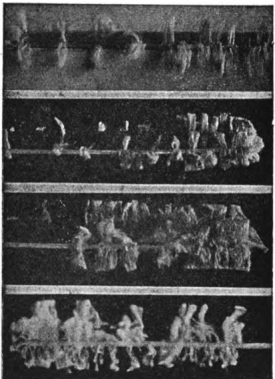
Figs.57 to 60. -- Formation of tufts of alumina on
strips of aluminium covered with invisible traces of
mercury. (Instantaneous photograph.)
The above oxidation does not manifest itself if the
aluminium be introduced into air or oxygen completely dry.
The presence of a small quantity of water vapour is
therefore indispensable for the production of the
phenomenon. The alumina formed is, besides, always hydrated.
Page 410
If,
instead of placing the aluminium on a support, it is thrown
into a vessel full of water immediately after taking it out
of the mercury, it energetically decomposes the liquid and
transforms itself into alumina. This operation only ceases
when the aluminium is entirely destroyed, a complete
destruction which never occurs with magnesium. A strip of
aluminium 1 millimetre in thickness, 1 centimetre in width,
and 10 centimetres in length is entirely destroyed by
oxidation in less than forty-eight hours.

Fig.
61. -- Arrangement of the experiment which allows us
to give to a strip of aluminium, after its extremity has
touched mercury, the property of decomposing water, and of
transforming itself entirely into alumina, even when the
mercury is withdrawn after the decomposition of the water
has commenced.
As with the transformed mercury, it is easy to preserve
indefinitely in the modified aluminium all its properties by
simply immersing it in a bottle of oil of vaseline.
An idea of the minute quantity of mercury necessary to
transform in so great a degree the properties of aluminium
may be gathered by putting into a precipitating glass filled
with distilled water, but containing a small quantity of
mercury, a strip of aluminium cleaned with emery and fixed
in a cork, so that it can only touch the mercury with its
lower extremity (Fig. 61). After a few hours the water
begins to decompose, and this decomposition, even after the
mercury has been taken away, continues till the strip has
been eaten away for a length of 5 to 6 centimètres above the
point in contact with the mercury.
In this experiment the action of the mercury has thus
extended far beyond the part in contact with it. It may
therefore be supposed that the mercury has travelled along
the strip of aluminium by
Page 411
an electro-capillary phenomenon. The following experiment is
free from this objection, and shows even more clearly the
slight quantity of mercury necessary to transform the
properties of aluminium.
Into a dry and very clean bottle is put a small quantity of
pure distilled mercury; the bottle is shaken for one minute,
then the mercury is poured out so that there remains no
visible trace of it on its sides, which, moreover, will have
kept all their transparency if the metal used was perfectly
pure. The bottle has, nevertheless, retained traces of metal
sufficient to transform the properties of aluminium. It is
only necessary to wash it with water acidulated by one-fifth
part of hydrochloric acid, to place in it a strip of
aluminium, and to shake the bottle for thirty seconds to
cause the strip to exhibit the properties of oxidation
mentioned, although it is impossible to discover on its
surface any trace whatever of amalgamation.¹
¹ As the conditions in which aluminium can combine with
mercury without the intervention of any reagent may be met
with in any laboratory, I at first supposed that some of the
facts I noted must have long been known. After fruitlessly
consulting the most accredited chemical treatises without
finding anything but facts relating to the amalgamation of
aluminium in the presence of bases, I made inquiries of the
most eminent chemists, and notably of M. Ditte, Professor of
Chemistry at the Sorbonne, and author of the most complete
and recent work on the properties of aluminium. One and all
answered that none of the facts I pointed out, neither as
regards aluminium nor mercury nor magnesium, had before been
published.
The proportion of mercury necessary to produce the
transformation of aluminium can be represented in figures.
If, to a bottle containing water acidulated by one-fifth of
hydrochloric acid is added a trace of bichloride of mercury
so weak that the liquid only contains 1/12000th of its
weight, and a strip of aluminium be inserted, and the bottle
shaken for two minutes, the aluminium will have acquired all
the properties I have indicated, although, as in the
preceding experiment, there is no
Page 412
trace of amalgamation visible to the naked eye.
The electro-motive force of the modified aluminium is more
than double that of ordinary aluminium. With a couple formed
of platinum, pure water, and ordinary aluminium the
electro-motive force I found was 0.75 volts. By replacing in
the same couple the ordinary aluminium by the modified
aluminium, the electro-motive force rose to 1.65 volts.
The hydrogen which is disengaged during the decomposition of
water by the modified aluminium renders the air a conductor
of electricity, as may be verified by connecting an
electroscope with a metal receptacle containing water and
fragments of transformed aluminium. The discharge of the
electroscope is about the same whether its charge be
positive or negative.
In addition to these new properties of oxidizing when cold
and of decomposing water exhibited by the aluminium, it has
also acquired the property of being affected by sulphuric,
acetic, and nitric acids, which in general have no action
upon it.
To observe this new property the following precautions
should be taken: -- For acetic acid, it is only necessary to
use it pure and crystallizable; for nitric acid, the metal
drawn from the bottle of mercury must be plunged into the
nitric acid of commerce. After a few seconds the metal is
very violently attacked, its temperature raised
considerably, accompanied by the disengagement of heavy
russet-colored vapour. The reaction is rendered less
dangerous by adding to the nitric acid half its weight of
water.
If nitric acid pure at 40° were employed instead of the
nitric acid of commerce, the aluminium would not be
affected.
The difference of action by pure and impure nitric
acid is not an isolated example. It has long
Page 413
been known that there is a difference in the action
exercised on lead by pure and ordinary water. Pure water
attacks it, while ordinary water does not. It is sufficient
to pour distilled water on recently prepared lead filings
for the liquid to become tinted in a few minutes by the
formation of oxide of lead. With ordinary instead of
distilled water the liquid remains perfectly limpid.
Ordinary water modifies the surface of the metal, and
deposits on it insoluble carbonates and sulphates.
Sulphuric acid does not affect ordinary aluminium, as the
chemistry books teach us; but it energetically attacks
modified aluminium. Pure sulphuric acid is almost devoid of
action. Sulphuric acid in twice its volume of water must be
used. Once the action has commenced, enough water can be
added to reduce the sulphuric acid to one-hundredth part.
The reaction continues with almost the same vivacity.
Sulphuric acid diluted to the one-hundredth degree, which
has an action almost nil on aluminium not already attacked,
has, on the contrary, a very great action as soon as the
reaction has started. Consequently, it has the power of
continuing but not of exciting it.
The fact that sulphuric acid pure or diluted does not attack
ordinary aluminium is taught in chemistry books, but it is
not quite exact. Pure sulphuric acid, it is true, has no
action, but with half its measure of water added it
instantaneously attacks aluminium, though less energetically
than in the case of modified aluminium. The verification of
so simple a fact not being open to any misconception, it
must be supposed that the divergence between what is written
in the books and what is shown by observation is due to the
chemists, who first studied the action of sulphuric acid on
aluminium, making use of a metal containing foreign bodies
which modern manufacture has
Page 414
succeeded in eliminating. Foreign bodies in aluminium
greatly modify its properties. I have come across samples of
impure aluminium with which I was unable to effect any of
the preceding experiments.
In his notable memoir on the properties of aluminium, M.
Ditte had already shown that this metal could be affected by
acids, but only by adopting certain devices. For weak
sulphuric acid to act, a little chloride of platinum has to
be added; for nitric acid, a vacuum has to be made above the
metal plunged into the acid. The attack, moreover, is very
slow, and in no wise violent, as is the case with modified
aluminium. M. Ditte has concluded, from his numerous
experiments, that aluminium is a metal easily liable to
attack under many conditions, several of which are still
undetermined. The fact appears indisputable. The Navy has
been compelled to abandon the use of aluminium, and unless
means be found to associate it with a metal able to modify
its properties, it will be impossible to employ it, as has
been proposed, for metallic constructions.
Page 415
CHAPTER XIII.
EXPERIMENTS ON THE PASSAGE OF THE ELEMENTS PRODUCED
BY THE DISSOCIATION OF MATTER THROUGH MATERIAL OBSTACLES.
I have already given, in the body of this work, photographs
showing how varied are the equilibria which may be imposed
on particles of dissociated matter by utilizing their
attractions and repulsions, and it would be useless to
return to the subject. I have likewise reproduced
photographs showing that by increasing the speed of
projection of these particles by a rise in the electric
tension of the apparatus generating them, they may be made
visibly to pass through material objects. This operation
having great importance, I recur to it so as to fully
describe the tecnique which I did not previously go into.
The apparatus used, re[resented in Fig. 62, is very simple,
but the adjustment of the great solenoid serving to
considerably raise the electric tension is rather delicate.
The position in which one of the wires starting from the
small solenoid will give the maximum result -- that is, a
long sheaf of effluves round the ball terminal of the
solenoid -- has to be ascertained by repeated experiments.
The coil used must give at least 30 centimètres of spark for
the effects observed to be very clear. When the apparatus is
properly regulated, there will be seen to issue from the
terminal a sheaf of effluves having the exact appearance of
the dotted rays reproduced in the sketch. These effluves
Page 416

Fig. 62. -- Diagram of the arrangement for
giving to the effluves produced by particles of dissociated
matter sufficient tension to enable them to pass through
thin plates of non-conducting bodies, such as glass and
ebonite. A, induction coil. It must be able to give sparks
of 30 centimetres minimum length. B, C, Leyden jars
connected with the poles of the coil. Their internal
coatings are connected to two rods, a, b, terminating with
balls which are set about a centimetre apart, and between
which the discharge takes place. E, small solenoid,
connected with the two external coatings of the Leyden jars.
H, large solenoid formed of coiled copper wire. It is
connected with the solenoid E by two wires, GF. The position
of the wire G is invariable. That of the wire F should be
determined by experiment until the maximum of effluves in
tufts at K is obtained. I, metallic rod fixed to the first
spire of the solenoid. At its extremity are formed the tufts
capable of passing through opaque bodies. K, strip of glass
or ebonite through which the tufts of effluves pass. Its
thickness must not exceed 1/2 millimètre maximum.
possess the surprising property of traversing without
deviation thin strips of various bodies: ebonite, glass,
etc., placed in their way. This effect can seldom be
produced if the thickness of these strips
Page 417
exceeds half a millimetre.¹
The experience is very striking. The course of these rays
can be followed with naked eye, which would not be the case
if it were a question of a secondary emission or of a
phenomenon of condensation.
I know of no other experiment by which the visible passage
of particles through a material obstacle can be verified. I
need not recall the fact that an electric spark can very
well pierce through a solid body, as can be verified by
placing a strip of glass or of cardboard between the two
poles of a static machine or of an induction coil. But then
the object is pierced, while in my experiment the effluves
pass through it without piercing it.
Mr. F. Legge has repeated this experiment with a Tesla
transformer, surrounded by solid vaseline. Owing to the
elevation of tension thus obtained, he has succeeded in
compelling the effluves to pass through ebonite discs
half-centimetre thick, while with the apparatus at my
disposal they will not pass through strips thicker than
half-millimètre.²
¹ It should be noted that the substance to be traversed must
be an insulator of electricity. I have myself used with
success discs of glass, ebonite, sulphur, and shellac
respectively, of 1/2 cm. in thickness, and a disc of
paraffin wax of 1 cm.; nor do I doubt that these thicknesses
might be exceeded if the tension were sufficiently raised,
-- F. L.
² The apparatus employed by me consists of a transformer of
the pattern designed by Elster an Geitel, and made by
Ernecke of Berlin. The oscillatory discharge is given by two
Leyden jars 40 cm. high, connected in parallel, discharging
through a spark gap of 1 cm. sheltered from the light, and
fed by a very powerful induction coil with a spark-length of
35 cm. -- F. L.
If the effluves, obtained as has been explained, are made to
pass through a Crookes' tube without either metallic cathode
or anode -- that is to say, through a simple glass receiver
in which a high
Page 418
vacuum has been created, a production of X rays will be
obtained in sufficient abundance to show clearly the
skeleton of the hand on a screen of platino-cyanide of
barium. This very unforeseen experiment has always surprised
the physicists to whom I have shown it.¹
¹ By suspending above the apparatus an inverted glass funnel
containing an inner funnel of thin copper foil from which a
wire is run so as to make contact with the charging rod of
an electroscope, it can be shown that these "effluves" are
positively charged. That the discharge from the secondary
coil of such a transformer as is mentioned in Note 2, p.
417, is positive, has been shown by the researches of Dr.
von Wesendonk. -- F. L.
Page 419
CHAPTER XIV.
DOCUMENTS RELATING TO THE HISTORY OF THE DISCOVERY OF
THE UNIVERSAL DISSOCIATION OF MATTER.
In a recent work M. Becquerel has given an historical sketch
of the discovery of radio-activity, and has caused the
passages relating to me to be reproduced in small volumes
for popular use. He asserts therein that my experiments for
the most part affect a complication "which conceals the real
cause of the phenomena observed." He concludes by saying,
"It is sufficient to read the publications of M. Gustave Le
Bon in Comptes rendus [de l'Académie des Sciences] to be
convicted that, at the time they were written, the author
had no idea of the phenomena of radio-activity."
Evidently no one is going to verify the assertions of M.
Becquerel in the Comptes rendus of this period (1896-97),
but should any one do so, what would be learn?
He would learn that for three years, M. Becquerel took
infinite pains, with multiple and varied experiments, to
prove that the radiations emitted by uranium could be
polarized, reflected, and refracted, and, consequently, were
only, according to the definition of J. J. Thomson, "one of
the forms of light" -- an opinion which M. Becquerel himself
acknowledged later to be entirely erroneous. The idea M.
Becquerel himself entertained at that time was therefore as
inexact as possible.
Page 420
In papers published by me at this very period, I upheld an
opinion diametrically opposite to his. I laboured, in fact,
to prove, contrary to his assertions, that the radiations of
uranium could not be reflected, refracted, nor polarized.
They, therefore, had no relationship to light, and
constituted in my ideas a new form of energy very much akin
to the X rays. I added that the uranium rays were identical
with the effluves emitted by all bodies, under the influence
of light. Time has proved the correctness of these various
assertions, which I was then alone in maintaining.
The historical sketch of M. Becquerel thus constitutes a
complete inversion of the most evident facts, and, were I
inclined to make use of the expressions he uses with regard
to me and the first experiments on the phenomena afterwards
termed "radio-activity," I have the right to say that it was
he, at that time in question, who "had no conception of the
phenomena of radio-activity." But since the text of the
Comptes rendus of the Académie des Sciences are referred to,
I will quote them.
All the experiments of M. Becquerel tending to prove that
the rays emitted by uranium refract, reflect, and polarize,
are described therein most circumstantially and in detail.
He proves the refraction of the uranium rays by means of a
mirror, and their polarization by the classic process of
tourmaline plates with crossed axes. These various
experiments he checks one by the other, and on three
different occasions repeats his assertions, each time
bringing forward new demonstrations (Comptes rendus, 1896,
pp. 561, 693, 763). His last controlling experiment was,
according to him, absolutely categorical, and he drew from
it the following conclusions: --
"This experiment therefore shows, for the invisible rays
emitted by salts of uranium, alike the
Page 421
double refraction, the polarization of the two rays and
their unequal absorption through the tourmaline."
We know -- for M. Becquerel has since acknowledged it -- how
incorrect these experiments were, and, consequently, what a
false idea he then entertained of radio-activity.
"What there is piquant in this," writes Professor de Heen on
the subject of the polarization and the reflection of the
uranium rays, "is, that it took three years for M. Becquerel
to convince himself that Dr. Gustave Le Bon was right, and
even then an American physicist had to come to the rescue.¹
M. Becquerel, moreover, gave explanations on this matter
before the Physical Congress in 1900 in a manner that would
lead to the belief that he had spontaneously discovered his
mistake.
"The experiment on the polarization of the uranium rays," he
stated, "did not in the end yield the same results either
with tourmaline plates or with other methods. The same
negative conclusions have been arrived at by M. Rutherford
and M Gustave Le Bon."²
¹ Professor Rutherford, who appears to be intended, is, as
has been said, not an American, but a Canadian. -- F. L.
² Congr?s de Physique, t. iii. p. 34.
I have indicated the passages in the Comptes rendus relating
to the first experiments of M. Becquerel; I will now recall
those concerning my own. At that period (1896-97) I was
still confusing two very different things: 1st, infra-red
radiations which, contrary to the teachings of science,
passed through, as I proved, most non-conducting bodies --
wood, stone, black paper, ebonite, etc.; 2nd, radiations
emitted by metals under the influence of light and which I
affirmed to be identical with the cathode and uranium rays,
as thenceforth admitted by all physicists.
Page 422
Here are a few extracts from my published papers --
"From the beginning of the year 1897 (Comptes rendus, 5th
August 1897, p. 755) I showed that all bodies struck by
light give birth to radiations of the family of the cathode
rays."
A few weeks later I showed the analogy of these radiations
emitted by bodies under the action of light with uranium
rays, and concluded my paper with the words, "The properties
of uranium must therefore only be one particular case of a
very general law." (Comptes rendus, 1897, p. 895.)
My first researches were developed for eight years in
numerous memoirs, in which I detailed every time new
experiments. And my first experiments having appeared to be
somewhat forgotten by authors who daily rediscovered facts
already pointed out by me, I drew attention to my anterior
publications in a note in the Comptes rendus de l' Académie
des Sciences, 1902, p. 32, from which I extract the
following: --
"At the very beginning of my researches on the mode of
energy to which I gave the name of Black Light, I stated
that the effluves emitted by bodies struck by light are of
the same nature as the uranium rays, which are commonly
considered as identical with the cathode rays, and as being
constituted by the elements of dissociated atoms, and the
carriers of electric changes.
"Enlarging the circle of these researches, I demonstrated
later that similar efflusives were manifested in a large
number of chemical reactions, and I was able to conclude
this production of effluves under very varying influences
cinstituted one of the most widespread of the phenomena of
nature.
"Since that epoch, several authors, Lenard especially, have
also arrived at this conclusion that
Page 423
metals struck by light generate cathode rays which are
subject to deviation by a magnet.
"All effluves disengaged under the action of light in the
conditions just set forth exhibit the closest analogies with
the emissions now described under the name of radio-activity
of matter. The production of these last therefore does
appear to be, as I was a long time alone in maintaining, a
particular case of a very general law. This general law is,
that under diverse influences, the atoms of matter may be
subject to a strong dissociation, and give birth to effluves
with properties very different from those of the bodies from
which they emanate." (Comptes rendus, 1902, p. 32.)
The loss of memory on the part of certain physicists had
already struck one of the most eminent of them. M. de Heen,
Professor of Physics at the University of Liège, somewhat
scandalized by this fact, wrote a memoir: Quel est l'auteur
de la découverte des phénomènes dits radio-actifs?
(published by the Institut de Physique of Liège in 1901) in
which, from published documents alone, he re-established the
truth.
I had at that time never seen the learned professor, and
only knew his paper through its being sent to me. Had he
consulted me before publishing it, I should have informed
him that the only point I cared for was the demonstration of
the universality of the radio-activity of matter, seeing
that the real author of the discovery of radio-activity was
Niepce de Saint-Victor, who revealed, fifty years ago, the
properties which salts of uranium possessed, of emitting for
months together radiations in the dark, as I will again show
later on. Those who afterwards brought the question entirely
up to date were Curie, with his great discovery of Radium,
and Rutherford with his study of the radiation of
radio-active bodies.
Page 424
The works for popular use due to the disciples of M.
Becquerel exhibit the above facts in a totally different
light. In M Berget's work Le Radium may be read, page 37,
"Thereafter the labours of M. Becquerel were so many
victories: one after the other he discovered in 1896 and
1897 that the rays emitted by uranium were subject neither
to reflection by mirrors nor refraction by prisms." This is
the exact contrary to what M. Becquerel was then
persistently seeking to demonstrate. The quotations given
above prove this clearly.
More than one philosophical lesson can be learned from the
above. I am not speaking, let it be understood, of the
method of writing history of which the above is a specimen;
it has never been written otherwise. I simply wish to point
out the intensity of the illusions which the suggestion
derived from preconceived ideas may create in the mind of a
clever physicist with many assistants. If Niepce de
Saint-Victor had not formerly written that the radiations
emitted in the dark by salts of uranium were light stored up
-- that is to say, a kind of phosphorescence -- M. Becquerel
would assuredly never have dreamed of considering that they
must necessarily be refracted, reflected, and polarized.
Such errors as these easily explain some of the enormities
written in complete good faith on the subject of the N rays.
In the same book, where I am so harshly dealt with, M.
Becquerel finally decided, for the first time, to mention
the name of Niepce de Saint-Victor, having hitherto confined
himself to reproducing his experiments on the salts of
uranium and following his predecessor even in his errors,
since he shared his belief in a kind of stored-up light.
Not very equitable towards the living, M. Becquerel is still
less so towards the dead, and his
Page 425
suppressions are at times very unilluminating. Niepce is
disposed of in a few lines. "Niepce," he says, "was unable
to observe the radiation of uranium because he employed
plates insufficiently sensitive."
It is sufficient to read the Comptes rendus of that period
to see how little foundation there is for this assertion. As
early as 1867, Niepce observed that salts of uranium
enclosed in a tin case caused impressions on plates in the
dark. "The same activity," he says, "is noticed after
several months as on the first day."¹
¹ Quoted by M. Guillaume from the Comptes rendus de
l'Académie des Sciences, 1867, in Radiations
Nouvelles, 2nd edition, p. 133.
If it were true -- and such is not at all the case -- that
Niepce de Saint-Victor had actually divined the existence of
the only body in nature which possessed the property of
emitting radiation in obscurity, such a divination would
have been a little more than a stroke of genius.
But Niepce had no such claims. He was a conscientious and
patient observer, ignored during his lifetime, forgotten
when dead. The fact that only two physicists have dared to
recall to M. Becquerel the experiments of Niepce shows how
small a degree of scientific independence exists in France.
It is impossible to think without bitterness of the
opposition offered to Niepce by the official scholars of his
time. If, instead of endeavouring to ridicule his memorable
experiments, an attempt had been made to repeat them, there
certainly would have been found some one to think of
determining how long the salts of uranium could continue, in
the darkness, to impress plates, exactly as it occurred to
M. Becquerel. And if Niepce had persisted, as did later M.
Becquerel, in the mistake of believing in stored-up light,
akin to phosphorescence, some one would again have been
found to
Page 426
show him -- as was shown to M. Becquerel -- that these
radiations, not being polarizable, could not be light.
Radio-active phenomena would then have been as quickly
discovered as they were where the demonstration of the
non-polarization of the uranium rays proved that it was a
question of something entirely novel. In view of the
discoveries brought to light by the simple fact that uranium
preserves indefinitely its powers of impressing a
photographic plate in darkness, it may be said that the
opposition and indifference to Niepce de Saint-Victor's
experiments have immensely retarded the progress of science
for more than fifty years.
To end definitely a polemic which might continue for ever, I
do not fear contradiction when I state that to judge the
work of one who makes researches, the subject of them should
be examined as to its state before and its condition after
his researches.
1stly. It was thought that uranium emitted a kind of
invisible light. Well, I proved that it emitted something
entirely new, which was analogous to the radiations of the
family of the X rays, and consequently had no relationship
whatever to light -- a fact which has since been completely
verified.
2ndly. It was absolutely unknown that metals struck by light
acquired properties identical with those of the uranium and
the cathode rays. I demonstrated this, contrary to all
accepted ideas. The fact, which has long been known, that
certain electrified metals lost their electric charge under
the influence of light, proceeded, according to Lenard, from
the fact that under this influence their surface became
pulverized into dust, which, disseminated in the air,
carried off the electric charges of the electrified
particles of the metal.
Lenard, however, was the first to acknowledge his error. On
the publication of my experiments,
Page 427
he renewed his own, and found that metals under the
influence of light emitted cathode rays which could be
deviated by a magnet,¹ and the experiments were subsequently
confirmed by J. J. Thomson.
¹ Lenard's memoir, Erzeugung Kathodenstrahlen durch ultra
violette Licht, was presented to the Academy of Sciences of
Vienna on the 18th October 1899. My experiments were
published in the Comptes rendus de l' Académie des Sciences
of Paris, on the 5th April 1897.
3rdly. At the time referred to it was believed, and M.
Becquerel believed, that radio-activity was a quite
exceptional phenomenon belonging to an infinitely limited
number of bodies. In a series of experiments I showed that
it was one of the most widespread phenomena in nature,
produced, not only under the influence of light, but under
that of heat, and of a large number of chemical reactions.
This opinion has gradually gained ground, and is now almost
universally admitted.
In the above enumeration I do not bring into prominence the
demonstration that all these phenomena are manifestations of
a new force -- namely, intra-atomic energy, which surpasses
all others by its colossal magnitude. The existence of this
force is still in some measure contested, and I only desired
to recall here those facts which are above all dispute.
4thly. The doctrine of the dissociation of matter was only
formulated a long time after my researches. The physicists
of the University of Cambridge have become its warm
partizans, since one of them declared in the course of a
recent polemic that it was "the most important theory of
physics"; but they have taken a long time to range
themselves on its side. In 1900, J. J. Thomson, a very
eminent scholar, but one who easily forgets the work of his
predecessors, still believed that radio-
Page 428
active emissions were a form of light. This is what he wrote
at that date: "Becquerel found that the radiations of
uranium can be reflected, polarized, and refracted, so that
it is evidently one of the forms of light." (Discharge of
Electricity through Gases, p. 57. 1898.)
This is what I wrote at the same date at the end of a long
memoir filled with experiments: "As a general conclusion, we
may say that under the influence of very varied causes --
light, chemical reactions, electrification, etc. -- bodies
can dissociate. Matter thus dissociated manifests itself
under the form of infinitely small particles of immense
speed, and capable of rendering the air a conductor of
electricity, and of traversing opaque bodies. These
particles represent a form of matter quite different from
those which chemistry has made known to us -- a new state
where te atom is probably dissociated.
"And surely there can be no question here of properties only
belonging to certain special bodies, such as uranium,
thorium, etc., for these bodies only represent, as I said
long since, particular cases of a very general law." (Revue
Scientifique, p. 458. April 1900.)
5thly. I will finally add that I was the first to formulate
in a special memoir the doctrine that all the phenomena of
the dissociation of matter are the manifestations of a new
force -- Intra-atomic Energy -- which surpasses all others
by its colossal magnitude, and whence are derived, according
to my researches, the greater part of the forces of nature,
especially electricity and the heat of the sun.
Page 429
INDEX OF SUBJECTS.
A.
Absorbents, 334
Academy of Sciences, 27, 278
Academy, The, quoted, 31
Acetylene, formation of, 154, 290
Actinium, 139
Actions, catalytic, 303
Affinity, 239, 240, 241
Aigrettes, 203, 204, 206
Air, the, a conductor of electricity, 155, 209, 323;
-- ionization of,
372
Alexins, 293
"Allotropic" states, 267, 268
Alloys, 278
Année Scientifique, quoted, 78
Anti-toxins, 293
Archives des Sciences Physiques de
Genève, quoted, 56
Astronomy, 308
Atoms, 1, 105, 116, 235, 347, 349;
-- structure of,
10, 228;
-- electric, 114, 128, 144, 145, 224, 312, 313;
-- genesis and
evolution of, 307
Attractions, 163, 240, 241-247
Aurora borealis, 158
B.
Bacteria, 237, 261, 301
Balance, the, 95
Benzene, 290
Bismuth, 145
Bodies, simple, unity of the
-- composition
of, 263-273;
-- are they elements of an unvarying fixity,
265;
-- variability
of, 274
Bodies, compound, variability of, 282
-- isomeric, metameric, polymeric 290
-- radio-active, 323, 325; cause of
the dissociation of, 390
-- transparency of, determined by
photography, 335
-- dissociation of, by light, 345, 346
Bolometer, the, 249, 250
C.
Cacodyl, 289
Cadmium, 140
Caffeine, 285
Calcium, sulphide of, 145, 180
"Canal rays," 122
Cells, artificial, 244, 245
Chemistry, kinematic, 292;
-- intra-atomic,
296, 306
Chlorophyll, 283
Cohesion, 239, 240, 241
Combustion, dissociation of matter by,
157, 377;
-- ions prduced
by, 397
Comptes rendus de l' Académie des
Sciences, 19, 21, 22; quoted, 422
Copper, 332
Corposants, 168
Corpuscles, 114, 120, 136, 236, 238
Crystals, semi-liquid, 256-262
Current, electric, 204; voltaic, 220,
222
D.
Diastases, 283, 293, 300
Dissociation of bodies, 345, 346
E.
Edifices, molecular, forces which maintain,
238-241;
-- chemical, 294
Effluves, 6, 24, 63, 85, 101, 105, 112, 151,
196, 207, 208, 275, 330, 338, 341, 346, 349, 416
Electric machine, elements emitted
-- by the poles
of an, 205
Electricity, origin of, 61-64, 162;
-- ionic, 109;
-- considered as
a semi-material substance, 198;
-- modern theory
of, 220;
-- static, 222;
-- air a
conductor of, 323;
-- apparatus for
reducing the loss of, 325;
-- leak of, 369
Electrodes, 226, 341, 368
Electrolysis, 264, 270
Electrometer, the, 125
Electrons, 96, 98, 111, 114, 115, 120, 128, 135, 204,
220, 227, 233, 234, 322
Electroscope, 324, 325, 327
Elements, material, chemical equilibria
-- --
of, 288
Emanations, 115, 132, 159, 326
Energy, intra-atamic, 5-8, 110, 202,
239, 295, 305, 427, 428
-- history of discovery of, 19-34
-- forces derived therefrom, 35, 60-67
-- existence of, 35-39
-- its magnitude, 35-51
-- power of, 36
-- quantity contained in matter, 39-46
-- forms under which it can be condensed
in matter, 46-49
-- the utilization of, 49-51
-- objections to the doctrine of, 68-79
-- kinetic, 209, 234, 235
English Mechanic, quoted, 31, 76
Enzymes, 300
Equilibria, chemical, of mineral substances,
288;
-- of organic
substances, 291;
-- oscillating,
304
Equilibrium, different forms of, 94-100, 241
Ether, 11, 13, 82, 87-93, 94-100, 101
Etherification, 294
Extrapolation, 193
F.
Field, electric, 222, 224;
-- magnetic, 121,
124, 126, 131, 136, 169, 209, 224, 322, 423
Fire, St Elmo's, 168
Fluid, ionic, 119
Fluids, electric and material, comparison
of, 216
Fluorescence, 150, 212, 322
"Foam cells," 99
"Foam structure," 257
Force, the element of, 1, 9, 14;
-- centrifugal,
234;
-- lines of, 221,
223, 246
Forces, molecular, origin of, 60-61
Formene, 291
Formiate, 302
G.
Galvanometer, the, 95, 324
Gas, marsh, 291
Gases, dissociation of the atoms of, 370;
-- action of,
377;
-- ionization of,
394
Glucose, 301
Gravitation, 218, 219
Gyroscope, the, 169
H.
Hæmoglobin, 283, 284
Heat, solar, origin of, 64-67, 162;
-- dissociation
of matter by, 158;
-- radiant, 312
Heliostat, 330
Helium, 115, 140, 253
Hydrodynamics, 256
Hydrogen, 253
Hydrostatics, 256
I.
Imponderable, the world of the, 80-86
Inertia, 194-196, 253
Iodoform, 237, 403
Ions, positive and negative, 115. 116, 132,
210, 233, 323;
-- produced by combustion, by chemical reaction, and by the oxidation of phosphorus, 397
Iron, pyrophoric, 279
Isomerism, 290
L.
Lamps, incandescent, 282
Light, the action of, 6, 94, 345, 358, 369;
-- Black, 32,
422;
-- dissociation
of matter by, 151;
-- solar, 152,
330, 342;
-- visible, 312;
-- invisible,
313;
-- leak caused by, 360
Liquids, 257
Lumière emmagasinée, 22
Lumière noire, 20, 21, 29, 31
Luminescence, invisible, 21
Lyræa, 309
M.
Magnesium, 277, 404, 407
Magnetism, 220
"Magnetons," 145
Mass, indestructibility of, 17;
-- variations of,
191
Matter, the element of, 1, 3, 17
-- not eternal, 1
-- new ideas on, 5
-- dissociation of, 7, 35, 374, 415;
-- history of the
discovery of the, 19-34, 419;
-- interpretations
of the experiments which reveal
the, 101-112;
-- characteristics
of the elements
-- furnished by the, 115-129;
-- by light, 151,
331;
-- by chemical
reaction, 153, 383;
-- by electric action, 156;
-- by heat, 158;
-- spontaneous,
159, 399;
-- artificial equilibria of the elements arising
from the, 163;
-- mechanism of
the, 177;
-- methods of
observation for verifying the, 322;
-- experiments on
the, 338;
-- during the
formation of gases, 385-386;
-- during the
oxidation of phosphorus, 386
Matter, propositions on, 8-9
-- and force, 9, 14
-- and ether, 13, 81-86, 101;
-- the intermediate world between, 188
-- and energy, 13, 82
-- vanishing of, 14, 16, 307
-- quantity of energy contained in, 39-46
-- forms under which energy can be condensed
in, 46-49
-- transformed into energy, 52-59
-- dematerialization of, 101, 131, 322; products
of the, 113-115; causes of the, 148-151
-- how it can dissociate, 172-187
-- birth, evolution, and end of, 228-247, 307-319
-- constitution of, 228, 230
-- magnitude of the elements of which
it is composed, 236
-- possesses an intense life, 247
-- mobility and sensibility of, 248
-- equilibria of, 252; unknown, 296
-- various aspects of, 256
-- transparency of, 349
Division of, 403
Mercury, 277, 339, 357, 404, 405, 406
Metals, cells in, 259;
-- colloidal,
269, 297
Meteorology, 345
Methane, 291
Micro-organisms, 259, 301
Microbes, 236, 259
Molecules, 117, 238, 240, 241, 398
Musk, 237, 403
Mycoderma aceti, 299
N.
Nature, 6, 13, 76, 171, 229, 255
Nature, 27, 196
Navy, the, 414
Nebulæ, 308
Nicotine, 283
Nirvana, 315
O.
"Organic molecules," 238
Oxygen, formation of, 154, 254, 290
Ozone, 290
P.
Particles, electric, 115, 116, 122, 202, 203, 220, 234
Phenomena, natural, part taken by the dissociation of matter
in, 161
Philosophical Magazine, quoted, 55, 181
Phosphorescence, 145, 155, 186, 276, 322,
384, 388
Phosphorus, oxidation of, ions producedby, 397
Photography, use of, 335, 343, 345
Polonium, 21, 136, 150, 156, 322
Polyhedra, 246
Polymerization, 294
Ponderability, the world of, 228
Ponderable and imponderable, the separation
between, 80
Pressure, osmotic, 243, 245, 246
Q.
Quinine, hydration of sulphate of, 154
R.
"Radiant matter," 31
Radio-activity, 7, 25, 30, 31, 37, 133, 143, 146, 155,
181, 276, 323, 388, 403, 419
Radio-tellurium, 150
Radium, 2, 6, 21, 26, 42, 57, 76, 77, 111, 115,
117, 122, 130, 136, 139, 183, 322, 357,
390, 423
"Rare earths," 266
Rays, cathode, 5, 20, 24, 26, 30, 76, 86, 101-105,
115, 121, 224
-- Röntgen, 31, 149
-- X, 5, 25, 30-32, 38, 57, 101, 102, 105, 106,
109-11, 115, 116, 120, 122, 126, 127, 137, 199, 200, 208,
209, 224, 232, 373, 418, 426
Reaction, chemical, dissociation of matter by, 153,
232;
-- ions produced by,
397
Repulsions, 163, 240, 241-247
Researches, experimental, 321 et seq.
Revue des Deux Mondes,quoted, 29
Revue des Idées, quoted, 33
Revue d' Italie,quoted, 69
Revue Générale des Sciences, quoted, 30
Revue Philosophique, quoted, 79
Revue Scientifique, 30; quoted, 69, 71, 72,
98, 284
S.
Saliva, 283
"Saturation current," 119
Science, a revolution in, 75
Selenium, a conductor of electricity, 268
Sirius, 309
Sodium, 85
Species, chemical, variability of, 274, 404
Spectrograph, 333, 338
Spectroscope, 308
Spectrum, the, 152, 158, 211, 338, 343, 374
Speed, variations of, 191
Spermatozoon, 238, 262
Spinthariscope, the, 133, 209
Spores, 237
Stereo-chemistry, 292
Strontium, sulphide of, 180
Structures, atomic and molecular, causes
capable of modifying, 172-177
Sub-atoms, 68
Substances, mineral, chemical equilibria of,
288
-- radio-active, 130, 131, 138, 390, 399;
-- causes capable
of producing the dissociation of,
179
Sulphide, phosphorescencent, 134
Sun, the, 158, 363
T.
Telegraphy, wireless, 224
Tension, osmotic, 243
Theobromine, 285
Thermo-chemistry, 269, 270, 271
Thermo-dynamics, 8, 52, 56, 69
Thermometer, the, 95
Thorium, 111, 115, 122, 130, 139, 357, 390
Tin, 339
Toxins, 293, 300, 301
Transparency, table of, 336
U.
Units, electro-magnetic, 125
Universe, immaterial basis of the, 87-93
Uranium, 5, 6, 20-22, 26, 105, 111, 130, 357,
390
V.
Vacuum, 117, 123
Vanilla, 403
W.
Water, decomposition of, 154, 406, 407, 410
Water-vapour, 125, 303
Wave-lengths, 336, 339, 340, 349, 368
Waves, calorific, 213; Hertzian, 121, 176, 211,
213, 214, 250, 312, 333, 349, 351, 353
Wind, electric, 209
World of the imponderable, the, 80-86
Y.
Yeast, 301
Z.
Zymase, 301