Pinhole Glasses
( Po'buckra Optics )
( Po'buckra Optics )
Wikipedia
Pinhole
glasses
Pinhole glasses, also known as stenopeic glasses, are eyeglasses with a series of pinhole-sized perforations filling an opaque sheet of plastic in place of each lens. Similar to the workings of a pinhole camera, each perforation allows only a very narrow beam of light to enter the eye which reduces the size of the circle of confusion on the retina and increases depth of field. In eyes with refractive error, the result is claimed to be a clearer image. However, a second effect may appear at the common bridge between each two adjacent holes, whereby two different rays of light coming from the same object (but each passing through a different hole) are diffracted back toward the eye and onto different places on the retina. This leads to double vision (objects having doubled edges) around the rim of each hole the eye is not focussing on, which can make the overall image disturbing and tiring to look at for prolonged periods of time.
Unlike conventional prescription glasses, pinhole glasses produce an image without the pincushion effect around the edges (which makes straight lines appear curved). While pinhole glasses are claimed to be useful for people who are both near- and far-sighted, they are not recommended for people with over 6 diopters of myopia. Additionally, pinhole glasses reduce brightness and peripheral vision,[1][2] and thus should not be used for driving or when operating machinery.[3]
Merchants state that after prolonged use, the plastic grating should become easy to ignore. However, each time the user blinks, the horizontal lines of the grating will briefly appear to be thicker. This is because the eyelid moving over the pupil will reduce the amount of light falling onto the retina and thus will briefly remove the lateral inhibition effect which normally makes all the holes appear bigger (and the grating appear thinner). So, as long as the user keeps blinking, they will be constantly reminded of the dark grating covering their eyes.
Pinhole glasses have been marketed by various companies on the claim that—combined with certain eye exercises—they could permanently improve eyesight. Skeptics argue that no scientific evidence has been found to support them. Due to a lack of formal clinical studies to substantiate this type of claim by companies selling pinhole glasses, this type of claim is no longer allowed to be made in the United States under the terms of a legal settlement with the Federal Trade Commission.[4]
The pinhole occluder, a device used by ophthalmologists and optometrists for diagnosis of refractive errors, works on the same principles, but is not intended for use outside of diagnosis.
As viewing through a pinhole can much improve clarity of vision of people with refractive error, in an emergency a clear view can sometimes be obtained by looking through a single improvised pinhole.
References
1. ^ Wittenberg S, Pinhole eyewear systems: a special report. J Am Optom Assoc. 1993 Feb;64(2):112-6
2. ^ Russell S. Worrall OD, Jacob Nevyas PhD, Stephen Barrett MD (September 12, 2007). "Eye-Related Quackery". Quackwatch. http://www.quackwatch.org/01QuackeryRelatedTopics/eyequack.html. Retrieved 2008-03-27.
3. ^ Cherrill Hicks (July 29, 1997). "The truth about pinhole glasses". London: The Independent. http://www.independent.co.uk/life-style/health-and-families/health-news/the-truth-about-pinhole-glasses-1253113.html.
4. ^ Casewatch
http://www.independent.co.uk/life-style/health-and-families/health-news/the-truth-about-pinhole-glasses-1253113.html
The truth about
pinhole glasses
Cherrill Hicks
Cherrill Hicks
Tuesday 29 July 1997
A pair of glasses which can permanently improve eyesight rather than just correct it may sound like the stuff of dreams. But this is the promise being made for "pinhole" glasses - they look like sunglasses covered with a grid of tiny holes - by their manufacturer, a company in Somerset. Wearing the glasses for 15-20 minutes a day, it claims, can lead to noticeable improvements in vision.
The glasses can apparently also help relieve VDU eye strain, fatigue and headaches - and all for the price of pounds 25 a pair.
These claims were recently given a splash in one particular tabloid, with the result that the company's lines are constantly engaged by eager potential purchasers. They are, however, strongly disputed by the College of Optometrists which says they are unsubstantiated and should be viewed "with a great deal of caution".
So who is right? There's no doubt that while they are being worn, pinhole glasses make for a clearer image for those with vision defects, similar to the effect of screwing up the eyes. They do this by artificially making the pupils smaller and reducing the amount of light getting through.
The "pinhole effect" has been known about for centuries and pinhole glasses are used by optometrists (who are qualified to examine vision) as a sight aid where conventional glasses cannot help - in the case of a scarred cornea, for example. But they are not normally used where prescription glasses can be used, because they cut down on light, and cannot give as clear an image.
The manufacturer, Trayner Pinhole Glasses, argues that its product has a more permanent effect than this. It says that while normal glasses encourage the eye to become lazy, the pinhole type encourage the ciliary muscles to become stronger, pulling the lens into the correct shape. This is based on the view that the eye can be made to adapt to its environment and can be encouraged to change shape towards normal. Improvements can be made, it is claimed, within a few weeks in the case of those who use reading glasses (where the lens is too stiff rather than the wrong shape), and within a few months in the case of those with distance lenses.
The traditional view, however, is that poor sight is for the most part genetic, and is caused by the eye being too short (in the case of long- sightedness) or too long (in short-sightedness), so that the image is focused either behind or in front of the retina. Optometrists say there is little evidence that muscle exercises of any kind will help poor sight, which can only be put right by prescription glasses.
What is certain is that so far, there have been no published clinical trials of the effect of pinhole glasses on permanent vision. The College of Optometrists points out that the company has been "pressed for scientific validation of its claims" but that clinical trials which were arranged "were not pursued to their conclusion". The company's director, Peter Duthie (whose own background is electronic engineering), admits that all his evidence is so far anecdotal but retorts that optometrists have been reluctant to carry out the trials which under current legislation he cannot conduct himself.
This is not the first time that pinhole glasses have been marketed in Britain. In 1992, Birmingham City Council won a case under the Trade Descriptions Act (1968) against a manufacturer making claims about the health benefits of pinhole glasses. In 1993 the Advertising Standards Authority upheld a complaint about claims that by wearing pinhole glasses, people could give up wearing conventional glasses.
Certainly there is no substitute for having the eye examined to detect problems in eyesight and eye disease; self-diagnosis is inadvisable. The College of Optometrists also says that walking round while wearing pinhole glasses in normal lighting conditions could be dangerous and wearing them while driving even more so.
Cherrill Hicks
US2011279768
US2011279768
EYEWEAR WITH PINHOLE APERTURE AND LENS
US2011279768
EYEWEAR WITH PINHOLE APERTURE AND LENS
BACKGROUND OF THE INVENTION
1. Field of the Invention
The present invention relates to eyewear, and more particularly, to corrective eyewear that provides the option of using a lens or a pinhole aperture disposed adjacent to the lens.
2. Description of Related Art
There are a number of conditions of the eye that affect one's visual acuity over a range of distances. Myopia ("near-sightedness") refers generally to a condition in which distant objects appear blurred. It is often caused by an elongated eyeball which causes light to focus in front of the retina instead of directly on it. On the other hand, hyperopia ("far-sightedness") refers to the opposite condition, in which nearby objects appear blurred. As one might guess, hyperopia is caused by a shortened eyeball which causes light to focus behind the retina instead of directly on it.
Those who are fortunate enough to have avoided developing myopia or hyperopia, however, will inevitably develop presbyopia. Presbyopia is a vision condition in which the crystalline lens of the eye loses its flexibility, making it difficult to focus on close objects. Presbyopia usually becomes noticeable in the early to mid-40s and is a natural part of the aging process of the eye. It is not a disease, and it cannot be prevented. Thus, the need for corrective eyewear will be inevitable for most people.
The most common types of corrective eyewear are corrective lenses, such as glasses or contact lenses. Corrective lenses may be worn to correct most refraction errors of the eyes. Single vision lenses have the same optical correction over the entire area of the lens and are therefore suitable for those who suffer from a single refractive error. Many people, however, may suffer from more than one refractive error. For example, a person may have various combinations of myopia, hyperopia, presbyopia, or astigmatism. In such cases, bifocals, trifocals, or progressive lenses may be necessary.
Bifocals and trifocals are eyeglasses in which the lenses have two and three distinct regions of different optical powers, respectively. Bifocals are most commonly prescribed to people with presbyopia who also require correction for myopia, hyperopia, and/or astigmatism. Trifocals similar to bifocals, with the exception that trifocals have an additional segment for intermediate vision above the reading section and below the distance section. Trifocals are becoming rarer as more and more people are choosing to wear progressive lenses. Progressive lenses provide a gradient of increasing lens power, from minimal or no magnification at the top of the lens to maximum magnification at the bottom of the lens. A wearer can view objects at different viewing distances by directing his line of sight through appropriate parts of the lens.
Although corrective lenses have been developed to correct a variety of refractive errors, they are still limited to correcting predefined refractive errors in a person's eyes. Thus, once prescribed and cut, corrective lenses are not adjustable to further other changes in a person's vision. An additional eye examination will be necessary to address these changes in the person's vision. What is needed therefore is an optical device which, in addition to corrective lenses, can easily provide yet another way for improving one's visual acuity over a range of distances.
SUMMARY
The present invention provides for an optical device which includes at least two mechanisms for improving or enhancing one's visual acuity. The first mechanism is provided by one or more corrective lenses, which improve visual acuity by bending light in a way that causes it to be focused directly onto the retina. The second mechanism is provided by pinhole apertures, which improve visual acuity by reducing the width of the bundle of light rays entering the pupil of the eye. Pinhole apertures produce a sharper image on the retina by reducing the amount of peripheral light rays that enter into the eye. It is the peripheral light rays which require the most bending to produced a focused image and which are primarily responsible for blurred vision. A pinhole aperture may also be used to project a magnified image on the retina, and thereby allow viewing of smaller objects such as small type, than would otherwise be possible.
In one embodiment, an optical device is provided. The optical device comprises a first vision element comprising at least one corrective lens and a second vision element comprising at least one aperture coupled to the first vision element. The first and second vision element may each at least partially reduces a refraction error of a user's eye when either or both are positioned in front of the user's eye. The at least one aperture is characterized by a diameter and thickness (determined by the thickness of the material that the aperture pierces), wherein the thickness is no greater than the diameter. In the alternative, the corrective lens may be replaced by a non-refractive lens, for example a shaded lens as used in sunglasses.
In another embodiment, a dual corrective eyewear is provided. The dual corrective eyewear comprises at least one lens; a frame supporting the lens; and at least one pinhole aperture disposed in the frame. The lens is configured to at least partially reduce a refraction error in a wearer's eyes by bending some of the light rays entering through the corrective lens and into the wearer's eye. The pinhole aperture is configured to at least partially reduce the refraction error in a wearer's eye by blocking some of the light rays from entering into the wearer's eye, to project a magnified image onto the user's retina, or both.
There are certain disadvantages associated with the use of corrective lenses. Corrective lenses often produce glare and distortion. For example, multi-focal lenses, which are designed to provide a continuously variable curve for a range of distances, often provide distorted images on either side of the center line, which may be uncomfortable or difficult to get used to. Another disadvantage is that corrective lenses are limited to correcting a predefined refractive error and do not adapt to respond to changes in the visual acuity of the eye.
Apertures, or pinhole apertures, on the other hand, are not associated with many of the problems inherent in corrective lenses. For example, apertures may provide an improved image at all distances, or over a greater range of distances, because they operate differently from corrective lenses. Apertures reduce the width of the bundle of diverging rays coming into a person's eye from each point on the viewed object. Normally, the full opening of the pupil admits light and it is the improper bending of the outermost peripheral light rays which causes refractive errors such as myopia, hyperopia, presbyopia and astigmatism to be noticeable. Apertures can therefore provide clearer vision in all of these conditions by blocking these peripheral rays and only letting into the eye those rays which pass through the central portion of the pupil. An aperture may also be used to produce a magnified or reduced image by varying the focal length, as applied in pinhole cameras, camera obscuras, or the like.
As used herein, "apertures" or "pinhole apertures" are used to describe holes through which a person's line of sight may be directed and that function to reduce the bundle of light rays entering into the person's eye to produce a clearer or a magnified image. Apertures or pinhole apertures are characterized by shape having a diameter and a thickness. The apertures or pinhole apertures may be of any suitable shape, such as a circle, ellipse, triangle, square, rectangle, or other polygon, so long as it is configured to at least partially block some of the peripheral light rays from entering into the person's eye. Regularly-shaped apertures may be more useful than irregularly-shaped apertures.
The diameter (d) of the aperture or pinhole apertures is defined as the largest distance that can be formed between two opposite points in the aperture. The diameter (d) should preferably be no greater than about 3 mm, preferably no greater than 2 mm, and more preferably no greater than 1 mm. In one aspect of the invention, the apertures or pinhole apertures have a diameter ranging from about 0.3 mm to about 2 mm, preferably about 0.5 mm to about 1.5 mm, and more preferably from about 0.8 mm to about 1.2 mm.
The thickness (t) of the aperture or pinhole aperture is the straight-line distance measured therethrough. The thickness (t) should preferably be no greater than the diameter (d) of the aperture or pinhole aperture. In one aspect, the ratio of the aperture diameter to thickness (d:t) should be no less than about 1:1.5, preferably greater than 1:1, and more preferably greater than 2:1. Generally, the thinner the aperture, the better the visual acuity and light provided by the aperture to the eye.
A plurality of apertures or pinhole apertures having a range of different diameters or thicknesses or both may be provided for viewing objects at various distances. The smaller openings may be used for viewing objects which are nearby, whereas the larger openings may be used for viewing distant objects. By providing a plurality of apertures of graduated sizes, the user can adjust the level of visual acuity obtained by selecting the appropriately sized aperture that provides an optically focused object. For convenience, the graduated apertures may be provided adjacent to one another through a common substrate. For example, apertures of different sizes may be arranged around a correcting lens of a pair of eyeglasses, through the eyeglasses frame.
Despite the advantages provided by apertures, however, there are still situations in which use of corrective lenses may be preferable to apertures. For example, because apertures reduce the amount of light entering into the eye, they may not be suitable for use at night or in conditions of poor or dim lighting. In some instances, the aperture size may be increased to permit more light to enter into the eye; however, larger apertures will result in a reduction in image sharpness or resolution. Thus, corrective lenses should be used in conditions of poor or inadequate lighting. Apertures also do not provide improved peripheral vision. Thus, the use of corrective lenses is recommended when engaging in activities involving movement, such as driving.
Thus a combination of corrective lenses and apertures may be used to provide improved visual acuity, not only over a range of distances but also over a range of conditions in which one or the other may be more suitable.
Other objects, features and advantages of the present invention will become apparent to those skilled in the art from the following detailed description. It is to be understood, however, that the detailed description and specific examples, while indicating preferred embodiments of the present invention, are given by way of illustration and not limitation. Many changes and modifications within the scope of the present invention may be made without departing from the spirit thereof, and the invention includes all such modifications.
BRIEF DESCRIPTION OF THE DRAWINGS
In the drawings and detailed description, like numerals refer to like parts throughout one or more of the drawings.
FIG. 1A is a perspective view of an exemplary corrective eyewear, illustrating the placement of the apertures in the frame front surrounding a lens.

FIG. 1B is a perspective view of an exemplary corrective eyewear, illustrating the placement of the apertures at the bottom end of the frame front.
FIG. 1C is a perspective view of another exemplary corrective eyewear, illustrating the placement of the apertures in the frame temples.
FIG. 2A is a perspective view of another exemplary corrective eyewear, illustrating the placement of the apertures in an elongated portion of the bottom frame front.
FIG. 2B is a perspective view of another exemplary corrective eyewear, illustrating the placement of the apertures in an elongated portion of the bottom frame front.
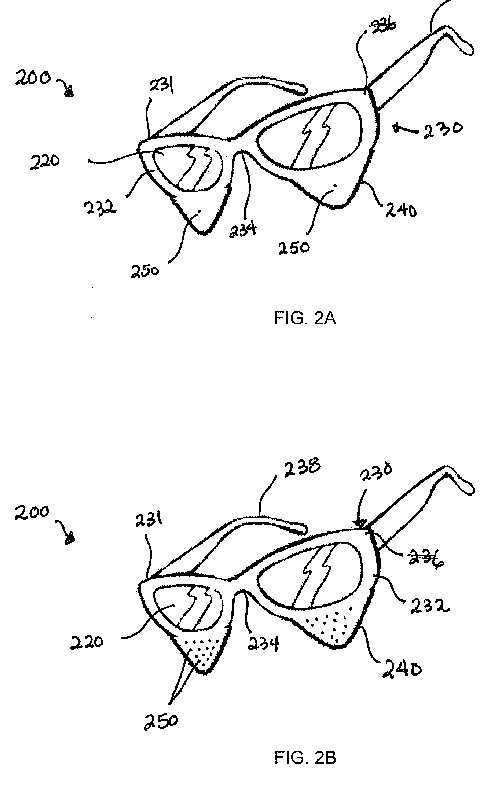
FIG. 3A is a perspective view of an exemplary rimless corrective eyewear, illustrating the placement of the apertures on an opaque plate attached to the frame temples.
FIG. 3B is a perspective view of another exemplary rimless corrective eyewear, illustrating a clip on piece comprising a plurality of graduated apertures.

FIGS. 4A-F is a plan view of various exemplary aperture shapes that may be used in with various embodiments.

FIG. 5 is a close-up perspective view of a round aperture showing an exemplary relationship between the diameter (d) and thickness (t) of an aperture made in a relatively thin material.

FIG. 6 is a close-up cross-sectional view showing an exemplary pinhole aperture made in a relatively thick material.

DETAILED DESCRIPTION
The present inventions provide for an optical device that provides pinhole apertures together with an eyeglass frame. In some embodiments, at least two different mechanisms for improving or enhancing one's visual acuity: one or more corrective lenses and one or more optical apertures. In other embodiments, the pinhole apertures may be provided in a frame that holds non-corrective lenses, such as shaded lenses for sun protection, or clear lenses for style. In still other embodiments, the apertures may be provided in an eyeglass frame that is configured to hold a corrective or non-corrective lens, but in which no lens has yet been inserted. In still other embodiments, pinhole apertures may be provided in a visor or other appliance that is configured to clip or attach to an eyeglass frame. Any or all of these embodiments may be preferred, depending on the various anticipated needs or desires of the end user.
Eyeglasses generally fall into three categories: full-rimmed, half-rimmed, wire-rimmed, and rimless. A full-rimmed eyeglass frame has a frame that completely encircles the lens. In a half-rimmed eyeglass frame, there is no frame on the bottom or top of the lens. In a wire-rimmed frame, the frame is constructed of a metal wire, which may be quite thin and lightweight. Rimless eyeglass frames generally have no frame around the lens and only a bridge connecting the lens pair and a pair of temples to support the lens on the user's face. The present invention may be provided in connection with any one of these eyeglass types.
FIGS. 1A-C show perspective views of various embodiments of full-rimmed frames with pinhole apertures. In FIGS. 1A-C, eyeglasses 100 comprise generally a corrective lens 120 that is supported in a frame 130. The frame 130 further comprises the frame front 132 surrounding the corrective lens 120, a bridge 134 to connect the two corrective lens 120, an end piece 136, and a pair of temples 138 connected to the end piece 136 by a hinge 131. The frame 130 may be constructed from any suitable material known in the art, such as plastic, metal, metal alloy, and composites. Preferably, the area of the frame front 132 comprising the apertures 150 should preferably be opaque and be constructed of relatively thin material so as to reduce the resulting thickness (t) of the apertures 150. Additionally, this area should preferably be substantially opaque. For example, for an aperture diameter in the range of about 0.8-1.2 mm, the frame should be less than 2 mm thick in the area where the aperture is placed, and more preferably, less than 1 mm thick. Where it is desired to maintain a thicker frame for structural or aesthetic reasons, the frame may be locally thinned in a surrounding area where the aperture is placed.
Referring now to the specific embodiments, FIG. 1A illustrates a full-rimmed eyeglass 100 having a plurality of pinhole apertures 150 disposed in the frame front 132 surrounding the corrective lens 120 and in the bridge 134. Although the apertures 150 in FIG. 1A are depicted as forming a single line around the corrective lens 120, the apertures 150 may also be provided in multiple rows as can be accommodated by the width of the frame front 132. If multiple rows of apertures are provided in the frame front 132, the apertures 150 in one row may be staggered with respect to the other rows. The pinhole apertures 150 may be the same size and shape, or may be provided in different sizes and/or shapes, for example, in graduated sizes.
In this embodiment, the pinhole apertures and lens are not designed to be used simultaneously. By displacing the frame front 132 from its normal resting position in any radial direction, a user may align one of the pinhole apertures with one or both eyes. This may be useful, for example, to read small type than cannot be read using the corrective lens 120. Also, a clear or shaded non-corrective lens may be substituted for the corrective lens 120, with optical correction provided solely by the pinhole apertures. This may be useful to provide sunglasses or fashion eyewear with a universal corrective tool-the pinhole aperture-for sporadic reading or close inspection of small items.
FIG. 1B illustrates a full-rimmed eyeglass 100 in which a plurality of pinhole apertures 150 are provided at the bottom of the frame front 132. Although the plurality of pinhole apertures 150 is depicted as being disposed in the bottom of the frame front 132, it is understood that the pinhole apertures 150 may also be disposed in the top of the frame front 132.
With regard to FIGS. 1A and 1B, providing pinhole apertures 150 at the top or bottom parts of the frame front 132 allow ease of use for the wearer to peer through the pinhole apertures 150. If the pinhole apertures 150 are located in the top section of the frame front 132, the wearer may direct his eyesight through the apertures by tilting his head forward and directing his line of sight upwards towards the pinhole apertures. The wearer may also position the eyeglasses 100 lower on the nose to position the pinhole apertures 150 directly in front of the wearer's eyes. Similarly, if the pinhole apertures 150 are located in the bottom section of the frame front 132, the wearer may direct his eyesight through the apertures by tilting his head backward and directing his line of sight downward towards the pinhole apertures 150. The wearer may also lift the glasses 100 higher on the nose to place the pinhole apertures 150 directly in front of the wearer's eyes.
FIG. 1C shows another embodiment of the eyeglasses 100 in which the pinhole apertures 150 are disposed in the frame temples 138. The embodiment depicted in FIG. 1C differs from the embodiments depicted in FIGS. 1A and B in that the wearer must first remove and rotate the eyeglasses 100 to position the frame temples 138 having the pinhole apertures 150 in front of the wearer's eyes. Although the embodiment in FIG. 1C depict the pinhole apertures 150 on both frame temples 138, it is understood that the pinhole apertures 150 may be provided on only a single frame temple 138.
In embodiments where the pinhole apertures 150 are provided on both frame temples 138, a plurality of apertures 150 having a variety of diameters may be provided on the frame temples 138 allowing a greater range of visual acuity. The apertures 150 may be graduated in size, with the smaller apertures on the bottom and the larger apertures on top, or vice versa. The smaller openings may be used for viewing objects which are nearby, whereas the larger openings may be used for viewing distant objects. By providing a plurality of apertures of graduated sizes, the user can adjust the level of visual acuity obtained by selecting the appropriately sized aperture that provides an optically focused object. The plurality of apertures may be provided along an axis that is roughly perpendicular to the user's line of sight and may increase or decrease in diameter along that axis.
FIGS. 2A-B depict embodiments of the dual corrective eyewear 200 comprising corrective lens 220 and a frame 230. The frame 230 comprises a frame front 232, a bridge 234 and a pair of frame temples 238 that is connected to the frame front 232 by a hinge 231. The hinge 231 permits the folding of the frame temples 238 onto the frame front 232 for storage when the eyewear 200 is not in use. The frame front 232 further comprises a substantially opaque elongated bottom panel 240 which comprises pinhole apertures 240. The elongated bottom panel 240 preferably has a thickness that is no greater than the diameter of the pinhole apertures 240. In FIG. 2A, a single pinhole aperture 250 is provided for each eye on the bottom panel 240, whereas in FIG. 2B, a plurality of pinhole apertures 250 are provided for each eye on the bottom panel 240.
It is understood that the number of pinhole apertures is not critical. In one aspect of this embodiment, the pinhole apertures are staggered and graduated. In the embodiments depicted in FIG. 2B, because the pinhole apertures should optimally be positioned in front of the user's eyes and because the distance between the user's eyes may vary from person to person, providing a plurality of pinhole apertures may ensure that at least one pair of pinholes will be optimally positioned in front of the user's eyes. Also, providing a plurality of pinholes also allows more light to pass through.
FIG. 3A shows an embodiment of a wireframe or rimless dual corrective eyewear 300. In this embodiment, the eyewear 300 comprises a pair of corrective lens 320, a bridge 340 that connects the corrective lens 320, and a pair of temples 360 attached to the corrective lens 320. Because the eyewear 300 is rimless or framed using a thin wire, it does not have a frame into which pinhole apertures may be disposed. Accordingly, an opaque plate 380 comprising a plurality of pinhole apertures 350 may be provided on the temples 360. In one aspect of this embodiment, the opaque plate 380 may be removably attached to either or both of the temples 360 and may be constructed of thin material having a thickness no greater than 2 mm, preferably no greater than 1 mm, and more preferably no greater than 0.5 mm. In another aspect of this embodiment, the plate 380 may be integrally molded with the temples 360 and be constructed of a substantially opaque material.
FIG. 3B depicts a pinhole attachment piece 301 which may be removably attached to the corrective lens 320 of the wireframe or rimless corrective eyewear of the type depicted in FIG. 3A. Because rimless eyewear and wireframe eyewear do not have as many structural parts onto which pinhole apertures may be provided, a separate pinhole attachment piece 301 may be provided. Thus, providing the pinhole attachment piece 301 obviates the need to provide the plate 380 depicted in FIG. 3A.
The pinhole attachment piece 301 comprises a pair of opaque lenses 325, a connector 345 that couples the opaque lenses 325 and hooks 335 disposed on the periphery of the opaque lenses 325. The hooks 335 are configured to couple the pinhole attachment piece 301 onto a pair of rimless or wireframe eyeglasses of the type depicted in FIG. 3A. The opaque lenses 325 each comprise a plurality of pinhole apertures 355. In the alternative, each opaque lens may have only a single pinhole aperture located at or near the center of the lens to as to be more readily aligned with the wearer's eyes.
A significant advantage in providing a pinhole attachment piece 301 depicted in FIG. 3B in conjunction with a rimless or wireframe eyewear is that the wearer may obtain a benefit of improved visual acuity that results from viewing the object through both the corrective lens 320 of FIG. 3A and the pinhole apertures of FIG. 3B simultaneously.
In one embodiment, the plurality of pinhole apertures 355 may be of a single diameter. In another embodiment, the plurality of pinhole apertures 355 may be of diameters of different sizes. In this latter embodiment, the pinhole apertures 355 may be provided in accordance with a size gradient, with the smaller diameters at the bottom of the opaque lenses 325 and the larger diameters at the top of the opaque lenses 325. In a preferred embodiment, the opaque lenses 325 is constructed of thin material having a thickness no greater than 2 mm, preferably no greater than 1 mm, and more preferably no greater than 0.5 mm.
FIGS. 1-3 depict the apertures as having a round shape. An advantage of having a round aperture is that it minimizes any higher-order diffraction effects. It is understood, however, that although FIGS. 1-3 depict round apertures, the apertures may also be configured in any shape, so long as that apertures are dimensioned to at least partially block out the peripheral light rays from entering into the eyes. Thus, the apertures may be characterized in accordance by its shape, diameter (d), and thickness (t). In the context of the apertures, the diameter (d) is defined as the largest distance that can be formed between two opposite points in the aperture shape.
FIGS. 4A-F provide examples of aperture shapes that may be suitable for use in connection with the present invention. The apertures in FIGS. 4A-F are each characterized by a diameter (d) which is the largest distance that can be formed between two opposite points in the aperture shape. In most instances, the diameter may be measured directly or calculated based on at least one known variable.
FIGS. 4A-B illustrate a circular aperture 400 and an elliptical aperture 402, respectively. As can be seen in these figures, the diameter (d) of the apertures define the largest distance and passes through the center of the apertures.
FIGS. 4C-D illustrate a square aperture 404 and a rectangular aperture 406, respectively. In these apertures, the diameter (d) is defined as the distance between any one of the two opposing corners. For the square aperture in FIG. 4C, the diameter d may be calculated based on the length of the two sides: d=[square root of]{square root over (2l<2>)}. For the rectangular aperture in FIG. 4D, the diameter d may be calculated based on the length and height of the figure: d=[square root of]{square root over (l<2>+h<2>)}.
FIG. 4E illustrate a hexagonal aperture 408 having a diameter (d). Because calculating the diameter (d) becomes more difficult with polygons having more than four sides, direct measurement of the diameter (d) is preferred.
FIG. 4F illustrates a triangular aperture 410 having a diameter (d). In the case of equilateral and isosceles triangles, the diameter (d) may be calculated as follows:
[mathematical formula]

The shape of the aperture is not critical, so long as the diameter (d) of the aperture is preferably no larger than about 2 mm. Generally, a smaller pinhole will result in better image resolution (sharper picture) as the projected circle of confusion is smaller at the image plane. An extremely small hole, however, can produce significant diffraction effects which will result in a less clear image. Thus, the diameter (d) should preferably be no greater than about 3 mm, preferably no greater than 2 mm, and more preferably no greater than 1 mm. In one aspect of the invention, the apertures or pinhole apertures have a diameter ranging from about 0.3 mm to about 2 mm, preferably about 0.5 mm to about 1.5 mm, and more preferably from about 0.8 mm to about 1.2 mm.
Alternatively, the pinhole diameter may be provided by taking into account the focal length and the wavelength of light. One method of calculating the optimal pinhole diameter is: d=1.9[square root of]{square root over (f[lambda])}, where d is diameter, f is focus length (distance from hole to the retina) and [lambda] is the wavelength of light. For example, for a pinhole to retina distance of 1 inch, the pinhole diameter will be 0.22 mm for a wavelength of light corresponding to yellow-green 550 nm), and for a pinhole to retina distance of 5 cm, the pinhole diameter will be 0.32 mm for the same wavelength of light.
In addition to the aperture shape and diameter, apertures are also generally characterized by a thickness (t), as shown in FIG. 5. The thickness (t) of the aperture 500 affects the amount of light that enters through the aperture and into the subject's eyes. As the diameter (d) of the aperture approaches the a thickness (t) of the material in which the aperture is provided, significant vignetting at the edges of the image will result, as less light will reach these areas. This is due to the shading effect of the sides of the hole for light coming in at other than a 90[deg.] angle. Thus, the aperture should be formed in as thin a material as possible. The thickness (t) should preferably be no greater than the diameter (d) of the aperture or pinhole aperture. In one aspect, the ratio of the aperture diameter to thickness (d:t) should be no less than about 1:1.5 66.7%), preferably greater than 1:1, and more preferably greater than 2:1. Generally, the thinner the aperture, the better the visual acuity and light provided by the aperture to the eye, so long as the aperture is made in an opaque material.
In some embodiments, it may be desirable to pierce a relatively thick material with a pinhole aperture. For example, a pinhole aperture may be placed through a relatively thick eyeglass frame as shown in FIGS. 1A-C. In such cases, it may be desirable to provide a localized thinning or opening of the frame in an area around the aperture, to maximize the aperture's effective diameter/thickness ratio. FIG. 6 shows an enlarged view, partial cross-section through a frame member 602 that is supporting a lens 604. A pinhole aperture 606 is provided through a front surface 608 of the frame member. Surface 608 is disposed away from the wearer's face (not shown) while surface 610 faces the wearer's face. A recess 612 may be provided in surface 608. Pinhole aperture 606 may pass from a bottom of the recess 612 through to the front surface 608. In this way, the ratio (d/t) may be maintained in a desired range.
The invention described and claimed herein is not to be limited in scope by the specific preferred embodiments herein disclosed, since these embodiments are intended as illustrations of several aspects of the invention. Any equivalent embodiments are intended to be within the scope of this invention. Indeed, various modifications of the invention in addition to those shown and described herein will become apparent to those skilled in the art from the foregoing description. Such modifications are also intended to fall within the scope of the appended claims
KR20110128422
JAEHAK-JUNGSOO EYEGLASSES
JAEHAK-JUNGSOO EYEGLASSES
Abstract -- Glasses for vision correction having a slope hole is provided to increase a pinhole effect by minimizing the disturbance of an external light source according to the location of pupils or vision. CONSTITUTION: A plurality of holes(5') is formed in a lens of glasses(3) having constant size and thickness. The hole is formed in order to give a pinhole effect to the lens of glasses. Each hole has an independent slope value. The lens of glasses is slotted by a drill having a slope value through jig. The lens of glasses is manufactured by a pre-set design to mold ejection.

KR101038556
KR20110002308
EYEGLASSES
KR20110002308
EYEGLASSES
Abstract -- A vision correction eye glasses is provided to allow the change of light by adjusting a pin hole of a lens according to the temperature. CONSTITUTION: A pinhole(50) having a certain diameter is formed on one side of a lens(30). A color changing unit(60) is formed by spreading the variable temperature paint on the outside of the pinhole. The non-transparent paint is spread on the outside of the color changing unit. The power applied to the heating body is additionally arranged through an eye glass frame.


How to
Make Pinhole Glasses - YouTube
http://www.youtube.com/watch?v=Wge7XDKQ2Tg
Dr. Hubbard, publisher of TheSurvivalDoctor.com, shows how to make pinhole glasses with