Chirality-Induced
Spin Selectivity ( CISS )
Related:
https://www.youtube.com/watch?v=uO3gojBAqsg&t=1055s
KITA, Ron : Chiralex Gravity Shield ... US8901943 -- Gravitational Attenuating Material
GREBBENIKOV, Viktor : Insect AntiGravity (1) ( 2 )
https://en.wikipedia.org/wiki/Chirality-induced_spin_selectivity
Chirality-induced spin selectivity (CISS) refers to multiple phenomena where the chirality of a chemical compound influences the spin of transmitted or emitted electrons. This effect was discovered by Ron Naaman and co-workers.[1]
Experiments were able to demonstrate the effect in the form of polarization of electrons scattered from chiral molecules, spin-dependent transmission probabilities through layers of chiral molecules, spin-selectivity of electron-transport in a chiral medium and enantio-selectivity in chemical reactions induced by spin-polarized electrons.[2]
Theoretical models were able to qualitatively explain the effect using spin-orbit coupling (SOC). But quantitatively, the predicted effect was always orders of magnitude smaller than what was measured in experiments. Whilst mechanism underlying CISS is not completely understood, a hybrid method comprising a film of pure gold with chiral molecules on it has produced results on par with the magnetic method.[3]
In 2025, Huang et al. reported voltage-controlled interfacial chirality in an otherwise achiral molybdenum disulfide surface by using an electric double-layer transistor with enantiopure ionic liquids; the induced state was detected through CISS and the electrical magnetochiral effect.[4]
References
Ray, K; Ananthavel, SP; Waldeck, DH; Naaman, R (February 1999). "Asymmetric scattering of polarized electrons by organized organic films of chiral molecules". Science. 283 (5403): 814–816. doi:10.1126/science.283.5403.814.
Evers, Ferdinand; Aharony, Amnon; Bar-Gill, Nir; Entin-Wohlman, Ora; Hedegård, Per; Hod, Oded; Jelinek, Pavel; Kamieniarz, Grzegorz; Lemeshko, Mikhail; Michaeli, Karen; Mujica, Vladimiro; Naaman, Ron; Paltiel, Yossi; Refaely-Abramson, Sivan; Tal, Oren (April 2022). "Theory of Chirality Induced Spin Selectivity: Progress and Challenges". Advanced Materials. 34 (13) 2106629. arXiv:2108.09998. Bibcode:2022AdM....3406629E. doi:10.1002/adma.202106629.
"The Quantum Twist: Scientists Unlock a New Way to Control Electrons". January 31, 2025.
Huang, Po-Jung; Ando, Yoshio; Tanaka, Miuko; Nishio, Yukito; Ideue, Toshiya; Taniguchi, Kouji (21 November 2025). "Proximity-induced chirality at the achiral conductive interface by electrical control of enantiopure ion adsorption". Science Advances. 11 (47) eadx2281. doi:10.1126/sciadv.adx2281.
https://www.weizmann.ac.il/sites/CISS/
The CISS Effect
Welcome toThe CISS EffectCommunity...
https://www.youtube.com/shorts/p3lde7wTmmg
https://www.youtube.com/watch?v=VKEZSfuMgL0
Chiral-induced Spin Selectivity // A Course on Abiogenesis by Dr. James Tour
In this episode, Dr. James Tour analyzes a false claim of molecular homochiral evolution, asking, in one example, how proteins could become homochiral when no prebiotically relevant route has been shown to synthesize, separate, or polymerize homochiral amino acids. Furthermore, a discussion on the possibility of racemic molecules in cells takes place. Finally, the amazing phenomenon of chiral-induced spin selectivity (CISS) is introduced, and Dr. Tour shows us how this enables the cell to be the amazing efficient machine that it is.
https://www.weizmann.ac.il/sites/CISS/publications
The CISS Effect
Welcome toThe CISS EffectCommunity...
https://pubs.acs.org/chreay/article/124/4/1950/154894/Chiral-Induced-Spin-Selectivity
Chiral Induced Spin Selectivity
Brian P. Bloom, et al.
[ PDF ]
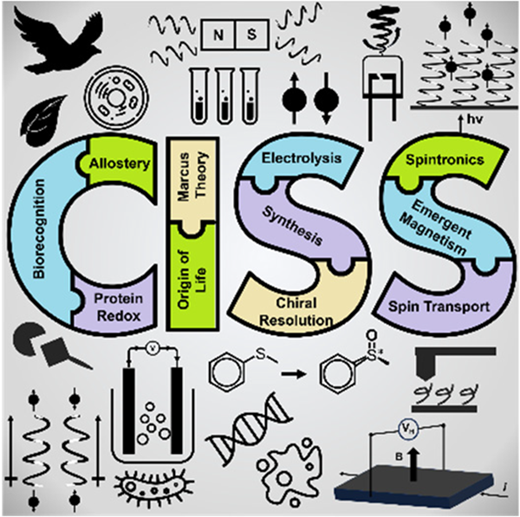
Abstract -- Since the initial landmark study on the chiral induced spin selectivity (CISS) effect in 1999, considerable experimental and theoretical efforts have been made to understand the physical underpinnings and mechanistic features of this interesting phenomenon. As first formulated, the CISS effect refers to the innate ability of chiral materials to act as spin filters for electron transport; however, more recent experiments demonstrate that displacement currents arising from charge polarization of chiral molecules lead to spin polarization without the need for net charge flow. With its identification of a fundamental connection between chiral symmetry and electron spin in molecules and materials, CISS promises profound and ubiquitous implications for existing technologies and new approaches to answering age old questions, such as the homochiral nature of life. This review begins with a discussion of the different methods for measuring CISS and then provides a comprehensive overview of molecules and materials known to exhibit CISS-based phenomena before proceeding to identify structure–property relations and to delineate the leading theoretical models for the CISS effect. Next, it identifies some implications of CISS in physics, chemistry, and biology. The discussion ends with a critical assessment of the CISS field and some comments on its future outlook.
Visual Abstract
https://www.nature.com/articles/s43246-026-01272-0
Chiral-induced spin selectivity in chiral solid-state materials for biomedical engineering
Rui Gao, Dan Meng & Xiongbin Lu
Chirality-induced spin selectivity (CISS) refers to multiple phenomena where the chirality of a chemical compound influences the spin of transmitted or emitted electrons. This effect was discovered by Ron Naaman and co-workers.[1]
Experiments were able to demonstrate the effect in the form of polarization of electrons scattered from chiral molecules, spin-dependent transmission probabilities through layers of chiral molecules, spin-selectivity of electron-transport in a chiral medium and enantio-selectivity in chemical reactions induced by spin-polarized electrons.[2]
Theoretical models were able to qualitatively explain the effect using spin-orbit coupling (SOC). But quantitatively, the predicted effect was always orders of magnitude smaller than what was measured in experiments. Whilst mechanism underlying CISS is not completely understood, a hybrid method comprising a film of pure gold with chiral molecules on it has produced results on par with the magnetic method.[3]
In 2025, Huang et al. reported voltage-controlled interfacial chirality in an otherwise achiral molybdenum disulfide surface by using an electric double-layer transistor with enantiopure ionic liquids; the induced state was detected through CISS and the electrical magnetochiral effect.[4]
https://www.nature.com/articles/s43246-026-01272-0
Chiral-induced spin selectivity in chiral solid-state materials for biomedical engineering
Rui Gao, Dan Meng & Xiongbin Lu
Chirality-induced spin selectivity (CISS) refers to multiple phenomena where the chirality of a chemical compound influences the spin of transmitted or emitted electrons. This effect was discovered by Ron Naaman and co-workers.[1]
Experiments were able to demonstrate the effect in the form of polarization of electrons scattered from chiral molecules, spin-dependent transmission probabilities through layers of chiral molecules, spin-selectivity of electron-transport in a chiral medium and enantio-selectivity in chemical reactions induced by spin-polarized electrons.[2]
Theoretical models were able to qualitatively explain the effect using spin-orbit coupling (SOC). But quantitatively, the predicted effect was always orders of magnitude smaller than what was measured in experiments. Whilst mechanism underlying CISS is not completely understood, a hybrid method comprising a film of pure gold with chiral molecules on it has produced results on par with the magnetic method.[3]
In 2025, Huang et al. reported voltage-controlled interfacial chirality in an otherwise achiral molybdenum disulfide surface by using an electric double-layer transistor with enantiopure ionic liquids; the induced state was detected through CISS and the electrical magnetochiral effect.[4]
Patents
SINGLE-PHOTON GENERATOR INCLUDING METAL NANOPARTICLES HAVING CHIRAL STRUCTURE AND TWO-DIMENSIONAL TRANSITION METAL DICHALCOGENIDE LAYER AND MANUFACTURING METHOD THEREOF
WO2026100850
Construction method of self-similar structure two-dimensional chiral metamaterial with sound insulation and shock absorption functions
CN122245538
Composite flapping wing structure based on chiral/anti-chiral core layer
CN122009454
Multi-directional impact-resistant paper-cut-origami synergistic metamaterial
CN122014779
Design method of disordered multifunctional metamaterial structure with low-frequency vibration isolation and negative Poisson's ratio effects
CN121963984
Tetra-chiral structure-based flexoelectric metamaterial
CN121922271
Different-chirality spliced variable-stiffness negative poisson ratio metamaterial structure
CN121897689
Rigidity-variable compression-torsion chiral metamaterial cell element based on integrated molding
CN121854550
Efficient three-dimensional spiral metamaterial optical device for chiral resolution of vortex beam
CN121784870
Novel reinforced hollow blade filled with chiral metamaterial lattice structure
CN121676478
Chiral liquid crystal superstructure for luminous object charge regulation and control and preparation method and application of chiral liquid crystal superstructure
CN121673652
Vanadium dioxide-based terahertz broadband chiral absorber capable of being actively regulated and controlled
CN121584271
Chiral metamaterial vibration reduction structure for high-speed train floor and preparation method of chiral metamaterial vibration reduction structure
CN121520328
Tunable narrow-band chiral metamaterial surface based on silicon and germanium antimony tellurium composite nanostructure
CN121522909
Tuned mass inertial damper of arch bridge suspender and optimization design method of tuned mass inertial damper
CN121473229
Tuned mass inertial torsional damper for rigid suspender of arch bridge and optimization design method thereof
CN121451498
Bifunctional chiral super-structure surface capable of switching polarization conversion and wave absorption
CN121332179
Ternary coupling enhanced perovskite chiral metamaterial and preparation system and method thereof
CN121248153
Chiral composite negative Poisson's ratio metamaterial
CN121111926
Star-shaped chiral impact-resistant energy-absorbing metamaterial and adjustment method of metamaterial structure
CN120946728
Curvature rod piece structure design method and system and rod piece structure application
CN120911031
Negative Poisson's ratio metamaterial wedge-shaped bottom
CN120828905
Aperiodic chiral mechanical metamaterial implementation method
CN120781587
Chiral metamaterial absorber for multifunctional sensing and preparation method thereof
CN120779504
Negative Poisson's ratio mechanical metamaterial anti-collision energy-absorbing device
CN223411334
Electromagnetic wave absorber with wave-transparent window capable of being dynamically opened and closed
CN223285279
Lightweight helicopter undercarriage based on mechanical metamaterial
CN120482348
Total space vector vortex generator
CN120262026
Energy-absorbing three-dimensional metamaterial with interactively combined positive and negative Poisson's ratio structures
CN120212178
Anti-tri-chiral structure-based flexoelectric metamaterial
CN120145772
Chiral metamaterial sensor based on vanadium dioxide
CN120142235
Two-dimensional light path device based on hyperbolic anisotropic metamaterial
CN120065383
Flexible chiral metasurface with tunable circular dichroism and polarization conversion function
CN119944313
Damping wheel of auxetic metamaterial sandwich thickness gradient structure
CN119911034
Chiral transmission device based on metamaterial waveguide
CN119556379
Metamaterial cell based on independent chiral distortion unit and metamaterial structure
CN119508403
Pressure contact type chiral-negative Poisson's ratio regulation and control acoustic metamaterial
CN119479600
Manufacturing method for space station protection structure and space station protection structure
CN119427808
Design method of spin selective absorption switch based on three-dimensional chiral metamaterial
CN119401137
Absorption and transmission integrated metamaterial structure with wave-transparent window capable of being dynamically opened and closed
CN119297612
Topological chiral vibration reduction metamaterial structure controlled by gyroscope
CN118998251
Manufacturing method of metamaterial using deformation of nucleic acid origami structure
KR20240160417
Variable stiffness unit, variable stiffness metamaterial and mechanical metamaterial
CN118815892
Self-balancing chiral metamaterial pipeline for low-frequency vibration isolation
CN118669642
Chiral-rhombic mechanical metamaterial based on mass amplification
CN118629378
Total-space transmission and reflection integrated multifunctional passive super-structure surface
CN118523089
Bionic metamaterial wide-spectrum polarized photoelectric detection integrated assembly and preparation method thereof
CN118366977
4D printing chiral superstructure heterogeneous stacked anisotropic deformable bearing structure
CN118287674
Three-dimensional four-chiral pressure-torsion metamaterial structure and manufacturing method thereof
CN118274058
Holographic metamaterial negative film and preparation system and method of holographic metamaterial optical device
CN118259511
Electric tower anti-collision device based on chiral mechanical metamaterial
CN117845805
Anti-chiral metamaterial research method based on NSGA-II optimization algorithm
CN117831679
Dual-band polarization converter based on chiral metasurface
CN117767017
Sole, performance adjusting method thereof and sports shoes
CN117322702
PHOTODETECTOR PIXEL, PHOTODETECTOR AND METHODS OF FORMING THE SAME
US202528376
Preparation method and application of metal detection wafer
CN117042573
Nano-scale chiral Swiss roll array continuous film, preparation method and application of nano-scale chiral Swiss roll array continuous film in polarization sensitive photocatalysis
CN116904932
Bionic net-shaped metamaterial based on three-dimensional horseshoe-shaped microstructure
CN116753449
Mechanical property database and numerical calculation method based on chiral lattice structure
CN116721722
Preparation method of laser direct writing type chiral terahertz metamaterial based on graphene film
CN116565571
Torsion angle measuring clamp for compression torsion mechanical test of chiral mechanical metamaterial
CN116026678
Electric power equipment real-time high temperature early warning system based on tubular chiral thermodynamic metamaterial
CN115824440
Chiral mechanical metamaterial structure with compression torsion coupling and swelling torsion coupling
CN115750643
A MECHANICAL METAMATERIAL WITH IMPROVING COMPRESSIVE RESPONSES
TWI793952
Chiral mechanical metamaterial sandwich structure without torsion size effect and application thereof
CN115691719
Frequency selective surface based on continuous fiber 3D printing and design and manufacturing method
CN115513668
Discrete macroscopic metamaterial systems
US2022290570
Chiral metamaterial unit and array for tunable multi-polarization conversion
CN115020988
Chiral metamaterial unit and array capable of tuning linear circular polarization conversion
CN115020989
Dual-frequency, dual-circular-polarization and high-isolation Fabry-Perot cavity MIMO antenna and processing method thereof
CN114843772
Underwater sound insulation metamaterial based on chiral structure
CN114724536
Optical diode based on asymmetric reflection of single-layer external chiral metasurface
CN114236648
Chiral serine identification method based on S-shaped mirror image structure terahertz metamaterial
CN114034659
NONMAGNETIC WAVEGUIDE TYPE ISOLATOR
JP2021193437
Structural design method of chiral acoustic metamaterial plate
CN113806975
Three-dimensional chiral acoustic metamaterial with high bearing capacity and low broadband vibration suppression performance
CN113808562
PLASMONIC META-SURFACE BASED MOLECULAR SENSORS AND METHODS FOR MAKING AND USING THEM
US2021373009
Z-shaped compression-torsion metamaterial structure
CN214226520
Chiral metamaterial circular polarization laser
CN113381277
Convertible external chiral terahertz metamaterial unit and device based on vanadium dioxide
CN113285232
Dynamic polarization regulation and control device based on anisotropic chiral metamaterial
CN113267901
Carbon matrix spiral chiral sequence metamaterial with abnormal ferromagnetic property and preparation method and application thereof
CN112938928
Lattice structure design for buckling driving large-angle torsion
CN112836250
Z-shaped compression-torsion metamaterial structure
CN112820362
Spatial chiral compression-torsion super-structure material
CN112693108
Polarization device based on diffraction chiral metamaterial and preparation method thereof and optoelectronic device
CN112630869
Micro-cavity with chiral polarization selectivity as well as preparation method and application thereof
CN112558294
Design method of chiral metamaterial structure with predetermined negative Poisson's ratio characteristic
CN112307663
Chiral auxetic metamaterial structure with compression-shear coupling characteristic and preparation method thereof
CN112045990
Chiral auxetic metamaterial structure with tension-torsion coupling characteristics and preparation method thereof
CN112049886
Controllable chiral structure based on GST phase change material temperature control and control method
CN111965849
Metamaterial polarization conversion device with chiral optical activity
CN111948750
Chiral metamaterial structure with asymmetric transmission characteristic and design method
CN111817013
Terahertz chiral metamaterial wave absorber with flexible substrate and manufacturing method
CN111490355
Integrated high extinction ratio infrared circular polarization detector and design method
CN111293188
Medium-infrared-band double-channel multi-information chiral tunable graphene metamaterial
CN110441926
Three-dimensional chiral spherical structure, metamaterial and use method thereof
CN110299617
Refractive index sensor and preparation method thereof
CN110186872
Novel three-dimensional cellular metamaterial with local tension-torsion coupling effect
CN109822981
Chiral microwave absorbing metamaterial and preparation and application thereof
CN109786973
Method for calculating spontaneous emission rate of two-level atoms near chiral metamaterial interface
CN109273057
Adjustable chiral unit, metamaterial and application method based on pin diode
CN109256621
Vibration absorber based on tension-torsion coupling metamaterial structure
CN108386472
QUASI-PLANAR CHIRAL METAMATERIAL
KR20180085314
Super material structure of glassy metal with chirality micro -structure
CN206799718
Metal glass metamaterial with chiral microstructure
CN107012409
Intrinsic electromagnetic metamaterial meta-surface capable of supporting TE (transverse electric) surface waves and TM (transverse magnetic) surface waves
CN106684569
Microwave band dual-layer metal wire structural chirality super surface
CN106058477
MESHED CHIRAL METAMATERIAL
KR20160113339
LEFT-HANDED CIRCULAR POLARISATION CONVERSION METAMATERIAL THIN FILM
WO2017020792
Chiral metamaterial micro unit structure with 90-degree polarization deflection characteristic
CN105140652
Gradually varied spiral metal chiral metamaterial circular polarizer
CN105137520
RIGHT-HANDED CIRCULAR POLARISATION CONVERSION METAMATERIAL THIN FILM
WO2017020791
Circularly-polarized horn antenna based on C waveband
CN104953293
Spiral-like metal chiral metamaterial circular polarizer
CN104865628
Double-L-shaped chiral metamaterial micro-unit structure with asymmetric transmission feature
CN104600434
Circular dichroism method and apparatus using negative index metamaterials
KR101494326
Microwave frequency band three-frequency-point polarization-independent 90-degree polarized revolver and application thereof
CN103715477
DOPED CHIRAL POLYMER METAMATERIALS
US2014017480
GYROTROPIC METAMATERIAL STRUCTURE
WO2013010071 ***
ACTIVE CHIRAL PHOTONIC METAMATERIAL
US2011141541
Chiral Metamaterials
US2010141358
MagnetoOptics
/Gyroptics
***Wikipedia.org
Magneto-optic effect
A magneto-optic effect is any one of a number of phenomena in which an electromagnetic wave propagates through a medium that has been altered by the presence of a quasistatic magnetic field. In such a medium, which is also called gyrotropic or gyromagnetic, left- and right-rotating elliptical polarizations can propagate at different speeds, leading to a number of important phenomena. When light is transmitted through a layer of magneto-optic material, the result is called the Faraday effect: the plane of polarization can be rotated, forming a Faraday rotator. The results of reflection from a magneto-optic material are known as the magneto-optic Kerr effect (not to be confused with the nonlinear Kerr effect).
In general, magneto-optic effects break time reversal symmetry locally (i.e., when only the propagation of light, and not the source of the magnetic field, is considered) as well as Lorentz reciprocity, which is a necessary condition to construct devices such as optical isolators (through which light passes in one direction but not the other).
Two gyrotropic materials with reversed rotation directions of the two principal polarizations, corresponding to complex-conjugate ε tensors for lossless media, are called optical isomers...
https://journals.aps.org/prl/abstract/10.1103/vxtm-kgrx
Phys. Rev. Lett. 135, 246704 – Published 12 December, 2025
DOI: https://doi.org/10.1103/vxtm-kgrx
Gyrotropic Magnetic Effect in Metallic Chiral Magnets
Nisarga Paul, Takamori Park, Jung Hoon Han, and Leon Balents
Abstract -- We study the gyrotropic magnetic effect (GME), the low-frequency limit of optical gyrotropy, in metals and semimetals coupled to chiral spin textures. In these systems, the chiral spin texture which lacks inversion symmetry can imprint itself upon the electronic structure through Hund’s coupling, leading to novel low-frequency optical activity. Using perturbation theory and numerical diagonalization of both relativistic and nonrelativistic models of conduction electrons coupled to spin textures, we analyze how the GME manifests in both single-𝑞
and multi-𝑞 textures. Analytical expressions for the rotatory power are derived in terms of universal scaling functions. Estimates based on realistic material parameters reveal an experimentally viable range of values for the rotatory power. The GME arises from the orbital and spin magnetic moments of conduction electrons, with the orbital part closely tied to Berry curvature and playing a significant role in relativistic metals but not so in nonrelativistic metals where there is no inherent Berry curvature. The spin contribution to the GME can be significant in nonrelativistic metals with a large Fermi energy. Our Letter shows that the GME can be a sensitive probe of magnetic chirality and symmetry breaking in metallic chiral magnets.
https://arxiv.org/abs/2601.04787
Intrinsic Gyrotropic Magnetic Current of Orbital Origin
Koushik Ghorai, Sankar Sarkar, Amit Agarwal
Abstract -- In gyrotropic crystals, an oscillating magnetic field induces a charge response known as the gyrotropic magnetic current. While its conventional origin is attributed to magnetic field modified band energy and shift in the Fermi-surface, a recent study identified an additional spin-driven magnetic displacement contribution. Here, we complete the picture by identifying the orbital counterpart of the magnetic displacement current. Using a density-matrix formulation that incorporates both minimal coupling and spin-Zeeman interactions, we derive the electronic equations of motion in the presence of an oscillating magnetic field and uncover a previously unexplored orbital contribution to the wavepacket velocity. Physically, this contribution arises from the time variation of the magnetic-field induced charge polarization. In the low frequency transport regime, this mechanism becomes purely intrinsic. We illustrate this intrinsic gyrotropic current of orbital origin in the PT-symmetric antiferromagnet CuMnAs. We show that the intrinsic gyrotropic magnetic current reverses sign upon Néel vector reversal, establishing it as a direct probe of antiferromagnetic order in CuMnAs and other PT-symmetric antiferromagnets.
https://www.nature.com/articles/s41598-023-48503-9
Scientific Reports volume 13, Article number: 21986 (2023)
Giant enhancement of nonreciprocity in gyrotropic heterostructures
Ioannis Katsantonis, Anna C. Tasolamprou, Thomas Koschny, Eleftherios N. Economou, Maria Kafesaki & Constantinos Valagiannopoulos
Abstract -- Nonreciprocity is a highly desirable feature in photonic media since it allows for control over the traveling electromagnetic waves, in a way that goes far beyond ordinary filtering. One of the most conventional ways to achieve nonreciprocity is via employing gyrotropic materials; however, their time-reversal-symmetry-breaking effects are very weak and, hence, large, bulky setups combined with very strong magnetic biases are required for technologically useful devices. In this work, artificial heterostructures are introduced to enhance the effective nonreciprocal behavior by reducing the contribution of the diagonal susceptibilities in the collective response; in this way, the off-diagonal ones, that are responsible for nonreciprocity, seem bigger. In particular, alternating gyrotropic and metallic or plasmonic films make an epsilon-near-zero (ENZ) effective-medium by averaging the diagonal permittivities of opposite sign, representing the consecutive layers. The homogenization process leaves unaltered the nonzero off-diagonal permittivities of the original gyrotropic substance, which become dominant and ignite strong nonreciprocal response. Realistic material examples that could be implemented experimentally in the mid-infrared spectrum are provided while the robustness of the enhanced nonreciprocity in the presence of actual media losses is discussed and bandwidth limitations due to the unavoidable frequency dispersion are elaborated. The proposed concept can be extensively utilized in designing optical devices that serve a wide range of applications from signal isolation and wave circulation to unidirectional propagation and asymmetric power amplification.
https://meep.readthedocs.io/en/latest/Scheme_Tutorials/Gyrotropic_Media/
Gyrotropic Media
In this example, we will perform simulations with gyrotropic media. See Materials for more information on how gyrotropy is supported....
Gyrotropic Crystals as a Basis for Creation of Helical Polychromatic Singular Beams
by Yuriy Egorov and Alexander Rubass
[ PDF ]
Abstract -- In this work, studies are carried out in the field of optical singular beams that have passed through gyrotropic crystals. We have experimentally shown that singular beams with a helical intensity distribution are formed when passing through a system of two gyrotropic crystals with opposite values of the gyration coefficient. It is shown that the system is capable of generating optical vortices with a double topological charge in one of the components of circular polarization when light propagates through two gyrotropic crystals.
https://ui.adsabs.harvard.edu/abs/2022APS..DPPPO7003R/abstract
Topological Edge States in Tunable Bulk Gyrotropic Media Composed of Magnetized Low-Temperature Plasma Discharges
Rodriguez, Jesse ; Houriez, Luc ; Mehrpour-Bernety, Hossein ; Cappelli, Mark
Abstract -- Gyrotropic media exhibit several interesting electromagnetic properties, including topologically protected edge states that allow for one-way, back-scattering immune propagation of interfacial electromagnetic waves. Unfortunately, such media are challenging to create for engineering applications since the use of ferromagnetic (gyrotropic) materials limit the range of operating frequencies and a homogeneous bulk magnetized plasma is difficult to produce in practice. In this presentation, we show how a tunable bulk gyrotropic medium can be constructed using magnetized low-temperature plasma discharge tubes in a two-dimensional photonic crystal configuration. Experiments are performed for microwave frequencies in the range of 2-10 GHz. Band structures for both the magnetized and unmagnetized case are compared and confirmed via experimental transmission measurements and numerical simulations of the actual device. Evidence for topologically-protected edge states from local field measurements is presented.
https://www.chess.cornell.edu/spontaneous-gyrotropic-electronic-order-1-tise2
Spontaneous Gyrotropic Electronic Order in 1?-TiSe₂
Elke Arenholz, CHESS
Abstract -- ..Now, a team of researchers lead by Nuh Gedik’s group (MIT) have demonstrated spontaneous chiral symmetry breaking by electrons in a material called 1T-TiSe2, despite its non-chiral crystal structure. They employed a new measurement technique, the “circular photogalvanic effect”: A change in photocurrent is measured when the helicity of light is flipped, which can only occur if the electrons in the material are chiral.
https://pubmed.ncbi.nlm.nih.gov/32103195/
Nature. 2020 Feb;578(7796):545-549.
doi: 10.1038/s41586-020-2011-8. Epub 2020 Feb 26.
Spontaneous gyrotropic electronic order in a transition-metal dichalcogenide
Su-Yang Xu et al
Abstract -- Chirality is ubiquitous in nature, and populations of opposite chiralities are surprisingly asymmetric at fundamental levels1,2. Examples range from parity violation in the subatomic weak force to homochirality in biomolecules. The ability to achieve chirality-selective synthesis (chiral induction) is of great importance in stereochemistry, molecular biology and pharmacology2. In condensed matter physics, a crystalline electronic system is geometrically chiral when it lacks mirror planes, space-inversion centres or rotoinversion axes1. Typically, geometrical chirality is predefined by the chiral lattice structure of a material, which is fixed on formation of the crystal. By contrast, in materials with gyrotropic order3-6, electrons spontaneously organize themselves to exhibit macroscopic chirality in an originally achiral lattice. Although such order-which has been proposed as the quantum analogue of cholesteric liquid crystals-has attracted considerable interest3-15, no clear observation or manipulation of gyrotropic order has been achieved so far. Here we report the realization of optical chiral induction and the observation of a gyrotropically ordered phase in the transition-metal dichalcogenide semimetal 1T-TiSe2. We show that shining mid-infrared circularly polarized light on 1T-TiSe2 while cooling it below the critical temperature leads to the preferential formation of one chiral domain. The chirality of this state is confirmed by the measurement of an out-of-plane circular photogalvanic current, the direction of which depends on the optical induction. Although the role of domain walls requires further investigation with local probes, the methodology demonstrated here can be applied to realize and control chiral electronic phases in other quantum materials4,16.
opg.optica.org/oe/fulltext.cfm?uri=oe-33-12-24370c
Magnet-less gyrotropy using time-periodic modulation of permittivity
Somayeh Boshgazi, Khashayar Mehrany, and Mohammad Memarian
[ PDF ]
Abstract -- Time-varying (TV) media in electromagnetics have unlocked new paths to important electromagnetic effects such as non-reciprocity, frequency conversion, and parametric amplification. In light of such advances over the past decade, a curious question arises as to whether chirality or/and gyrotropy, may also be achieved using TV dielectrics. In this paper, we propose a suitable time-modulation of the permittivity tensor in a static achiral and non-gyrotropic crystal and thereby emulate gyrotropy without the need of magnetic materials and external magnetic bias field. The emulated gyrotropy is owed to the temporal rotation of the principal axes of the permittivity tensor, which sustains only circularly/elliptically polarized eigenmodes. A possible realization using modulated electro-optic effects in a nonlinear crystal is proposed, showing a feasible approach to realize gyrotropy by time variation in non-magnetic achiral media.
https://journals.iucr.org/paper?a18430
Acta Cryst. (1980). A36, 760-762
https://doi.org/10.1107/S0567739480001532
The acoustic gyrotropic tensor in crystals
K. Kumaraswamy and N. Krishnamurthy
Abstract -- The acoustic gyrotropic tensor is a fifth-rank tensor characterized by dij, l = -dji, l, with i, j = 11, 22, 33, (23, 32), (31, 13), (12, 21), l = 1, 2, 3, and controls the acoustical activity in crystals. With the employment of group theoretical methods, the number of independent coefficients of this tensor and the character for this tensor under proper and improper rotation are worked out. A classification of the acoustically active classes is given.
https://scipost.org/SciPostPhys.16.2.055/pdf
Nonreciprocal superconducting transport and the spin Hall effect in gyrotropic structures
Tim Kokkeler, Ilya Tokatl, F. Sebastian Bergeret
Abstract -- The search for superconducting systems exhibiting nonreciprocal transport and, specifically, the diode effect, has proliferated in recent years. This trend has encompassed a wide variety of systems, including planar hybrid structures, asymmetric SQUIDs, and certain noncentrosymmetric superconductors. A common feature of such systems is a gyrotropic symmetry, realized on different scales and characterized by a polar vector. Alongside time-reversal symmetry breaking, the presence of a polar axis allows for magnetoelectric effects, which, when combined with proximity-induced superconductivity, results in spontaneous non-dissipative currents that underpin the superconducting diode effect. With this symmetry established, we present a comprehensive theoretical study of transport in a lateral Josephson junction composed of a normal metal support- ing the spin Hall effect, and attached to a ferromagnetic insulator. Due to the presence of the latter, magnetoelectric effects arise without requiring external magnetic fields. We determine the dependence of the anomalous currents on the spin relaxation length
and the transport parameters commonly used in spintronics to characterize the interface between the metal and the ferromagnetic insulator. Therefore, our theory naturally unifies nonreciprocal transport in superconducting systems with classical spintronic effects, such as the spin Hall effect, spin galvanic effect, and spin Hall magnetoresistance. We propose an experiment involving measurements of magnetoresistance in the normal state and nonreciprocal transport in the superconducting state. Such experiment would, on the one hand, allow for determining the parameters of the model and thus verifying with a greater precision the theories of magnetoelectric effects in normal systems. Ons the other hand, it would contribute to a deeper understanding of the underlying microcopic origins that determine these parameters.
https://www.worldscientific.com/doi/pdf/10.1142/9789812709547_0024?download=true&srsltid=AfmBOoqNrqOpEFuxYAi4OhQ3xdAfUnvo9Xv5qvI6FTSuK-i3T5Dro9YP
https://doi.org/10.1142/9789812709547_0024
Distinctive feature of 1D anisotropic and gyrotropic photonic crystals
Alexey P. Vinogradov et al
Abstract:-- The magneto-optical properties of 1D photonic crystals (PC) are considered. The consideration is focused on the distinctive features of 1D PCs because any devices made on the base of 1D PC are more robust for losses than those employing 2D or 3D PC. To make better off the properties of comparative simple 1D geometry we suggest the usage of anisotropic and gyrotropic materials. Firstly, such PCs exhibit new physical phenomena, namely, formation of the Yeh band gaps, magnetooptical and birefringence effects. Secondly, since the anisotropy and gyrotropy are easy caused by the external electric and magnetic fields the new properties of the PCs are tunable. The functioning of switchable filter, magnetic superlens and other devices are considered.
https://openurl.ebsco.com/EPDB%3Agcd%3A14%3A23004686/detailv2?sid=ebsco%3Aplink%3Acrawler-gcd&id=ebsco%3Agcd%3A162435617&crl=c&jrnl=00213640&link_origin=none
Gyrotropic Oscillations of Magnetic Vortices in Two Interacting Ferromagnetic Disks.
Skorokhodov, E. V.; Tatarskiy, D. A.; Gorev, R. V.; Mironov, V. L.; Fraerman, A. A.
Abstract -- The gyrotropic motion of vortex magnetization distributions in two coupled ferromagnetic disks has been experimentally studied and numerically simulated. The dependence of the resonant frequency of the collective gyrotropic oscillation mode of vortices on the distance between the centers of disks has been studied by magnetic resonance force spectroscopy. The energy of the interaction of magnetic vortices as a function of the distance between disks has been estimated from this dependence using solutions of the Thiele equation.