Stefan MARINOV
Magnetic
Vortex Hyper-Ionization Device ( MAGVID )
http://www.tuks.nl/pdf/Reference_Material/MarinovMotor/Bujic%20-%20Stefan%20Marinov%20and%20his%20Magnetic%20Vortex%20Device.pdf
Stefan Marinov's Magnetic Vortex Hyper-Ionization Device (MAGVID)
[ PDF ]
https://www.youtube.com/watch?v=iTuDrJVzCpo
The Marinov motor : A very peculiar machine.
This video shows three versions of the Marinov motor ( Siberian Coliu) which I have constructed using 3D printed parts. The motor is paradoxical because it is designed in such a way that the magnetic flux cutting the rotor is minimized by using an enclosed torus shaped magnet. It has been argued by several authors, including Marinov, that the device operates via the vector A potential, or even the Aharonov Bohm effect. Others have argued that it is driven by flux leakage. My purpose was to show that the machine works and works well, reaching speeds of several hundred RPM at moderate power inputs of a few watts.
https://www.youtube.com/watch?v=HwZXhUZyroA
Stefan Marinov motor / generator anti-Lenz test
In this follow on from my first Marinov motor video, I construct a 3D printed generator based on Stefan Marinov's Siberian Coliu design. My version uses a novel two magnetic torus rotor to allow the use of a continuous coil stator of 150 turns. This allows the generator to have a decent power output of several hundred mW at 2200 RPM, enough to test Marinov's claimed anti-Lenz effect. I do observe that current is generated in the same direction as the drive voltage, but when the generator is loaded with a resistor, the drive motor looses speed and starts drawing more current, suggesting that Lenz's law is operating as expected.
https://www.youtube.com/watch?v=DjKhggNJGls
Ball Bearing Motor - How to Make/How it Works // RimstarOrg
A ball bearing motor, showing how to make one and how it works. I use roller bearings from which I've removed the grease and a piece of wood for the flywheel. For the low voltage, high current I use a microwave oven transformer. This is sometimes also called a Marinov motor.
https://www.youtube.com/watch?v=bUV9MOS49FM
Not Deployed Until Needed // Ashton Forbes
Magnetic vortex propulsion, plasma shielding, and Doppler-based cloaking may already exist...just not in public view.
This breakdown explores the suppressed science behind teleporting craft, time-dilation effects, and the bending of electromagnetic perception. From inertial mass reduction to faster-than-light communication, the physics suggest this technology is real, functional, and fully developed… but not deployed until needed. [ S. Marinov ]
https://1lib.sk/book/37845805/6f8f84/the-coordinate-transformations-of-the-absolute-spacetime-theory.html
The coordinate transformations of the absolute space-time theory
Stefan Marinov
[ PDF ]
https://1lib.sk/book/38452947/d87d99/velocity-of-light-in-a-moving-medium-according-to-the-absolute-spacetime-theory.html
Velocity of light in a moving medium according to the absolute space-time theory
Stefan Marinov
[ PDF ]
https://1lib.sk/book/37854612/0dbda6/the-light-doppler-effect-treated-by-absolute-spacetime-theory.html
The light Doppler effect treated by absolute spacetime theory
[ PDF ]
https://1lib.sk/book/37845756/36af69/rotating-disk-experiments.html
Rotating disk experiments
[ PDF ]
https://1lib.sk/book/37851958/e844ba/gravitational-dynamic-time-dilation-according-to-absolute-spacetime-theory.html
Gravitational (dynamic) time dilation according to absolute space-time theory
[ PDF ]
https://1lib.sk/book/37868940/101ee9/are-phonons-particles.html
Are phonons particles?
S. Marinov
[ PDF ]
https://1lib.sk/book/37845783/9b2fe2/concerning-santos-experiment-to-test-special-relativity.html
Concerning Santos' experiment to test special relativity
S. Marinov
[ PDF ]
https://1lib.sk/book/34423429/6b4954/a-pure-experiment-to-establish-that-the-velocity-of-light-does-not-depend-on-the-velocity-of-the-sou.html
A pure experiment to establish that the velocity of light does not depend on the velocity of the source
Stefan Marinov
[ PDF ]
https://1lib.sk/book/37866619/626c60/problems-of-synchronization-in-special-relativity-a-reply-to-g-cavalleri-and-g-spinelli.html
Problems of synchronization in special relativity: A reply to G. Cavalleri and G. Spinelli
[ PDF ]
https://1lib.sk/book/38452785/757193/the-secondorder-effects-in-the-rotating-disk-experiment.html
The second-order effects in the “rotating disk” experiment
[ PDF ]
https://1lib.sk/book/37852065/788f9d/the-quasidoppler-experiment-according-to-absolute-spacetime-theory.html
The quasi-Doppler experiment according to absolute space-time theory
[ PDF ]
https://1lib.sk/book/37890827/18d389/measurement-of-the-laboratorys-absolute-velocity.html
Measurement of the Laboratory's Absolute Velocity
[ PDF ]
https://1lib.sk/book/42598967/c1f46e/stefan-marinov-wins-friends.html
Stefan Marinov wins friends
[ PDF ]
https://1lib.sk/book/38453259/a16960/the-experimental-verification-of-the-absolute-spacetime-theoryi.html
The experimental verification of the absolute space-time theory
Newtonian time synchronization with the help of light signals
[ PDF ]
https://1lib.sk/book/2371605/62a7d5/generation-of-free-momentum-and-free-energy-by-the-help-of-centrofugal-forces.html
Generation of free momentum and Free energy by the help of Centrofugal forces
Stefan Marinov
[ PDF ]
https://1lib.sk/book/3202202/b18adc/divine-elektromagnetism...html
Divine elektro-magnetism
Stefan Marinov
[ PDF ]
https://1lib.sk/book/1273318/6f7766/marinov-to-the-worlds-scientific-conscience.html
MARINOV TO THE WORLD'S SCIENTIFIC CONSCIENCE
Stefan Marinov
[ PDF ]
https://link.springer.com/article/10.1007/BF00708535
Coordinate Transformations of the Absolute Space Time Theory
Stefan Marinov
[ PDF ]
https://www.jamespaulwesley.org/Document_Files/IN_MEMORIAM_STEFAN_MARINOV_JP-Wesley.pdf
In memoriam: Stefan Marinov
[ PDF ]
https://haroldaspden.org/lectures/25.htm
LECTURE NO. 25 -- THE MARINOV MOTOR
Harold Aspden, 1998
[ htm ]
http://www.selnet.org/is1/pp-08-05.pdf
https://www.researchgate.net/publication/26447008_New_Measurement_of_the_Earth%27s_Absolute_Velocity_with_the_Help_of_the_of_the_Coupled_Shutters_Experiment
New Measurement of the Earth's Absolute Velocity with the Help of the of the "Coupled Shutters" Experiment
S. Marinov
[ PDF ]
https://archive.org/details/eppursimuoveaxiomarinovrich/page/n1/mode/2up
https://dn790008.ca.archive.org/0/items/eppursimuoveaxiomarinovrich/eppursimuoveaxiomarinovrich.pdf
Eppur si Muove : axiomatics, fundamentals and experimental verification of the absolute space-time theory
Marinov, Stefan
[ DJVU ]
https://kirkmcd.princeton.edu/examples/marinov2.pdf
Marinov’s Paradoxical Motor
Kirk T. McDonald
[ PDF ]
https://arxiv.org/abs/physics/0612201
Re-Analysis of the Marinov Light-Speed Anisotropy Experiment
Reginald T Cahill (Flinders University)
[ PDF ]
Abstract -- The anisotropy of the speed of light at 1 part in 10^3 has been detected by Michelson and Morley (1887), Miller (1925/26), Illingworth (1927), Joos (1930), Jaseja et al. (1964), Torr and Kolen (1984), De Witte (1991) and Cahill (2006) using a variety of experimental techniques, from gas-mode Michelson interferometers (with the relativistic theory for these only determined in 2002) to one-way RF coaxial cable propagation timing. All agree on the speed, right ascension and declination of the anisotropy velocity. The Stephan Marinov experiment (1984) detected a light speed anisotropy using a mechanical coupled shutters technique which has holes in co-rotating disks, essentially a one-way version of the Fizeau mechanical round-trip speed-of-light experiment. The Marinov data is re-analysed herein because the velocity vector he determined is in a very different direction to that from the above experiments. No explanation for this difference has been uncovered.
https://www.semanticscholar.org/paper/Observations-of-the-Marinov-Motor-Phipps/88a937981ae9f9663c591f9aca5db108faf122f0/figure/0
Observations of the Marinov Motor
T. Phipps
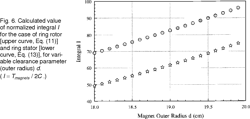
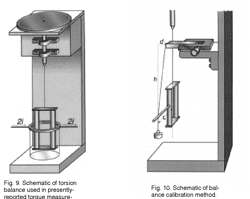
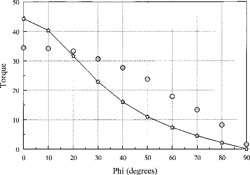
Abstract -- It is verified that the Marinov motor works and that its torque magnitude roughly agrees with the theory given by Wesley (1). The existence of this device appears to refute the widely-held belief of physicists that the Lorentz force law suffices to describe all observable electromagnetic force manifestations.
https://archive.org/details/thornywayoftruthpart1maririch
The Thorny Way of Truth , Part 1
Stefan Marinov
[ PDF ]
The Thorny Way of Truth, Part 2
Stefan Marinov
[ PDF ]
The Thorny Way of Truth, Part 3
Stefan Marinov
[ PDF ]
The Thorny Way of Truth, Part 4
Stefan Marinov
[ PDF ]
The Thorny Way of Truth, Part 5
Stefan Marinov
[ PDF ]
The Thorny Way of Truth, Part 6
Stefan Marinov
[ PDF ]
The Thorny Way of Truth, Part 7
Stefan Marinov
[ PDF ]
The Thorny Way of Truth, Part 8
Stefan Marinov
[ PDF ]
The Thorny Way of Truth, Part 9
[ PDF ]
Classical Physics
Stefan Marinov
[ PDF ]
https://grokipedia.com/page/Stefan_Marinov
Stefan Marinov


Stefan Marinov (1 February 1931 – 15 July 1997) was a Bulgarian physicist and researcher who formulated the absolute space-time theory as an empirical alternative to special relativity, proposing that light propagation occurs relative to an undetectable absolute frame revealed through anisotropies in one-way light speed measurements.[1] His key experiments, including the coupled-mirrors and toothed-wheels setups, purported to detect the solar system's velocity at approximately 300 km/s through ether drift, underpinning transformations that treat time as absolute while accommodating observed relativistic effects.[2] Marinov authored books such as Eppur Si Muove and over 50 papers, founded the journal Deutsche Physik, and invented devices like the Marinov motor—an electromagnetic apparatus claimed to generate torque without net energy input—pursuing applications in free energy generation.[3] Facing political repression in Bulgaria for scientific dissent and human rights advocacy, including arrests and forced psychiatric confinement, he emigrated in 1976 to Austria, where he persisted in marginalized research amid rejections from established journals and institutions until his suicide by defenestration from the University of Graz library, attributed to exhaustion from unrelenting opposition.[2][4]
Early Life and Education
Birth and Family BackgroundStefan Marinov was born on February 1, 1931, in Sofia, Bulgaria.[2][5] He was born into a wealthy intellectual family, with his father serving as a Bulgarian diplomat stationed in Prague, which exposed Marinov to multiple languages from an early age, including German, Bulgarian, Russian, French, Italian, Czech, Serbo-Croatian, and English.[2] Some accounts describe the family as aligned with communist intellectuals, consistent with the political context of Bulgaria following the establishment of communist rule after World War II.[6]
Academic Training and Early Influences
Stefan Marinov received his early education in Sofia, Bulgaria, where he attended primary school and developed an interest in physics through personal experiments, such as constructing electric motors around age 15.[7] He completed secondary education at the Liceo Sovietico in Prague in 1948.[7] Marinov began university studies in physics at Charles University in Prague in 1948, but these were interrupted in 1951 amid Cold War tensions, leading him to volunteer at the Varna High Navy School.[7] He resumed and completed his degree at Sofia University's Faculty of Physics and Mathematics from 1953 to 1958, obtaining a physics qualification with a focus on classical electromagnetism and theoretical physics.[7] [2] During his studies, Marinov was initially influenced by Marxist philosophy and dialectical materialism, which shaped his early worldview but which he later repudiated in favor of empirical, first-principles approaches to physics.[7] Key scientific influences included classical figures such as James Clerk Maxwell, Heinrich Hertz, Hendrik Lorentz, Galileo Galilei, Isaac Newton, Carl Friedrich Gauss, and Michael Faraday, whose works on electromagnetism and mechanics informed his foundational training.[7] His family's intellectual background, including his father's diplomatic career in Prague, also fostered multilingualism and exposure to diverse ideas, enhancing his capacity for independent research.[2]
Professional Career in Bulgaria
Academic PositionsStefan Marinov served as an assistant professor of physics in the Faculty of Physics at Sofia University from 1960 to 1974.[8] During this period, he engaged in experimental research and teaching while also maintaining an affiliation with the Institute of Physics at the Bulgarian Academy of Sciences, where he joined in 1960.[2] His tenure involved developing early experiments questioning foundational principles of modern physics, including setups related to absolute motion detection.[9] Marinov's position at Sofia University ended in 1974 following the results of his "coupled mirrors" experiment, which purported to demonstrate evidence against special relativity and prompted official backlash under the Bulgarian communist regime.[2] He was dismissed from his academic role, subjected to a second compulsory psychiatric confinement (the first occurring in 1966–1967 for regime criticism), and prohibited from seeking further employment, relying instead on a minimal pension until his departure from Bulgaria in 1976.[2] These events reflected broader suppression of nonconformist scientific inquiry in state-controlled institutions during the era.[4]
Initial Scientific Contributions
During his time at Sofia University from 1960 to 1974, Stefan Marinov served as an assistant professor of physics and conducted research within the Department of Theoretical Physics under Prof. D. I. Stoyanov.[8] In this capacity, he focused on theoretical aspects of physics, including early investigations into electromagnetic phenomena and foundational principles of mechanics. Marinov's work during this period adhered to classical frameworks while beginning to question established interpretations of relativity through empirical approaches.[2] A key aspect of his initial contributions involved devising and executing experiments to detect the absolute motion of the Earth relative to an ether-like medium, predating his more extensive independent efforts post-emigration. These setups, conducted at the university, aimed to measure directional anisotropies in light propagation and mechanical effects, positing evidence for an absolute reference frame over relativistic null results. Such endeavors, though preliminary and unpublished in mainstream Western journals due to institutional constraints in Bulgaria, laid the groundwork for his critiques of special relativity and underscored his commitment to first-principles experimentation over doctrinal acceptance.[8][2] Marinov's affiliation with the Physics Institute of the Bulgarian Academy of Sciences from 1960 further supported these pursuits, enabling access to resources for theoretical modeling and basic apparatus. However, his emerging non-conformist positions—challenging Einsteinian tenets with claims of detectable absolute motion—prompted institutional repercussions, including compulsory psychiatric confinement in 1966–1967, reflecting systemic intolerance for empirical challenges to prevailing paradigms within Soviet-influenced academia.[2] Despite this, his early experimental protocols demonstrated rigorous attention to causal mechanisms in electromagnetism and inertial frames, influencing his later self-published treatises.[8]
Emigration and Independent Research
Relocation to Western EuropeIn September 1977, following years of professional persecution in Bulgaria—including dismissal from Sofia University in 1974 and incarceration in a psychiatric clinic for his dissenting scientific views—Stefan Marinov obtained a passport and emigrated to Brussels, Belgium.[2] There, he self-published his first major work, Eppur Si Muove?, through C.B.D.S., articulating his critiques of relativity and advocacy for absolute space-time.[10] Marinov's stay in Brussels was short-lived, as he faced expulsion from Belgium, along with other Western European countries like France and Italy, due to his stateless status and activism protesting human rights abuses in Eastern Europe.[2] By 1980, after a brief period in the United States, he relocated to Graz, Austria, where he resided illegally for three years until receiving permanent residency in 1983; his Bulgarian citizenship was revoked that same year, with authorities confiscating his property.[2] To sustain himself in Graz, Marinov worked for eight years as a stable boy at a horse farm near the city, a stark contrast to his prior academic career, while continuing independent experiments and publications on ether theory and overunity devices.[2] He remained in Graz until his death in 1997, using the location as a base for disseminating his work through journals like Deutsche Physik starting in 1992.[11]
Establishment of Independent Publications and Experiments
Following his emigration from Bulgaria in September 1977, Stefan Marinov relocated initially to Brussels before settling in Graz, Austria, where he pursued self-funded research unaligned with institutional physics. Lacking access to university facilities, he established independent publishing channels to disseminate his theories and experimental data, beginning with monographs such as Classical Physics in 1981 and the multi-volume series The Thorny Way of Truth, with the first installment on restoring absolute space-time concepts appearing in 1982 through East-West Publishers in Graz.[8][12] Subsequent volumes of The Thorny Way of Truth, released through 1990, compiled documents on alleged violations of conservation laws, including interrupted-circuit experiments purportedly demonstrating overunity energy effects, all self-edited without external peer review.[7] In 1992, Marinov founded and edited the quarterly Deutsche Physik: International Glasnost Journal on Fundamental Physics, printed in limited runs from Graz, primarily to advocate for transparency ("glasnost") in foundational physics against what he viewed as dogmatic relativism. The journal, distributed via personal networks to fringe researchers, featured his articles on ether drag, absolute velocity measurements, and critiques of Maxwell's displacement current, alongside reproductions of his experimental schematics and correspondence challenging mainstream dismissals; by 1996, it had reached at least 22 issues, though circulation remained under 100 copies per edition due to its non-commercial, dissident orientation.[2][13][14] Complementing these publications, Marinov improvised laboratory setups in private quarters for experiments aimed at empirical validation of absolute space-time, eschewing grant-dependent equipment for cost-effective mechanical and optical apparatuses. His coupled-shutters device, refined post-emigration and first detailed around 1984, used co-rotating disks with synchronized apertures to probe one-way light-speed anisotropy, yielding claimed detections of Earth's velocity relative to an absolute frame at approximately 360 km/s toward the constellation Dorado; results were iteratively reported in The Thorny Way of Truth and later Deutsche Physik, with a 1992 analysis asserting consistency with classical ether models over relativistic isotropy.[15][16] These efforts, conducted solo or with minimal collaborators, prioritized replication accessibility but drew methodological critiques for potential synchronization artifacts, as noted in independent re-analyses.[15] By the mid-1990s, Marinov extended independent testing to electromagnetic motors and interrupted circuits, publishing raw data and diagrams to invite verification, though without standardized controls typical of institutional labs.[17]
Key Theories and Experimental Claims
Critique of Special RelativityStefan Marinov rejected the core postulates of special relativity, particularly the invariance of the speed of light in all inertial frames and the relativity of simultaneity, arguing instead for an absolute space-time framework where light propagates at a constant speed c relative to a stationary ether filling absolute space. In this view, all inertial frames share the same absolute time, and apparent relativistic effects arise from motion relative to the ether rather than frame equivalence. Marinov contended that special relativity's synchronization conventions artificially conceal detectable anisotropies in light propagation, leading to causal inconsistencies and paradoxes, such as acausal signaling in certain thought experiments. He derived alternative formulas for phenomena like the Doppler effect within absolute space-time, predicting directional dependencies that differ from relativistic predictions by terms of order v/c, where v is the observer's absolute velocity.[18][19] Marinov's experimental critiques focused on direct measurements of one-way light speed anisotropy to demonstrate a preferred absolute frame, claiming these invalidated special relativity's empirical basis. In his 1974 coupled-mirrors experiment, he used rotating mirrors to compare light travel times in opposite directions, reporting a small but detectable difference attributable to Earth's motion through the ether, which he interpreted as evidence against isotropic light speed in the lab frame. This setup, refined in later "coupled shutters" variants with co-rotating disks featuring apertures, aimed to eliminate conventional synchronization biases; Marinov reported anisotropies consistent with an absolute velocity of approximately 370 km/s for Earth, directed toward the constellation Leo. These results, he argued, refuted the null outcome of the Michelson-Morley experiment by addressing alleged flaws like ether drag, while aligning with a Newtonian-like ether model modified for second-order effects.[2][15][16] Further challenging special relativity, Marinov proposed seasonal puzzles involving voltage induction in moving conductors under varying solar illumination, predicting polarity shifts that relativity would not produce without an absolute frame. He analyzed these as implying ether-mediated influences on electromagnetic induction, contradicting the frame-independent Lorentz transformations. Marinov also critiqued experiments like Santos' fiber-optic test, deriving null results under absolute space-time that highlighted relativity's dependence on arbitrary clock synchronization, which he deemed unphysical and masking true causal propagation in absolute space. Despite these claims, Marinov's interpretations relied on assumptions of mechanical rigidity and ether properties that mainstream analyses attributed to overlooked systematic errors, such as disk imperfections or refractive effects, rather than disproof of relativity.[20][21]
Absolute Ether and Space-Time Concepts
Marinov's absolute space-time theory posited the existence of an absolute space as a universal reference frame, distinct from the relative frames of special relativity, in which the speed of light propagates isotropically at a constant value c in all directions. This absolute space serves as the rest frame of a luminiferous ether, reviving a modified version of 19th-century ether conceptions where the medium drags partially with moving bodies according to a Fresnel-like coefficient, but without physical length contraction.[18][22] The theory's core postulate asserts that light velocity constancy holds solely relative to this absolute frame, enabling detection of absolute motion through one-way light speed anisotropy, which averages to c for round-trip measurements, thus reconciling null results in experiments like Michelson-Morley.[23][16] In contrast to Newtonian absolute space, Marinov's framework incorporates second-order effects in v/c (where v is velocity relative to absolute space), yielding a "aether-Marinov model" of propagation that predicts deviations from classical ether drag in high-precision tests.[16][24] Time remains absolute and universal, but kinematic dilation occurs as an objective effect proportional to the difference in absolute velocities of clocks, independent of relative motion between observers.[10] Gravitational time dilation, termed "dynamic," arises from ether density gradients induced by mass, slowing clocks in stronger fields without curving space-time geometry.[25] Marinov detailed coordinate transformations for this theory, replacing Lorentz boosts with mappings that preserve absolute simultaneity and allow direct measurement of velocity against the ether frame, as outlined in his 1979 publication.[1] These transformations underpin explanations for phenomena like the Doppler effect and Sagnac phase shifts, attributing them to absolute motion rather than relativistic curvature or synchronization conventions.[18] In his 1977 monograph Eppur si muove, he axiomatized space as Euclidean and infinite, time as linear and independent, and energy as conserved within the absolute frame, claiming empirical verification through anisotropies in light and particle experiments.[26] The theory aimed to restore pre-relativistic causality by privileging ether-based propagation over vacuum invariance, predicting detectable absolute velocities on the order of 360 km/s for Earth, directed toward the constellation Leo.[8]
Perpetual Motion and Overunity Devices
Marinov maintained that the second law of thermodynamics lacks universal applicability and that perpetual motion machines of the second kind—devices producing net positive work without external input—are physically realizable through interactions with an absolute cosmic ether. In his multi-volume series The Thorny Way of Truth, published between 1984 and the early 1990s, he compiled theoretical derivations and experimental setups purporting to demonstrate violations of energy conservation, particularly via electromagnetic forces unbalanced by absolute motion relative to the ether.[27][28] These claims hinged on his rejection of relativistic principles, positing that ether drag enables asymmetric energy extraction, allowing overunity coefficients where output exceeds measurable input.[29] Central to Marinov's overunity theories was the assertion that classical electromagnetism, when accounting for absolute reference frames, permits closed-loop systems to draw indefinite energy from the ether's zero-point fluctuations or inertial fields, without entailing entropy increase in isolated setups. He cited configurations involving rotating magnets and conductors that allegedly generated self-sustaining voltages, challenging the statistical basis of thermodynamic prohibitions on such machines.[30] Marinov emphasized empirical anomalies over doctrinal adherence, arguing that mainstream dismissal stemmed from unexamined assumptions about frame invariance rather than reproducible disproof.[31] Throughout the 1990s, Marinov disseminated newsletters and conference reports endorsing overunity prototypes, including electromagnetic generators purportedly scaling to hundreds of watts without fuel, framing them as validations of ether-mediated energy transduction.[32] He contended that incomplete energy circuits in his devices—where gains were observed but not fully looped—arose from measurement limitations, not inherent impossibility, and urged replication to confirm ether-sourced power.[17] These positions aligned with his broader critique of conservation laws as local approximations, inapplicable in absolute-space contexts.[33]
Devices and Specific Experiments
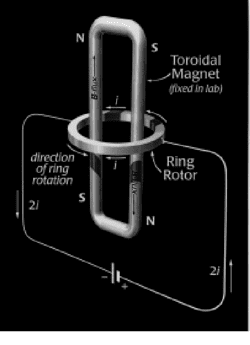
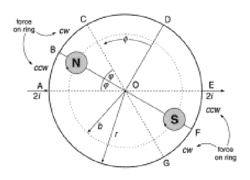
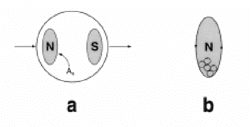
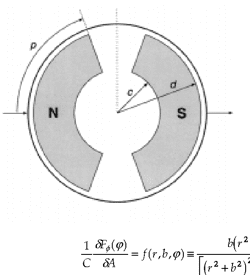
The Marinov Motor -- The Marinov motor consists of a toroidal magnet, approximated by stacks of disk magnets with opposing axial polarizations, enclosed within an annular conductor such as a copper ring or liquid-filled trough, with the assembly mounted to allow rotation about the symmetry axis.[34] Current is supplied to the conductor via sliding contacts or brushes connected to a DC battery, inducing a torque that causes unidirectional rotation regardless of current direction in some configurations.[3] Stefan Marinov described variants including a "ring and magnet-pair motor," where radial current paths in the conductor interact with the magnet's fringe fields to produce motion.[35] Marinov claimed the motor demonstrated a paradox under classical electromagnetism, as an ideal toroidal field yields zero external magnetic field, implying no Lorentz force (J × B) on the current-carrying conductor, yet observable rotation occurred.[34] He posited this as evidence for an absolute ether medium, enabling reaction forces against space itself, and suggested scalability to overunity devices or perpetual motion by minimizing back-torque through asymmetric field interactions.[3] In one setup powered by 220 V AC at 9 A and 50 Hz, Marinov reported slow rotational acceleration to one revolution every few seconds, attributing excess torque to ether drag rather than conventional induction.[3] However, no independent measurements confirmed overunity efficiency; input power exceeded mechanical output, consistent with resistive losses and frictional drag.[36] Independent replications, such as Jeff Kooistra's "Warlock's Wheel" variant, used a multi-turn coil around a torus of opposing magnet stacks, with jeweled bearings and opto-electronic commutation from two batteries, achieving sustained co-rotation of both magnet and conductor in the same direction upon brush reversal.[36] Torque measurements in torsion balance experiments yielded nonzero values aligning with fringe field leakage, not ether effects, with net forward torque estimated as the difference between primary (I × B from magnet currents) and secondary (return path) forces.[37] These tests, including video demonstrations from 1998, verified rotation but found no violation of Newton's third law or energy conservation, as motion ceased without current.[3] [36] Conventional explanations resolve the apparent paradox via non-ideal effects: magnetic leakage fields outside the toroid produce J × B torque, augmented by Biot-Savart interactions between conductor currents and magnetization currents within the magnet, or vector potential gradients (∇(v · A)) in moving frames, akin to Aharonov-Bohm phases without net B field.[34] [37] The rotation direction invariance with current reversal stems from circuit geometry, including return wire paths, yielding consistent handedness without requiring absolute motion.[34] While Marinov and supporters like Harold Aspden invoked ether to explain prograde motion as an imbalance against absolute space, empirical data supports classical Lorentz invariance, with the device functioning as a specialized homopolar motor exhibiting no anomalous energy gain.[3] [34]
Other Electromagnetic and Inertial Devices
Marinov developed the Magnetic Vortex Hyper-Ionization Device (MAGVID), an electromagnetic apparatus consisting of a four-coil, two-phase ring stator similar to an AC motor and a central solenoid, designed to generate combined static, alternating, and pulsating direct current magnetic fields.[38] These fields purportedly created an oblate spheroid sheet of ionized particles and electrons external to the device, manipulated via Lorentz forces to form an electric sheet with minimal energy dissipation at high frequencies or in vacuum conditions.[38] Marinov tested the MAGVID approximately one month prior to his death on July 15, 1997, reporting conventional outputs such as extreme high voltages capable of spinning compass needles, alongside unconventional effects including electromagnetic Doppler shifts, internal time dilation measurements, reduced inertia or mass, enhanced acceleration, "speed compression," and shielding from an ionized cloud; he suggested potential applications in faster-than-light travel and telepathic communication via modulated EEG waves in the 1-60 Hz range.[38] These claims originated from Marinov's USENET postings under a pseudonym in 1995, with no independent replications documented in peer-reviewed literature.[38] In pursuit of overunity electromagnetic generation, Marinov explored self-accelerating generators, configurations where extracting electrical load allegedly increased rotational speed rather than decelerating it, challenging standard Lenz's law interpretations under his absolute ether framework.[32] Detailed in his self-published work The Thorny Way of Truth, these devices involved cleverly arranged conductors and magnets to induce voltages purportedly dependent on absolute motion, aiming to demonstrate energy extraction without proportional input drag; Marinov claimed empirical evidence of acceleration under load in specific setups, attributing it to ether-mediated interactions violating conventional conservation in relative frames.[39] Variants, such as ring-and-magnet-pair assemblies, were later referenced in patents as extensions of his motor principles but adapted for generation, though measurements consistently aligned with classical electromagnetism upon rigorous testing.[35] For inertial applications, Marinov investigated electromagnetic systems for reactionless propulsion, including an inertial-force driven vehicle concept leveraging asymmetric field interactions in an absolute space-time to produce net thrust without expelled mass.[17] He asserted these devices exploited ether drag differentials, with early experiments suggesting directional motion independent of relative velocity; however, associates later identified measurement artifacts as the source of apparent propulsion, confirming no violation of momentum conservation.[17] Complementary electromagnetic detectors for absolute motion, such as coupled conductor systems inducing direction-dependent EMFs, were employed to calibrate inertial claims, yielding velocity anisotropies on the order of hundreds of km/s aligned with galactic motion, though subsequent analyses upheld isotropy consistent with special relativity.[15] By 1997, Marinov's final self-published validations affirmed classical electromagnetic predictions, nullifying overunity or propulsion anomalies in his constructed apparatuses.[2]
Reception and Controversies
Mainstream Scientific DismissalMarinov's critiques of special relativity, particularly his claims of measurable absolute motion through experiments like the 1974 coupled-mirrors setup, were rejected by mainstream physicists for failing to account for synchronization effects inherent to the theory's postulates, which render one-way light speed indeterminate without convention. A re-analysis of his 1984 Graz experiment identified unaddressed apparatus asymmetries—such as scaling factors and directional biases—that aligned adjusted data with prior ether-drift studies but undermined his raw interpretations of anisotropy as falsifying relativity.[40] These methodological oversights, combined with discrepancies from established null results like Michelson-Morley, positioned his work outside reproducible empirical consensus. Devices such as the Marinov motor, purported to achieve overunity output via asymmetric electromagnetic interactions, encountered dismissal for implying perpetual motion, contravening the first and second laws of thermodynamics as verified in countless calorimetric and efficiency tests. No independent mainstream validations emerged, with claims relegated to fringe replication attempts lacking controlled metrology or peer-reviewed scrutiny in journals like Physical Review.[41] A 1990 Nature commentary encapsulated community skepticism by dubbing Marinov's directional light-speed variations a "seasonal puzzle" from an anti-relativist outlier, offering no prize for resolution and highlighting the absence of compelling evidence to upend relativity's predictive successes in accelerators and astrophysics.[11] This pattern of non-engagement stemmed from Marinov's self-publication strategy and institutional expulsions—such as from Bulgarian academia for dissent—bypassing rigorous refereeing, rendering his output non-falsifiable within standard paradigms. Mainstream sources, prioritizing paradigms with broad evidential backing over isolated anomalies, thus marginalized his contributions as pseudoscientific, though some noted his ingenuity in classical formulations without conceding theoretical validity.
Support from Fringe and Dissident Communities
Marinov's rejection of special relativity and advocacy for absolute ether and overunity devices garnered support from dissident physicists and free energy enthusiasts who shared his empirical skepticism toward mainstream theoretical paradigms. James Paul Wesley, a proponent of absolute space-time theories, praised Marinov in a 1997 memorial as a dedicated empirical physicist who championed classical mechanics over relativistic abstractions and pursued perpetual motion as a viable engineering goal, noting their collaborative presentations on these topics.[2] Similarly, Thomas E. Phipps, a critic of Einsteinian relativity, highlighted the Marinov motor's verified operation by independent experimenters as evidence challenging conventional electromagnetic theory, describing it as an unresolved anomaly in physics literature.[42] These ideas circulated in niche publications like Deutsche Physik, a journal edited by Marinov from 1993 until its final issue in 1997, which primarily featured his anti-relativistic experiments and device claims, attracting a small readership among alternative physics advocates.[14] Free energy communities, including outlets such as New Energy News and Infinite Energy magazine, reprinted and discussed Marinov's work on self-accelerating motors and the "Siberian Coliu" generator, framing them as suppressed breakthroughs in overunity technology.[32][43] Enthusiasts in these groups, often self-described as dissidents against institutional physics, replicated aspects of the Marinov motor and cited his ether-based explanations in forums and journals dedicated to anomalous energy production.[44] Posthumously, some supporters within these circles alleged institutional suppression of Marinov's findings, with claims that his 1997 suicide was orchestrated to eliminate a threat from viable free energy sources, though such assertions lack empirical corroboration beyond anecdotal tributes.[45] Marinov's The Thorny Way of Truth series, documenting his struggles and experiments, continues to be archived and referenced in free energy repositories as inspirational for independent researchers pursuing causal, non-relativistic models.[39] This support remains confined to fringe networks, with no uptake in peer-reviewed mainstream venues.
Debates on Empirical Validity and Suppression Claims
Marinov's experimental claims, particularly those challenging special relativity through measurements of light-speed anisotropy and absolute motion, have faced rigorous scrutiny regarding their empirical reproducibility and methodological soundness. In his 1975 "coupled mirrors" experiment and subsequent variants like the 1984 "coupled shutters" setup in Graz, Marinov reported detecting directional variations in light propagation speed, attributing them to Earth's absolute velocity through a preferred ether frame, with measured anisotropies on the order of 10^{-3} to 10^{-4} c. Supporters, including physicist James Paul Wesley, argued these results aligned with classical ether models and contradicted Lorentz invariance, citing independent verifications that purportedly confirmed kinematic time dilation effects independent of relative motion. However, mainstream analyses, such as a 1990 Nature correspondence, highlighted potential systematic errors in Marinov's optical alignments and synchronization methods, noting that null results from interferometric tests (e.g., by Filippas and Fox in 1964) undermine his one-way speed claims without invoking relativity's postulates. Re-analyses, including tangential motion corrections in light paths, have shown that Marinov's reported asymmetries could arise from unaccounted geometric effects rather than absolute motion, with no peer-reviewed replications upholding his findings under controlled conditions.[15][2][11] The Marinov motor, an electromagnetic device claimed to produce torque via asymmetric induction without net magnetic flux linkage, exemplifies ongoing validity debates. Marinov asserted in 1979 that it violated standard action-reaction principles by generating unidirectional rotation from AC-driven coils around a toroidal core, with observed torques up to several newton-meters in prototypes. Fringe investigators, such as Thomas Phipps, reported qualitative confirmations of rotational effects consistent with Marinov's and Wesley's theoretical interpretations, which posit "notional induction" bypassing Faraday's law flux requirements. Theoretical critiques, however, including Kirk McDonald's 2021 modeling, demonstrate that observed torques stem from conventional Lorentz forces on coil currents interacting with residual fringe fields, not overunity or anti-relativistic mechanisms, with finite solenoid approximations explaining the effect without paradoxes. Empirical tests in non-peer-reviewed venues have yielded mixed results, often attributing motion to thermal imbalances or measurement artifacts rather than novel physics, underscoring the absence of controlled, reproducible overunity outputs in rigorous setups.[34][46][36] Claims of suppression permeate Marinov's narrative and that of his adherents, who allege institutional barriers prevented validation of his ether-based and overunity assertions. Marinov frequently cited rejections from journals like Physical Review and loss of academic positions in Bulgaria and Austria as evidence of orchestrated dismissal, linking it to entrenched relativity dogma and energy interests, with self-published works like The Thorny Way of Truth (1980s series) detailing alleged censorship of his absolute velocity data. Supporters in alternative physics circles, including free-energy advocates, echo this, pointing to his 1997 suicide amid financial and professional isolation as symptomatic of broader suppression of paradigm-threatening research. Counterarguments frame these setbacks as standard scientific gatekeeping against unsubstantiated claims, noting Marinov's access to international conferences and self-publishing outlets without documented interference, and attributing non-acceptance to empirical flaws over conspiracy—evident in the lack of suppressed replications by independent labs despite public schematics. Academic biases toward established theories exist, yet no verifiable evidence of active suppression, such as fabricated retractions or funding blacklists, emerges beyond routine peer-review outcomes.[47][2][41]
Death and Aftermath
Circumstances of SuicideOn July 15, 1997, Stefan Marinov, aged 66, died by suicide after jumping from the seventh-floor staircase of the University Library at the University of Graz in Austria.[2][29] The fall resulted in fatal injuries upon landing on the stairs below, with no witnesses reporting the act itself.[48] Marinov left behind suicide notes specifying notifications to family members, including his son Maxim Marinov in Sofia, Bulgaria, and his wife Elena Kiriakova.[49] These notes indicated exhaustion from prolonged struggles against perceived scientific censorship and indifference toward his theories.[2] Prior to this, Marinov had attempted suicide in Paris as a public protest against suppression of his work, underscoring a pattern of dramatic responses to professional frustrations.[50] Investigations by associates, including physicist Panos Pappas, confirmed physical evidence at the scene consistent with the official ruling, such as Marinov's bicycle remaining chained nearby, ruling out immediate suspicions of foul play in the immediate aftermath.[50] Despite this, Marinov's death occurred amid ongoing isolation from mainstream academia, following years of self-published challenges to relativity and ether theories.[29]
Conspiracy Theories Surrounding Death
Following Stefan Marinov's death on July 15, 1997, officially ruled a suicide by jumping from the sixth floor of the University of Graz library in Austria, a subset of his supporters in alternative physics and free energy communities advanced theories of foul play.[4] These claims posit that Marinov was murdered by vested interests in the energy sector or scientific establishment to prevent dissemination of his alleged overunity devices, such as the Marinov motor, which purportedly violated conservation laws by generating excess energy from electromagnetic interactions.[51] Proponents argue that his persistent challenges to mainstream physics, including absolute space-time theories and perpetual motion claims, threatened entrenched paradigms and lucrative industries reliant on fossil fuels and conventional power generation.[52] Key evidentiary assertions in these theories stem from on-site investigations by associates like Panos Pappas, a physicist and Marinov collaborator, who examined the death scene shortly after. Pappas reported that Marinov's bicycle remained chained to a nearby post, inconsistent with an unassisted leap, and noted the absence of typical impact debris or blood spatter at the supposed jump point, suggesting possible staging or external intervention.[50] Additional suspicions arose from the body's discovery in a courtyard grate below, described in some accounts as "suspicious circumstances" amid Marinov's active patent filings and public demonstrations of devices like inertial propulsion systems just weeks prior.[51] These narratives often link Marinov's case to broader patterns of "suppressed inventors," citing parallels with figures like Nikola Tesla or Rudolf Diesel, whose deaths fueled similar suppression lore, though without forensic corroboration.[53] Despite such claims circulating in fringe forums and self-published memoriam pieces, no independent autopsies, police re-investigations, or empirical evidence have substantiated murder over suicide.[29] Marinov's prior documented threats of self-harm, including a 1990s ultimatum to editors rejecting his papers, align with the official narrative of despondency amid professional isolation and institutional rebuffs.[29] Conspiracy adherents, often from dissident science networks, dismiss this as cover-up, attributing skepticism to systemic bias against paradigm-shifting research, yet their arguments rely predominantly on anecdotal inconsistencies rather than verifiable causal chains or material proof.[45] Marinov's final will, dated the day of his death and bequeathing research materials to collaborators, has been interpreted by some as a defiant act against suppression, though it equally supports premeditated suicide.[17]
Legacy and Publications
Major Published Works
Marinov's most extensive publication effort was the multi-volume Classical Physics series, released in 1981 by Est-Ovest Editrice Internatzionale in Graz, Austria.[54] This work outlined his proposed reformulation of physics grounded in absolute space and time, rejecting key tenets of special relativity. The series included four parts: Part I on mathematical apparatus; Part II on axiomatics and low-velocity mechanics; Part III on high-velocity mechanics, where he derived Lorentz transformations from absolute motion rather than postulates; and Part IV on gravimagnetism, extending his framework to gravitational effects.[54] A second major series, The Thorny Way of Truth, comprised at least eight volumes self-published by Marinov through East-West Publishers in Graz starting in 1982.[12] [55] These volumes compiled correspondence, experimental reports, and theoretical arguments aimed at demonstrating violations of conservation laws, such as momentum and energy, through devices like his coupled pendulums and motors. Volume 1 focused on restoring absolute space-time conceptions; subsequent volumes addressed specific claims, including displacement current critiques (Volume 7, 1990) and perpetual motion mechanisms.[39] The series served as a personal archive of his disputes with mainstream academia, often reproducing rejections from journals to argue suppression.[28] In 1993, Marinov published Divine Electromagnetism, a treatise reinterpreting electromagnetic theory within his absolute framework, emphasizing direction-dependent light speed and potential free-energy implications.[56] Earlier, in 1987, he released Eppur si muove, compiling evidence for Earth's absolute motion against relativistic null results.[57] These works, primarily disseminated via small presses or direct mailing due to institutional rejection, totaled over a dozen books and reflected his lifelong critique of post-Einsteinian physics.[2]
Influence on Alternative Physics Movements
Marinov's rejection of special relativity in favor of absolute space-time, substantiated by experiments such as the 1974 coupled-mirrors test purporting to detect Earth's velocity relative to the cosmic ether, resonated with dissident physicists advocating empirical over theoretical primacy.[2] His editorship of Deutsche Physik, a journal dedicated to non-relativistic viewpoints, served as a key outlet for fringe theoretical challenges, fostering a network of contributors skeptical of Einsteinian orthodoxy.[4] The Marinov motor, an electromagnetic device claimed to produce torque without net energy input via counter-rotating fields, drew interest from alternative energy researchers; independent verifications by investigators including Patrick Bailey confirmed anomalous motion under specific conditions, prompting derivatives like Jeff Kooistra's adaptations explored in overunity motor designs.[42][36] These efforts positioned Marinov's work as a touchstone for claims of suppressed inertial propulsion technologies within free-energy advocacy.[17] Marinov cultivated an international following among alternative physics proponents, including travels to California in the 1980s and 1990s to demonstrate devices and lecture on perpetual motion possibilities, influencing communities pursuing aether revival and anti-relativistic mechanics.[58] Figures like Harold Aspden cited his magnet-current experiments as inspirational for vacuum-field energy extraction models, while his coupled-shutters protocol inspired subsequent anisotropy measurements challenging light-speed isotropy assumptions.[3][8] This legacy amplified movements critiquing mainstream physics' dismissal of absolute reference frames, though replications often yielded inconsistent results attributable to measurement precision limits.
References